%20%20--%3E%0A%3Csvg%20version%3D%221.1%22%20id%3D%22Layer_1%22%20xmlns%3D%22http%3A%2F%2Fwww.w3.org%2F2000%2Fsvg%22%20xmlns%3Axlink%3D%22http%3A%2F%2Fwww.w3.org%2F1999%2Fxlink%22%20x%3D%220px%22%20y%3D%220px%22%0A%09%20viewBox%3D%220%200%20684.6%2068.1%22%20style%3D%22enable-background%3Anew%200%200%20684.6%2068.1%3B%22%20xml%3Aspace%3D%22preserve%22%3E%0A%3Cg%3E%0A%09%3Cpath%20d%3D%22M444.1%2C29.3h-17.4v14.5h17.4V29.3z%20M36.4%2C68.1l29.3-50.8V0H50.4L32.9%2C36.8L15.5%2C0H0v68.1h16.7V45.8l12.4%2C22.3H36.4z%0A%09%09%20M49.1%2C68.1h16.6V23.4L49.1%2C52.1V68.1z%20M76.6%2C68.1h45V53.8H93.3V41.6h21V27.1h-21V14.8h28.3V0.1h-45V68.1z%20M175.6%2C68.1h17.3v-68%0A%09%09h-16.5v40.3L150%2C0.1h-17.6v68h16.7V27.7L175.6%2C68.1z%20M235.8%2C14.8h15.4V0.1h-47.4v14.7H219v53.2h16.8V14.8z%20M290.3%2C45.9h-17.1%0A%09%09l7.5-15.6h2L290.3%2C45.9z%20M298.7%2C68.1h18l-32.2-68h-5.7l-32%2C68h18l3.3-7.1h27.1L298.7%2C68.1z%20M325.2%2C68.1h46.2V53.8h-29.6V0.1h-16.7%0A%09%09V68.1z%20M423.7%2C14.8h27.2V0.1H407v68h16.7V14.8z%20M462%2C68.1h46.2V53.8h-29.6V0.1H462V68.1z%20M564.8%2C34.1c0%2C10.7-7.2%2C19.2-18.5%2C19.2%0A%09%09c-11.4%2C0-18.5-8.5-18.5-19.2s7.1-19.2%2C18.5-19.2C557.6%2C14.9%2C564.8%2C23.4%2C564.8%2C34.1%20M580.6%2C34.1c0-19-14.2-34-34.3-34%0A%09%09c-20.2%2C0-34.3%2C15-34.3%2C34c0%2C19%2C14.1%2C34%2C34.3%2C34C566.4%2C68.1%2C580.6%2C53.1%2C580.6%2C34.1%20M604.8%2C20.5c0-4.1%2C3.3-6.2%2C6.7-6.2%0A%09%09c4.4%2C0%2C6.6%2C3%2C6.6%2C6.6h14.7C631.8%2C9.1%2C625.1%2C0.1%2C611%2C0.1c-12%2C0-21.7%2C9.3-21.7%2C20.6c0%2C10.9%2C5.9%2C15.9%2C16.7%2C19.8%0A%09%09c5.2%2C1.8%2C11.5%2C3.2%2C11.5%2C8c0%2C3.3-2.4%2C5.5-6.4%2C5.5c-3.6%2C0-6.6-3-6.6-6.7h-15.2c0%2C11.5%2C7.9%2C20.8%2C21.8%2C20.8c12%2C0%2C21.6-9.3%2C21.6-20.6%0A%09%09c0-10-5.3-16.4-16.7-19.8C610.6%2C26.1%2C604.8%2C25.3%2C604.8%2C20.5%20M670%2C20.9h14.7C683.8%2C9.1%2C677.1%2C0.1%2C663%2C0.1c-12%2C0-21.7%2C9.3-21.7%2C20.6%0A%09%09c0%2C10.9%2C5.9%2C15.9%2C16.7%2C19.8c5.2%2C1.8%2C11.5%2C3.2%2C11.5%2C8c0%2C3.3-2.4%2C5.5-6.4%2C5.5c-3.6%2C0-6.6-3-6.6-6.7h-15.2c0%2C11.5%2C7.9%2C20.8%2C21.8%2C20.8%0A%09%09c12%2C0%2C21.6-9.3%2C21.6-20.6c0-10-5.3-16.4-16.7-19.8c-5.4-1.6-11.3-2.4-11.3-7.2c0-4.1%2C3.3-6.2%2C6.7-6.2C667.7%2C14.4%2C670%2C17.3%2C670%2C20.9%0A%09%09%22%2F%3E%0A%3C%2Fg%3E%0A%3C%2Fsvg%3E%0A)

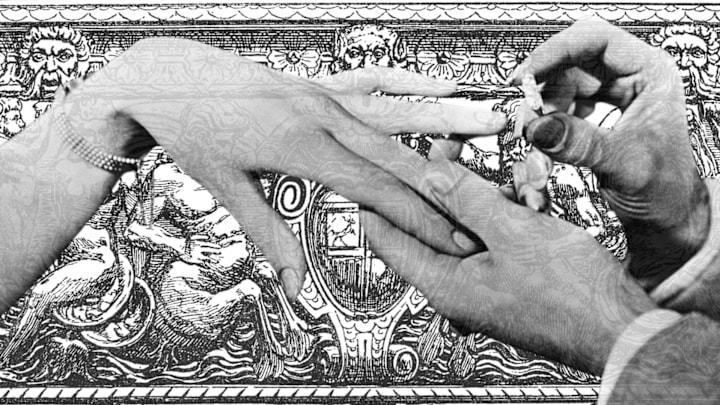
In simple terms, a dowry is an allotment of money, goods, or property that is brought to a marriage by the bride, and legally transferred to her husband (or her husband’s family) as part of their marital arrangements.
Let's take a closer look at how dowries shaped families and societies over the centuries.
WHAT IS A DOWRY?

Historically, and in legal contexts, the term is essentially the opposite of the bride’s dower, which is the portion of her husband’s estate that is legally arranged to be handed over to her in the event of his death. Both terms, meanwhile, originate from a Latin word that literally means “to hand over” or “to apportion out.”
The practice of involving money and goods in a couple’s marital negotiations is widespread, with anthropologists finding similar systems and arrangements in cultures globally. It’s staggeringly old, with a dowry mentioned multiple times in the world’s oldest known surviving set of legal codes, the ancient Babylonian Code of Hammurabi, drawn up in the mid-1700s BC.
DOWRYS THROUGHOUT HISTORY

The Babylonians’ rules were complex, and as such covered almost every conceivable marital outcome. They also made it clear that the dowry—as bizarre and unfair a system as it might seem to some modern eyes—was originally intended to be a kind of financial safety net for a young woman, contributing to her and her family’s support during her lifetime, and after her husband’s death.
As such, although the dowry was legally handed to her husband at marriage, the law almost always favored the wife’s side in all future eventualities. Should a woman pre-decease her husband, for instance, her dowry would pass to their children, leaving him with no stake in it. If she were to die childless, however, her dowry would be reverted to her family, again leaving the husband without. If a woman had children, then was widowed, remarried, and then died, meanwhile, the children from her first marriage still took precedence.
The Romans adopted this ancient practice and adapted it, instituting numerous new rules and laws to formalize the system. Although dowries were not necessary to validate a legal marriage in Roman law, for instance, there were nevertheless laws (and a considerable amount of social expectation) in place that made it understood that the bride’s father would contribute to his daughter’s new life. Rules were even brought in by the Romans, too, that stopped fathers who were unhappy with their daughter’s choice of husband from withholding a dowry as a means of trying to derail the union.
By the Middle Ages, the tradition of the dowry in Europe had become so well established that goods and materials were presented in ornate bridal chests, delivered on the wedding day. In Tudor England, meanwhile, the fondness of wealthy families and royalty to cement their power and forge alliances with neighboring estates and nations made the negotiation of a dowry an intense and often expensive practice. Catherine of Aragon’s dowry at her marriage to Prince Arthur, the Prince of Wales (the elder brother of her future husband, Henry VIII), was a colossal sum of 200,000 crowns in 1501.
DOING AWAY WITH DOWRYS

While the practice later traveled to North America during the colonial era, over time, the notion of entering a dowry into marital arrangements began to fall by the wayside. Changes to marital and inheritance law in the 19th century—on both sides of the Atlantic—rendered it increasingly obsolete. The growing enthusiasm for equal rights and the feminist movements that followed it in the 20th century proved the final straws.
Of course, in many countries, cultures, and religions today, this practice persists. And even in places where rules and laws likewise have changed over time—the 1961 Dowry Prohibition Act technically outlawed dowries in India—the tradition of a bride’s dowry is still maintained, even if just as a gesture rather than a legal obligation.