%20%20--%3E%0A%3Csvg%20version%3D%221.1%22%20id%3D%22Layer_1%22%20xmlns%3D%22http%3A%2F%2Fwww.w3.org%2F2000%2Fsvg%22%20xmlns%3Axlink%3D%22http%3A%2F%2Fwww.w3.org%2F1999%2Fxlink%22%20x%3D%220px%22%20y%3D%220px%22%0A%09%20viewBox%3D%220%200%20684.6%2068.1%22%20style%3D%22enable-background%3Anew%200%200%20684.6%2068.1%3B%22%20xml%3Aspace%3D%22preserve%22%3E%0A%3Cg%3E%0A%09%3Cpath%20d%3D%22M444.1%2C29.3h-17.4v14.5h17.4V29.3z%20M36.4%2C68.1l29.3-50.8V0H50.4L32.9%2C36.8L15.5%2C0H0v68.1h16.7V45.8l12.4%2C22.3H36.4z%0A%09%09%20M49.1%2C68.1h16.6V23.4L49.1%2C52.1V68.1z%20M76.6%2C68.1h45V53.8H93.3V41.6h21V27.1h-21V14.8h28.3V0.1h-45V68.1z%20M175.6%2C68.1h17.3v-68%0A%09%09h-16.5v40.3L150%2C0.1h-17.6v68h16.7V27.7L175.6%2C68.1z%20M235.8%2C14.8h15.4V0.1h-47.4v14.7H219v53.2h16.8V14.8z%20M290.3%2C45.9h-17.1%0A%09%09l7.5-15.6h2L290.3%2C45.9z%20M298.7%2C68.1h18l-32.2-68h-5.7l-32%2C68h18l3.3-7.1h27.1L298.7%2C68.1z%20M325.2%2C68.1h46.2V53.8h-29.6V0.1h-16.7%0A%09%09V68.1z%20M423.7%2C14.8h27.2V0.1H407v68h16.7V14.8z%20M462%2C68.1h46.2V53.8h-29.6V0.1H462V68.1z%20M564.8%2C34.1c0%2C10.7-7.2%2C19.2-18.5%2C19.2%0A%09%09c-11.4%2C0-18.5-8.5-18.5-19.2s7.1-19.2%2C18.5-19.2C557.6%2C14.9%2C564.8%2C23.4%2C564.8%2C34.1%20M580.6%2C34.1c0-19-14.2-34-34.3-34%0A%09%09c-20.2%2C0-34.3%2C15-34.3%2C34c0%2C19%2C14.1%2C34%2C34.3%2C34C566.4%2C68.1%2C580.6%2C53.1%2C580.6%2C34.1%20M604.8%2C20.5c0-4.1%2C3.3-6.2%2C6.7-6.2%0A%09%09c4.4%2C0%2C6.6%2C3%2C6.6%2C6.6h14.7C631.8%2C9.1%2C625.1%2C0.1%2C611%2C0.1c-12%2C0-21.7%2C9.3-21.7%2C20.6c0%2C10.9%2C5.9%2C15.9%2C16.7%2C19.8%0A%09%09c5.2%2C1.8%2C11.5%2C3.2%2C11.5%2C8c0%2C3.3-2.4%2C5.5-6.4%2C5.5c-3.6%2C0-6.6-3-6.6-6.7h-15.2c0%2C11.5%2C7.9%2C20.8%2C21.8%2C20.8c12%2C0%2C21.6-9.3%2C21.6-20.6%0A%09%09c0-10-5.3-16.4-16.7-19.8C610.6%2C26.1%2C604.8%2C25.3%2C604.8%2C20.5%20M670%2C20.9h14.7C683.8%2C9.1%2C677.1%2C0.1%2C663%2C0.1c-12%2C0-21.7%2C9.3-21.7%2C20.6%0A%09%09c0%2C10.9%2C5.9%2C15.9%2C16.7%2C19.8c5.2%2C1.8%2C11.5%2C3.2%2C11.5%2C8c0%2C3.3-2.4%2C5.5-6.4%2C5.5c-3.6%2C0-6.6-3-6.6-6.7h-15.2c0%2C11.5%2C7.9%2C20.8%2C21.8%2C20.8%0A%09%09c12%2C0%2C21.6-9.3%2C21.6-20.6c0-10-5.3-16.4-16.7-19.8c-5.4-1.6-11.3-2.4-11.3-7.2c0-4.1%2C3.3-6.2%2C6.7-6.2C667.7%2C14.4%2C670%2C17.3%2C670%2C20.9%0A%09%09%22%2F%3E%0A%3C%2Fg%3E%0A%3C%2Fsvg%3E%0A)

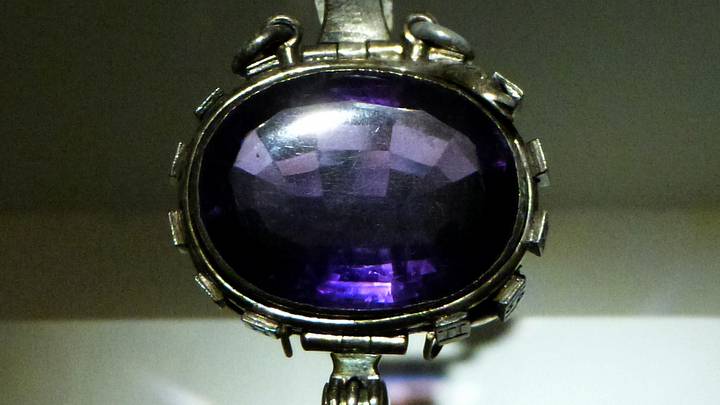
If you ever find yourself in the Vault gallery in London’s Natural History Museum, you might stumble upon a small purple stone set in a ring of silver with two scarab beetle beads laid on one end.
This little stone carries a legacy that, if you believe the tales, is littered with disaster, tragedy, and death. This same amethyst apparently scared its previous owner so much that he kept it locked inside seven different boxes within a bank safe until his death—and, if recent reports are to be believed, the curse may not yet be over.
The Tale of the Cursed Amethyst

What we know of the amethyst comes from a letter written by Edward Heron-Allen, the stone’s most recent owner before the Natural History Museum. In the note, he called the stone “trebly accursed and stained with blood” and advised whoever acquired it next to immediately toss it into the ocean.
A polymath, scholar, and violin-maker, Heron-Allen claimed that the stone had been taken from the Temple of the God Indra at Cawnpore (now Kanpur) during a 19th-century mutiny during which Indians rebelled against British colonial authorities. After that, he said, it was brought to England by a Bengal cavalryman named Colonel W. Ferris.
According to Heron-Allen, the trouble began almost immediately. Ferris found himself plagued by chaos and misfortune that resulted in his losing almost everything he had. The same fate befell his son after he inherited the stone, so he bequeathed it to a friend who later committed suicide—and gave the stone back to him in his will.
In 1890, Heron-Allen bought the stone, but according to his letter, his life immediately became plagued by disasters. He eventually gave the stone to a singer who, he wrote, suddenly found that “her voice was dead and gone” and never sang again.
After that, Heron-Allen claimed to have thrown the stone into a canal, but said it was given back to him after being discovered by a dredger.
Following this, the scholar made the decision to lock the stone up. “I feel that it is exerting a baleful influence over my new born daughter so I am now packing it in seven boxes and depositing it at my bankers, with directions that it is not to see the light again until I have been dead thirty three years,” Heron-Allen wrote.
His daughter, however, seemingly did not obey his wishes. In 1944, less than a year after his death, she opened the case and donated the stone to the Natural History Museum.
The Cursed Amethyst: Haunted or Hoax?

As gripping as all this is, there may actually be no truth to it. Historians have raised some doubts about the validity of Heron-Allen’s claims, with many theorizing that the letter and the story of the stone were all meant to posthumously draw attention to his 1921 novel The Purple Sapphire, which he wrote under the pseudonym Christopher Blayre.
The book tells a rather similar story to the one Heron-Allen depicted in his letter, focusing on a cursed stone that haunts a colonel who acquires it. Scholars have also noted that Heron-Allen had falsely stated that the insurrection at Cawnpore occurred in 1855 when it actually occurred in 1857.
Regardless, the cursed amethyst has enthralled many thanks to the strange tangle of legends that surrounds it. In more recent years, the amethyst provided inspiration for one of the more popular books of the 2010s—Anthony Doerr’s All the Light We Cannot See, which features a cursed diamond known as the “sea of flames.” Doerr was inspired by tales of the amethyst, as well as the cult of fascination that tends to surround valuable jewels.
“I’m always interested in how I behave around little valuable things,” the author said to the American Booksellers Association in 2014. “What is it about us that covets these things, finds beauty in them? And isn’t it arbitrary that we decided diamonds are so valuable in the first place?”
The cursed amethyst is far from the only supposedly haunted stone in museum halls, let alone the only haunted object on display around the world. In particular, stones stolen from colonized or war-torn lands seem to have a particular hold on people's imagination, no doubt due to the greed and corruption they can so easily come to symbolize.
According to art critic Hettie Judah, “the suggestion that riches and power are founded on something dark and rotten is irresistible; the enigmatic diamond dazzling as a crystalline emblem both of magnificent wealth and of wickedness.”
The Cursed Amethyst Today

Today, the amethyst continues to rest in the halls of London’s Natural History Museum—but its supposed reign of terror may not be over, at least according to some who have come into contact with it in more recent years.
Natural History Museum member John Whittaker has added some new layers of lore to the stone’s legacy in the 21st century. He claimed that when he was transporting the stone to an event in 2004, he and his wife were trapped in their car during a terrible thunderstorm—an experience he called the “most horrific” of his life.
He went on to claim that the night before he was supposed to transport the jewel once again, he was struck down by an awful stomach bug—and said he missed the third time after being beset by awful stomach pain that led to him passing a kidney stone. Could it be that the curse lives on?