%20%20--%3E%0A%3Csvg%20version%3D%221.1%22%20id%3D%22Layer_1%22%20xmlns%3D%22http%3A%2F%2Fwww.w3.org%2F2000%2Fsvg%22%20xmlns%3Axlink%3D%22http%3A%2F%2Fwww.w3.org%2F1999%2Fxlink%22%20x%3D%220px%22%20y%3D%220px%22%0A%09%20viewBox%3D%220%200%20684.6%2068.1%22%20style%3D%22enable-background%3Anew%200%200%20684.6%2068.1%3B%22%20xml%3Aspace%3D%22preserve%22%3E%0A%3Cg%3E%0A%09%3Cpath%20d%3D%22M444.1%2C29.3h-17.4v14.5h17.4V29.3z%20M36.4%2C68.1l29.3-50.8V0H50.4L32.9%2C36.8L15.5%2C0H0v68.1h16.7V45.8l12.4%2C22.3H36.4z%0A%09%09%20M49.1%2C68.1h16.6V23.4L49.1%2C52.1V68.1z%20M76.6%2C68.1h45V53.8H93.3V41.6h21V27.1h-21V14.8h28.3V0.1h-45V68.1z%20M175.6%2C68.1h17.3v-68%0A%09%09h-16.5v40.3L150%2C0.1h-17.6v68h16.7V27.7L175.6%2C68.1z%20M235.8%2C14.8h15.4V0.1h-47.4v14.7H219v53.2h16.8V14.8z%20M290.3%2C45.9h-17.1%0A%09%09l7.5-15.6h2L290.3%2C45.9z%20M298.7%2C68.1h18l-32.2-68h-5.7l-32%2C68h18l3.3-7.1h27.1L298.7%2C68.1z%20M325.2%2C68.1h46.2V53.8h-29.6V0.1h-16.7%0A%09%09V68.1z%20M423.7%2C14.8h27.2V0.1H407v68h16.7V14.8z%20M462%2C68.1h46.2V53.8h-29.6V0.1H462V68.1z%20M564.8%2C34.1c0%2C10.7-7.2%2C19.2-18.5%2C19.2%0A%09%09c-11.4%2C0-18.5-8.5-18.5-19.2s7.1-19.2%2C18.5-19.2C557.6%2C14.9%2C564.8%2C23.4%2C564.8%2C34.1%20M580.6%2C34.1c0-19-14.2-34-34.3-34%0A%09%09c-20.2%2C0-34.3%2C15-34.3%2C34c0%2C19%2C14.1%2C34%2C34.3%2C34C566.4%2C68.1%2C580.6%2C53.1%2C580.6%2C34.1%20M604.8%2C20.5c0-4.1%2C3.3-6.2%2C6.7-6.2%0A%09%09c4.4%2C0%2C6.6%2C3%2C6.6%2C6.6h14.7C631.8%2C9.1%2C625.1%2C0.1%2C611%2C0.1c-12%2C0-21.7%2C9.3-21.7%2C20.6c0%2C10.9%2C5.9%2C15.9%2C16.7%2C19.8%0A%09%09c5.2%2C1.8%2C11.5%2C3.2%2C11.5%2C8c0%2C3.3-2.4%2C5.5-6.4%2C5.5c-3.6%2C0-6.6-3-6.6-6.7h-15.2c0%2C11.5%2C7.9%2C20.8%2C21.8%2C20.8c12%2C0%2C21.6-9.3%2C21.6-20.6%0A%09%09c0-10-5.3-16.4-16.7-19.8C610.6%2C26.1%2C604.8%2C25.3%2C604.8%2C20.5%20M670%2C20.9h14.7C683.8%2C9.1%2C677.1%2C0.1%2C663%2C0.1c-12%2C0-21.7%2C9.3-21.7%2C20.6%0A%09%09c0%2C10.9%2C5.9%2C15.9%2C16.7%2C19.8c5.2%2C1.8%2C11.5%2C3.2%2C11.5%2C8c0%2C3.3-2.4%2C5.5-6.4%2C5.5c-3.6%2C0-6.6-3-6.6-6.7h-15.2c0%2C11.5%2C7.9%2C20.8%2C21.8%2C20.8%0A%09%09c12%2C0%2C21.6-9.3%2C21.6-20.6c0-10-5.3-16.4-16.7-19.8c-5.4-1.6-11.3-2.4-11.3-7.2c0-4.1%2C3.3-6.2%2C6.7-6.2C667.7%2C14.4%2C670%2C17.3%2C670%2C20.9%0A%09%09%22%2F%3E%0A%3C%2Fg%3E%0A%3C%2Fsvg%3E%0A)

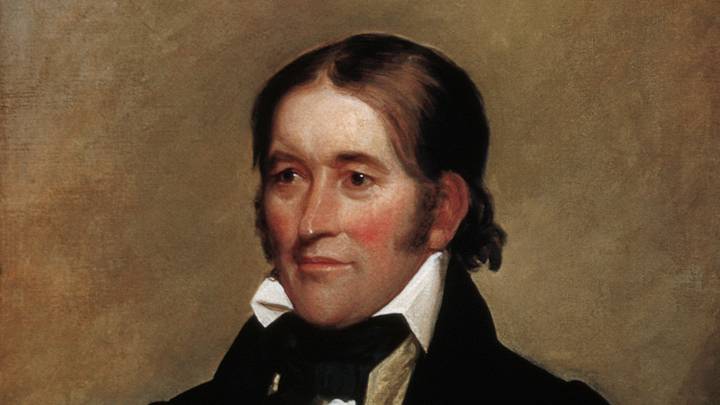
Few names are more synonymous with frontier mythology than Davy Crockett. This name might evoke visions of swashbuckling, home-on-the-range adventure for many of us, an image bolstered by countless legends that have developed over the years about this larger-than-life figure.
Crockett was very much a real person, though. Born on August 17, 1786 near the Nolichucky River in what is now eastern Tennessee, he grew up in an impoverished pioneer family and learned the art of hunting and surviving on the frontier at an early age. He went on to join the Tennessee militia and served in the War of 1812. He then went into politics, winning a seat in the U.S. House of Representatives in 1827.
Initially a supporter of Andrew Jackson, he later became a strong critic of Jackson’s policies. He was the only Tennessean to vote against the Indian Removal Bill, which authorized the Trail of Tears, a forced relocation of 100,000 Native Americans that resulted in an estimated 10,000 deaths from starvation, disease, and other causes.
While in Congress, Crockett became famous for his storytelling abilities and charismatic persona. During his lifetime, he was the subject of multiple plays and books that mythologized his frontier upbringing and seeded some long-held rumors. Crockett published his own autobiography in an effort to correct some of the misconceptions, yet he also worked to foster some of them.
“Everything about him, including his death, was mythologized,” Michael Wallis, author of the biography David Crockett: The Lion of the West, told Smithsonian. “And he had a lot to do with creating the mythology himself. He was a wonderful, down-home country boy storyteller.”
After losing his seat in Congress, Crockett joined the Texas War for Independence, and is believed to have died while defending the Alamo. In 1954, Walt Disney’s television series Davy Crockett helped spread his story to a much wider audience, magnifying the myth and cementing Crockett's place as an icon of the American frontier. But who was the real Davy Crockett?
- He didn’t go by Davy
- He didn’t kill a bear as a 3-year-old
- His image may have partly been an act
- He may not have died in battle at the Alamo
He didn’t go by Davy

Not only did “Davy Crockett” not call himself Davy during his lifetime—he apparently actively hated this nickname. He signed his documents “David Crockett” and, according to various accounts, attempted to distance himself from the “Davy” moniker. However, the name became forever tied to his legacy thanks to Walt Disney’s 1954 miniseries starring Fess Parker, which featured the popular song “The Ballad of Davy Crockett.”
He didn’t kill a bear as a 3-year-old

“The Ballad of Davy Crockett” was responsible for more than cementing Crockett's association with a nickname he disliked. It also popularized another myth that sounds wildly outlandish when you think about it—the idea that Crockett killed a bear as a toddler.
“Raised in the woods so's he knew every tree / killed him a bear when he was only 3” makes for a great lyric, and life was definitely hard for kids on the frontier, but Crockett’s autobiography makes no such mention of such a thing. However, that does not mean that bears were safe from Crockett. In his autobiography, the frontiersman did claim he once killed 105 bears in a year, though naturally, this claim has also been contested.
His image may have partly been an act

During his tenure as a politician, Crockett actively crafted an image of a rough-hewn, coarse backwoodsman in an effort to connect with his constituents. At the time, politicians were generally of the elite and educated class, but Crockett—who only received roughly 100 days of formal schooling in his life—used his background as an advantage. He purposefully told outlandish stories, bragged about bad table manners, wore hunting shirts, used coarse language, and worked to preserve his reputation as a brash outdoorsman.
Simultaneously, during his political career, he was known as polite and well-spoken. And despite his reputation for coonskin caps—which he was seen wearing when departing for Texas, but did not typically sport—contemporaries claimed he dressed formally while Congress was in session.
“In Washington, he behaved as a respectable congressman but enjoyed the attention he received as a rough, far-west backwoodsman,” wrote historian William Groneman. “In West Tennessee, he remained a trustworthy and reliable frontier neighbor, but enjoyed the status of his congressional title.”
He may not have died in battle at the Alamo

When Crockett lost his bid for reelection in 1835 due to Andrew Jackson’s camp’s campaign against him, the frontiersman headed south and joined Texas revolutionaries’ efforts to gain independence from the Mexican Republic. “I told the people of my district that, if they saw fit to re-elect me, I would serve them as faithfully as I had done,” Crockett reportedly said upon arriving in Texas. “But, if not, they might go to hell, and I would go to Texas. I was beaten, gentlemen, and here I am.”
A popular myth claims that he led a contingent called the “Tennessee Mounted Volunteers” into battle, but in reality, Crockett arrived in Texas accompanied by just a few people and enlisted as a private in the Volunteer Auxiliary Corps.
Crockett died during the siege of the Alamo in 1836, which was a disastrous loss for Texas. At the time, some newspapers reported that he’d lost his life while fighting heroically until the very end, and this became part of Crockett’s legacy. However, significant evidence has emerged to support the narrative that he may have surrendered, and was then taken as a prisoner of war and killed.
Some of this evidence remains contested, however. The truth is that no one knows for sure how Crockett died, though the tale of his death has certainly been embellished. Regardless, all this—his upbringing, the persona he crafted during his political career, and his death at the Alamo—all helped immortalize him as a folk hero.