%20%20--%3E%0A%3Csvg%20version%3D%221.1%22%20id%3D%22Layer_1%22%20xmlns%3D%22http%3A%2F%2Fwww.w3.org%2F2000%2Fsvg%22%20xmlns%3Axlink%3D%22http%3A%2F%2Fwww.w3.org%2F1999%2Fxlink%22%20x%3D%220px%22%20y%3D%220px%22%0A%09%20viewBox%3D%220%200%20684.6%2068.1%22%20style%3D%22enable-background%3Anew%200%200%20684.6%2068.1%3B%22%20xml%3Aspace%3D%22preserve%22%3E%0A%3Cg%3E%0A%09%3Cpath%20d%3D%22M444.1%2C29.3h-17.4v14.5h17.4V29.3z%20M36.4%2C68.1l29.3-50.8V0H50.4L32.9%2C36.8L15.5%2C0H0v68.1h16.7V45.8l12.4%2C22.3H36.4z%0A%09%09%20M49.1%2C68.1h16.6V23.4L49.1%2C52.1V68.1z%20M76.6%2C68.1h45V53.8H93.3V41.6h21V27.1h-21V14.8h28.3V0.1h-45V68.1z%20M175.6%2C68.1h17.3v-68%0A%09%09h-16.5v40.3L150%2C0.1h-17.6v68h16.7V27.7L175.6%2C68.1z%20M235.8%2C14.8h15.4V0.1h-47.4v14.7H219v53.2h16.8V14.8z%20M290.3%2C45.9h-17.1%0A%09%09l7.5-15.6h2L290.3%2C45.9z%20M298.7%2C68.1h18l-32.2-68h-5.7l-32%2C68h18l3.3-7.1h27.1L298.7%2C68.1z%20M325.2%2C68.1h46.2V53.8h-29.6V0.1h-16.7%0A%09%09V68.1z%20M423.7%2C14.8h27.2V0.1H407v68h16.7V14.8z%20M462%2C68.1h46.2V53.8h-29.6V0.1H462V68.1z%20M564.8%2C34.1c0%2C10.7-7.2%2C19.2-18.5%2C19.2%0A%09%09c-11.4%2C0-18.5-8.5-18.5-19.2s7.1-19.2%2C18.5-19.2C557.6%2C14.9%2C564.8%2C23.4%2C564.8%2C34.1%20M580.6%2C34.1c0-19-14.2-34-34.3-34%0A%09%09c-20.2%2C0-34.3%2C15-34.3%2C34c0%2C19%2C14.1%2C34%2C34.3%2C34C566.4%2C68.1%2C580.6%2C53.1%2C580.6%2C34.1%20M604.8%2C20.5c0-4.1%2C3.3-6.2%2C6.7-6.2%0A%09%09c4.4%2C0%2C6.6%2C3%2C6.6%2C6.6h14.7C631.8%2C9.1%2C625.1%2C0.1%2C611%2C0.1c-12%2C0-21.7%2C9.3-21.7%2C20.6c0%2C10.9%2C5.9%2C15.9%2C16.7%2C19.8%0A%09%09c5.2%2C1.8%2C11.5%2C3.2%2C11.5%2C8c0%2C3.3-2.4%2C5.5-6.4%2C5.5c-3.6%2C0-6.6-3-6.6-6.7h-15.2c0%2C11.5%2C7.9%2C20.8%2C21.8%2C20.8c12%2C0%2C21.6-9.3%2C21.6-20.6%0A%09%09c0-10-5.3-16.4-16.7-19.8C610.6%2C26.1%2C604.8%2C25.3%2C604.8%2C20.5%20M670%2C20.9h14.7C683.8%2C9.1%2C677.1%2C0.1%2C663%2C0.1c-12%2C0-21.7%2C9.3-21.7%2C20.6%0A%09%09c0%2C10.9%2C5.9%2C15.9%2C16.7%2C19.8c5.2%2C1.8%2C11.5%2C3.2%2C11.5%2C8c0%2C3.3-2.4%2C5.5-6.4%2C5.5c-3.6%2C0-6.6-3-6.6-6.7h-15.2c0%2C11.5%2C7.9%2C20.8%2C21.8%2C20.8%0A%09%09c12%2C0%2C21.6-9.3%2C21.6-20.6c0-10-5.3-16.4-16.7-19.8c-5.4-1.6-11.3-2.4-11.3-7.2c0-4.1%2C3.3-6.2%2C6.7-6.2C667.7%2C14.4%2C670%2C17.3%2C670%2C20.9%0A%09%09%22%2F%3E%0A%3C%2Fg%3E%0A%3C%2Fsvg%3E%0A)

The strong bond between humans and dogs has been established for millennia, dating back at least 15,000 years. Alongside the practical skills that canines offer humans—from hunting to protection to warmth—they’ve also been a source of friendship, with no other animal displaying quite the same level of loyalty.
But there are a few hounds throughout history who have taken the title of “man’s best friend” a little more seriously than others—here are six such good dogs.
Greyfriars Bobby

In 1850, John Gray got a job as a nightwatchman for the police in Edinburgh, but he didn’t walk the streets alone, with his faithful Skye Terrier, Bobby, sticking close by his side. The pair patrolled the city together until 1858, when Gray died of tuberculosis. He was buried in Greyfriars Kirkyard and Bobby then stayed by his gravestone for the next 14 years. The only time the little dog left the graveyard was to get his daily meal at a local coffee shop.
Bobby became well-known around the area, eventually earning the moniker Greyfriars Bobby. In 1867, his vigil was threatened by a new by-law that required all dogs to be licensed. But thankfully, Sir William Chambers, the Lord Provost of Edinburgh, paid for Bobby’s license and collar, allowing the pooch to continue sitting at Gray’s grave until his own death in 1872.
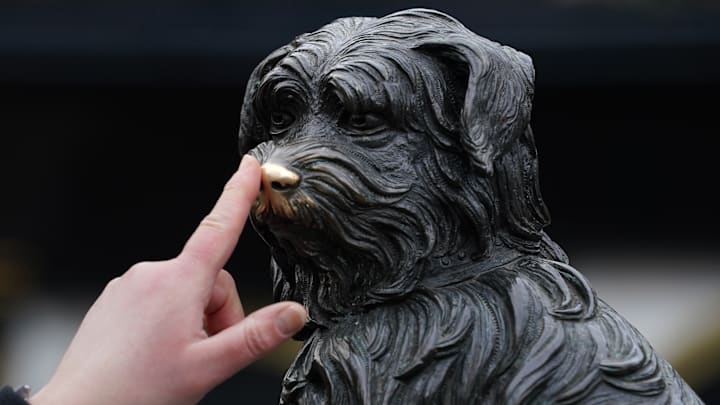
One year later, a fountain topped by a bronze life-size statue of Greyfriars Bobby was erected just outside the kirkyard’s entrance. Visitors sometimes rub Bobby’s nose for luck—resulting in it having a golden sheen—but city officials have warned against this damage-causing practice.
Bobbie the Wonder Dog
In August 1923, the Brazier family from Silverton, Oregon, took a road trip to visit relatives in Wolcott, Indiana. At a gas stop near the end of their outward journey, their dog Bobbie—who was a mix of a Scotch Collie and an English Shepherd—got into a fight with three local dogs and ran off. The Braziers thought he would come back soon, but when that didn’t happen, they had to continue on without their beloved pet.
Six months later, Bobbie shockingly showed up in Silverton, having walked all the way home from Indiana. Not unexpectedly after such a long journey, he looked a little worse for wear.
“His toenails were worn off by the gravel and sand; his flanks were thin from the long run, and the mane was tangled and shaggy,” reported The Oregonian. His exact route isn’t known, but he crossed eight states, and it’s estimated that he walked between 2,500 and 2,800 miles—in winter, no less—to get back to his family.
Bobbie’s incredible feat of loyalty-inspired endurance made him a local celebrity. When he died in 1927, a wreath was even placed on his grave by canine movie star Rin Tin Tin.
Shep
On the banks of the Missouri River in Fort Benton, Montana, is a memorial to a very good sheepdog called Shep. In the summer of 1936, Shep’s shepherd owner became ill and went to the hospital, where he died a few days later. Shep had waited at the hospital’s entrance, and he then watched as his owner’s body was loaded onto a train car to be sent back to his family out east.
From that day onwards, Shep waited at the train station in the hope of his master returning. The faithful sheepdog checked every train for five and a half years, with the station’s staff looking after him. Sadly, his vigil ended at the start of 1942 when he was struck by an incoming train.
Hachikō

At the start of 1924, agriculture professor and dog lover Hidesaburō Ueno added a third dog to his pack—an Akita called Hachi (the kō on the end is an honorific term). Ueno’s three dogs would walk with him to Tokyo’s Shibuya train station when he went to work and would wait there for him until he returned. But on May 21, 1925, Ueno never came back because he died from a brain hemorrhage.
Hachikō was particularly affected by Ueno’s death. “While people were attending the wake, Hachi smelled Dr Ueno from the house and went inside the living room. He crawled under the coffin and refused to move,” wrote Professor Mayumi Itoh, Hachikō’s biographer.
Hachikō was eventually given to Ueno’s gardener, but every day the dog waited outside Shibuya station for his original owner. The Akita remained steadfast in his wait until his own death in 1935.
There are numerous statues and memorials to Hachikō throughout Tokyo. The most famous statue stands where the loyal dog waited, just outside Shibuya Station’s northwest exit (which is now named Hachikō Exit). People can also visit the real Hachikō, who was taxidermied and is now displayed at the National Museum of Nature and Science.
Fido
In Italian, fido means “faithful,” so it’s no surprise that it became a popular dog name. But there are two particular dogs that are credited with popularizing the name. President Abraham Lincoln had a mutt called Fido—although he didn’t join his master in the White House due to his alternately skittish and rowdy temperament.
The other famous Fido—who was also a crossbreed—lived in Italy. On a winter night in 1941, Carlo Soriano came across a stray dog while he was traveling home to Luco from his job as a bricklayer in Borgo San Lorenzo. Soriano took the dog in and the two became fast friends, with Fido waiting at the bus stop each evening for his master to return from work. But on December 30, 1943, Soriano never got off the bus because he had been killed when San Lorenzo was bombed during World War II.
Fido returned to the bus stop each night for the next 13 years, dutifully awaiting his owner’s return. “He has set an example of fidelity to our village and deserves to be placed on the list of Luco’s honored citizens,” the mayor commented in 1957. To further honor Fido, the pooch was also given an exemption from the requirement of a dog license.
Ruswarp
On January 20, 1990, Graham Nuttall and his Border Collie Ruswarp (pronounced “Russup”) went hiking in the Welsh mountains. The pair sadly never returned, and a week-long search failed to find them. It wasn’t until April 7 that a walker happened upon Nuttall’s body—with Ruswarp still standing guard over his beloved master. The dog was so weak after the 11-week watch that he had to be carried off the mountain and sadly died shortly after attending Nuttall’s funeral.
A statue of Ruswarp now stands at Garsdale Station along the Settle to Carlisle train line in North Yorkshire. Nuttall and Ruswarp had played a part in saving the line back in the 1980s.
“A petition objecting to the closure was signed by 32,000 people and one dog. That dog was Ruswarp who had his say with a paw print,” explained Mark Rand, chairman of the Friends of the Settle to Carlisle Line. “Today the railway line is thriving again. Having a statue there of Ruswarp will symbolise not only the successful fight to save the line but also the loyalty of man’s best friend.”