%20%20--%3E%0A%3Csvg%20version%3D%221.1%22%20id%3D%22Layer_1%22%20xmlns%3D%22http%3A%2F%2Fwww.w3.org%2F2000%2Fsvg%22%20xmlns%3Axlink%3D%22http%3A%2F%2Fwww.w3.org%2F1999%2Fxlink%22%20x%3D%220px%22%20y%3D%220px%22%0A%09%20viewBox%3D%220%200%20684.6%2068.1%22%20style%3D%22enable-background%3Anew%200%200%20684.6%2068.1%3B%22%20xml%3Aspace%3D%22preserve%22%3E%0A%3Cg%3E%0A%09%3Cpath%20d%3D%22M444.1%2C29.3h-17.4v14.5h17.4V29.3z%20M36.4%2C68.1l29.3-50.8V0H50.4L32.9%2C36.8L15.5%2C0H0v68.1h16.7V45.8l12.4%2C22.3H36.4z%0A%09%09%20M49.1%2C68.1h16.6V23.4L49.1%2C52.1V68.1z%20M76.6%2C68.1h45V53.8H93.3V41.6h21V27.1h-21V14.8h28.3V0.1h-45V68.1z%20M175.6%2C68.1h17.3v-68%0A%09%09h-16.5v40.3L150%2C0.1h-17.6v68h16.7V27.7L175.6%2C68.1z%20M235.8%2C14.8h15.4V0.1h-47.4v14.7H219v53.2h16.8V14.8z%20M290.3%2C45.9h-17.1%0A%09%09l7.5-15.6h2L290.3%2C45.9z%20M298.7%2C68.1h18l-32.2-68h-5.7l-32%2C68h18l3.3-7.1h27.1L298.7%2C68.1z%20M325.2%2C68.1h46.2V53.8h-29.6V0.1h-16.7%0A%09%09V68.1z%20M423.7%2C14.8h27.2V0.1H407v68h16.7V14.8z%20M462%2C68.1h46.2V53.8h-29.6V0.1H462V68.1z%20M564.8%2C34.1c0%2C10.7-7.2%2C19.2-18.5%2C19.2%0A%09%09c-11.4%2C0-18.5-8.5-18.5-19.2s7.1-19.2%2C18.5-19.2C557.6%2C14.9%2C564.8%2C23.4%2C564.8%2C34.1%20M580.6%2C34.1c0-19-14.2-34-34.3-34%0A%09%09c-20.2%2C0-34.3%2C15-34.3%2C34c0%2C19%2C14.1%2C34%2C34.3%2C34C566.4%2C68.1%2C580.6%2C53.1%2C580.6%2C34.1%20M604.8%2C20.5c0-4.1%2C3.3-6.2%2C6.7-6.2%0A%09%09c4.4%2C0%2C6.6%2C3%2C6.6%2C6.6h14.7C631.8%2C9.1%2C625.1%2C0.1%2C611%2C0.1c-12%2C0-21.7%2C9.3-21.7%2C20.6c0%2C10.9%2C5.9%2C15.9%2C16.7%2C19.8%0A%09%09c5.2%2C1.8%2C11.5%2C3.2%2C11.5%2C8c0%2C3.3-2.4%2C5.5-6.4%2C5.5c-3.6%2C0-6.6-3-6.6-6.7h-15.2c0%2C11.5%2C7.9%2C20.8%2C21.8%2C20.8c12%2C0%2C21.6-9.3%2C21.6-20.6%0A%09%09c0-10-5.3-16.4-16.7-19.8C610.6%2C26.1%2C604.8%2C25.3%2C604.8%2C20.5%20M670%2C20.9h14.7C683.8%2C9.1%2C677.1%2C0.1%2C663%2C0.1c-12%2C0-21.7%2C9.3-21.7%2C20.6%0A%09%09c0%2C10.9%2C5.9%2C15.9%2C16.7%2C19.8c5.2%2C1.8%2C11.5%2C3.2%2C11.5%2C8c0%2C3.3-2.4%2C5.5-6.4%2C5.5c-3.6%2C0-6.6-3-6.6-6.7h-15.2c0%2C11.5%2C7.9%2C20.8%2C21.8%2C20.8%0A%09%09c12%2C0%2C21.6-9.3%2C21.6-20.6c0-10-5.3-16.4-16.7-19.8c-5.4-1.6-11.3-2.4-11.3-7.2c0-4.1%2C3.3-6.2%2C6.7-6.2C667.7%2C14.4%2C670%2C17.3%2C670%2C20.9%0A%09%09%22%2F%3E%0A%3C%2Fg%3E%0A%3C%2Fsvg%3E%0A)

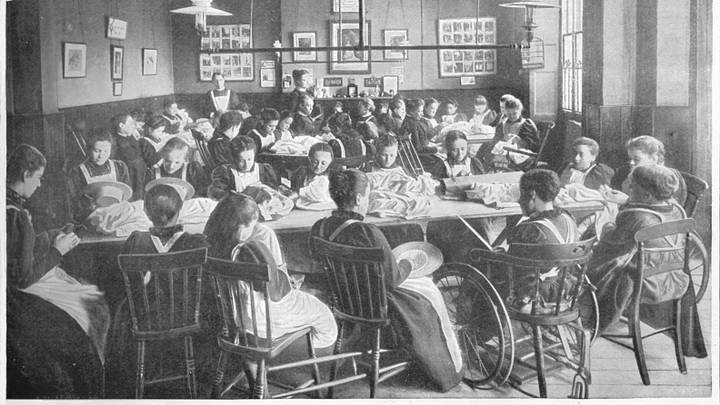
In the early Victorian era, typically only the children of richer families could be afforded an education, often from a private tutor or governess in the comfort of their home. Children of poorer families, on the other hand, were expected to work and play their part in supporting the home from an early age, and as a result wouldn’t receive much in the way of any formal education.
The introduction of so-called “ragged” schools in the 1840s—charitable organizations that offered free school lessons and a lunchtime meal to the poorest children—gradually began to change all that, and in the second half of the 19th century, educational reforms made schooling compulsory and more readily available to all Victorian children. Britain’s 1870 Education Act, for instance, eventually made school mandatory for all children between the ages of 5 and 13. A day at a Victorian school was not an easy one, though, and was often long, hard, and strict. Typically lasting from 9 to 5, school days began with prayers and devotional sessions, and were then divided into long, dry lessons of repetition and rigid routines—while teachers could dole out harsh discipline and even beatings for ill behavior in class.
And on top of all of that, pupils would be expected to follow strict (and, in some cases, rather old-fashioned) rules.
Here are eight school rules Victorian children had to follow.
BOYS AND GIRLS SHOULD NOT MIX
Victorian schools were typically segregated by gender, even down to boys and girls having separate entrances. Although schools in larger cities often had dozens (if not hundreds) of pupils per class, smaller village schools and schools in rural areas might only have had a few children in them, but boys and girls would still have been expected to sit and learn apart.
BOW OR CURTSEY WHEN YOUR NAME IS CALLED
Teachers in Victorian classrooms started the day by checking attendance with the school register. Pupils would typically stand while their names were read aloud, and would be expected to bow (for boys) or curtsy (for girls) while answering “present” when the teacher reached their name.
STAND UP WHEN AN ADULT ENTERS THE ROOM

Victorian society was notoriously well-mannered and driven by a strict code of etiquette, and many school rules reflected those expectations. Pupils were ultimately expected to stand whenever an adult entered the classroom as a sign of respect.
IT’S “SIR” OR “MISS” TO YOU
One Victorian rule that has survived through to the modern day in many schools today is the preference for referring to teachers as “sir,” “miss,” or “ma’am.”
NO SPEAKING UNLESS SPOKEN TO
Victorian classrooms were quiet, with pupils expected to remain silent until called on by their teacher to speak. As a result, there was no group work and no opportunity to ask questions or request a little more clarification, even if a pupil didn’t understand the lesson. When a pupil was called on to speak or give an answer, they would be expected to stand while doing so too.
RIGHT-HANDED WRITING ONLY

All school children, left-handers included, would have been expected to write with their right hand in Victorian schoolrooms. The reasoning behind this bizarrely uncompromising rule was an age-old mixture of practicality (avoiding smudging text as the hand moves across the paper), superstition (the left-hand side was long associated with an ill influence), and pseudoscience (with left-handedness even seen as a developmental issue in the Victorian era that could be “cured”). The methods of achieving an entirely right-handed cohort of pupils were often macabre, though, with reports of some teachers tying stubborn left-handed pupils’ hands behind their backs to prevent them from using them.
POSTURE AND DEPORTMENT ARE IMPORTANT
A lot of Victorian learning revolved around learning by rote, with students variously memorizing, copying, or reading aloud the strings of words, grammatical conjugations, multiplication tables, Bible verses, and other texts the teacher would write on the chalkboard. During these periods of copying and recital, pupils would often be expected to remain still and maintain excellent posture, sitting upright at their desks, and with their hands held palms down on the table.
ANY FAILURE OF THE RULES WILL GO PUNISHED
Schoolkids in Victorian times could be punished for everything from talking or fidgeting in class to being late, answering back, submitting poor work, or just generally being a little slower than their peers. In an age long before learning difficulties became an important topic, slower students would be singled out and made to stand in the corner of the classroom wearing a humiliating dunce’s cap—a tall conical paper hat with a large letter D written on it.