%20%20--%3E%0A%3Csvg%20version%3D%221.1%22%20id%3D%22Layer_1%22%20xmlns%3D%22http%3A%2F%2Fwww.w3.org%2F2000%2Fsvg%22%20xmlns%3Axlink%3D%22http%3A%2F%2Fwww.w3.org%2F1999%2Fxlink%22%20x%3D%220px%22%20y%3D%220px%22%0A%09%20viewBox%3D%220%200%20684.6%2068.1%22%20style%3D%22enable-background%3Anew%200%200%20684.6%2068.1%3B%22%20xml%3Aspace%3D%22preserve%22%3E%0A%3Cg%3E%0A%09%3Cpath%20d%3D%22M444.1%2C29.3h-17.4v14.5h17.4V29.3z%20M36.4%2C68.1l29.3-50.8V0H50.4L32.9%2C36.8L15.5%2C0H0v68.1h16.7V45.8l12.4%2C22.3H36.4z%0A%09%09%20M49.1%2C68.1h16.6V23.4L49.1%2C52.1V68.1z%20M76.6%2C68.1h45V53.8H93.3V41.6h21V27.1h-21V14.8h28.3V0.1h-45V68.1z%20M175.6%2C68.1h17.3v-68%0A%09%09h-16.5v40.3L150%2C0.1h-17.6v68h16.7V27.7L175.6%2C68.1z%20M235.8%2C14.8h15.4V0.1h-47.4v14.7H219v53.2h16.8V14.8z%20M290.3%2C45.9h-17.1%0A%09%09l7.5-15.6h2L290.3%2C45.9z%20M298.7%2C68.1h18l-32.2-68h-5.7l-32%2C68h18l3.3-7.1h27.1L298.7%2C68.1z%20M325.2%2C68.1h46.2V53.8h-29.6V0.1h-16.7%0A%09%09V68.1z%20M423.7%2C14.8h27.2V0.1H407v68h16.7V14.8z%20M462%2C68.1h46.2V53.8h-29.6V0.1H462V68.1z%20M564.8%2C34.1c0%2C10.7-7.2%2C19.2-18.5%2C19.2%0A%09%09c-11.4%2C0-18.5-8.5-18.5-19.2s7.1-19.2%2C18.5-19.2C557.6%2C14.9%2C564.8%2C23.4%2C564.8%2C34.1%20M580.6%2C34.1c0-19-14.2-34-34.3-34%0A%09%09c-20.2%2C0-34.3%2C15-34.3%2C34c0%2C19%2C14.1%2C34%2C34.3%2C34C566.4%2C68.1%2C580.6%2C53.1%2C580.6%2C34.1%20M604.8%2C20.5c0-4.1%2C3.3-6.2%2C6.7-6.2%0A%09%09c4.4%2C0%2C6.6%2C3%2C6.6%2C6.6h14.7C631.8%2C9.1%2C625.1%2C0.1%2C611%2C0.1c-12%2C0-21.7%2C9.3-21.7%2C20.6c0%2C10.9%2C5.9%2C15.9%2C16.7%2C19.8%0A%09%09c5.2%2C1.8%2C11.5%2C3.2%2C11.5%2C8c0%2C3.3-2.4%2C5.5-6.4%2C5.5c-3.6%2C0-6.6-3-6.6-6.7h-15.2c0%2C11.5%2C7.9%2C20.8%2C21.8%2C20.8c12%2C0%2C21.6-9.3%2C21.6-20.6%0A%09%09c0-10-5.3-16.4-16.7-19.8C610.6%2C26.1%2C604.8%2C25.3%2C604.8%2C20.5%20M670%2C20.9h14.7C683.8%2C9.1%2C677.1%2C0.1%2C663%2C0.1c-12%2C0-21.7%2C9.3-21.7%2C20.6%0A%09%09c0%2C10.9%2C5.9%2C15.9%2C16.7%2C19.8c5.2%2C1.8%2C11.5%2C3.2%2C11.5%2C8c0%2C3.3-2.4%2C5.5-6.4%2C5.5c-3.6%2C0-6.6-3-6.6-6.7h-15.2c0%2C11.5%2C7.9%2C20.8%2C21.8%2C20.8%0A%09%09c12%2C0%2C21.6-9.3%2C21.6-20.6c0-10-5.3-16.4-16.7-19.8c-5.4-1.6-11.3-2.4-11.3-7.2c0-4.1%2C3.3-6.2%2C6.7-6.2C667.7%2C14.4%2C670%2C17.3%2C670%2C20.9%0A%09%09%22%2F%3E%0A%3C%2Fg%3E%0A%3C%2Fsvg%3E%0A)

Most of us tend to think of waking up in the middle of the night as an inconvenience at best. Lying awake at 2 or 3 A.M. never feels great, especially if you have an early morning the next day.
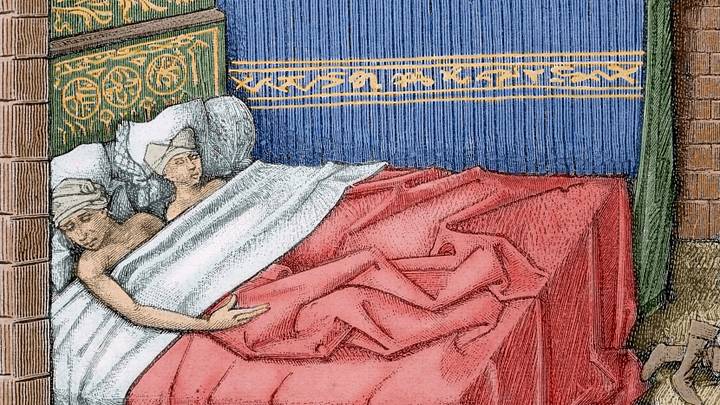
Yet it turns out that in medieval times—and most likely long before that—people around the world may have slept in two shifts, naturally waking up for a few hours in the middle of each night before retiring once again. This time could have been used for prayer, chores, intimacy, or simply lying in bed and having late-night chats. For most of human history, at least before electricity altered our circadian rhythms, this manner of sleeping may even have been the default way we spent our nights.
How the Two Sleeps Theory Emerged

The idea that people may have slept in two sessions was first proposed by historian Roger Ekirch, who conceptualized it after reading a 17th-century courtroom testimony that mentioned, in an intriguingly casual way, a “first sleep.”
The testimony in question was given by Jane Rowth, a nine-year-old girl whose mother was murdered on the night of April 13, 1699. In her statement, she mentioned that just before the event occurred, she and her mother had awoken from their “first sleep.” The offhand way she used these words sparked Erkirch’s curiosity, and he began seeking out additional mentions of two-part sleeps. He found them.
Mentions of first and second sleeps appear in Geoffrey Chaucer’s The Canterbury Tales, and in William Baldwin’s Beware the Cat, widely considered to be the first satirical novel. They also appeared in songs, medical texts, articles, and more, and extended far beyond England’s borders and far earlier than medieval times.
Apparently, people slept in two sessions in Africa, South America, the Middle East, and many other regions. Ekirch also found references to biphasic sleep in ancient texts by the Greek philosopher Plutarch, the Roman historian Livy, and other major historical figures.
All this led Ekirch to propose that people may have slept in two parts for most of history, with things only changing when artificial lighting began allowing people to stay up later and later into the night.
What Did People Do During Two Sleeps?

Nowadays, many of us likely take our clean, comfortable beds for granted. Yet nights looked very different in medieval times. People often slept in large groups, with parents, children, relatives, and non-family members all crammed together in one bed. Groups frequently had designated sleeping positions, with female children next to their mothers, who slept next to their husbands, who slept next to their sons, who slept next to other relatives, and so on. These beds were often full of lice, fleas, and other bugs.
According to Ekirch’s theory, people’s first sleep would typically last from around 9 to 11 P.M. They would then rise and remain awake until around 1 or 2 A.M. This moonlit time was used in many different ways. Sometimes, it served as an excuse to get extra chores done. People also used this time for prayer or philosophical reflection. Sometimes, they stayed in bed and talked. If husbands and wives could find the privacy, this was also a convenient time for intimacy.
In general, this seemed to be a time for connection and reflection—one that may have allowed people to engage with spiritual practices or connection in a deeper fashion than they could in the daylight hours. “Families rose from their beds to urinate, smoke tobacco, and even visit close neighbors,” Ekirch wrote. “Remaining abed, many persons also made love, prayed, and, most important, reflected on the dreams that typically preceded waking from their ‘first sleep’. Not only were these visions unusually vivid, but their images would have intruded far less on conscious thought had sleepers not stirred until dawn.”
Things seemingly shifted with the rise of artificial lighting, which enabled people to stay up later and also suppressed melatonin, leading to later sleep times. Intriguingly, in numerous studies where people have attempted to sleep without clocks or artificial lighting over the course of several weeks, they have often naturally begun to sleep in two segments once again.
So the next time you wake up in the middle of the night, instead of panicking or staring at the ceiling, you might take the opportunity to reflect on your ancient ancestors, who may have done just the same thing—and for whom a few hours of wakefulness around midnight was a part of life as valuable as any other.