%20%20--%3E%0A%3Csvg%20version%3D%221.1%22%20id%3D%22Layer_1%22%20xmlns%3D%22http%3A%2F%2Fwww.w3.org%2F2000%2Fsvg%22%20xmlns%3Axlink%3D%22http%3A%2F%2Fwww.w3.org%2F1999%2Fxlink%22%20x%3D%220px%22%20y%3D%220px%22%0A%09%20viewBox%3D%220%200%20684.6%2068.1%22%20style%3D%22enable-background%3Anew%200%200%20684.6%2068.1%3B%22%20xml%3Aspace%3D%22preserve%22%3E%0A%3Cg%3E%0A%09%3Cpath%20d%3D%22M444.1%2C29.3h-17.4v14.5h17.4V29.3z%20M36.4%2C68.1l29.3-50.8V0H50.4L32.9%2C36.8L15.5%2C0H0v68.1h16.7V45.8l12.4%2C22.3H36.4z%0A%09%09%20M49.1%2C68.1h16.6V23.4L49.1%2C52.1V68.1z%20M76.6%2C68.1h45V53.8H93.3V41.6h21V27.1h-21V14.8h28.3V0.1h-45V68.1z%20M175.6%2C68.1h17.3v-68%0A%09%09h-16.5v40.3L150%2C0.1h-17.6v68h16.7V27.7L175.6%2C68.1z%20M235.8%2C14.8h15.4V0.1h-47.4v14.7H219v53.2h16.8V14.8z%20M290.3%2C45.9h-17.1%0A%09%09l7.5-15.6h2L290.3%2C45.9z%20M298.7%2C68.1h18l-32.2-68h-5.7l-32%2C68h18l3.3-7.1h27.1L298.7%2C68.1z%20M325.2%2C68.1h46.2V53.8h-29.6V0.1h-16.7%0A%09%09V68.1z%20M423.7%2C14.8h27.2V0.1H407v68h16.7V14.8z%20M462%2C68.1h46.2V53.8h-29.6V0.1H462V68.1z%20M564.8%2C34.1c0%2C10.7-7.2%2C19.2-18.5%2C19.2%0A%09%09c-11.4%2C0-18.5-8.5-18.5-19.2s7.1-19.2%2C18.5-19.2C557.6%2C14.9%2C564.8%2C23.4%2C564.8%2C34.1%20M580.6%2C34.1c0-19-14.2-34-34.3-34%0A%09%09c-20.2%2C0-34.3%2C15-34.3%2C34c0%2C19%2C14.1%2C34%2C34.3%2C34C566.4%2C68.1%2C580.6%2C53.1%2C580.6%2C34.1%20M604.8%2C20.5c0-4.1%2C3.3-6.2%2C6.7-6.2%0A%09%09c4.4%2C0%2C6.6%2C3%2C6.6%2C6.6h14.7C631.8%2C9.1%2C625.1%2C0.1%2C611%2C0.1c-12%2C0-21.7%2C9.3-21.7%2C20.6c0%2C10.9%2C5.9%2C15.9%2C16.7%2C19.8%0A%09%09c5.2%2C1.8%2C11.5%2C3.2%2C11.5%2C8c0%2C3.3-2.4%2C5.5-6.4%2C5.5c-3.6%2C0-6.6-3-6.6-6.7h-15.2c0%2C11.5%2C7.9%2C20.8%2C21.8%2C20.8c12%2C0%2C21.6-9.3%2C21.6-20.6%0A%09%09c0-10-5.3-16.4-16.7-19.8C610.6%2C26.1%2C604.8%2C25.3%2C604.8%2C20.5%20M670%2C20.9h14.7C683.8%2C9.1%2C677.1%2C0.1%2C663%2C0.1c-12%2C0-21.7%2C9.3-21.7%2C20.6%0A%09%09c0%2C10.9%2C5.9%2C15.9%2C16.7%2C19.8c5.2%2C1.8%2C11.5%2C3.2%2C11.5%2C8c0%2C3.3-2.4%2C5.5-6.4%2C5.5c-3.6%2C0-6.6-3-6.6-6.7h-15.2c0%2C11.5%2C7.9%2C20.8%2C21.8%2C20.8%0A%09%09c12%2C0%2C21.6-9.3%2C21.6-20.6c0-10-5.3-16.4-16.7-19.8c-5.4-1.6-11.3-2.4-11.3-7.2c0-4.1%2C3.3-6.2%2C6.7-6.2C667.7%2C14.4%2C670%2C17.3%2C670%2C20.9%0A%09%09%22%2F%3E%0A%3C%2Fg%3E%0A%3C%2Fsvg%3E%0A)

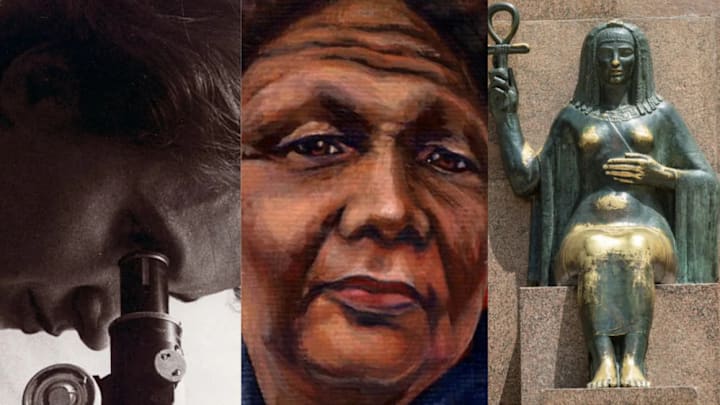
Women, broadly speaking, have been embroiled in a long, winding fight for equality that very much continues today. Despite many women facing various levels of sexism, racism, financial inequality, and the like across time, history is full of powerful, important female figures—many of whose achievements were never recognized, or were recognized very, very belatedly.
Of course, the women on this list are actually some of the more famous and widely lauded women to have been discredited or overlooked by history, and there are countless more women whose invisible labor still goes unheralded and unrecognized. Work traditionally assigned to women, such as housework, has also historically gone uncredited and disregarded compared to success in male-dominated fields, which is a whole other topic—and fortunately, there are whole fields of academic study dedicated to exploring this complexity and honoring the lives of forgotten and erased women.
For now, read on to discover nine amazing women whose stories were written out of history books at one point or another, but whose legacies are at last being properly reclaimed and honored.
- Enheduanna
- Hypatia of Alexandria
- Rosalind Franklin
- Ada Lovelace
- Sybil Ludington
- Alice Ball
- Marthe Gautier
- Fanny Mendelssohn
- Mary Seacole
Enheduanna


Did you know that the first named author in all of history happens to be a woman? That honor is owed to Enheduanna, a Mesopotamian high priestess, poet, and princess who wrote devotional poetry to the goddess Innana, a deity of love and war, in the Sumerian city of Ur around 2,300 BCE.
As high priestess of the moon god Nanna, she wrote prolifically, and her words had a significant impact on the politics and religious life of her day. Her writing paid tribute to Innana’s power and duality, but Enheduanna also described her own personal life and is the first writer known to have referenced herself in any kind of tablet or document.
Much of her work was lost for thousands of years, and her contributions have long been overshadowed by those of male authors. However, in the early 20th century, archaeologists discovered tablets containing her work in the desert of modern-day Iraq, and many scholars have also worked to properly honor her contributions in the years since then.
Hypatia of Alexandria

Hypatia of Alexandria was the world’s leading mathematician and astronomer during her time in Alexandria, then a province of Egypt within the Roman Empire. She also regularly taught and lectured on philosophy and wrote a number of influential commentaries on philosophical texts. Unfortunately, her Neoplatonist philosophy was labeled “pagan” at a time that Judaism and Christianity were in strong conflict with other faiths, and religious intolerance led to her murder by a Christian mob in 415 CE.
Her contributions to the field of mathematics and philosophy have often been overshadowed by accounts of her violent death, and she has often been portrayed as a martyr or symbol rather than a scholar in her own right. Still, many efforts have been made to reclaim her legacy in the 20th and 21st centuries.
Rosalind Franklin

Rosalind Franklin’s research was critical to the discovery of DNA’s structure, yet most of the recognition for this achievement went to fellow scientists James Watson and Francis Crick, who received the Nobel Prize in 1962 “for their discoveries concerning the molecular structure of nucleic acids and its significance for information transfer in living material.”
In 1952, Franklin developed a famous X-ray image of DNA known as “Photo 51,” which provided evidence for DNA’s double-helix structure and which may have been instrumental in helping Watson and Crick make their discovery. According to some interpretations of what happened, the image may have been shared with Watson and Crick without Franklin’s permission, though some contest that this may simply be a rumor. Regardless, Watson and Crick did use some of Franklin’s data without asking for her permission, and Franklin remained largely uncredited for her contributions during her lifetime.
Ada Lovelace

Ada Lovelace was a mathematician and programmer born in England in 1815. Sometimes called the first computer programmer, she designed a program for her associate Charles Babbage’s Analytical Engine and was one of the first people to propose that computers could be given instructions, which essentially launched the entire field of computer programming into being. The daughter of the poet Lord Byron, Lovelace even predicted that computers would someday be able to compose music and create graphics—essentially foreseeing the rise of artificial intelligence hundreds of years before it emerged.
Sybil Ludington

Paul Revere may be the most famous horseback rider to emerge out of the Revolutionary War, but his efforts actually may have been far surpassed by Sybil Ludington, who—at the age of 16—is said to have ridden 40 miles in the rain to summon local militias after a British attack on Danbury, Connecticut on April 26, 1777. Her ride is believed to have been twice the distance of Paul Revere’s, yet she receives a fragment of the attention he does in history classes. Still, she is said to have received a formal thank you from General George Washington after her efforts at the time.
Alice Ball

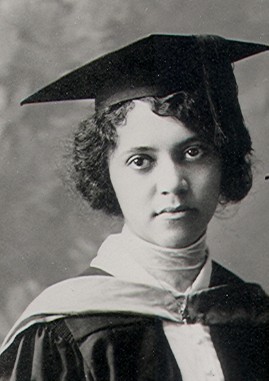
Alice Ball was a chemist who discovered the first effective treatment for Hansen’s disease, also known as leprosy, and she did it before the age of 24. Born in 1892, Ball became the first woman to receive a M.S. degree in chemistry from the College of Hawaii, and went on to become the college’s first female chemistry professor.
Her research culminated in the discovery of a treatment for leprosy that used oil from chaulmoogra trees, which until then had only been used topically. Ball’s work isolated fatty acids in the substance and created an injectable solution that was used for over 30 years to help people with leprosy, which until then had been a feared, devastating, and widespread disease. After her death the year after her discovery, the college’s president, Dr. Arthur Dean, took credit for Ball’s work, and it wasn’t until the early 2000s that Ball received formal recognition from the institution.
Marthe Gautier


Dr. Marthe Gautier was a French doctor who discovered that Down syndrome is caused by an extra chromosome. In the late 1950s, she began working at the Armand-Trosseau Hospital under Dr. Raymond Turpin, who had a theory that Down syndrome might be connected to chromosome changes but was unable to prove it. Gautier, whose work at Harvard had made her an expert in cell cultures, began to research the idea and eventually discovered that every cell in people with Down syndrome has an extra copy of chromosome 21.
She told Dr. Jérôme Lejeune, an associate who took credit for Gautier’s revelations at a conference in Montreal soon after. Lejeune also listed himself as the first author in a report about the study for a scientific journal; he listed Gautier second and orchestrated the whole thing entirely without her permission. In the 1990s, a New York Times obituary gave Lejeune sole credit for discovering the cause of Down syndrome, and he has continued to receive accolades since then. However, Gautier published an account of her story in 2009, and has since begun to obtain proper credit for her work.
Fanny Mendelssohn

Composer Felix Mendelssohn is one of the most famous German composers of the Romantic period, but his sister, Fanny, was also a talented musician. However, their father is said to have encouraged Felix’s career, but not Fanny’s. Felix was also apparently supportive of his sister’s work, but not of her efforts to publish it. Some of her songs were ultimately published under Felix’s name, including a piece called “Italien”—which Queen Victoria specifically requested when Felix was invited to perform for her at Buckingham Palace.
Fanny wrote over 460 pieces of music during her life, and may have pioneered a type of composition called “Songs Without Words,” which later became centerpieces of her brother’s career. She finally published under her own name at age 40, but sadly died the following year. Today, music historians are still unearthing pieces believed to have been written by Felix that may actually be owed to Fanny.
Mary Seacole

Mary Seacole was a Jamaican-British businesswoman and nurse who left behind a legacy of kindness and activism. Born in Jamaica, Seacole grew up helping her family run a boarding house and learning traditional Caribbean medicine from her mother. Two years after the Crimean War began in 1853, Seacole went to England and asked to become an army nurse so she could help wounded soldiers. When her request was declined, she went to Crimea anyway and set up a hospital, store, and rehabilitation center called the British Hotel with a relative named Thomas Day.
Seacole rose to great notoriety and was compared to Florence Nightingale at the time, and often went to the battlefield herself to tend to soldiers. After her return, she had very little money but a great deal of love and praise from the soldiers she had helped and their families, and an 80,000-person fundraising gala was held in her honor in 1857. After her death in 1881, though, she was largely forgotten by history until about a century later, when a group of nurses set about reviving her legacy.