%20%20--%3E%0A%3Csvg%20version%3D%221.1%22%20id%3D%22Layer_1%22%20xmlns%3D%22http%3A%2F%2Fwww.w3.org%2F2000%2Fsvg%22%20xmlns%3Axlink%3D%22http%3A%2F%2Fwww.w3.org%2F1999%2Fxlink%22%20x%3D%220px%22%20y%3D%220px%22%0A%09%20viewBox%3D%220%200%20684.6%2068.1%22%20style%3D%22enable-background%3Anew%200%200%20684.6%2068.1%3B%22%20xml%3Aspace%3D%22preserve%22%3E%0A%3Cg%3E%0A%09%3Cpath%20d%3D%22M444.1%2C29.3h-17.4v14.5h17.4V29.3z%20M36.4%2C68.1l29.3-50.8V0H50.4L32.9%2C36.8L15.5%2C0H0v68.1h16.7V45.8l12.4%2C22.3H36.4z%0A%09%09%20M49.1%2C68.1h16.6V23.4L49.1%2C52.1V68.1z%20M76.6%2C68.1h45V53.8H93.3V41.6h21V27.1h-21V14.8h28.3V0.1h-45V68.1z%20M175.6%2C68.1h17.3v-68%0A%09%09h-16.5v40.3L150%2C0.1h-17.6v68h16.7V27.7L175.6%2C68.1z%20M235.8%2C14.8h15.4V0.1h-47.4v14.7H219v53.2h16.8V14.8z%20M290.3%2C45.9h-17.1%0A%09%09l7.5-15.6h2L290.3%2C45.9z%20M298.7%2C68.1h18l-32.2-68h-5.7l-32%2C68h18l3.3-7.1h27.1L298.7%2C68.1z%20M325.2%2C68.1h46.2V53.8h-29.6V0.1h-16.7%0A%09%09V68.1z%20M423.7%2C14.8h27.2V0.1H407v68h16.7V14.8z%20M462%2C68.1h46.2V53.8h-29.6V0.1H462V68.1z%20M564.8%2C34.1c0%2C10.7-7.2%2C19.2-18.5%2C19.2%0A%09%09c-11.4%2C0-18.5-8.5-18.5-19.2s7.1-19.2%2C18.5-19.2C557.6%2C14.9%2C564.8%2C23.4%2C564.8%2C34.1%20M580.6%2C34.1c0-19-14.2-34-34.3-34%0A%09%09c-20.2%2C0-34.3%2C15-34.3%2C34c0%2C19%2C14.1%2C34%2C34.3%2C34C566.4%2C68.1%2C580.6%2C53.1%2C580.6%2C34.1%20M604.8%2C20.5c0-4.1%2C3.3-6.2%2C6.7-6.2%0A%09%09c4.4%2C0%2C6.6%2C3%2C6.6%2C6.6h14.7C631.8%2C9.1%2C625.1%2C0.1%2C611%2C0.1c-12%2C0-21.7%2C9.3-21.7%2C20.6c0%2C10.9%2C5.9%2C15.9%2C16.7%2C19.8%0A%09%09c5.2%2C1.8%2C11.5%2C3.2%2C11.5%2C8c0%2C3.3-2.4%2C5.5-6.4%2C5.5c-3.6%2C0-6.6-3-6.6-6.7h-15.2c0%2C11.5%2C7.9%2C20.8%2C21.8%2C20.8c12%2C0%2C21.6-9.3%2C21.6-20.6%0A%09%09c0-10-5.3-16.4-16.7-19.8C610.6%2C26.1%2C604.8%2C25.3%2C604.8%2C20.5%20M670%2C20.9h14.7C683.8%2C9.1%2C677.1%2C0.1%2C663%2C0.1c-12%2C0-21.7%2C9.3-21.7%2C20.6%0A%09%09c0%2C10.9%2C5.9%2C15.9%2C16.7%2C19.8c5.2%2C1.8%2C11.5%2C3.2%2C11.5%2C8c0%2C3.3-2.4%2C5.5-6.4%2C5.5c-3.6%2C0-6.6-3-6.6-6.7h-15.2c0%2C11.5%2C7.9%2C20.8%2C21.8%2C20.8%0A%09%09c12%2C0%2C21.6-9.3%2C21.6-20.6c0-10-5.3-16.4-16.7-19.8c-5.4-1.6-11.3-2.4-11.3-7.2c0-4.1%2C3.3-6.2%2C6.7-6.2C667.7%2C14.4%2C670%2C17.3%2C670%2C20.9%0A%09%09%22%2F%3E%0A%3C%2Fg%3E%0A%3C%2Fsvg%3E%0A)

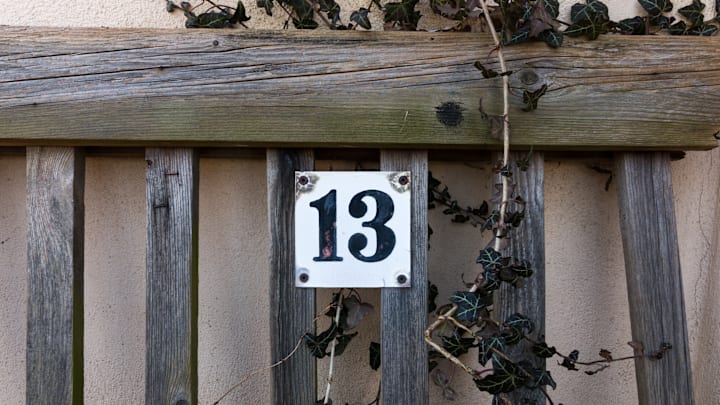
Friday the 13th has been the subject of mythology and speculation for a long time. The origins of superstitions around the date are somewhat unclear, though they have been traced back to the belief that Judas may have been the 13th guest at the Last Supper in the Bible. Friday, meanwhile, is associated with Jesus's crucifixion and Adam and Eve's expulsion from the Garden of Eden, according to some medieval folk beliefs. Today, the idea that Friday the 13th might be unlucky is one of the most widespread folk beliefs in the Western world—and the reasons for that are as complex as the belief’s origins.
You won’t catch Dr. Kerry Noonan using the word superstition, though. While the folklorist doesn’t mind when people use that term, she prefers to use the word “belief,” telling Mental Floss that she feels that “superstition is sort of a pejorative word…I always think that saying 'superstition' is like saying someone else’s belief is stupid,” she adds. “Most people are embarrassed to admit they're superstitious.”
Why Are Beliefs About Friday the 13th So Widespread?
Who among us hasn’t raised an eyebrow when deciding to book a flight or travel somewhere on Friday the 13th, after all? According to Noonan, who lectures on this topic at Champlain College, this particular superstition—or belief—is so widespread for a number of reasons. One primary reason that the Friday the 13th story has stuck around is that, regardless of their religious or spiritual beliefs, people tend to care quite a lot about luck.
“As a folklorist, I always look at function and symbolic meanings,” Noonan says. “Function is what people get out of something or what it does for them. And symbolic meanings are how something ties into underlying cultural values or fears or worries.”
When it comes to Friday the 13th, “I’m gonna say many people are worried about luck,” she surmises. “All of us want to attract good luck and avoid bad luck. There are many things outside of our control. So we all do things. We might throw salt over our left shoulder. We might knock on wood to deflect bad luck. In Eastern European Jewish culture, you spit a couple times after you say something if you don't wanna jinx it.”
Underlying this desire, she explains, “is this natural human desire to control the uncontrollable.” Superstitions, folk beliefs, and even religions can crop up, she adds, within the space between what people can control and what they can’t.
Highly stressful situations or events can also lead to a spike in folk beliefs. “There's also been some research that says when humans are in a really stressful situation, our adherence to folk belief tends to go up,” says Noonan. Ultimately, it all goes back to the same thing, she says—“asserting control over a situation that you feel is out of control.”
This idea was summarized by 20th-century anthropologist Bronisław Malinowski, who theorized that magic serves as a “gap-filler” in times of uncertainty. “What he means by that,” Noonan explains, “is that if there is a gap between what we can control and the outcome that we desire, then we fill that gap with both beliefs and magical behaviors.”
Often, these beliefs and behaviors stick around not because the masses wholeheartedly subscribe to them, but because people also tend to feel that it “couldn’t hurt” to honor these superstitions, even year after year. “It couldn't hurt to knock wood. It couldn't hurt to wear my lucky shirt to the job interview. It couldn't hurt to, you know, go outside, turn around three times, and spit,” Noonan says.
It’s also possible that Friday the 13th, in particular, has stuck around so long because the occasion is so general, she notes. There are no specific behaviors or activities designed to counteract any bad luck that might originate on this date, making it accessible and low-effort. It’s also connected to a specific date that occurs somewhat regularly, but not regularly enough to grow stale or ordinary.
How Pop Culture Influences Folk Beliefs
Of course, another reason beliefs about Friday the 13th have imprinted themselves so firmly into the American cultural landscape in particular is the franchise Friday the 13th. Noonan herself was an actor in the sixth movie in the franchise, and she looks back fondly on her memories of her time on set. At one point, she says, she even had to tell C. J. Graham, the actor playing Jason Voorhees, to stop talking to her, as it was difficult to pretend to be scared after speaking to him so casually.
Certainly, she says, the movies have also helped cement the Friday the 13th myth in popular imagination, and they are clear examples of how pop culture and folklore can have symbiotic relationships.
Decades before the franchise premiered, beliefs about Friday the 13th also gained prominence thanks to the 1907 novel Friday, the Thirteenth by Thomas W. Lawson, which played a similar role in bolstering suspicions about the day's unluckiness. And centuries before that, fairy tales including the Brother Grimm's Sleeping Beauty featured a storyline where 12 fairies were invited to see the baby princess, but the 13th fairy—who happened to be evil—was not invited, leading to the story's central curse.
In all of these cases, “pop culture reinforces folk culture,” Noonan observes. “Mass-mediated culture borrows from folk beliefs and stories, like ghost stories and other kinds of beliefs, and uses them to make a mass-mediated project, which goes back out into the culture.”
Still, just like the origins of the belief that Friday the 13th might be unlucky are slightly obscure, the reasons why the date has stuck around are a bit nebulous, and are rooted in personal and individual fears that many of us happen to share.
“We perpetuate it,” says Noonan, “because we learned it when we were young, or we learned it from someone that we trust or care about, or because we saw pop culture representation—or because it's sort of fun to think of it, or it's a good way to blame why I'm being clumsy on that day.”