%20%20--%3E%0A%3Csvg%20version%3D%221.1%22%20id%3D%22Layer_1%22%20xmlns%3D%22http%3A%2F%2Fwww.w3.org%2F2000%2Fsvg%22%20xmlns%3Axlink%3D%22http%3A%2F%2Fwww.w3.org%2F1999%2Fxlink%22%20x%3D%220px%22%20y%3D%220px%22%0A%09%20viewBox%3D%220%200%20684.6%2068.1%22%20style%3D%22enable-background%3Anew%200%200%20684.6%2068.1%3B%22%20xml%3Aspace%3D%22preserve%22%3E%0A%3Cg%3E%0A%09%3Cpath%20d%3D%22M444.1%2C29.3h-17.4v14.5h17.4V29.3z%20M36.4%2C68.1l29.3-50.8V0H50.4L32.9%2C36.8L15.5%2C0H0v68.1h16.7V45.8l12.4%2C22.3H36.4z%0A%09%09%20M49.1%2C68.1h16.6V23.4L49.1%2C52.1V68.1z%20M76.6%2C68.1h45V53.8H93.3V41.6h21V27.1h-21V14.8h28.3V0.1h-45V68.1z%20M175.6%2C68.1h17.3v-68%0A%09%09h-16.5v40.3L150%2C0.1h-17.6v68h16.7V27.7L175.6%2C68.1z%20M235.8%2C14.8h15.4V0.1h-47.4v14.7H219v53.2h16.8V14.8z%20M290.3%2C45.9h-17.1%0A%09%09l7.5-15.6h2L290.3%2C45.9z%20M298.7%2C68.1h18l-32.2-68h-5.7l-32%2C68h18l3.3-7.1h27.1L298.7%2C68.1z%20M325.2%2C68.1h46.2V53.8h-29.6V0.1h-16.7%0A%09%09V68.1z%20M423.7%2C14.8h27.2V0.1H407v68h16.7V14.8z%20M462%2C68.1h46.2V53.8h-29.6V0.1H462V68.1z%20M564.8%2C34.1c0%2C10.7-7.2%2C19.2-18.5%2C19.2%0A%09%09c-11.4%2C0-18.5-8.5-18.5-19.2s7.1-19.2%2C18.5-19.2C557.6%2C14.9%2C564.8%2C23.4%2C564.8%2C34.1%20M580.6%2C34.1c0-19-14.2-34-34.3-34%0A%09%09c-20.2%2C0-34.3%2C15-34.3%2C34c0%2C19%2C14.1%2C34%2C34.3%2C34C566.4%2C68.1%2C580.6%2C53.1%2C580.6%2C34.1%20M604.8%2C20.5c0-4.1%2C3.3-6.2%2C6.7-6.2%0A%09%09c4.4%2C0%2C6.6%2C3%2C6.6%2C6.6h14.7C631.8%2C9.1%2C625.1%2C0.1%2C611%2C0.1c-12%2C0-21.7%2C9.3-21.7%2C20.6c0%2C10.9%2C5.9%2C15.9%2C16.7%2C19.8%0A%09%09c5.2%2C1.8%2C11.5%2C3.2%2C11.5%2C8c0%2C3.3-2.4%2C5.5-6.4%2C5.5c-3.6%2C0-6.6-3-6.6-6.7h-15.2c0%2C11.5%2C7.9%2C20.8%2C21.8%2C20.8c12%2C0%2C21.6-9.3%2C21.6-20.6%0A%09%09c0-10-5.3-16.4-16.7-19.8C610.6%2C26.1%2C604.8%2C25.3%2C604.8%2C20.5%20M670%2C20.9h14.7C683.8%2C9.1%2C677.1%2C0.1%2C663%2C0.1c-12%2C0-21.7%2C9.3-21.7%2C20.6%0A%09%09c0%2C10.9%2C5.9%2C15.9%2C16.7%2C19.8c5.2%2C1.8%2C11.5%2C3.2%2C11.5%2C8c0%2C3.3-2.4%2C5.5-6.4%2C5.5c-3.6%2C0-6.6-3-6.6-6.7h-15.2c0%2C11.5%2C7.9%2C20.8%2C21.8%2C20.8%0A%09%09c12%2C0%2C21.6-9.3%2C21.6-20.6c0-10-5.3-16.4-16.7-19.8c-5.4-1.6-11.3-2.4-11.3-7.2c0-4.1%2C3.3-6.2%2C6.7-6.2C667.7%2C14.4%2C670%2C17.3%2C670%2C20.9%0A%09%09%22%2F%3E%0A%3C%2Fg%3E%0A%3C%2Fsvg%3E%0A)

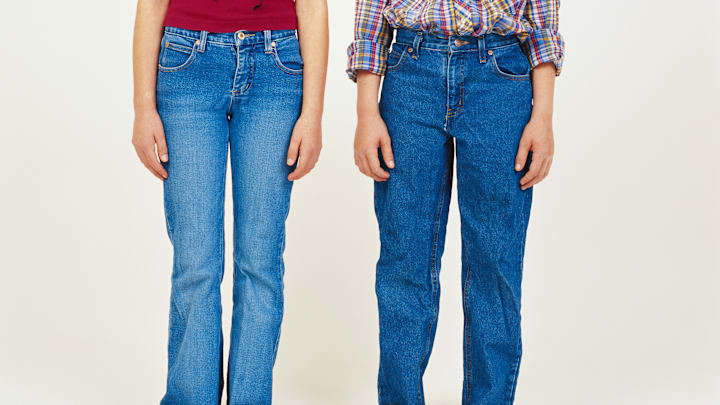
Considering that you’re only putting on one item of clothing, it might seem odd to say that you’re putting on a “pair” of pants. So why do we do it?
Etymologically, pants is a 19th-century shortening of the far older word pantaloons, which can in turn be traced back to a stock character in Italian comic theatre named Pantaloon (or, in Italian, Pantalone). He appeared in the commedia dell’arte stage plays that became popular across Europe in the 1500s and 1600s, typically attired in a bright red vest and breeches with tight-fitting stockings.
In later performances, this breeches-and-stockings combo was often swapped for a longer pair of red trousers, and when this style of trousers later proved popular in England in the mid 17th century, it was given the character’s name, pantaloons.
The Oxford English Dictionary’s earliest record of a pair of pantaloons dates from 1661. According to Merriam-Webster, this was first clipped down to pants in 1833 (with underpants following on in 1925). But if Pantaloon was just the name of a single character, why did the garment named after him—as well as the pants and underpants that followed—come to be spoken of as a pair, and given a plural –s?

The “Split” Hose
At least part of the answer here is said to be that many early forms of pants consisted of two separate leg coverings that were put on one leg at a time, and tied together at the waist; sometimes these different legs were even worn in contrasting colors on either leg, as part of a garish, heraldic-inspired medieval style known as mi-parti.
These early two-part pants, known as “split” hose, were later ousted by so-called “joined” hose, in which the two legs were sewn together as a single garment, and it was these that eventually evolved into our modern pants and trousers.
Despite now being a single item of clothing, though, the fact that garments like these historically constituted a separate pair of legs has nonetheless been maintained in our language. So we still talk about pairs of two-legged pants, trousers, jeans, and slacks, despite the two legs having long been joined together.

The Linguistic Side
There is, however, something else going on in words like this besides just historical fashion. In linguistic terms, pants is an example of a plurale tantum—a word only ever used in its plural form.
Other examples here include the likes of alms, headquarters, annals, jitters, creeps, shenanigans, condolences, surroundings, and outskirts. But while none of these are ever used singularly (so you can’t just donate one alm, or embark on a single shenanigan), these words also imply a seemingly unending or unspecified number.
Other examples of plurale tantum words, though, are a little more specific: Just like pants and trousers, they are single objects that have a clearly two-part or bifurcated form, and so are always spoken of in pairs.
So we not only talk about pairs of pants and pairs of trousers, but also pairs of scissors, shears, tweezers, pincers, nutcrackers, stirrups, handcuffs, sunglasses, spectacles, goggles, binoculars, forceps, pliers, and tongs—all of which consist of two things joined together that, on their own, would be all but useless.
Clearly, it’s not true to say that items like scissors and tweezers were originally made or sold as two separate halves to be joined together when used (as was apparently true of medieval trousers). Instead, we have come to think of objects like these as pairs simply because they have such an obvious two-part form—the two blades of a set of scissors, the two lenses of a pair of spectacles, and so on.

So, yes, although medieval hose might have been worn as a pair of individual legs, it might also be true that we have come to think of them as a pair of pants because they, too, have such an obviously bifurcated “one-leg-and-then-the-other” form.
All told, then, our pair of pants has an appropriately two-part history, with both the quirks of medieval fashion and the quirks of our language to blame.