%20%20--%3E%0A%3Csvg%20version%3D%221.1%22%20id%3D%22Layer_1%22%20xmlns%3D%22http%3A%2F%2Fwww.w3.org%2F2000%2Fsvg%22%20xmlns%3Axlink%3D%22http%3A%2F%2Fwww.w3.org%2F1999%2Fxlink%22%20x%3D%220px%22%20y%3D%220px%22%0A%09%20viewBox%3D%220%200%20684.6%2068.1%22%20style%3D%22enable-background%3Anew%200%200%20684.6%2068.1%3B%22%20xml%3Aspace%3D%22preserve%22%3E%0A%3Cg%3E%0A%09%3Cpath%20d%3D%22M444.1%2C29.3h-17.4v14.5h17.4V29.3z%20M36.4%2C68.1l29.3-50.8V0H50.4L32.9%2C36.8L15.5%2C0H0v68.1h16.7V45.8l12.4%2C22.3H36.4z%0A%09%09%20M49.1%2C68.1h16.6V23.4L49.1%2C52.1V68.1z%20M76.6%2C68.1h45V53.8H93.3V41.6h21V27.1h-21V14.8h28.3V0.1h-45V68.1z%20M175.6%2C68.1h17.3v-68%0A%09%09h-16.5v40.3L150%2C0.1h-17.6v68h16.7V27.7L175.6%2C68.1z%20M235.8%2C14.8h15.4V0.1h-47.4v14.7H219v53.2h16.8V14.8z%20M290.3%2C45.9h-17.1%0A%09%09l7.5-15.6h2L290.3%2C45.9z%20M298.7%2C68.1h18l-32.2-68h-5.7l-32%2C68h18l3.3-7.1h27.1L298.7%2C68.1z%20M325.2%2C68.1h46.2V53.8h-29.6V0.1h-16.7%0A%09%09V68.1z%20M423.7%2C14.8h27.2V0.1H407v68h16.7V14.8z%20M462%2C68.1h46.2V53.8h-29.6V0.1H462V68.1z%20M564.8%2C34.1c0%2C10.7-7.2%2C19.2-18.5%2C19.2%0A%09%09c-11.4%2C0-18.5-8.5-18.5-19.2s7.1-19.2%2C18.5-19.2C557.6%2C14.9%2C564.8%2C23.4%2C564.8%2C34.1%20M580.6%2C34.1c0-19-14.2-34-34.3-34%0A%09%09c-20.2%2C0-34.3%2C15-34.3%2C34c0%2C19%2C14.1%2C34%2C34.3%2C34C566.4%2C68.1%2C580.6%2C53.1%2C580.6%2C34.1%20M604.8%2C20.5c0-4.1%2C3.3-6.2%2C6.7-6.2%0A%09%09c4.4%2C0%2C6.6%2C3%2C6.6%2C6.6h14.7C631.8%2C9.1%2C625.1%2C0.1%2C611%2C0.1c-12%2C0-21.7%2C9.3-21.7%2C20.6c0%2C10.9%2C5.9%2C15.9%2C16.7%2C19.8%0A%09%09c5.2%2C1.8%2C11.5%2C3.2%2C11.5%2C8c0%2C3.3-2.4%2C5.5-6.4%2C5.5c-3.6%2C0-6.6-3-6.6-6.7h-15.2c0%2C11.5%2C7.9%2C20.8%2C21.8%2C20.8c12%2C0%2C21.6-9.3%2C21.6-20.6%0A%09%09c0-10-5.3-16.4-16.7-19.8C610.6%2C26.1%2C604.8%2C25.3%2C604.8%2C20.5%20M670%2C20.9h14.7C683.8%2C9.1%2C677.1%2C0.1%2C663%2C0.1c-12%2C0-21.7%2C9.3-21.7%2C20.6%0A%09%09c0%2C10.9%2C5.9%2C15.9%2C16.7%2C19.8c5.2%2C1.8%2C11.5%2C3.2%2C11.5%2C8c0%2C3.3-2.4%2C5.5-6.4%2C5.5c-3.6%2C0-6.6-3-6.6-6.7h-15.2c0%2C11.5%2C7.9%2C20.8%2C21.8%2C20.8%0A%09%09c12%2C0%2C21.6-9.3%2C21.6-20.6c0-10-5.3-16.4-16.7-19.8c-5.4-1.6-11.3-2.4-11.3-7.2c0-4.1%2C3.3-6.2%2C6.7-6.2C667.7%2C14.4%2C670%2C17.3%2C670%2C20.9%0A%09%09%22%2F%3E%0A%3C%2Fg%3E%0A%3C%2Fsvg%3E%0A)

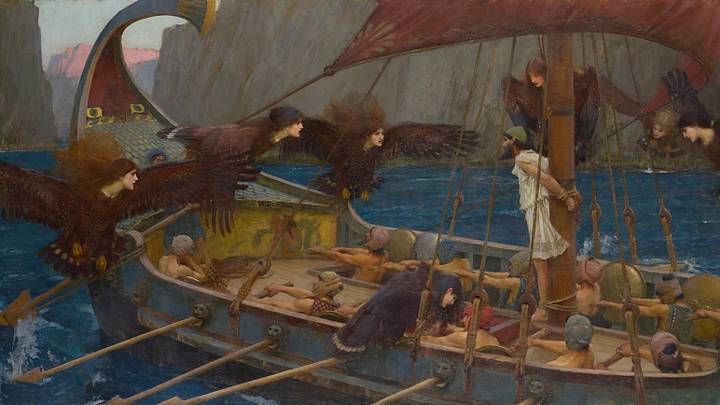
If you know the story of Homer’s Odyssey (or you’ve seen the recent big-screen adaptation), then you’ll know all about the monstrous Sirens that play a part in Odysseus’ journey home.
The Odyssey isn’t the only ancient tale to feature these creatures, but Homer’s account of the Sirens is perhaps the best known. According to him, the Sirens—depicted as monstrous winged creatures, halfway between women and giant birds—inhabited an island of Greece, from where they produced a song that was so captivating that anyone who heard it could not help but be lured toward it, whereupon both they and their ship would be dashed to pieces on the rocks of the island’s coast.
In the Odyssey (no spoilers!), Odysseus and his men are ultimately forced to come up with an ingenious solution in order to pass safely by the Sirens’ lair on his journey back to Ithaca.
Where the Word “Siren” Comes From

The Sirens of Homer’s tale are believed to take their name from a Greek word that literally means “ensnarer” or “entangler”—a reference to their fatally enrapturing song and allure. We still use the term “siren song” to refer to some kind of tempting sound or enticing proposition today, and an alluring yet equally dangerous woman might likewise be referred to as a siren.
But the monstrous Sirens of Homer’s tale share a name with the “sirens” that go off when there’s some kind of emergency. So how did the titles of these mythical creatures come to be synonymous with an alarm?
An Instrument Adopts the Word “Siren”

Oddly, the missing link in this story is a bizarre musical instrument that was partly invented around the turn of the 19th century by two somewhat eccentric scientists: one, a Scottish physicist and noted conspiracy theorist named John Robison, and the other, a French scientist, engineer, and polymath named Baron Charles Cagniard de la Tour.
Sometime around 1799, Robison invented a device intended to measure the flow of air required to produce specific musical tones in wind-powered musical instruments. The device he designed—which consisted of a kind of stopcock, powered by a rotating wheel, that could open and close a pneumatic tube to allow a measured flow of air to pass through it—was attached to the bellows of a church organ to gauge the amount of airflow required to make each musical pitch.
Then, twenty or so years later, over in France, Baron Cagniard made a series of improvements to Robison’s device and outlined his updated design in a paper published in 1819. His device now consisted of a pair of discs—one of which could move, while the other was stationary—mounted at the end of a pneumatic tube.
The discs each contained a series of tiny holes through which a flow of air could pass, and so as the moving disc rotated, it would intermittently disrupt the flow of air through the holes in the stationary disc. When the holes in the two discs aligned, however, the air could flow directly from one to the other, and this constant disruption and resumption of the air flow produced a musical tone, with a frequency corresponding to the speed of the disc’s rotation.
Baron Cagniard named this improved device the sirène, or “siren,” as it worked just as proficiently underwater—a reference perhaps to the Sirens’ maritime songs (or else to the watery fate of all those who heard it).
From Myth to Mechanical Alarm

That name was then reused some four decades later, when engineers on both sides of the Atlantic began tinkering with Cagniard’s device, ostensibly in an effort to utilize its strong tone as a naval signaling device.
In the 1860s, the American inventor Joseph Henry developed a steam-powered version of Caginard’s siren, which he intended to be used as a foghorn. A decade later, the British inventor James Douglass helped design a hot-air-powered siren, which replaced the coaxial discs with a pair of metal cylinders, one inside the other, which was likewise intended to be used as a coastguarding signal.
Similar mechanical devices—which made sounds by passing air through a pair of discs or cylinders, only one of which was mobile—were soon being used anywhere a loud and unavoidable sound was required, from lighthouses to emergency vehicles, civil defense systems, quarries, and even weapons testing ranges. And as all of these devices were rolled out, the same 2,000-year-old Greek name simply rolled on with them, so that today you’re just as likely to find a siren on top of a police car as on one of the Odyssey’s legendary islands.