%20%20--%3E%0A%3Csvg%20version%3D%221.1%22%20id%3D%22Layer_1%22%20xmlns%3D%22http%3A%2F%2Fwww.w3.org%2F2000%2Fsvg%22%20xmlns%3Axlink%3D%22http%3A%2F%2Fwww.w3.org%2F1999%2Fxlink%22%20x%3D%220px%22%20y%3D%220px%22%0A%09%20viewBox%3D%220%200%20684.6%2068.1%22%20style%3D%22enable-background%3Anew%200%200%20684.6%2068.1%3B%22%20xml%3Aspace%3D%22preserve%22%3E%0A%3Cg%3E%0A%09%3Cpath%20d%3D%22M444.1%2C29.3h-17.4v14.5h17.4V29.3z%20M36.4%2C68.1l29.3-50.8V0H50.4L32.9%2C36.8L15.5%2C0H0v68.1h16.7V45.8l12.4%2C22.3H36.4z%0A%09%09%20M49.1%2C68.1h16.6V23.4L49.1%2C52.1V68.1z%20M76.6%2C68.1h45V53.8H93.3V41.6h21V27.1h-21V14.8h28.3V0.1h-45V68.1z%20M175.6%2C68.1h17.3v-68%0A%09%09h-16.5v40.3L150%2C0.1h-17.6v68h16.7V27.7L175.6%2C68.1z%20M235.8%2C14.8h15.4V0.1h-47.4v14.7H219v53.2h16.8V14.8z%20M290.3%2C45.9h-17.1%0A%09%09l7.5-15.6h2L290.3%2C45.9z%20M298.7%2C68.1h18l-32.2-68h-5.7l-32%2C68h18l3.3-7.1h27.1L298.7%2C68.1z%20M325.2%2C68.1h46.2V53.8h-29.6V0.1h-16.7%0A%09%09V68.1z%20M423.7%2C14.8h27.2V0.1H407v68h16.7V14.8z%20M462%2C68.1h46.2V53.8h-29.6V0.1H462V68.1z%20M564.8%2C34.1c0%2C10.7-7.2%2C19.2-18.5%2C19.2%0A%09%09c-11.4%2C0-18.5-8.5-18.5-19.2s7.1-19.2%2C18.5-19.2C557.6%2C14.9%2C564.8%2C23.4%2C564.8%2C34.1%20M580.6%2C34.1c0-19-14.2-34-34.3-34%0A%09%09c-20.2%2C0-34.3%2C15-34.3%2C34c0%2C19%2C14.1%2C34%2C34.3%2C34C566.4%2C68.1%2C580.6%2C53.1%2C580.6%2C34.1%20M604.8%2C20.5c0-4.1%2C3.3-6.2%2C6.7-6.2%0A%09%09c4.4%2C0%2C6.6%2C3%2C6.6%2C6.6h14.7C631.8%2C9.1%2C625.1%2C0.1%2C611%2C0.1c-12%2C0-21.7%2C9.3-21.7%2C20.6c0%2C10.9%2C5.9%2C15.9%2C16.7%2C19.8%0A%09%09c5.2%2C1.8%2C11.5%2C3.2%2C11.5%2C8c0%2C3.3-2.4%2C5.5-6.4%2C5.5c-3.6%2C0-6.6-3-6.6-6.7h-15.2c0%2C11.5%2C7.9%2C20.8%2C21.8%2C20.8c12%2C0%2C21.6-9.3%2C21.6-20.6%0A%09%09c0-10-5.3-16.4-16.7-19.8C610.6%2C26.1%2C604.8%2C25.3%2C604.8%2C20.5%20M670%2C20.9h14.7C683.8%2C9.1%2C677.1%2C0.1%2C663%2C0.1c-12%2C0-21.7%2C9.3-21.7%2C20.6%0A%09%09c0%2C10.9%2C5.9%2C15.9%2C16.7%2C19.8c5.2%2C1.8%2C11.5%2C3.2%2C11.5%2C8c0%2C3.3-2.4%2C5.5-6.4%2C5.5c-3.6%2C0-6.6-3-6.6-6.7h-15.2c0%2C11.5%2C7.9%2C20.8%2C21.8%2C20.8%0A%09%09c12%2C0%2C21.6-9.3%2C21.6-20.6c0-10-5.3-16.4-16.7-19.8c-5.4-1.6-11.3-2.4-11.3-7.2c0-4.1%2C3.3-6.2%2C6.7-6.2C667.7%2C14.4%2C670%2C17.3%2C670%2C20.9%0A%09%09%22%2F%3E%0A%3C%2Fg%3E%0A%3C%2Fsvg%3E%0A)

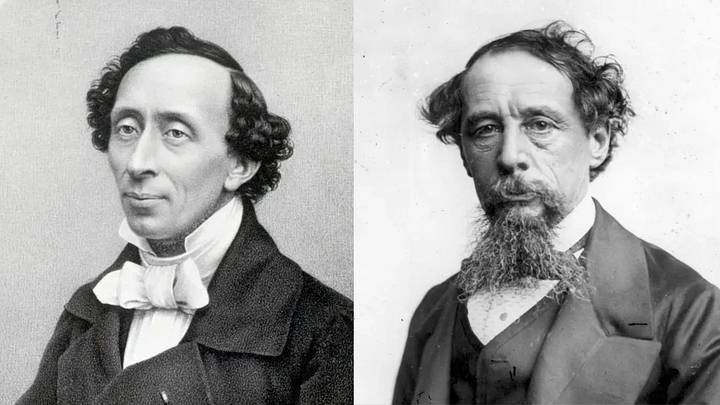
Hans Christian Andersen and Charles Dickens are two of the most celebrated authors of the 19th century. The pair were acquaintances as well, but things unfortunately disintegrated during an extraordinarily awkward five weeks Andersen spent living at Dickens’ home.
An Early Correspondence

Dickens and Andersen met at a party in 1847. At the time, Dickens was extremely famous, while Andersen was successful in Denmark and had come to London to seek translators to help his work succeed in the English market. Upon meeting Dickens, Andersen was starstruck and expressed as much, telling Dickens he was the “greatest writer of our time.” This apparently flattered Dickens, who sent Andersen a package containing books and a note of thanks.
The pair went on to correspond for nearly a decade. However, Dickens would apparently often take months to respond, while Anderson would write back enthusiastically.
Things came to a head when Dickens suggested that Andersen come visit him in a July 1856 letter filled with what some analysts have interpreted as insincerity and passive-aggressiveness. “In these nine years you have not faded out of the hearts of the English people, but have become even better known and more beloved,” Dickens wrote in the missive, an unusually flowery and flattery-filled sentence for the writer.
Whatever the letter actually meant to imply, Andersen took it as a serious invitation and began excitedly telling the press he was going to stay with Dickens. In March of the following year, Andersen finally wrote to Dickens to tell him that he planned to visit. “[M]y visit is intended for you alone,” he wrote. “Above all, always leave me a small corner in your heart.”
Perhaps feeling backed into a corner, Dickens accepted. “Hans Christian Andersen may perhaps be with us, but you won’t mind him—especially as he speaks no language but his own Danish, and is suspected of not even knowing that,” he told a friend at the time.
An Extremely Awkward Visit

It was, overall, not an ideal time for Andersen to come and stay. Dickens’ latest work, Little Dorrit, was receiving a great deal of criticism; he was in the middle of intense rehearsals for the play The Frozen Deep; and he was also beginning to consider leaving his wife, Catherine, for an 18-year-old actress. (In 1858, Dickens would force Catherine to move out of the house. He would also paint her as emotionally unstable in public writings—a character assessment that biographers would later challenge—and later confessed to attempting to have her committed to an asylum in private letters.)
Into this came Andersen, by all accounts a tall and rather childlike man who lacked in some social graces. Born extremely poor yet filled with big dreams from a young age, Andersen was painfully shy as a child, yet possessed a beautiful singing voice he hoped would help him make his fortune. Ultimately, he was told his appearance would affect his singing career and was encouraged to write instead. While he eventually achieved great success in this endeavor, his life was marked by numerous intense unrequited affections for both men and women. One such man was Dickens, for whom Andersen appeared to possess a platonic yet strong fondness.
Things started off on the wrong foot immediately. On his first morning at the house, Andersen requested to be shaved by Dickens' eldest son, claiming this was a Danish custom; the family later sent him to a barber by horse and carriage. That evening, as Dickens held out an arm for a lady at dinner, Andersen took the writer’s arm himself, “leading [Dickens] triumphantly into the dining room,” as Dickens’s son Henry recalled.
Dickens, busy with rehearsals, evaded Andersen by spending much of his time out and about in London. Andersen, meanwhile, tried and seemingly failed to endear himself to Dickens’ children. “He was a bony bore, and stayed on and on,” Dickens’ daughter Kate wrote of the man.
Dickens wrote rather cruelly about Andersen to his friends and was harshly critical of Andersen’s linguistic skills and his personality. In one letter, he recalled a faux pas that occurred when Andersen took a cab home. “It turned out that a cab driver had brought him from the City, by way of the new unfinished thoroughfare through Clerkenwell,” Dickens wrote. “Satisfied that the cabman was bent on robbery and murder, he had put his watch and money into his boots—together with a Bradshaw, a pocket-book, a pair of scissors, a penknife, a book or two, a few letters of introduction and some other miscellaneous property.”
Elssewhere in the letter, Dickens criticized Andersen’s habits, which apparently included crafting and collecting flowers. “Whenever he got to London, he got into wild entanglements of Cabs and Sherry, and never seemed to get out of them again until he came back here, and cut out paper into all sorts of patterns, and gathered the strangest little nosegays in the woods,” he wrote.
Andersen’s emotional and sensitive nature also appeared to rub Dickens the wrong way. At a performance of the play Dickens was starring in, Andersen loudly burst into tears during his character’s death scene. He later also became emotional at a party following the play because, despite being recognized by Queen Victoria earlier in the night, he felt his presence was not receiving enough attention. At one point he lay down and cried in the Dickens’ garden after one of his works received a poor review, and also cried upon leaving Dickens’ home, a full five weeks after arriving.
It was all too much for Dickens, who pinned a note above the mirror in Andersen’s room following his departure that read, “Hans Andersen slept in this room for five weeks—which seemed to the family AGES!”
The End of a Friendship

A later letter Andersen penned to Dickens reveals that he was at least somewhat aware of how poorly the visit had gone. “Kindly forget,” he wrote, “the unfavourable aspect which our life together may have shown you of me.”
Dickens responded with yet another passive-aggressive letter. “The corn-fields that were golden, when you were here, are ploughed up brown; the hops are being picked; the leaves on the trees are just beginning to turn; and the rain is falling, as I write, very sadly—very steadily,” he wrote. It would be the last time he ever responded to Andersen, who sent him several different letters in the months after that before accepting that he had been, to use a very modern word for an ancient situation, ghosted.
Andersen, who went on to achieve the immortality he had dreamed of as a child as a writer of strange and magical stories, often filled his fairy tales with creatures and beings who do not quite fit into the society around them. From the Ugly Duckling to The Little Mermaid, many of his characters dream of worlds where they truly belonged. Still, he continued to speak highly of Dickens, and lamented his death in 1870.
There are a number of lessons, perhaps, to be gained from all this. One is that while meeting your heroes may sometimes lead to a satisfying correspondence, living with them is a whole other matter. Another is that you can always say no when someone accepts your passive-aggressive invitation to stay in their house.