%20%20--%3E%0A%3Csvg%20version%3D%221.1%22%20id%3D%22Layer_1%22%20xmlns%3D%22http%3A%2F%2Fwww.w3.org%2F2000%2Fsvg%22%20xmlns%3Axlink%3D%22http%3A%2F%2Fwww.w3.org%2F1999%2Fxlink%22%20x%3D%220px%22%20y%3D%220px%22%0A%09%20viewBox%3D%220%200%20684.6%2068.1%22%20style%3D%22enable-background%3Anew%200%200%20684.6%2068.1%3B%22%20xml%3Aspace%3D%22preserve%22%3E%0A%3Cg%3E%0A%09%3Cpath%20d%3D%22M444.1%2C29.3h-17.4v14.5h17.4V29.3z%20M36.4%2C68.1l29.3-50.8V0H50.4L32.9%2C36.8L15.5%2C0H0v68.1h16.7V45.8l12.4%2C22.3H36.4z%0A%09%09%20M49.1%2C68.1h16.6V23.4L49.1%2C52.1V68.1z%20M76.6%2C68.1h45V53.8H93.3V41.6h21V27.1h-21V14.8h28.3V0.1h-45V68.1z%20M175.6%2C68.1h17.3v-68%0A%09%09h-16.5v40.3L150%2C0.1h-17.6v68h16.7V27.7L175.6%2C68.1z%20M235.8%2C14.8h15.4V0.1h-47.4v14.7H219v53.2h16.8V14.8z%20M290.3%2C45.9h-17.1%0A%09%09l7.5-15.6h2L290.3%2C45.9z%20M298.7%2C68.1h18l-32.2-68h-5.7l-32%2C68h18l3.3-7.1h27.1L298.7%2C68.1z%20M325.2%2C68.1h46.2V53.8h-29.6V0.1h-16.7%0A%09%09V68.1z%20M423.7%2C14.8h27.2V0.1H407v68h16.7V14.8z%20M462%2C68.1h46.2V53.8h-29.6V0.1H462V68.1z%20M564.8%2C34.1c0%2C10.7-7.2%2C19.2-18.5%2C19.2%0A%09%09c-11.4%2C0-18.5-8.5-18.5-19.2s7.1-19.2%2C18.5-19.2C557.6%2C14.9%2C564.8%2C23.4%2C564.8%2C34.1%20M580.6%2C34.1c0-19-14.2-34-34.3-34%0A%09%09c-20.2%2C0-34.3%2C15-34.3%2C34c0%2C19%2C14.1%2C34%2C34.3%2C34C566.4%2C68.1%2C580.6%2C53.1%2C580.6%2C34.1%20M604.8%2C20.5c0-4.1%2C3.3-6.2%2C6.7-6.2%0A%09%09c4.4%2C0%2C6.6%2C3%2C6.6%2C6.6h14.7C631.8%2C9.1%2C625.1%2C0.1%2C611%2C0.1c-12%2C0-21.7%2C9.3-21.7%2C20.6c0%2C10.9%2C5.9%2C15.9%2C16.7%2C19.8%0A%09%09c5.2%2C1.8%2C11.5%2C3.2%2C11.5%2C8c0%2C3.3-2.4%2C5.5-6.4%2C5.5c-3.6%2C0-6.6-3-6.6-6.7h-15.2c0%2C11.5%2C7.9%2C20.8%2C21.8%2C20.8c12%2C0%2C21.6-9.3%2C21.6-20.6%0A%09%09c0-10-5.3-16.4-16.7-19.8C610.6%2C26.1%2C604.8%2C25.3%2C604.8%2C20.5%20M670%2C20.9h14.7C683.8%2C9.1%2C677.1%2C0.1%2C663%2C0.1c-12%2C0-21.7%2C9.3-21.7%2C20.6%0A%09%09c0%2C10.9%2C5.9%2C15.9%2C16.7%2C19.8c5.2%2C1.8%2C11.5%2C3.2%2C11.5%2C8c0%2C3.3-2.4%2C5.5-6.4%2C5.5c-3.6%2C0-6.6-3-6.6-6.7h-15.2c0%2C11.5%2C7.9%2C20.8%2C21.8%2C20.8%0A%09%09c12%2C0%2C21.6-9.3%2C21.6-20.6c0-10-5.3-16.4-16.7-19.8c-5.4-1.6-11.3-2.4-11.3-7.2c0-4.1%2C3.3-6.2%2C6.7-6.2C667.7%2C14.4%2C670%2C17.3%2C670%2C20.9%0A%09%09%22%2F%3E%0A%3C%2Fg%3E%0A%3C%2Fsvg%3E%0A)

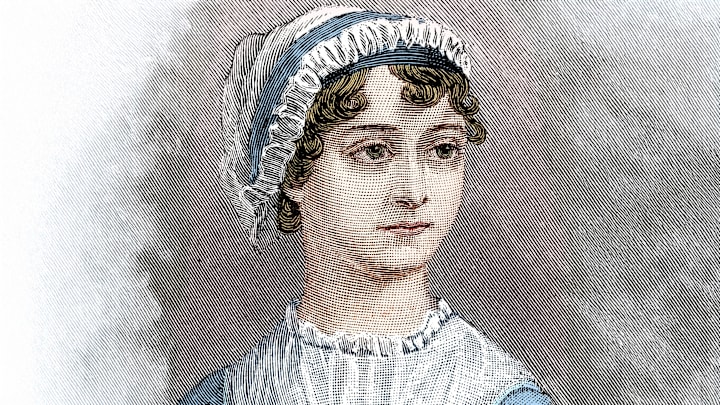
Jane Austen was born in the village of Steventon in Hampshire, on the south coast of England, on December 16, 1775.
The seventh of her family’s eight children, the Austen household was a lively and artistic one, and Jane was encouraged by her parents to learn and read widely—and indulge her creative side. Ultimately, she published her first full-length novel, Sense and Sensibility, in 1811 at the age of just 36. Sadly, she died just six years later, aged 41, from a mysterious condition variously presumed to have been Addison’s disease, lupus, lymphoma, or—according to a rather more scandalous theory recently put forward by the British Library—accidental arsenic poisoning.
Given such a short life, Austen’s entire written output is admittedly not quite as vast as many of the other well-known classic authors of the 18th and 19th centuries. Nevertheless, she went on to publish a further three novels during her lifetime—Pride and Prejudice (1813), Mansfield Park (1814), and Emma (1815)—and completed a further two more, Persuasion and Northanger Abbey, that were published posthumously, six months after her death, in 1817.
Alongside this longer fiction, meanwhile, Austen wrote several short stories and juvenilia, and started work on a handful of other novels and novellas that remained unfinished at the time of her death. With this year marking the 250th anniversary of her birth, here’s a quick primer of five of Austen’s most iconic books to give anyone new to her writing an idea of where to start.
- Emma (1815)
- Pride and Prejudice (1813)
- Sense and Sensibility (1811)
- Northanger Abbey (1817)
- Lady Susan (1871)
Emma (1815)

The last of the four full-length novels Austen published in her lifetime, Emma was published anonymously (as with all of Austen’s work; her identity was only revealed by her brother after her death) in 1815.
And, although it’s also the longest, Emma is widely considered the most overtly comical and accessible of Austen’s books, as it is less concerned with the literary parody and critique that would feature far more strongly in her earlier three titles—making it an ideal starting place for anyone new to her work.
Emma Wodehouse herself is also one of Austen’s funniest, wittiest, and most iconic heroines. “Handsome, clever, and rich,” as Austen describes her, she spends much of the novel indulging in her fondness for matchmaking, albeit with a predictable mix of romantic and comically disastrous results.
Given the title character’s flawed self-willedness, however, Austen herself claimed that her readers would not much like Emma (“I’m going to take a heroine whom no one but myself will much like,” she once commented), but two centuries of readers would likely disagree.
Pride and Prejudice (1813)

If Emma is Austen’s most accessible book, then Pride and Prejudice must surely be her most popular and her most famous.
This iconic tale of the five Bennett sisters and their romantic endeavors has been adapted for cinema and television more than a dozen times (with a new six-part miniseries on its way), while Keira Knightley picked up a Best Actress Oscar nomination for her performance as the lead sister, Elizabeth Bennett, in 2005.
Anyone familiar with Austen’s writing will know Pride and Prejudice to be a novel full of wit, heart, razor-sharp observation, and impeccable characterization: this may be Elizabeth Bennett’s story, but the novel is so masterfully written that all five Bennett sisters are given room to shine, alongside their suitors (of various quality and standing), and their exceptionally realized parents, the fussbudget Mrs. Bennett and cool, calm, and collected Mr. Bennett.
For anyone new to Austen’s writing, however, it can’t be a bad thing to start with a book that is widely heralded as Austen’s masterpiece—if not the greatest classic novel of all time. (Not bad for a book she apparently started work on when she was just 20 years old.)
You May Also Like:
Add Mental Floss as a preferred news source!
Sense and Sensibility (1811)

Austen’s debut novel, Sense and Sensibility established many of the traits that would go on to characterize almost all her written work: young romantically-minded heroines and their dashing potential suitors, as well as keenly-observed humor and satire of 18th-century society and its typical characters.
The novel revolves around the two elder Dashwood sisters, Elinor and Marianne, who each represent one of the two characteristics in the title. Elinor is common sense and cool-headedness personified, while Marianne is the younger and more emotional of the pair, embodying the book’s “sensibility.”
Together with their younger sister and recently widowed mother, the sisters must navigate a sudden impoverishment, alongside their romantic entanglements with some of Austen’s most intriguing bachelors, and the emotional fallout from the heartbreaks that ensue along the way.
Northanger Abbey (1817)

One of the two Austen novels published after her death in 1817, Northanger Abbey has amassed something of a difficult reputation over the years, and is considered by some to be the strangest and most difficult of her six full-length novels.
Perhaps for good reason too, given that the book features a fairly unconventional heroine, who has none of the usual traits a good romantic literary heroine might have, as well as long and somewhat rambling treatises about the state of contemporary literature in the late 1700s. Given that it has long been a mainstay of many an English literature course, moreover, Northanger Abbey’s reputation has also likely suffered in recent years from having been uncompromisingly forced on many unwilling high school readers.
To other Austen fans, however, Northanger Abbey is an all-too-often overlooked and underappreciated masterpiece, full of all the same subtle wit and heart as her other, more esteemed work.
The central character, 17-year-old Catherine Morland, might be unconventional (“No one who had ever seen Catherine Morland in her infancy would have supposed her born to be an heroine”), but that is Austen’s point: Catherine comes from a safe and sensible background, and is not beautiful nor intelligent enough to have attracted much romantic attention so far in her life.
As a result, her naïve worldview has been shaped by little more than her love of the sensational gothic literature that was in vogue at the time of Austen’s writing—and which Austen herself is all too happy here to lampoon. It might not be the easiest of her novels to tackle for a first-time reader (although it is by some distance the shortest), but Northanger Abbey is perhaps long overdue for its flowers.
Lady Susan (1871)

In truth, all six of Austen’s full-length novels are iconic masterpieces in their own way, and any one of them would make for excellent reading. But once those six books are over, what then?
Austen’s other literary work included novellas and short stories, as well as 11-and-a-half chapters of what was seemingly due to be her seventh novel, Sanditon (which went on to be completed after her death by an array of later writers—including a similarly unfinished attempt by Austen’s niece, Anna LeFroy.)
Of all of this remaining work, though, perhaps the most intriguing and worthwhile is the short novella, Lady Susan.
Written sometime in the mid-1790s, Lady Susan is an epistolatory novel (presented as a series of letters) that follows the machinations of the conceited and guileful title character, Lady Susan Vernon, as she toys with the romantic lives of the family members and characters around her.
Austen never submitted the novel for publication during her lifetime (it was eventually released long after her death, in 1871), and it seems likely she kept the manuscript only as a fun diversion for her and her theatrically-minded family to perform at home.
As a result, Lady Susan has never quite caught on among readers and Austen fans alike, with many thinking the lead character too unlikeable, the romantic heroes and heroines too bland, and the book as a whole lacking much of the depth and wit that would characterize Austen’s later novels.
Other viewpoints, however, are more positive and see Lady Susan as a biting and subversive commentary on a woman’s place in the 18th-century world: Lady Susan, now widowed, has no outlet for her intelligence, and the society around her has nothing to offer an older woman to make her life feel fulfilled. All told, the book offers a fascinating insight into a young author still finding her voice, yet still finding much to say about the world in which she found herself.