%20%20--%3E%0A%3Csvg%20version%3D%221.1%22%20id%3D%22Layer_1%22%20xmlns%3D%22http%3A%2F%2Fwww.w3.org%2F2000%2Fsvg%22%20xmlns%3Axlink%3D%22http%3A%2F%2Fwww.w3.org%2F1999%2Fxlink%22%20x%3D%220px%22%20y%3D%220px%22%0A%09%20viewBox%3D%220%200%20684.6%2068.1%22%20style%3D%22enable-background%3Anew%200%200%20684.6%2068.1%3B%22%20xml%3Aspace%3D%22preserve%22%3E%0A%3Cg%3E%0A%09%3Cpath%20d%3D%22M444.1%2C29.3h-17.4v14.5h17.4V29.3z%20M36.4%2C68.1l29.3-50.8V0H50.4L32.9%2C36.8L15.5%2C0H0v68.1h16.7V45.8l12.4%2C22.3H36.4z%0A%09%09%20M49.1%2C68.1h16.6V23.4L49.1%2C52.1V68.1z%20M76.6%2C68.1h45V53.8H93.3V41.6h21V27.1h-21V14.8h28.3V0.1h-45V68.1z%20M175.6%2C68.1h17.3v-68%0A%09%09h-16.5v40.3L150%2C0.1h-17.6v68h16.7V27.7L175.6%2C68.1z%20M235.8%2C14.8h15.4V0.1h-47.4v14.7H219v53.2h16.8V14.8z%20M290.3%2C45.9h-17.1%0A%09%09l7.5-15.6h2L290.3%2C45.9z%20M298.7%2C68.1h18l-32.2-68h-5.7l-32%2C68h18l3.3-7.1h27.1L298.7%2C68.1z%20M325.2%2C68.1h46.2V53.8h-29.6V0.1h-16.7%0A%09%09V68.1z%20M423.7%2C14.8h27.2V0.1H407v68h16.7V14.8z%20M462%2C68.1h46.2V53.8h-29.6V0.1H462V68.1z%20M564.8%2C34.1c0%2C10.7-7.2%2C19.2-18.5%2C19.2%0A%09%09c-11.4%2C0-18.5-8.5-18.5-19.2s7.1-19.2%2C18.5-19.2C557.6%2C14.9%2C564.8%2C23.4%2C564.8%2C34.1%20M580.6%2C34.1c0-19-14.2-34-34.3-34%0A%09%09c-20.2%2C0-34.3%2C15-34.3%2C34c0%2C19%2C14.1%2C34%2C34.3%2C34C566.4%2C68.1%2C580.6%2C53.1%2C580.6%2C34.1%20M604.8%2C20.5c0-4.1%2C3.3-6.2%2C6.7-6.2%0A%09%09c4.4%2C0%2C6.6%2C3%2C6.6%2C6.6h14.7C631.8%2C9.1%2C625.1%2C0.1%2C611%2C0.1c-12%2C0-21.7%2C9.3-21.7%2C20.6c0%2C10.9%2C5.9%2C15.9%2C16.7%2C19.8%0A%09%09c5.2%2C1.8%2C11.5%2C3.2%2C11.5%2C8c0%2C3.3-2.4%2C5.5-6.4%2C5.5c-3.6%2C0-6.6-3-6.6-6.7h-15.2c0%2C11.5%2C7.9%2C20.8%2C21.8%2C20.8c12%2C0%2C21.6-9.3%2C21.6-20.6%0A%09%09c0-10-5.3-16.4-16.7-19.8C610.6%2C26.1%2C604.8%2C25.3%2C604.8%2C20.5%20M670%2C20.9h14.7C683.8%2C9.1%2C677.1%2C0.1%2C663%2C0.1c-12%2C0-21.7%2C9.3-21.7%2C20.6%0A%09%09c0%2C10.9%2C5.9%2C15.9%2C16.7%2C19.8c5.2%2C1.8%2C11.5%2C3.2%2C11.5%2C8c0%2C3.3-2.4%2C5.5-6.4%2C5.5c-3.6%2C0-6.6-3-6.6-6.7h-15.2c0%2C11.5%2C7.9%2C20.8%2C21.8%2C20.8%0A%09%09c12%2C0%2C21.6-9.3%2C21.6-20.6c0-10-5.3-16.4-16.7-19.8c-5.4-1.6-11.3-2.4-11.3-7.2c0-4.1%2C3.3-6.2%2C6.7-6.2C667.7%2C14.4%2C670%2C17.3%2C670%2C20.9%0A%09%09%22%2F%3E%0A%3C%2Fg%3E%0A%3C%2Fsvg%3E%0A)

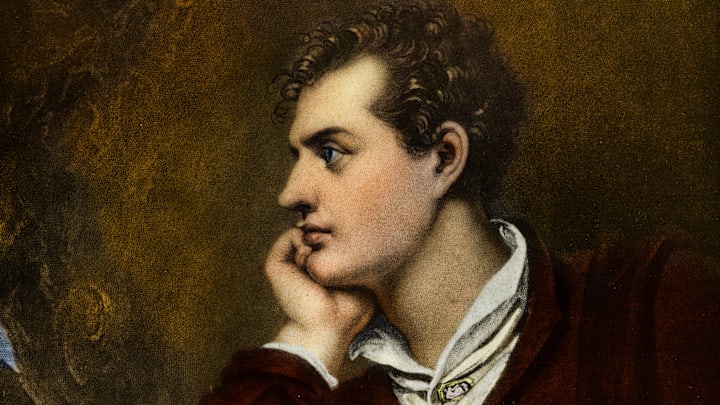
Lord Byron—or George Gordon Byron, 6th Baron Byron, to give him his full name—was one of the defining figures of the Romantic movement. Two of his most famous works are Don Juan (1819 – 1824), a satiric poem about the womanizing folk legend, and Childe Harold’s Pilgrimage (1812 – 1818), an autobiographical poem which created the brooding Byronic hero archetype (think Heathcliff from Emily Brontë’s Wuthering Heights).
But in addition to his poetry, Byron also gained notoriety because of his personality. Famously described as “mad, bad, and dangerous to know” by Lady Caroline Lamb—one of his many lovers—Byron himself was an example of a Byronic hero. He was rebellious, eccentric, lived a life of luxury, and was no stranger to scandalous sexual exploits.
But Byron lived fast and died young, succumbing to a fever on April 19, 1824—when he was just 36 years old. In honor of the 202nd anniversary of his death, here are six fascinating facts about Lord Byron.
- Byron had a pet bear at university.
- Byron had a chalice made from a skull.
- Byron inspired the first vampire novel.
- Byron coined the phrase “truth is stranger than fiction.”
- One of Byron’s daughters—Ada Lovelace—was the world’s first computer programmer.
- Byron’s memoirs were burned for being too scandalous.
Byron had a pet bear at university.

In the early 1800s, Byron studied at Trinity College, Cambridge, but there was one downside to attending the reputable school: he wasn’t allowed to bring his beloved dog, a Newfoundland called Boatswain. But while dogs were banned, there was no rule against bears (presumably because no one had ever tried to bring one onto campus), so Byron got himself a pet bear in protest.
“I have got a new friend, the finest in the world, a tame bear,” he told a friend in an 1807 letter. “When I brought him here, they asked me what to do with him, and my reply was, ‘he should sit for a fellowship.’” Trinity did not let the bear enroll as a student, but Byron was allowed to keep the furry predator—much to the displeasure of at least one of his tutors, who was, in the poet’s own words, “Doom’d to daily cares; by pugilistic pupils and by bears.”
Byron had a chalice made from a skull.

Byron’s ancestral home, Newstead Abbey, was once a priory, and so its grounds were the final resting place of numerous monks. One day, the gardener found a large and well-preserved skull, which Byron decided to turn into a drinking cup. The British poet would sometimes fill the skull chalice with wine and pass it around at parties “whilst many a grim joke was cut at its expense.” Byron was so enamored with the macabre cup that he even wrote a poem about it, “Lines Inscribed Upon a Cup Formed from a Skull,” which included lines such as “Better to hold the sparkling grape, / Than nurse the earth-worm’s slimy brood.”
Byron inspired the first vampire novel.

In the summer of 1816, Byron was hosting some of his writer friends at a rented estate near Lake Geneva. One gloomy night, he proposed that they have a scary story writing contest, out of which was born not only the first sci-fi novel, Mary Shelley’s Frankenstein (1818), but also the first vampire novel, John Polidori’s The Vampyre (1819).
Polidori was Byron’s physician, and he was inspired to write the story after reading the few paragraphs that his patient had penned for the contest, simply titled “A Fragment.” Although Byron abandoned the vampire story, Polidori took it and expanded it. Byron even apparently served as the inspiration for the titular vampire, the eccentric Lord Ruthven. When The Vampyre was then published in 1819, it was without Polidori’s knowledge or name—the book was wrongly attributed to Byron, but the mistake was eventually corrected.
Byron coined the phrase “truth is stranger than fiction.”

Author Mark Twain is sometimes credited with coining the phrase “truth is stranger than fiction,” and while it is true that the words appear in his travelogue Following the Equator (1897), he didn’t come up with the famous phrase himself. The creator was actually Lord Byron, who wrote the line in Don Juan: “‘Tis strange—but true; for truth is always strange, / Stranger than fiction.”
Byron is also credited with popularizing the Latin phrase “carpe diem,” which literally means “pluck the day” in English but is usually translated as “seize the day.” Roman poet Horace is the one who originally penned the phrase, but its popularization in English can be traced back to Byron. In an 1817 letter (later published in 1830), he wrote: “I never anticipate,—carpe diem—the past at least is one’s own, which is one reason for making sure of the present.”
One of Byron’s daughters—Ada Lovelace—was the world’s first computer programmer.

Byron’s sexual conquests occasionally resulted in children—Clara Allegra Byron was the result of his extramarital affair with Claire Clairmont, and he is also thought to have sired Elizabeth Medora Leigh
with his half-sister Augusta Leigh—but he only had one legitimate child: Ada Lovelace. Byron was an absentee father; he separated from Annabella Byron not long after Ada was born and left the childcare to his ex-wife. He then died when his daughter was just eight years old.
Rather than pursuing the arts like her father, Ada became a mathematician. She is credited with creating the first machine algorithm—essentially making her the first computer programmer. Coincidentally, she died at the same age as her father—cancer killed her at just 36 years old.
Byron’s memoirs were burned for being too scandalous.

Byron didn’t want his memoirs to be published while he was still alive, which is no surprise given that they likely detailed his scandalous sex life—which included sleeping with men (which was illegal at the time), having affairs with married women, and impregnating his half-sister. But the poet didn’t care if the world read his memoirs once he was dead, so he gave the manuscript to his friend and fellow poet Thomas Moore and said, “When I am cold—you may do what you please.”
When Byron died on April 19, 1824, Moore and a few of Byron’s other friends gathered to discuss what to do with the pages. “The whole Memoirs were fit only for a brothel, and would damn Lord Byron to everlasting infamy if published,” according to his friend John Cam Hobhouse. Most of the others agreed, and the manuscript was tossed onto the fire.
No other copy of Byron’s memoirs has ever been found and the document’s burning has been described as “the greatest crime in literary history.”