%20%20--%3E%0A%3Csvg%20version%3D%221.1%22%20id%3D%22Layer_1%22%20xmlns%3D%22http%3A%2F%2Fwww.w3.org%2F2000%2Fsvg%22%20xmlns%3Axlink%3D%22http%3A%2F%2Fwww.w3.org%2F1999%2Fxlink%22%20x%3D%220px%22%20y%3D%220px%22%0A%09%20viewBox%3D%220%200%20684.6%2068.1%22%20style%3D%22enable-background%3Anew%200%200%20684.6%2068.1%3B%22%20xml%3Aspace%3D%22preserve%22%3E%0A%3Cg%3E%0A%09%3Cpath%20d%3D%22M444.1%2C29.3h-17.4v14.5h17.4V29.3z%20M36.4%2C68.1l29.3-50.8V0H50.4L32.9%2C36.8L15.5%2C0H0v68.1h16.7V45.8l12.4%2C22.3H36.4z%0A%09%09%20M49.1%2C68.1h16.6V23.4L49.1%2C52.1V68.1z%20M76.6%2C68.1h45V53.8H93.3V41.6h21V27.1h-21V14.8h28.3V0.1h-45V68.1z%20M175.6%2C68.1h17.3v-68%0A%09%09h-16.5v40.3L150%2C0.1h-17.6v68h16.7V27.7L175.6%2C68.1z%20M235.8%2C14.8h15.4V0.1h-47.4v14.7H219v53.2h16.8V14.8z%20M290.3%2C45.9h-17.1%0A%09%09l7.5-15.6h2L290.3%2C45.9z%20M298.7%2C68.1h18l-32.2-68h-5.7l-32%2C68h18l3.3-7.1h27.1L298.7%2C68.1z%20M325.2%2C68.1h46.2V53.8h-29.6V0.1h-16.7%0A%09%09V68.1z%20M423.7%2C14.8h27.2V0.1H407v68h16.7V14.8z%20M462%2C68.1h46.2V53.8h-29.6V0.1H462V68.1z%20M564.8%2C34.1c0%2C10.7-7.2%2C19.2-18.5%2C19.2%0A%09%09c-11.4%2C0-18.5-8.5-18.5-19.2s7.1-19.2%2C18.5-19.2C557.6%2C14.9%2C564.8%2C23.4%2C564.8%2C34.1%20M580.6%2C34.1c0-19-14.2-34-34.3-34%0A%09%09c-20.2%2C0-34.3%2C15-34.3%2C34c0%2C19%2C14.1%2C34%2C34.3%2C34C566.4%2C68.1%2C580.6%2C53.1%2C580.6%2C34.1%20M604.8%2C20.5c0-4.1%2C3.3-6.2%2C6.7-6.2%0A%09%09c4.4%2C0%2C6.6%2C3%2C6.6%2C6.6h14.7C631.8%2C9.1%2C625.1%2C0.1%2C611%2C0.1c-12%2C0-21.7%2C9.3-21.7%2C20.6c0%2C10.9%2C5.9%2C15.9%2C16.7%2C19.8%0A%09%09c5.2%2C1.8%2C11.5%2C3.2%2C11.5%2C8c0%2C3.3-2.4%2C5.5-6.4%2C5.5c-3.6%2C0-6.6-3-6.6-6.7h-15.2c0%2C11.5%2C7.9%2C20.8%2C21.8%2C20.8c12%2C0%2C21.6-9.3%2C21.6-20.6%0A%09%09c0-10-5.3-16.4-16.7-19.8C610.6%2C26.1%2C604.8%2C25.3%2C604.8%2C20.5%20M670%2C20.9h14.7C683.8%2C9.1%2C677.1%2C0.1%2C663%2C0.1c-12%2C0-21.7%2C9.3-21.7%2C20.6%0A%09%09c0%2C10.9%2C5.9%2C15.9%2C16.7%2C19.8c5.2%2C1.8%2C11.5%2C3.2%2C11.5%2C8c0%2C3.3-2.4%2C5.5-6.4%2C5.5c-3.6%2C0-6.6-3-6.6-6.7h-15.2c0%2C11.5%2C7.9%2C20.8%2C21.8%2C20.8%0A%09%09c12%2C0%2C21.6-9.3%2C21.6-20.6c0-10-5.3-16.4-16.7-19.8c-5.4-1.6-11.3-2.4-11.3-7.2c0-4.1%2C3.3-6.2%2C6.7-6.2C667.7%2C14.4%2C670%2C17.3%2C670%2C20.9%0A%09%09%22%2F%3E%0A%3C%2Fg%3E%0A%3C%2Fsvg%3E%0A)

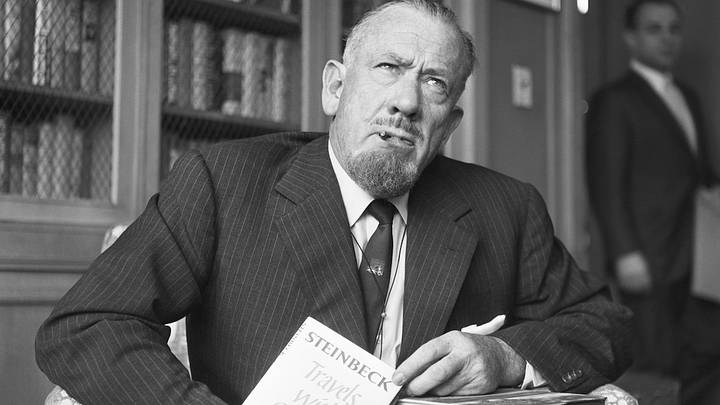
Of everything John Steinbeck published, the one he liked best was East of Eden, and the Library of Congress puts the matter about as plainly as it can be put: "Of the many novels that John Steinbeck wrote, East of Eden was his favorite and the one of which he was proudest." What makes the claim unusually easy to check is that he left a running account of his own opinion while the book was still in longhand.
A Notebook of Daily Letters
In January 1951, Steinbeck's editor at Viking Press, Pascal Covici—"Pat" to him for sixteen years by then—gave him a large notebook to write the novel in. Steinbeck used the right-hand pages for the manuscript and the left-hand pages for a daily letter to Covici, written in pencil, never mailed, and never meant for publication. He kept it up every working day from January 29 to November 1, 1951, and after his death the letters were published as Journal of a Novel: The East of Eden Letters.
The first entry is not a warm-up. "We come now to the book," he writes. "It has been planned a long time. I planned it when I didn't know what it was about."
That same morning he set the bar where nobody could miss it. "This book will be the most difficult of all I have ever attempted," he told Covici, and then, a few paragraphs on: "I think perhaps it is the only book I have ever written. I think there is only one book to a man." He was 48 years old and had already published Of Mice and Men, Cannery Row, and The Grapes of Wrath, which had won him a Pulitzer Prize eleven years earlier.

A Story for His Sons
The most personal half of the headline is not a matter of tone or interpretation, either, because Steinbeck wrote it into the plan out loud: "In a sense it will be two books—the story of my county and the story of me." The county is the Salinas Valley he grew up in. The Hamilton family that fills half the novel is his own mother's family: Samuel Hamilton was his maternal grandfather, and the Olive Hamilton who leaves home at fifteen to go to school in Salinas and becomes a country schoolteacher was his mother.
Steinbeck also put himself into the book as a boy, an "I" who turns up in the Salinas Valley chapters remembering things, which means the novel's narrator is not a device so much as an address.
The address had two specific recipients. "I am choosing to write this book to my sons," he wrote in that same first entry. "They are little boys now, and they will never know what they came from through me, unless I tell them. It is not written for them to read now but when they are grown, and the pains and joys have tousled them a little." Thom and John were six and four.

In the Box and Beyond
When the manuscript was finished, Steinbeck carved a wooden box for it by hand, put all 250,000 words inside, and gave the whole thing to Covici; a photograph of the box is the frontispiece of Journal of a Novel. The note he set on top became the dedication printed at the front of the novel, in which he recalls Covici asking for a box to hold "whatever you have," and getting exactly that. "And still the box is not full," it ends.
Viking published East of Eden in September 1952, and readers made it a bestseller. The reviewers were another story: the biblical scaffolding that Steinbeck had spent ten months building struck many of them as heavy-handed, and the Library of Congress's own summary of the reception records that "critics said the biblical references were unsophisticated and clumsy." He had written to Covici in advance that the concepts would be hard and the philosophy "old and yet new born," which is not a description of a book expecting an easy ride.
Steinbeck never revised the verdict he had recorded in pencil on the left-hand pages. Ten years after publication, he won the Nobel Prize in Literature, and the book he had called the only one he ever wrote has outsold most of what the reviewers preferred.