%20%20--%3E%0A%3Csvg%20version%3D%221.1%22%20id%3D%22Layer_1%22%20xmlns%3D%22http%3A%2F%2Fwww.w3.org%2F2000%2Fsvg%22%20xmlns%3Axlink%3D%22http%3A%2F%2Fwww.w3.org%2F1999%2Fxlink%22%20x%3D%220px%22%20y%3D%220px%22%0A%09%20viewBox%3D%220%200%20684.6%2068.1%22%20style%3D%22enable-background%3Anew%200%200%20684.6%2068.1%3B%22%20xml%3Aspace%3D%22preserve%22%3E%0A%3Cg%3E%0A%09%3Cpath%20d%3D%22M444.1%2C29.3h-17.4v14.5h17.4V29.3z%20M36.4%2C68.1l29.3-50.8V0H50.4L32.9%2C36.8L15.5%2C0H0v68.1h16.7V45.8l12.4%2C22.3H36.4z%0A%09%09%20M49.1%2C68.1h16.6V23.4L49.1%2C52.1V68.1z%20M76.6%2C68.1h45V53.8H93.3V41.6h21V27.1h-21V14.8h28.3V0.1h-45V68.1z%20M175.6%2C68.1h17.3v-68%0A%09%09h-16.5v40.3L150%2C0.1h-17.6v68h16.7V27.7L175.6%2C68.1z%20M235.8%2C14.8h15.4V0.1h-47.4v14.7H219v53.2h16.8V14.8z%20M290.3%2C45.9h-17.1%0A%09%09l7.5-15.6h2L290.3%2C45.9z%20M298.7%2C68.1h18l-32.2-68h-5.7l-32%2C68h18l3.3-7.1h27.1L298.7%2C68.1z%20M325.2%2C68.1h46.2V53.8h-29.6V0.1h-16.7%0A%09%09V68.1z%20M423.7%2C14.8h27.2V0.1H407v68h16.7V14.8z%20M462%2C68.1h46.2V53.8h-29.6V0.1H462V68.1z%20M564.8%2C34.1c0%2C10.7-7.2%2C19.2-18.5%2C19.2%0A%09%09c-11.4%2C0-18.5-8.5-18.5-19.2s7.1-19.2%2C18.5-19.2C557.6%2C14.9%2C564.8%2C23.4%2C564.8%2C34.1%20M580.6%2C34.1c0-19-14.2-34-34.3-34%0A%09%09c-20.2%2C0-34.3%2C15-34.3%2C34c0%2C19%2C14.1%2C34%2C34.3%2C34C566.4%2C68.1%2C580.6%2C53.1%2C580.6%2C34.1%20M604.8%2C20.5c0-4.1%2C3.3-6.2%2C6.7-6.2%0A%09%09c4.4%2C0%2C6.6%2C3%2C6.6%2C6.6h14.7C631.8%2C9.1%2C625.1%2C0.1%2C611%2C0.1c-12%2C0-21.7%2C9.3-21.7%2C20.6c0%2C10.9%2C5.9%2C15.9%2C16.7%2C19.8%0A%09%09c5.2%2C1.8%2C11.5%2C3.2%2C11.5%2C8c0%2C3.3-2.4%2C5.5-6.4%2C5.5c-3.6%2C0-6.6-3-6.6-6.7h-15.2c0%2C11.5%2C7.9%2C20.8%2C21.8%2C20.8c12%2C0%2C21.6-9.3%2C21.6-20.6%0A%09%09c0-10-5.3-16.4-16.7-19.8C610.6%2C26.1%2C604.8%2C25.3%2C604.8%2C20.5%20M670%2C20.9h14.7C683.8%2C9.1%2C677.1%2C0.1%2C663%2C0.1c-12%2C0-21.7%2C9.3-21.7%2C20.6%0A%09%09c0%2C10.9%2C5.9%2C15.9%2C16.7%2C19.8c5.2%2C1.8%2C11.5%2C3.2%2C11.5%2C8c0%2C3.3-2.4%2C5.5-6.4%2C5.5c-3.6%2C0-6.6-3-6.6-6.7h-15.2c0%2C11.5%2C7.9%2C20.8%2C21.8%2C20.8%0A%09%09c12%2C0%2C21.6-9.3%2C21.6-20.6c0-10-5.3-16.4-16.7-19.8c-5.4-1.6-11.3-2.4-11.3-7.2c0-4.1%2C3.3-6.2%2C6.7-6.2C667.7%2C14.4%2C670%2C17.3%2C670%2C20.9%0A%09%09%22%2F%3E%0A%3C%2Fg%3E%0A%3C%2Fsvg%3E%0A)

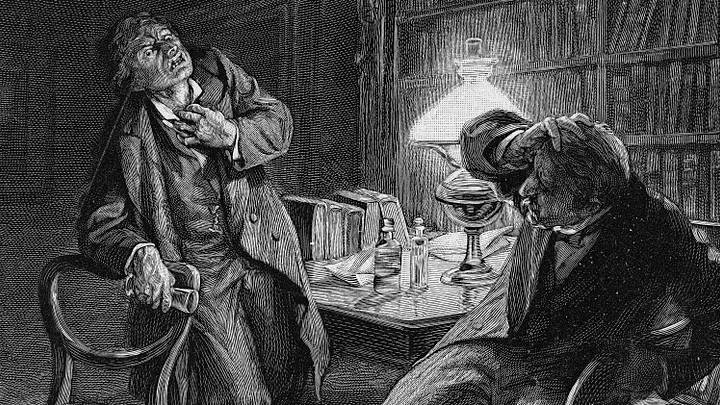
In the autumn of 1885, Robert Louis Stevenson was living in Bournemouth, England, in a house he called Skerryvore, sick, broke, and often confined to bed. One night he cried out in his sleep, and his wife, Fanny, woke him up.
He wasn’t grateful.
“I was dreaming a fine bogey tale,” he told her, and by daybreak he was writing it down. Three days later he had a first draft of what would become Strange Case of Dr. Jekyll and Mr. Hyde, and soon after that the draft was gone, burned in the fireplace. Mental Floss has noted that there’s more than one version of how that happened: the two eyewitnesses who wrote about it left three, because one of them told it two ways.
Fanny’s Letter

The account that made headlines came out in October 2000, when a letter Fanny had written to Stevenson’s friend, the poet W.E. Henley, surfaced ahead of an auction at Phillips in London. As The Guardian reported, Fanny dismissed the draft as “a quire full of utter nonsense,” and wrote: “He said it was his greatest work. I shall burn it after I show it to you.”
Phillips expected the letter to sell for around £1,500, and the head of the auction house’s book department, Liz Merry, offered a theory about Fanny’s motive: she may have found “Dr Jekyll and the duality of man rather distasteful,” and Merry added that Fanny seemed uneasy that he was writing for a “shilling shocker” market. That was Merry’s guess, not Fanny’s words, and Fanny had reasons beyond taste to worry. In an earlier letter quoted by The Guardian, she complained that her husband was “possessed of a story” and that she feared “it will only be energy wasted – as all his late work has been.” The couple were deep in debt.
Fanny’s Preface

Long before that letter turned up, in a preface written for a 1905 edition of Stevenson’s works, Fanny had told the story without casting herself as the arsonist. In her version, the first draft, “containing thirty thousand words,” was finished in three days, “only to be entirely destroyed and immediately re-written from another point of view.” She didn’t say who destroyed it, only what had been wrong with it: it had missed the allegory, “probably from haste, and the compelling influence of the dream.”
Lloyd’s Fire

Fanny’s son from her first marriage, Lloyd Osbourne, was in the house at Skerryvore that autumn, and in 1924 he published the most dramatic account of all. He remembered Stevenson reading the draft aloud to him and his mother, and his mother criticizing it: Stevenson had “missed the allegory” and made it “merely a story.” Stevenson was furious, and Lloyd left the room rather than listen to them argue. When he returned, Stevenson came downstairs and conceded the point. “I have absolutely missed the allegory, which, after all, is the whole point of it,” he said, and then he threw the manuscript into the fire himself while Fanny made an “ineffectual start to prevent him.”
“It was all wrong,” Stevenson explained when they protested. “…The only way was to put temptation beyond my reach.” According to Lloyd, he wrote the new version in another three days.
Gone Either Way

The three accounts don’t agree on who struck the match, and they don’t even agree on the numbers: Fanny put the total at sixty thousand words in six days, Lloyd at sixty-four thousand. Every version ends with the first draft gone. The second one was a smash.
Strange Case of Dr. Jekyll and Mr. Hyde came out in 1886, and Fanny later wrote that it was pirated across America and that clergymen used it as a text for their sermons. Whatever was in the version that burned, the only people who ever described it were the ones arguing about the fire.