%20%20--%3E%0A%3Csvg%20version%3D%221.1%22%20id%3D%22Layer_1%22%20xmlns%3D%22http%3A%2F%2Fwww.w3.org%2F2000%2Fsvg%22%20xmlns%3Axlink%3D%22http%3A%2F%2Fwww.w3.org%2F1999%2Fxlink%22%20x%3D%220px%22%20y%3D%220px%22%0A%09%20viewBox%3D%220%200%20684.6%2068.1%22%20style%3D%22enable-background%3Anew%200%200%20684.6%2068.1%3B%22%20xml%3Aspace%3D%22preserve%22%3E%0A%3Cg%3E%0A%09%3Cpath%20d%3D%22M444.1%2C29.3h-17.4v14.5h17.4V29.3z%20M36.4%2C68.1l29.3-50.8V0H50.4L32.9%2C36.8L15.5%2C0H0v68.1h16.7V45.8l12.4%2C22.3H36.4z%0A%09%09%20M49.1%2C68.1h16.6V23.4L49.1%2C52.1V68.1z%20M76.6%2C68.1h45V53.8H93.3V41.6h21V27.1h-21V14.8h28.3V0.1h-45V68.1z%20M175.6%2C68.1h17.3v-68%0A%09%09h-16.5v40.3L150%2C0.1h-17.6v68h16.7V27.7L175.6%2C68.1z%20M235.8%2C14.8h15.4V0.1h-47.4v14.7H219v53.2h16.8V14.8z%20M290.3%2C45.9h-17.1%0A%09%09l7.5-15.6h2L290.3%2C45.9z%20M298.7%2C68.1h18l-32.2-68h-5.7l-32%2C68h18l3.3-7.1h27.1L298.7%2C68.1z%20M325.2%2C68.1h46.2V53.8h-29.6V0.1h-16.7%0A%09%09V68.1z%20M423.7%2C14.8h27.2V0.1H407v68h16.7V14.8z%20M462%2C68.1h46.2V53.8h-29.6V0.1H462V68.1z%20M564.8%2C34.1c0%2C10.7-7.2%2C19.2-18.5%2C19.2%0A%09%09c-11.4%2C0-18.5-8.5-18.5-19.2s7.1-19.2%2C18.5-19.2C557.6%2C14.9%2C564.8%2C23.4%2C564.8%2C34.1%20M580.6%2C34.1c0-19-14.2-34-34.3-34%0A%09%09c-20.2%2C0-34.3%2C15-34.3%2C34c0%2C19%2C14.1%2C34%2C34.3%2C34C566.4%2C68.1%2C580.6%2C53.1%2C580.6%2C34.1%20M604.8%2C20.5c0-4.1%2C3.3-6.2%2C6.7-6.2%0A%09%09c4.4%2C0%2C6.6%2C3%2C6.6%2C6.6h14.7C631.8%2C9.1%2C625.1%2C0.1%2C611%2C0.1c-12%2C0-21.7%2C9.3-21.7%2C20.6c0%2C10.9%2C5.9%2C15.9%2C16.7%2C19.8%0A%09%09c5.2%2C1.8%2C11.5%2C3.2%2C11.5%2C8c0%2C3.3-2.4%2C5.5-6.4%2C5.5c-3.6%2C0-6.6-3-6.6-6.7h-15.2c0%2C11.5%2C7.9%2C20.8%2C21.8%2C20.8c12%2C0%2C21.6-9.3%2C21.6-20.6%0A%09%09c0-10-5.3-16.4-16.7-19.8C610.6%2C26.1%2C604.8%2C25.3%2C604.8%2C20.5%20M670%2C20.9h14.7C683.8%2C9.1%2C677.1%2C0.1%2C663%2C0.1c-12%2C0-21.7%2C9.3-21.7%2C20.6%0A%09%09c0%2C10.9%2C5.9%2C15.9%2C16.7%2C19.8c5.2%2C1.8%2C11.5%2C3.2%2C11.5%2C8c0%2C3.3-2.4%2C5.5-6.4%2C5.5c-3.6%2C0-6.6-3-6.6-6.7h-15.2c0%2C11.5%2C7.9%2C20.8%2C21.8%2C20.8%0A%09%09c12%2C0%2C21.6-9.3%2C21.6-20.6c0-10-5.3-16.4-16.7-19.8c-5.4-1.6-11.3-2.4-11.3-7.2c0-4.1%2C3.3-6.2%2C6.7-6.2C667.7%2C14.4%2C670%2C17.3%2C670%2C20.9%0A%09%09%22%2F%3E%0A%3C%2Fg%3E%0A%3C%2Fsvg%3E%0A)

We've all heard nursery rhymes as children, but some are less innocent than they first appear. Quite a few nursery rhymes are actually linked to some pretty dark historical events. "Three Blind Mice" is one such example.
"Three Blind Mice" is one of the nursery rhymes that has a darker theme, even without knowledge of history. A farmer's wife uses a carving knife to cut off the tails of the blind mice. Not exactly the most wholesome message to begin with, but the allegory related to this tale is even worse. "Three Blind Mice" is connected to the infamous reign of "Bloody Mary."

The Oxford Martyrs and Mary I
Mary I of England, daughter of King Henry VIII and his first wife, Catherine of Aragon, was given the nickname Bloody Mary after she killed a number of her people due to religious differences. Mary was a staunch Catholic and hated the Protestant Church, especially since her father had created Protestantism in England in order to divorce Mary's mother.
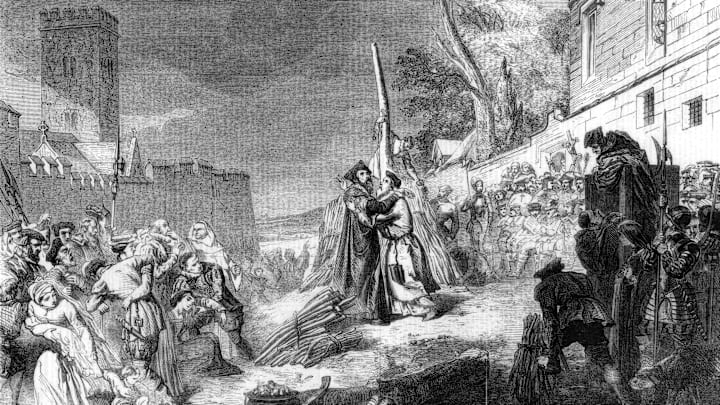
Three Protestant ministers were arrested under the guise of plotting against Mary and were burned at the stake for heresy and treason. The three men, nicknamed the Oxford Martyrs after the place of their trials and deaths, were Hugh Latimer, Nicholas Ridley, and Thomas Cranmer, the Archbishop of Canterbury. According to a popular theory, these three martyrs are the three blind mice, while Mary I is the farmer's wife chopping off their tails.

Skepticism About This Meaning
"Three Blind Mice" has been interpreted as an allegory of Mary Tudor's execution of three prominent ministers of the Church of England for more than a century. Some have even said that the Oxford Martyrs were blinded as part of the torture they endured while imprisoned. There is no evidence of physical blindness, but other theories say that the Protestants were metaphorically blinded to the danger Mary posed to them.
With a cursory glance at history and "Three Blind Mice," the story of the Oxford Martyrs seems to fit. But looking deeper, some details just don't make sense. The first written version of "Three Blind Mice" is from Thomas Ravenscroft's Deuteromelia in 1609. This was a little over fifty years after Mary had Latimer, Ridley, and Cranmer executed. Plus, Ravenscroft's lyrics do not mention the mice being harmed at all.

Original Lyrics
The "Three Blind Mice" from Deuteromelia is very different from the version we know today. The original lyrics are as follows:
Three Blinde Mice, three Blinde Mice,
Dame Iulian, Dame Iulian,
The Miller and his merry olde Wife,
she scrapte her tripe; licke thou the knife.
Aside from some unsanitary cooking practices, which let it be noted that we do not advise licking the knife after you've scraped tripe clean, there isn't any hint of violence in the original rhyme. You could try to argue that the miller's wife was scraping the mice's entrails clean, but that also wouldn't make sense, because mice are too small to clean and cook their intestinal lining.

Who is Dame Julian?
Another reason why the story of Queen Mary and the Oxford Martyrs doesn't actually fit with "Three Blind Mice" is because of the reference to Dame Iulian (Julian) in the original version. There is no such person who would reliably match the same time period as "Bloody Mary." Many believe that the Dame Julian referred to in "Three Blind Mice" is Julian of Norwich, who lived two centuries before Mary I's reign.
Julian of Norwich was a nun who lived in seclusion, also known as an anchoress, who wrote a book about her visions of Jesus Christ, titled Revelations of Divine Love. However, her writings wouldn't even be known until 1670, much later than Queen Mary or even Thomas Ravencroft's "Three Blind Mice." It's much more likely that Ravenscroft was referring to Dame Juliana Berners, a writer of hunting and falconry texts that grew in popularity just before 1609.

What Does "Three Blind Mice" Actually Mean?
With the hint at cleaning tripe, a necessary part of preparing meat that you've hunted, Juliana Berners makes more sense as the Dame Julian of the original "Three Blind Mice." But, even if Berners is the right historical figure, there are still so many holes in the search for meaning behind the nursery rhyme.
In the end, it seems like the origins of "Three Blind Mice," like many other old writings, are a bunch of educated guesswork. We may never truly know the meaning behind the lyrics. And the folk history of it being symbolic of the martyrdom of three Protestants will continue to be linked to "Three Blind Mice." Maybe one of the more modern versions was written with Queen Mary and the Protestants in mind. Then, the origins of the nursery rhyme could be retroactively accurate, and we could put this mystery to bed.