%20%20--%3E%0A%3Csvg%20version%3D%221.1%22%20id%3D%22Layer_1%22%20xmlns%3D%22http%3A%2F%2Fwww.w3.org%2F2000%2Fsvg%22%20xmlns%3Axlink%3D%22http%3A%2F%2Fwww.w3.org%2F1999%2Fxlink%22%20x%3D%220px%22%20y%3D%220px%22%0A%09%20viewBox%3D%220%200%20684.6%2068.1%22%20style%3D%22enable-background%3Anew%200%200%20684.6%2068.1%3B%22%20xml%3Aspace%3D%22preserve%22%3E%0A%3Cg%3E%0A%09%3Cpath%20d%3D%22M444.1%2C29.3h-17.4v14.5h17.4V29.3z%20M36.4%2C68.1l29.3-50.8V0H50.4L32.9%2C36.8L15.5%2C0H0v68.1h16.7V45.8l12.4%2C22.3H36.4z%0A%09%09%20M49.1%2C68.1h16.6V23.4L49.1%2C52.1V68.1z%20M76.6%2C68.1h45V53.8H93.3V41.6h21V27.1h-21V14.8h28.3V0.1h-45V68.1z%20M175.6%2C68.1h17.3v-68%0A%09%09h-16.5v40.3L150%2C0.1h-17.6v68h16.7V27.7L175.6%2C68.1z%20M235.8%2C14.8h15.4V0.1h-47.4v14.7H219v53.2h16.8V14.8z%20M290.3%2C45.9h-17.1%0A%09%09l7.5-15.6h2L290.3%2C45.9z%20M298.7%2C68.1h18l-32.2-68h-5.7l-32%2C68h18l3.3-7.1h27.1L298.7%2C68.1z%20M325.2%2C68.1h46.2V53.8h-29.6V0.1h-16.7%0A%09%09V68.1z%20M423.7%2C14.8h27.2V0.1H407v68h16.7V14.8z%20M462%2C68.1h46.2V53.8h-29.6V0.1H462V68.1z%20M564.8%2C34.1c0%2C10.7-7.2%2C19.2-18.5%2C19.2%0A%09%09c-11.4%2C0-18.5-8.5-18.5-19.2s7.1-19.2%2C18.5-19.2C557.6%2C14.9%2C564.8%2C23.4%2C564.8%2C34.1%20M580.6%2C34.1c0-19-14.2-34-34.3-34%0A%09%09c-20.2%2C0-34.3%2C15-34.3%2C34c0%2C19%2C14.1%2C34%2C34.3%2C34C566.4%2C68.1%2C580.6%2C53.1%2C580.6%2C34.1%20M604.8%2C20.5c0-4.1%2C3.3-6.2%2C6.7-6.2%0A%09%09c4.4%2C0%2C6.6%2C3%2C6.6%2C6.6h14.7C631.8%2C9.1%2C625.1%2C0.1%2C611%2C0.1c-12%2C0-21.7%2C9.3-21.7%2C20.6c0%2C10.9%2C5.9%2C15.9%2C16.7%2C19.8%0A%09%09c5.2%2C1.8%2C11.5%2C3.2%2C11.5%2C8c0%2C3.3-2.4%2C5.5-6.4%2C5.5c-3.6%2C0-6.6-3-6.6-6.7h-15.2c0%2C11.5%2C7.9%2C20.8%2C21.8%2C20.8c12%2C0%2C21.6-9.3%2C21.6-20.6%0A%09%09c0-10-5.3-16.4-16.7-19.8C610.6%2C26.1%2C604.8%2C25.3%2C604.8%2C20.5%20M670%2C20.9h14.7C683.8%2C9.1%2C677.1%2C0.1%2C663%2C0.1c-12%2C0-21.7%2C9.3-21.7%2C20.6%0A%09%09c0%2C10.9%2C5.9%2C15.9%2C16.7%2C19.8c5.2%2C1.8%2C11.5%2C3.2%2C11.5%2C8c0%2C3.3-2.4%2C5.5-6.4%2C5.5c-3.6%2C0-6.6-3-6.6-6.7h-15.2c0%2C11.5%2C7.9%2C20.8%2C21.8%2C20.8%0A%09%09c12%2C0%2C21.6-9.3%2C21.6-20.6c0-10-5.3-16.4-16.7-19.8c-5.4-1.6-11.3-2.4-11.3-7.2c0-4.1%2C3.3-6.2%2C6.7-6.2C667.7%2C14.4%2C670%2C17.3%2C670%2C20.9%0A%09%09%22%2F%3E%0A%3C%2Fg%3E%0A%3C%2Fsvg%3E%0A)

The United States stock market crashed in 1929, and the Roaring ‘20s came tumbling down.
Banks closed, incomes fell, and citizens across the country lost their jobs and homes. The Dust Bowl destroyed farmland as crop prices dropped, driving many farms into foreclosure. Families saw their life savings disappear and had to become resourceful, making do with very little.
According to Encyclopedia Britannica, Americans had plunged into "the worst depression ever experienced by a world economy," not knowing that their survival would one day be stamped in the history books.
While the crash affected the entire United States, some states saw higher unemployment rates and income drops than others. Many relied on basic resources, government relief programs, and community support just to make it to the next day.
Here's why the Great Depression occurred and where America was hit hardest.
WHAT CAUSED THE GREAT DEPRESSION?

Several factors fueled the economic collapse of the late 1920s and early 1930s.
According to History, mass consumption after World War I left businesses "vulnerable to sudden shifts in consumer confidence." Countries that once worked together to run the international financial system before the war were now at odds.
Questionable get-rich-quick schemes multiplied throughout the Roaring ‘20s. American investors bought stocks "on margin," borrowing up to 90% of the price from banks. When the market crashed in October 1929, investors raced to withdraw their money and sell their stocks, causing a ripple effect, according to American University economics professor Mary Eschelbach Hansen.
"It had a wealth effect on consumption (when people’s wealth falls, they consume less), and it also made consumers and firms pessimistic. Then came a series of banking panics and failures. Households lost more of their wealth, and the lines of credit that firms used were disrupted. Unemployment soared."
Created in 1913 to promote economic stability, the Federal Reserve System actually helped accelerate the Great Depression. Interest rates declined, citizens over invested, and the money supply (which grew 67% from 1921 to 1929) was contracted in an attempt to temper the stock market, until it slowed too drastically.
Another factor in the Great Depression was the Gold Standard. When the stock market crashed, investors began trading their dollars for gold. The Fed responded to the dollar’s declining value by raising interest rates, which caused businesses to close and impacted the livelihoods of ordinary families across the nation.
As if this weren’t enough to topple the economy, President Hoover signed the Smoot-Hawley Act in 1930, raising U.S. tariffs. Other countries retaliated by slapping tariffs on U.S. exports, lowering demand for American products abroad.
The U.S. economy did not return to normalcy until around 1940, amid the onset of another World War. Increased government spending, job creation, and President Franklin Delano Roosevelt signing the New Deal helped support recovery after the Great Depression.
WHERE THE GREAT DEPRESSION HIT AMERICA THE HARDEST

Not all states experienced the Great Depression in the same way.
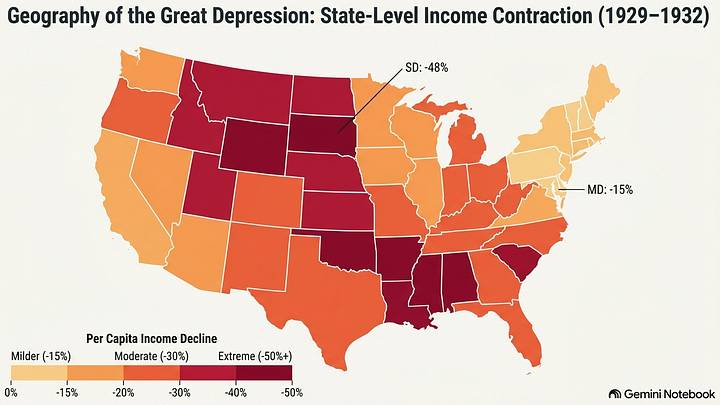
According to the National Bureau of Economic Research, income declined more in some regions than others; South Dakota experienced the greatest loss of work, while Maryland experienced the least.
The states hit hardest by the Great Depression were those in the Dust Bowl: Kansas, Oklahoma, Texas, New Mexico, Colorado, and Nebraska. These states simultaneously faced both a collapsing economy and a drought. As a result, by the end of the Great Depression, 200,000 Americans had left the Great Plains for California.
States in the South Atlantic, like Maryland, were less affected than the Plains because they had more industries. Political hubs and self-sufficient rural communities were also better equipped to navigate the crisis than other regions.