%20%20--%3E%0A%3Csvg%20version%3D%221.1%22%20id%3D%22Layer_1%22%20xmlns%3D%22http%3A%2F%2Fwww.w3.org%2F2000%2Fsvg%22%20xmlns%3Axlink%3D%22http%3A%2F%2Fwww.w3.org%2F1999%2Fxlink%22%20x%3D%220px%22%20y%3D%220px%22%0A%09%20viewBox%3D%220%200%20684.6%2068.1%22%20style%3D%22enable-background%3Anew%200%200%20684.6%2068.1%3B%22%20xml%3Aspace%3D%22preserve%22%3E%0A%3Cg%3E%0A%09%3Cpath%20d%3D%22M444.1%2C29.3h-17.4v14.5h17.4V29.3z%20M36.4%2C68.1l29.3-50.8V0H50.4L32.9%2C36.8L15.5%2C0H0v68.1h16.7V45.8l12.4%2C22.3H36.4z%0A%09%09%20M49.1%2C68.1h16.6V23.4L49.1%2C52.1V68.1z%20M76.6%2C68.1h45V53.8H93.3V41.6h21V27.1h-21V14.8h28.3V0.1h-45V68.1z%20M175.6%2C68.1h17.3v-68%0A%09%09h-16.5v40.3L150%2C0.1h-17.6v68h16.7V27.7L175.6%2C68.1z%20M235.8%2C14.8h15.4V0.1h-47.4v14.7H219v53.2h16.8V14.8z%20M290.3%2C45.9h-17.1%0A%09%09l7.5-15.6h2L290.3%2C45.9z%20M298.7%2C68.1h18l-32.2-68h-5.7l-32%2C68h18l3.3-7.1h27.1L298.7%2C68.1z%20M325.2%2C68.1h46.2V53.8h-29.6V0.1h-16.7%0A%09%09V68.1z%20M423.7%2C14.8h27.2V0.1H407v68h16.7V14.8z%20M462%2C68.1h46.2V53.8h-29.6V0.1H462V68.1z%20M564.8%2C34.1c0%2C10.7-7.2%2C19.2-18.5%2C19.2%0A%09%09c-11.4%2C0-18.5-8.5-18.5-19.2s7.1-19.2%2C18.5-19.2C557.6%2C14.9%2C564.8%2C23.4%2C564.8%2C34.1%20M580.6%2C34.1c0-19-14.2-34-34.3-34%0A%09%09c-20.2%2C0-34.3%2C15-34.3%2C34c0%2C19%2C14.1%2C34%2C34.3%2C34C566.4%2C68.1%2C580.6%2C53.1%2C580.6%2C34.1%20M604.8%2C20.5c0-4.1%2C3.3-6.2%2C6.7-6.2%0A%09%09c4.4%2C0%2C6.6%2C3%2C6.6%2C6.6h14.7C631.8%2C9.1%2C625.1%2C0.1%2C611%2C0.1c-12%2C0-21.7%2C9.3-21.7%2C20.6c0%2C10.9%2C5.9%2C15.9%2C16.7%2C19.8%0A%09%09c5.2%2C1.8%2C11.5%2C3.2%2C11.5%2C8c0%2C3.3-2.4%2C5.5-6.4%2C5.5c-3.6%2C0-6.6-3-6.6-6.7h-15.2c0%2C11.5%2C7.9%2C20.8%2C21.8%2C20.8c12%2C0%2C21.6-9.3%2C21.6-20.6%0A%09%09c0-10-5.3-16.4-16.7-19.8C610.6%2C26.1%2C604.8%2C25.3%2C604.8%2C20.5%20M670%2C20.9h14.7C683.8%2C9.1%2C677.1%2C0.1%2C663%2C0.1c-12%2C0-21.7%2C9.3-21.7%2C20.6%0A%09%09c0%2C10.9%2C5.9%2C15.9%2C16.7%2C19.8c5.2%2C1.8%2C11.5%2C3.2%2C11.5%2C8c0%2C3.3-2.4%2C5.5-6.4%2C5.5c-3.6%2C0-6.6-3-6.6-6.7h-15.2c0%2C11.5%2C7.9%2C20.8%2C21.8%2C20.8%0A%09%09c12%2C0%2C21.6-9.3%2C21.6-20.6c0-10-5.3-16.4-16.7-19.8c-5.4-1.6-11.3-2.4-11.3-7.2c0-4.1%2C3.3-6.2%2C6.7-6.2C667.7%2C14.4%2C670%2C17.3%2C670%2C20.9%0A%09%09%22%2F%3E%0A%3C%2Fg%3E%0A%3C%2Fsvg%3E%0A)

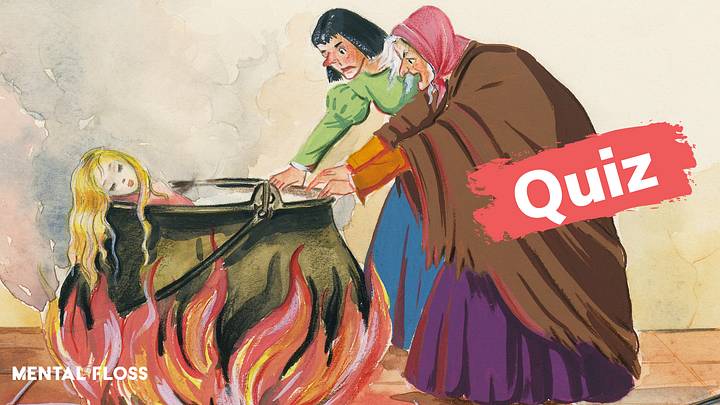
While many people's first exposure to fairy tales these days comes from Disney, most know that the stories have been sanitized for younger audiences. Grimm fairy tales, in particular, are known for their darker twists, such as Rapunzel's prince blinding himself and Cinderella's stepsisters cutting off parts of their own feet.
How well do you know these Grimm fairy tales? Test your knowledge by determining whether these summaries are real or made up:
Many people still don't know more than a handful of the hundreds of stories recorded by the Brothers Grimm. Some of this is for good reason, as several of the stories are openly racist or antisemitic, and were used by the Nazis to justify their actions. Many other stories simply didn't capture the imagination as well as their more famous counterparts.
With this in mind, you might be shocked by some of the stories that actually exist within the full body of the Grimm fairy tale collection.
Take More Quizzes:
10 Real Grimm Fairy Tales You’ve Never Heard Of
1. The Devil with the Three Golden Hairs
Included in Volume 1 of Kinder- und Hausmärchen (Children's and Household Tales), "The Devil with Three Golden Hairs" tells the story of a boy prophesied to marry the King's daughter. The King tries repeatedly to have the boy killed before finally telling him he must go down to Hell and retrieve three of the Devil's hairs. Along the way, the boy learns about three problems plaguing the people he meets.
When he reaches Hell, the Devil's grandmother takes pity on the boy and turns him into an ant while she speaks to her grandson. She gathers three of his hairs and gets answers to what is causing the people's troubles. When the Devil leaves, the boy returns home, solving the problems along his path. After returning home, the boy sends the King off to be the new ferryman to Hell and lives happily with his princess.
2. The Wedding of Mrs. Fox
There are two versions of "The Wedding of Mrs. Fox," but both follow broadly the same plot. Mr. Fox believes that his wife is unfaithful to him and decides that the only way to test her is by pretending to die. Mrs. Fox is devastated by the loss but eventually decides she must remarry, or she won't be able to take care of herself and her maid.
From there, she must decide between the suitors. In the first version, she refuses all the fox suitors until one comes who has nine tails, as Mr. Fox did. In the second, she rejects multiple other animals as suitors until another fox comes along. Either way, she agrees to marry him, at which point Mr. Fox gets up and attacks her and her suitors. Retellings frequently give her the chance to scold him back for creating such an unfair test.
3. Gambling Hansel
The story "Gambling Hansel" is an odd twist on several traditional fairy tale tropes. It begins with the Lord and St. Peter coming to the house of a man named Gambling Hansel. Though he squanders their money on gambling and lies to them, the Lord still offers him three favors. He asks for cards and dice that can never lose and a tree that would trap anyone who climbed up it.
With these gifts, Hansel “wins” most of the wealth of the world. God sends Death to stop Hansel, but Hansel traps him in the tree for seven years, preventing anyone from dying.
When the Lord and St. Peter come back, he frees Death and moves on to the afterlife. He lands in Hell but wins all of the Devil's demons in a game. He uses them to storm Heaven, nearly breaking it apart. Finally, God casts him down and his soul shatters, with fragments attaching to all those who gamble uncontrollably today.
4. The Dog and the Sparrow
"The Dog and the Sparrow" is more like a fable than a fairy tale, but it still works within the collection as a warning to those who would abuse animals. It begins with a starving sheep dog meeting a sparrow, who provides him with food. After eating, the dog gets tired and lies down in the road.
A man comes along in a wagon, heading straight for the dog. The sparrow warns him not to run over the dog, but he chooses to hit and kill the dog anyway.
As punishment, the sparrow spills all of the man's wine and causes him to kill his horses. Not satisfied, the sparrow gathers its friends to eat all of the man's food and plague his house. Eventually, the man and his wife attempt to kill the bird, only for the ax to kill the man instead.
5. Mary's Child
There are many fairy tales modeled on the base story of "Mary's Child," but most eliminate the presence of major Christian figures like the Virgin Mary. However, the original version keeps her, having Mary adopt a poor young girl and bring her up to Heaven with her.
One day, Mary leaves Heaven and gives the girl a set of 13 keys, one of which she is forbidden to use.
As most heroines in this kind of story do, the girl uses the 13th key and then lies to Mary about it. She is cast down to Earth for lying, and eventually loses the ability to speak as well. The girl becomes a Queen, but every time she bares a child, Mary takes it away. The people begin to theorize that the girl is eating the babies, and after her third child disappears, she is sentenced to death.
Only when she finally confesses to having opened the forbidden door does Mary bring back her children and grant her happiness.
6. How Six Men got on in the World
Although "How Six Men got on in the World" feels somewhat like a gathering of superheroes, it follows most of the tropes that were common in Grimm fairy tales. A soldier is upset with how his kingdom treated him, so he gathers a group of talented men to follow him.
One was strong enough to lift trees easily; another could shoot the eye of a fly from miles away. The remaining three included a man who could power windmills with his breath, one who could outrun any bird, and one who caused frost if he wore his hat properly.
They go on together as a team, with two of their company winning a race for the king's daughter. The king tries to kill them by cooking the room they were brought to, but the one who could freeze things keeps them safe. Finally, the king bribes them to go away, and the strong man takes all the gold that the king has.
When the king tries to arrest them, the man who breathes powerful winds casts the soldiers aside, allowing the six men to leave in peace.
7. The Juniper Tree
"The Juniper Tree" is perhaps the best known of the Grimm collection's minor tales, as it has been used as an example of just how brutal the stories can get. A woman desperately wanted to have a child, but when she successfully gave birth to a son, she promptly died. The father buries her under the juniper tree, remarries, and has a daughter with his second wife.
The second wife wants her daughter to be the sole heir, so she slams the boy's neck in a chest. Worried about being blamed, she set up his body and balanced his head on top, tricking her daughter into thinking she'd killed her brother. Together, they cut up his body and turn it into dinner.
The daughter is upset, so she takes her brother's bones to the juniper tree, where he transforms into a bird. He sings his tale to the people in town, earning three gifts: a gold chain, red shoes, and a millstone.
The bird flies back to the house, where he gives his father the gold chain and his sister the red shoes. When his stepmother comes out of the house, he drops the millstone on her. The father and sister then came outside to find that the little boy had come back to life, and they lived happily without the wicked stepmother.
8. The Pink
"The Pink" is one of the rare fairy tales in which the main character has two loving parents, who are not the cause of their hardships.
A queen prayed to have a son, and the angels told her that she would have a child with the power to make all his wishes come true. The castle cook learns about this power and steals the child, making it seem like the mother's fault.
The cook instructs the unwitting child to create a life of luxury for them, along with a young girl to serve as his companion. But the cook becomes paranoid and eventually tells the girl to kill him.
She refuses, telling the boy what happened, and the boy transforms the cook into a black poodle. The boy then returns home, having transformed the girl into a carnation for the journey. He frees his mother from captivity, reveals himself to his father, and marries the girl, while the cook is forced to eat burning coals and is then transformed back into a human, just to be torn apart for his crimes.
9. The Grave Mound
While many of the fairy tales that have become successful focus on royalty in a vague sense, many of the other Grimm tales have a stricter focus on the morality of the rich.
This is the case in "The Grave Mound," which begins with a very rich man realizing he has been a stingy, cruel person. He looks for a chance to repent, and his neighbor comes over to beg for a loan of corn to feed his family. The rich man tells him that he will give the man double what he asked, so long as the man stands guard over his grave for three days after his death.
The rich man dies a few days later, and the poor man keeps his word. Nothing happens the first two nights, but on the third, he is joined by a former soldier.
They watch the grave together until midnight, when the Devil comes for the rich man's soul. He tries to scare the men off, but both refuse to leave. When he offers a bribe, the soldier asks for enough gold to fill his boot. While the Devil gathers the money, he cuts through the bottom of his shoe and places it over a hole in the ground.
The Devil takes three trips attempting to gather enough gold to satisfy the men, which takes long enough for the sun to come up, saving the rich man's soul. The poor man and the soldier take the Devil's gold, giving half to charity and agreeing to live off the other half themselves.
10. The Three Languages
"The Three Languages" might actually be one of the closest Grimm stories to a Disney fairy tale, as it features a child cast out by a cruel parent who achieves greatness with the help of animal companions.
The story follows a count's son, whose father thought he was unfathomably stupid. He sent his son to train under three scholars, but the boy only came back with knowledge of the languages of dogs, birds, and frogs.
Outraged at his son for acquiring such useless knowledge, the count disinherits his son and orders his death. The servants fake his death, and the boy runs away. He first seeks shelter in a tower plagued by man-eating dogs, but he befriends them and releases them from a curse.
Then, he travels to Rome, where he is told a frightening prediction by the frogs. The Pope just died, and the cardinals decided to replace him with someone who could perform a miracle.
When he reaches the church, two doves appear on the boy's shoulders as a sign of God's blessing. The boy was then named Pope, and though he knew nothing about religion, his animal friends guided him in his duties.
Check out the Mental Floss quiz page for new trivia challenges daily.