%20%20--%3E%0A%3Csvg%20version%3D%221.1%22%20id%3D%22Layer_1%22%20xmlns%3D%22http%3A%2F%2Fwww.w3.org%2F2000%2Fsvg%22%20xmlns%3Axlink%3D%22http%3A%2F%2Fwww.w3.org%2F1999%2Fxlink%22%20x%3D%220px%22%20y%3D%220px%22%0A%09%20viewBox%3D%220%200%20684.6%2068.1%22%20style%3D%22enable-background%3Anew%200%200%20684.6%2068.1%3B%22%20xml%3Aspace%3D%22preserve%22%3E%0A%3Cg%3E%0A%09%3Cpath%20d%3D%22M444.1%2C29.3h-17.4v14.5h17.4V29.3z%20M36.4%2C68.1l29.3-50.8V0H50.4L32.9%2C36.8L15.5%2C0H0v68.1h16.7V45.8l12.4%2C22.3H36.4z%0A%09%09%20M49.1%2C68.1h16.6V23.4L49.1%2C52.1V68.1z%20M76.6%2C68.1h45V53.8H93.3V41.6h21V27.1h-21V14.8h28.3V0.1h-45V68.1z%20M175.6%2C68.1h17.3v-68%0A%09%09h-16.5v40.3L150%2C0.1h-17.6v68h16.7V27.7L175.6%2C68.1z%20M235.8%2C14.8h15.4V0.1h-47.4v14.7H219v53.2h16.8V14.8z%20M290.3%2C45.9h-17.1%0A%09%09l7.5-15.6h2L290.3%2C45.9z%20M298.7%2C68.1h18l-32.2-68h-5.7l-32%2C68h18l3.3-7.1h27.1L298.7%2C68.1z%20M325.2%2C68.1h46.2V53.8h-29.6V0.1h-16.7%0A%09%09V68.1z%20M423.7%2C14.8h27.2V0.1H407v68h16.7V14.8z%20M462%2C68.1h46.2V53.8h-29.6V0.1H462V68.1z%20M564.8%2C34.1c0%2C10.7-7.2%2C19.2-18.5%2C19.2%0A%09%09c-11.4%2C0-18.5-8.5-18.5-19.2s7.1-19.2%2C18.5-19.2C557.6%2C14.9%2C564.8%2C23.4%2C564.8%2C34.1%20M580.6%2C34.1c0-19-14.2-34-34.3-34%0A%09%09c-20.2%2C0-34.3%2C15-34.3%2C34c0%2C19%2C14.1%2C34%2C34.3%2C34C566.4%2C68.1%2C580.6%2C53.1%2C580.6%2C34.1%20M604.8%2C20.5c0-4.1%2C3.3-6.2%2C6.7-6.2%0A%09%09c4.4%2C0%2C6.6%2C3%2C6.6%2C6.6h14.7C631.8%2C9.1%2C625.1%2C0.1%2C611%2C0.1c-12%2C0-21.7%2C9.3-21.7%2C20.6c0%2C10.9%2C5.9%2C15.9%2C16.7%2C19.8%0A%09%09c5.2%2C1.8%2C11.5%2C3.2%2C11.5%2C8c0%2C3.3-2.4%2C5.5-6.4%2C5.5c-3.6%2C0-6.6-3-6.6-6.7h-15.2c0%2C11.5%2C7.9%2C20.8%2C21.8%2C20.8c12%2C0%2C21.6-9.3%2C21.6-20.6%0A%09%09c0-10-5.3-16.4-16.7-19.8C610.6%2C26.1%2C604.8%2C25.3%2C604.8%2C20.5%20M670%2C20.9h14.7C683.8%2C9.1%2C677.1%2C0.1%2C663%2C0.1c-12%2C0-21.7%2C9.3-21.7%2C20.6%0A%09%09c0%2C10.9%2C5.9%2C15.9%2C16.7%2C19.8c5.2%2C1.8%2C11.5%2C3.2%2C11.5%2C8c0%2C3.3-2.4%2C5.5-6.4%2C5.5c-3.6%2C0-6.6-3-6.6-6.7h-15.2c0%2C11.5%2C7.9%2C20.8%2C21.8%2C20.8%0A%09%09c12%2C0%2C21.6-9.3%2C21.6-20.6c0-10-5.3-16.4-16.7-19.8c-5.4-1.6-11.3-2.4-11.3-7.2c0-4.1%2C3.3-6.2%2C6.7-6.2C667.7%2C14.4%2C670%2C17.3%2C670%2C20.9%0A%09%09%22%2F%3E%0A%3C%2Fg%3E%0A%3C%2Fsvg%3E%0A)

Anyone who lives in a cold climate will know that snow and ice come in many different forms. There’s a big difference between a gently falling snow flurry (the white Christmas dream) and a shower of hail (which no one wants to be caught in). But nature has also produced some rather more unusual frozen formations, such as the six examples below.
Brinicles
Antarctica holds the record for the coldest temperature ever recorded on Earth, with Russia’s Vostok Station plunging to −128.6°F back in 1983. The sea around and below the icy tundra is a fairly stable 28°F – 50°F—which allows life to flourish—but the subzero temperature above sometimes creeps down into the water via brinicles.
A brinicle is essentially a hollow stalactite made of ice that forms when brine is forced out of frozen seawater. The salt-rich water is denser and has a lower freezing point than the surrounding ocean, so it sinks, and as it does, the warmer ocean water it comes into contact with freezes. When the downward-growing brinicle eventually reaches the ocean bed, it creates a slow-moving river of ice that kills any sea life in its path, leading to it being described as a “stealthy finger of death.”
Giant Snowballs
It’s a strange sight to see thousands of snowballs lining a beach, and you might initially think that they were created by particularly productive human hands, but they’re actually the result of waves. These naturally occurring snowball clusters have been found around the world, including on the beaches of Hailuoto Island, just off the coast of Finland, and on the edge of Lake Michigan in the United States.
George Goodfellow, a weather expert at the BBC, explains that the snowballs “form from pieces of larger ice sheet which then get jostled around by waves, making them rounder.” The snowballs are then either blown onto the beach by wind or are left behind when the tide goes out.
Although many examples of this strange cold-weather phenomenon are the size of typical snowballs, they can also grow very large. For instance, in 2016, an 11-mile stretch of coastline along the Gulf of Ob in Russia was covered in massive snowballs reaching up to three feet across.
Snow Rollers
Snow rollers are another type of snowball created by nature, but they occur on land. Also known as “snow bales” and “snow doughnuts,” these formations are hollow in the center and are created and pushed along by wind, essentially making them the winter version of tumbleweeds. Most snow rollers are fairly small, but in 2007, a massive 26-inch-tall example was recorded in Washington State.
Conditions need to be just right for snow rollers to form. An icy base layer needs to be topped by a dusting of snow that is wet enough to adhere to itself, but dry enough to lift from the ground. The temperature needs to be just above freezing, which is warm enough for the snow to be malleable, but cold enough that it won’t melt.
To get that signature doughnut shape, the wind needs to be blowing at around 30 miles per hour, and the landscape needs to be clear of protruding plants and objects to allow the formations to actually roll and pick up snow.
Penitentes
Nieves penitentes (Spanish for “penitent snows”)—usually simply called “penitentes”—are fields of jagged blades of ice that look like they belong on another planet. It’s not uncommon for them to grow to a height of 6 feet, and they can even reach a staggering 16 feet tall. Their name comes from the fact that they resemble pointy-hooded monks with their heads bowed in penance.
Penitentes only form on glaciers at very high altitudes where the air is dry, such as in the Andes Mountains. The frozen blades tend to be angled towards the sun, the heat from which is responsible for sculpting the strange shapes.
Essentially, when sunlight hits high-altitude snow and ice, a process called sublimation can occur—which is when the melting snow skips the liquid phase and turns directly into vapor. This causes curved depressions to form, which concentrate the sunlight and make the depressions grow even faster, leaving behind the spectacular spikes.
Snow Monsters
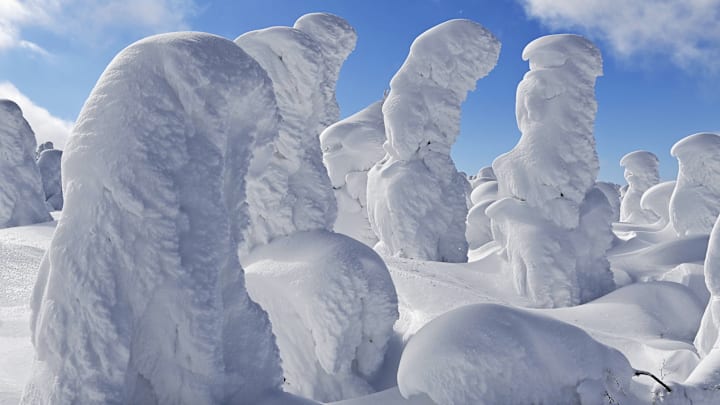
During the winter months, the slopes of Japan’s Mount Zaō are covered in bizarre figures known as “juhyo” or “snow monsters.” While the snowy formations look like strange mythical creatures, they’re actually the result of snow and ice building up on evergreen Aomori todomatsu trees.
Snow monsters can only be created under very specific conditions—on Mount Zaō, it’s a combination of strong winds of up to 85 feet per second and an air temperature of 21°F – 31°F. The fir trees act as the base layer, with water droplets that are carried by the wind freezing on contact with the leaves and branches. Over time, layers of rime ice gradually build up. Eventually, the ice forms ridges and curls known as “shrimp tails” on the trees.
Sadly, Zaō’s snow monsters have been shrinking in size over the past decade or so. Not only has the planet been warming up, but the mountain’s fir trees have fewer branches and leaves—meaning less surface area for the snow and ice to build upon—due to various insect infestations. While climate change is a worldwide problem, in 2023, the Juhyo Revival Conference was launched to try to tackle the issue by revitalizing the trees.
Pancake Ice
Pancake ice is exactly what it sounds like: ice that is shaped like pancakes. Typically slushy in texture, the peculiarly-shaped ice most often forms on freezing oceans, specifically around the Arctic and Antarctic.
But the slushy circles have also occasionally formed in other places, including on rivers in Scotland and on North America’s Great Lakes. The pancake-shaped disks typically range from one to 10 feet in diameter and have been known to reach up to four inches thick.
On oceans, the pancakes are formed by slabs of ice breaking up and then being shaped by both the ocean’s current and by knocking into each other. On rivers, they’re made of frozen foam that gets trapped in an eddy. The disks sometimes look more like lily pads than pancakes, with raised edges that are caused by bumping into each other or by slush splashing onto the edge and then freezing.
You May Also Like:
Add Mental Floss as a preferred news source!