Where Knowledge Junkies Get Their Fix
McAfee Secure sites help keep you safe from identity theft, credit card fraud, spyware, spam, viruses and online scams
Stacy Conradt
8 Fairy Tales And Their Not-So-Happy Endings
by Stacy Conradt - December 14, 2007 - 4:10 PM

slipper1.jpgYou might have noticed from an earlier post that I’m a bit of a Disney buff. This is kind of out of character for me, to be honest, because I’m not a huge fan of happily ever after. I like movie endings that are unexpected. After doing a little research, though, I realized that maybe fairy tales and I are a perfect match: those Disney endings where the prince and the princess end up blissfully married don’t really happen in the original stories. To make sure kids go home happy, not horrified, Disney usually has to alter the endings. Read on for the original endings to a couple of Disney classics (and some more obscure tales).

1. Cinderella

Don’t break out your violins for this gal just yet. All that cruelty poor Cinderella endured at the hands of her overbearing stepmother might have been well deserved. In the oldest versions of the story, the slightly more sinister Cinderella actually kills her first stepmother so her father will marry the housekeeper instead. Guess she wasn’t banking on the housekeeper’s six daughters moving in or that never-ending chore list.

2. Sleeping Beauty

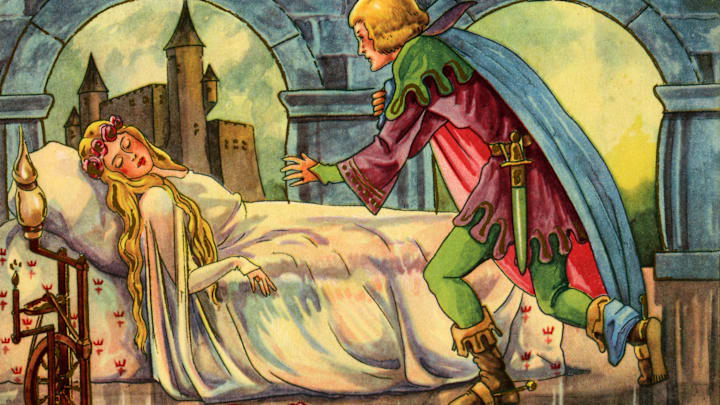
In the original version of the tale, it’s not the kiss of a handsome prince that wakes Sleeping Beauty, but the nudging of her newborn twins. That’s right. While unconscious, the princess is impregnated by a monarch and wakes up to find out she’s a mom twice over. Then, in true Ricki Lake form, Sleeping Beauty’s “baby’s daddy” triumphantly returns and promises to send for her and the kids later, conveniently forgetting to mention that he’s married. When the trio is eventually brought to the palace, his wife tries to kill them all, but is thwarted by the king. In the end, Sleeping Beauty gets to marry the guy who violated her, and they all live happily ever after.

3. Snow White

At the end of the original German version penned by the brothers Grimm, the wicked queen is fatally punished for trying to kill Snow White. It’s the method she is punished by that is so strange – she is made to dance wearing a pair of red-hot iron shoes until she falls over dead.

4. The Little Mermaid

mermaid.jpgYou’re likely familiar with the Disney version of the Little Mermaid story, in which Ariel and her sassy crab friend, Sebastian, overcome the wicked sea witch, and Ariel swims off to marry the man of her dreams. In Hans Christian Andersen’s original tale, however, the title character can only come on land to be with the handsome prince if she drinks a potion that makes it feel like she is walking on knives at all times. She does, and you would expect her selfless act to end with the two of them getting married. Nope. The prince marries a different woman, and the Little Mermaid throws herself into the sea, where her body dissolves into seam foam.

Now here are four more fairy tales you might not be familiar with, but you might have trouble forgetting.

1. The King Who Wished to Marry His Daughter
What It’s Like: Cinderella, with an incestuous twist

The King’s wife dies and he swears he will never marry again unless he finds a woman who fits perfectly into his dead Queen’s clothes. Guess what? His daughter does! So he insists on marrying her. Ew. Understandably, she has a problem with this and tries to figure out how to avoid wedding dear old dad. She says she won’t marry him until she gets a trunk that locks from outside and inside and can travel over land and sea. He gets it, but she says she has to make sure the chest works. To prove it, he locks her inside and floats her in the sea. Her plan works: she just keeps floating until she reaches another shore. So she escapes marrying her dad, but ends up working as a scullery maid in another land… from here you can follow the Cinderella story. She meets a prince, leaves her shoe behind, he goes around trying to see who it belongs to. The End.

2. The Lost Childen
What It’s Like: Hansel & Gretel meets Saw 2

This French fairy tale starts out just like Hansel & Gretel. A brother and sister get lost in the woods and find themselves trapped in cages, getting plumped up to be eaten. Only it’s not a wicked witch, it’s the Devil and his wife. The Devil makes a sawhorse for the little boy to bleed to death on (seriously!) and then goes for a walk, telling the girl to get her brother situated on the sawhorse before he returned. The siblings pretend to be confused and ask the Devil’s wife to demonstrate how the boy should lay on the sawhorse; when she shows them they tie her to it and slit her throat. They steal all of the Devil’s money and escape in his carriage. He chases after them once he discovers what they’ve done, but he dies in the process. Yikes.

3. The Juniper Tree
What It’s Like: Every stepchild’s worst nightmare

Cannibalism, murder, decapitation… freakiness abounds left and right in this weird Grimm story. A widower gets remarried, but the second wife loathes the son he had with his first wife because she wants her daughter to inherit the family riches. So she offers the little boy an apple from inside a chest. When he leans over to get it, she slams the lid down on him and chops his head off. Note: if you’re trying to convince your child to eat more fruits and veggies, do not tell them this story. Well, the woman doesn’t want anyone to know that she killed the boy, so she puts his head back on and wraps a handkerchief around his neck to hide the fact that it’s no longer attached. Her daughter ends up knocking his head off and getting blamed for his death. To hide what happened, they chop up the body and make him into pudding, which they feed to his poor father. Eventually the boy is reincarnated as a bird and he drops a stone on his stepmother’s head, which kills her and brings him back to life.

4. Penta of the Chopped-off Hands
What It’s Like: Um…you tell us

These old fairy tales sure do enjoy a healthy dose of incest. In this Italian tale, the king’s wife dies and he falls in love with Penta… his sister. She tries to make him fall out of love with her by chopping off her hands. The king is pretty upset by this; he has her locked in a chest and thrown out to sea. A fisherman tries to save her, but Penta is so beautiful that his jealous wife has her thrown back out to sea. Luckily, Penta is rescued by a king (who isn’t her brother). They get married and have a baby, but the baby is born while the king is away at sea. Penta tries to send the king the good news of the baby, but the jealous fisherman’s wife intercepts the message and changes it to say that Penta gave birth to a puppy. A puppy?! The evil wife then constructs another fake message, this time from the king to his servants, and says that Penta and her baby should be burned alive. OK, long story short: the king figures out what the jealous wife is up to and has her burned. Penta and the king live happily ever after. I can’t really figure out what the moral of this tale is. Chopping hands off? Giving birth to a dog? I just don’t get it. Help me out here, people.

OK, there has to be a ton of other creepy fairy tales out there that you would never read to your kids to lull them off to a peaceful slumber. Let’s hear ‘em!

More from mental_floss

5 Amazing Stories of Messages in Bottles
*
11 Famous Actors and the Big TV Roles They Turned Down
*
Boxers, Briefs or Loincloth? A Brief History of Men’s Underwear
*
The Mojave Desert’s Airplane Graveyard: A Photo Tour
*
7 Crafty Zoo Escapes
*
31 Unbelievable High School Mascots

twitterbanner.jpg

shirts-555.jpg

tshirtsubad_static-11.jpg

Comments (233)
  1. A tangent —

    I have a theory that the reason a girl’s viriginity at marriage was historically so important is because it was a way for the father to show he had never molested the daughter.

    That would also tie into the idea that an unmarried woman who was raped had dishonored the family’s name. There was no longer proof that the father had not violated the daughter.

  2. Yes yes yes! When I read Brothers Grimm, I was astonished at the base cruelty and downer-ness of the stories.

    I believe their version of Sleeping Beauty ended with “And they all lived happily until they died.” Cheery!

  3. Maybe kids back then were made of stronger stuff. They weren’t always PC and not everyone made the team. They died young and started work when they should have been starting school. Today these stories are horrible, but maybe back then they weren’t…um as bad. Don’t get me wrong, I’ve read the Brothers Grimm and it kept me up at night.

  4. “The Girl Who Trod on a Loaf” by Hans Christian Anderson.

    It’s rather long, but to summarize: there’s a proud and cruel little girl named Inge who likes to torture bugs by pulling their wings off and such, and is just generally wicked. She is sent by her patroness to visit her parents (of whose humble origins she is embarassed), and bring them a loaf of bread. She dresses in her finest, but on her way comes across a patch of mud. Rather than ruin her fancy shoes, she puts the bread in the mud and steps on it, only to sink into the ground through various levels of…Hell, I guess, in which she sees humans in varying degrees of misery. She is hungry but unable to break off any of the loaf (oh, did I mentioned her foot is permanently attached to it?) because her body has gone stiff and she cannot move. She is also, at some point, covered in the bugs and flies she has tortured, but they of course cannot fly away since they have no wings.

    There is some redemption at the end, I think. After ages of torment, she’s penitent, and turns into a bird or something. It seems to be the gruesome bits that have stuck in my memory.

  5. Maybe these stories were based on real events, retold and changed in many details to make them jucier. Or maybe the tellers got several stories mixed up. Not much was written down in those days so you couldn’t look a story up, you just had to improvise.

  6. In the Brothers Grimm, the story of Ashenpudle, (I know I’m probably not spelling that correctly) also known as the Ash-Maiden, is another version of the Cinderella tale. When the first step-sister can’t fit into the slipper she cuts off her toes. Because the prince is oblivious to this development, poetry spewing birds alert him to the trail of blood left by the missing toes. He returns the first step-sister, to which the second step sister responds by cutting off her heel to fit into the slipper.

    Evidently the prince was not too swift(could tie back to the incestuous Fairy Tale relationships previously mentioned. His parents were obviously related! because the poetry birds have to alert him once again to the trail of blood.

    Everything works out for the prince and the Ash-Maiden and they live happily ever after. However, post wedding the step-mother and step-sisters are not so lucky. Ala’ Alfred Hitchcock, the birds come back and peck out the ladies’ eyes as punishment.

    For some reason, this story didn’t give me nightmares. What was more likely to keep me awake was the prayer,

    “Now I lay me down to sleep,
    I pray the Lord my soul to keep,
    If I should DIE before I wake,
    I play the Lord my soul to take.”

    Whoever thought that was an appropriate bedtime thought for a child to have??

  7. In one of my college English classes, we studied folk and fairy tales. We learned of one in particular that was quite interesting: Tam and Cam, a Vietnamese version of Cinderella. At the end, The Cinderella character boils her wicked stepsister alive and turns her into a delicious sauce, which is given to the wicked stepmother. Stepmother eats the sauce made of her daughter and when told that she has been eating her daughter, the stepmother dies instantly from shock.

    It is actually kind of a neat story for those of us who don’t like the sappy endings…

  8. I’m thinking the same person who thought that bedtime prayer was appropriate also thought of telling children “Don’t let the bed bugs bite!” just before they went to sleep. Persoanlly it gave me nightmares of bugs crawling all over me every night. It was beyond my mother’s comprehension why I was a child insomniac.

  9. What about “Rock-a-bye baby on the treetop when the wind blows the cradle will rock when the bough breaks the cradle will fall and down will come baby cradle and all” Even when I was a little girl I thought this nursery rhyme was sick!

  10. I read the original Snow White in an illustrated book. (The part about the iron shoes and dancing until she drops dead part, oddly enough wasn’t illustrated, but rather was a Post Script of some sort at the end of the book).

    Somehow I wasn’t scarred for life by it.

  11. I know it’s not a fairy tale, but Disney did do a version of it (which I have not and will never watch); the Hunchback of Notre Dame.

    It is one of my favourite books of all time, and the ending, though sad, is awesome. I’m not going to ruin it for anyone who’s planning on reading it, but it was awesome, sad, and the book was much more realistic in terms of relationships than I’m sure a version Disney put out would be, simply for the fact that Disney caters to a target audience of children, and this book is DEFINITELY not a child’s book.

  12. Igmar Bergman’s movie, The Virgin Spring, is based on a Swedish medieval folk tale. Story goes like:

    A Christian man sends one of his 2 daughters on an errand. She is blond and naive. The other sister is dark-haired and pagan, and jealous of her sister (who is obviously the family favorite) and so puts a frog in the blond sister’s bread and makes a weird prayer.

    The blond girl comes across 2 guys and a little boy in the woods, and invites them to have a little picnic with her. While they are eating, the bread is cut and the frog jumps out. Somehow this signals the guys into rape mode, and they ravage and kill the girl. They tear off her clothes and raid her bags, and leave her body, naked on the forest floor.

    The girl’s killers wind up coming to her family’s house for lodging. They try to sell them the daughter’s dress! The family then know that these men killed the daughter, and the father ambushes them soon after, killing them. But then he goes on a rampage, and kills the little boy as well (who helplessly saw the rape and murder), kills several goats, and tears down a young tree with his bare hands!

    The dark-haired daughter repents her part in her sister’s death and converts. The father repents having done revenge, when Christianity says to “turn the other cheek”. The family then goes to look for her body, and when they find her, the father proclaims that he will build a church where they found her. When they lift her, a spring burts forth where her head was resting.

    the end!

    Also, The Juniper Tree was made into a movie, actually, the singer Björk is in it!

  13. Reading the Grimm tales made me not like Disney. The originals are so much more interesting.

  14. Have you read Princess Bubble? she does not find a prince but ends up happy. I copied a little about the book b/c I thougth this book was really great!

    Princess Bubble stars a princess who is confused by the traditional fairy tale messages that say she must find her “prince” before she can live “happily ever after.” Princess Bubble dons her “thinking crown” to research traditional fairy tales, interviews married girlfriends, and even takes counsel from her mother, who advises her to sign up at FindYourPrince.com. With a little help from her fairy godmother (this is still a fairy tale after all), Ms. Bubble discovers that “living happily ever after” is not about finding a prince. “True happiness,” the book reveals, “is found by loving God, being kind to others, and being comfortable with who you are already!”

  15. Of course Hansel and Gretel and Little Red Riding Hood have to be horrible. How else do you keep your young kids from wandering off into the woods?

  16. You know, I have heard that the Bros. Grimm did not originally intend they’re stories for children. However, for some ungodly reason, Parents at the time thought their chldren would enjoy them. I know my four-year old would love to hear a story about birds crushing the heads of evil step-mothers with millstones any time. Anyway The Grimm brothers decided to tone them down a bit afterward. At least, thats what I’ve heard.

  17. OK, the reason the terrible tales were thought to be something to tell kids is that they were often an attempt by parents to get messages across to their kids about “if you do thus and such, thus and such will happen to you” or that kind of thing. Not always well thought-out attempts. I also think it was sort of like sitting around the campfire telling “ghost” stories.

    Now, the reason virginity was so prized (and still is in some circles) is that it was the way to prove that the children the woman bore were/are actually her husband’s children. Usually in these types of societies, the men, once they married/marry a woman, kept them pretty much locked up away from other men. This is why in some countries, it’s illegal/immoral for a woman to travel away from home with anyone who is not her husband or a male relative. No way to ensure she hasn’t been unfaithful.

  18. Thanks so much for the stories! I have an old book of Grimm’s fairy tales but even they are not as gruesome as this. I always thought that the stepmothers were really exaggerated in these stories, until i met one just like them. She took the stepkid’s christmas presents for herself, gave away their pets, and calls the kid fat (& this kid is only 9 & not even slightly overweight.)

  19. Disney has ruined myth in America. These tales were real in that people did evil things and people actually died! Disney has sanitized myth and eliminated death except as a joke. Thats why these old tales are so compelling. Disney has also ruined copyright laws forever. By paying off congress to extend Mickeys corporate copyrights into perpetuity. It sure would have been hard for Disney to make Snow White had she never entered into the public domaine! GOOGLE IS EVIL!

  20. Man, the Wicked Queen dancing until she dies in red hot iron shoes would be great to watch! Better than Elaine on Seinfeld!

    :D

  21. This site has links to many of the original Grimm tales and the Struvelpeter stories. There’s one in particular where a boy’s parents tell him not to suck his thumb or they’ll be cut off. He doesn’t listen and that’s exactly what happens.

  22. Hans Christian Andersen’s stories are all horrifically depressing. “The Red Shoes” is about a girl who puts on a pair of lovely red boots that force her to dance and dance and dance. She can’t take off the shoes once they’re on, so she eventually cuts off her feet to stop the dancing, and the feet just keep on dancing even once removed.

    “The Snow Queen” and “The Wild Swans” are also beautiful stories that gave me nightmares when I read them as a child. A well-meaning uncle who knew I loved to read mythology books gave me the Andersen stories and possibly scarred me for life.

  23. These are so interesting. Im a Disney buff myself. I love it

  24. I don’t know if you read the graphic novel series “Fables” but they use a lot of the original fairy tales. Here’s a hint of stuff they pull – there’s only one Prince Charming – he married, and then divorced Snow white, Cinderella, and Sleeping beauty. ;)

  25. The Brave Tin Soldier by HC Anderson still brings a tear to my eye. Think Toy Story meets Romeo and Juliet. A one-legged tin soldier who lives in a child’s toy collection falls in love with a paper ballerina doll. A goblin jack-in-the-box warns him not to long for what he cannot have, but he pays no mind. In trying to be with the ballerina he falls out the window, goes down the drain, is eaten by a fish, and by chance is brought back into the same house when the fish is bought at the market by the boy’s mom. Then for no reason the boy throws the soldier into the oven, and somehow the ballerina winds up in there too. In the end they both die in the fire, the soldier leaving only a lump of tin shaped like a heart, and the ballerina only her corsage. I think I’ll cry now ~_~

  26. Igmar Bergman’s movie, The Virgin Spring, is based on a Swedish medieval folk tale.

    This film is also what “last house on the left” was based on.

  27. personally i think people as a whole has become so obsessed with apperaring nice and friendly, it has completly changed these stories of everyday happenings into something macabre. think about it, worse things happen nowadays. people have become soft and self-centered, always trying to be PC.

  28. Famous Romanian story:

    Mother (goat) lives alone with three kids. For some reason she has to leave, instructs the kids to not open the door to anyone. But big bad wolf comes, tricks the older 2 kids to open the door (third, smaller, hides). The door comes in, kills the older 2 brothers, ! cuts heads off, displays them in window !, and smear the blood all over the walls, then leaves.
    The mother goat returns, see the disaster, gets crazy by grief, but is comforted by the smaller kid that survived hidden. Then it decides to get revenge, goes after the wolf, and disembowels him (alive) then hills him.

    Tell me this isn’t weird; but when told when I was young, it didn’t generate any nightmares, it was all business as usual. The Andersen’s “Matchstick Girl” still gives me the creeps though.

  29. That’s odd I was sure that The Little Mermaid was taken from Rusalka as it has more elements similar to the The Little Mermaid such as loosing her voice. And although the Hans Christian Andersen version has many similarities to the Antonín Dvořák version they have different origins.

  30. My theory of these kinds of stories is that this sort of behaviour was probably quite common once. Okay people didn’t turn into birds on a regular basis, but butchering the family hog was probably considered entertainment. Its not a far leap think of some bratty little kid getting hog tied as punishment. As far a incest and murder. I’m not sure people quite understood the ramifications. They did think of different racial groups as beings other than human, and since most of them died horrible deaths from the plague or a venereal disease, gruesome death was probably quite normal and expected. Incest? It was before mass transit and people really didn’t travel. I’m sure there was a really tight gene pool back then. And Master of the house and all, I think they assumed certain privileges. But I’m just guessing.

  31. I have a book of Oscar Wilde stories – they are mostly pretty horrific too. I bought it for a child but ended up keeping it when I read a few, not suitable for children I’d say!

  32. The Juniper Tree seems to be the craziest of all these. I have comments about all of these stories however if I said everything I’m thinking it’ll take me forever to get it all typed out and take up waaay to much space! So about it I’m just going to say wow. haha… I had no idea about a lot of it.

    However did you know, that in Hansel and Gretel, it’s supposedly based on a true story? Except that instead of the happily ever after, they get plumped up, cooked and ate. The end. Sad huh?

  33. Take a look at this related post on
    Disney and Sex, Witchcraft, Killing, etc.

    markhere.blogspot.com

  34. I don’t know if anyone has heard it or not, but there was a version of the three little pigs where at the end, the wolf can’t get in the stone house so he decides to drop down through the chimney and the smart pig figures he would do somethings like this, so he’s ready. He had put a big pot of boiling broth. Down comes the wolf and the lock the top on and make wolf stew. Yum…there’s also a French version of little red ridding hood that is all about the wolf trying to get it on with Red. Good stories

  35. Okay a little bit of history. Until very recently the royal houses of most European nations were an incestuous lot. They married their sisters, cousins, fathers, mothers whatever in a bid to concentrate power and money in the hands of the few, and to broker peace among nations. “Childhood” as we think of it is a modern creation. Invented during the industrial Revolution at about the same time they invented weekends, 40 hour work weeks and child labor laws. Children back when these stories were written were considered little adults and were protected from nothing. They were put to work as soon as they could understand and physically do what they were told.

    Consider this a marriage was not considered binding until “consumated” and the Catholic Church raised the age of consent to 7 years old in the 1500s. Child brides and grooms were not uncommon. Say two families had wealth and wished to combine it. They Would promise a 1st born son to a 1st born daughter. If it so happened that these people were born at significantly different times so be it. Thus you could easily have a 15 year old girl marrying an infant boy to seal the deal.

    The giving birth to animals was a sign of witchcraft. Witches mating with “Satan” would supposedly give birth to all maner of animals. Thus the burn them alive comand.

    These are tales from a different era and different places they come from people that we have to really stretch our imaginations to understand.

  36. I seem to remember an HC Andersen tale (”The Storks” ?) where a boy is punished for throwing stones at storks by having them bring him a new baby brother who is already dead. Then there’s “Little Ole” – the cute little scamp who brings sleep and sweet dreams to good children. Which is all very well until Andersen introduces Ole’s identical twin brother who behaves in exactly the same way except that the children he visits don’t actually, er, wake up.

  37. Aw, Emma, but Oscar Wilde is so _good_. ;) And there are some stories that are totally child-appropriate. Like the one about the girl killing the moutain lion. It’s like the original grrl power story XP

    I used to have a giant book of Grimm’s fairy tales. I could never read Anderson’s after reading the aforementioned one about the Tin Soldier. XP ;.; so sad.

    What about that Grim story where the queen can’t talk because of some kind of family curse that requires her to knit dresses out of feathers/flowers (I forget which) to free her sisters from the curse, and the stepmother kills her firstborn and smears it’s blood on her lips so it looks like she killed and ate her own children o.O; Then, as they’re about to hang her for the murder, she almost finishes the last outfit (seriously, they’re hanging you and you’re *knitting?*) except for the last sleeve and so all her sisters are restored to full health (except one, who now has a swan’s wing instead of an arm for the rest of her life. I bet *she* lived happily ever after XP) and she can now talk. So she incriminates the stepmother who is hanged in her stead.

    How uplifting!

  38. Elizabeth, that’s a fascinating idea. Do you have any evidence or real-world suggestion that it might be so?

    I guess an intact hymen proves both that the father didn’t dishonor the family by raping the daughter, and also that the daughter didn’t dishonor the family by having intercourse before marriage, or maybe even having some other children before, who knows.

    Either way I guess people would conclude the family would not be fit for polite society.

    (If only they knew what goes on in polite society!)

  39. 2 things:
    no, oscar wilde’s fairy tales are not meant for children–they’re satirical.

    i was raised on grimm’s fairy tales. we had the book of all of them and my mom would read them to me every night, and write the date by each one as we read it so we wouldn’t skip any! i loved them.
    my favorite was “the three snake leaves”. in it, a young man has to pass trials to marry a princess. when they get married, he has to promise that he’ll be buried with her when she dies, even if he’s still alive. within a year, she dies and he is locked up with her dead body in an underground vault with three days’ worth of bread and wine. he is grief-stricken, but then he sees two snakes slithering towards her body. he cuts one in pieces, whereupon the other snake escapes. it returns shortly with three leaves. it puts the leaves on the cuts, and the first snake is revived whole. they slither off, leaving the leaves. the man puts the leaves on his wife’s eyes and mouth and she is revived. they knock and are released. however, she’s changed and doesn’t love him anymore. they take a sea voyage where she falls in love with the sea captain and they plot to kill the man and tell her father (the king) he fell overboard in a storm. a servant overhears this and tells the man, who devises a plot to escape the boat early. the princess and the captain think their plan succeeds, while the man actually returns home faster than their ship can, and he tells the king all about the plan. he hides in a closet while the princess and the captain tell their dramatic story, at the end of which the king calls the man out of the closet, kills the princess (his daughter) and the captain, and makes the man heir to the throne.

  40. My country had a bunch of ‘em… here’s a few I could hardly forget:

    Once upon a time there was a guy who fell in love with a girl. The girl’s father got mad of this and so he ran after the poor bum with a bolo (it’s like a machete, only scarier). The father didn’t get to kill the kid but he was successful in taking out an arm, Black Knight style. The boy flees to a faraway land, and the arm soon grew into the first banana tree (that’s why banana bunches kind of resemble hands).

    In another story, which isn’t as gruesome but kinda racist (versions vary)… Bathala, the god of all gods, was making (uhm, baking?) people out of clay and then cooks them in a furnace. His first batch was cooked too quickly, and was too stale. Unsatisfied, he threw them out to a faraway place which became the land of westerners and Chinese. The second batch was cooked too long. Unsatisfied, he threw them out to a faraway place which became the land of black people, or Africa. The third batch was cooked just right, and so Bathala lets them settle in his land which is the Philippines. Yay!

  41. As bizarre and sick and twisted as some of these stories may seem, fairy tales, in general, do have a good purpose. As G.K. Chesterton said, “Fairy Tales are more than true; not because they tell us that dragons exist, but because they tell us that dragons can be beaten.”

  42. This has to be the best article about fairy tales I’ve ever read! I knew Disney changed a ton about their movies, but not THAT much.

    And the comments about the darker stories are fantastic. I now have to get a couple of these darker fairy tales and read them for myself. :D

  43. Seam foam?

  44. Elizabeth, it was more of a matter where the bride’s family had to prove not only her honor, but that any child ensuing from the marriage (especially if born shortly after) was the groom’s.

  45. You’ll find some of these and more in a wonderful book called, “Grimm’s Grimmest.”

    Ashenputel, Juniper Tree are both in there . Warped stories, dark graphics – perfect for bedtime stories. /sarcasm

    Not sure of the editors, but you should be able to find it on Amazon.

  46. In my Intro. to English course, we took this one step further and analyzed the original fairy tales and their subsequent transformations. I found the following interesting:

    Sleeping Beauty
    The princess is pricked by a needle and unable to stop bleeding–figuratively, the blood symbolizes her menstruation. Her sleeping is a sign of her entry into the latent stage; she will only wake up when she is able to bear children.

    The Little Mermaid
    Uhh, my details are a little shady, but I remember the significance of Ariel losing her voice. In order for Ariel to become a real girl (with legs and a vagina), she must become subordinate and/or mute. This was followed with quite a lengthy discussion about Ursula’s penis-envy. Her tentacles and decorations are phallic, and somebody mentioned the fact that she originally ruled before King Triton.

    Snow White
    This one is quite heavily saturated with traditional Christian imagery and might well be taken as a re-telling of the story of Christ. Also, in the original, the seven dwarves did not exist in their traditional form–they were in Snow White’s head, thus the “burrowing.”

    Little Red Riding Hood
    The basket/red attire can be taken as symbols of chastity; the wolf, something of a perverted old man. LRRH is a story about a seductress, and in the originals, LRRH seduces the wolf. Also, when the hunter cuts Grandma/LRRH from the stomach, this is a symbol of re-birth and exit from the womb. LRRH has finally reached adulthood.

    I can barely recall a lot of the details, but it’s important to note that the significance of these conclusions is ultimately up to the reader. Such interpretations are a hybrid of psychological and literary theory and thus greater conclusions must be made about the works as a whole.

  47. thanks for the information and happy holidays

  48. Here’s another good one: In the Disney version, Hercules defeats Hades and he and Megera defeat live happily ever after.

    In the greek myth, however, Hera casts a spell on Hercules and he then kills Megera and his children.

  49. I had forgotten how bad some fairy tales were, and when I started to read Hansel and Gretal to my grandson, I got embarrassed, and made up my own story as I went along.

  50. Your terrific article was stolen by the following website:

    www. bspcn. com/2007/12/17/8-fairy-tales-and-their-not-so-happy-endings/

  51. When I studied social history at the university we actually read books on not-so-happy fairy tales. Basically, these were not to entertain the children but to teach them such things as “if you are girl and you go to the forest by yourself you might get raped, murdered etc.”, so, don’t go. In one of the books the LRRH is dressed in red because her cloak is a symbol of blood and the wolf is actually a rapist. “If one of your parents dies and you get a step parent be nice to them or you will live to regret it” etc.

  52. My favorite tale is one called “Paper Bag Princess”

    Its about a princess who is beautiful and is going to be married to a handsome prince, but a dragon comes and destroys her clothes and castle and steals her soon-to-be-hubby.

    The only thing she can find to wear is a paper bag. she goes on a hunt to find him and save him. She reaches the castle, tricks the dragon into exhaustion, and goes to save the prince.

    he is disgusted that her hair is not washed, that she is filthy, and is wearing a paper bag.

    she calls him a bum and and decides that she doesnt need to marry someone who is ungrateful.

    Guess what book my favorite niece is getting fro christmas?

  53. bzzyb Says:
    “Now I lay me down to sleep,
    I pray the Lord my soul to keep,
    If I should DIE before I wake,
    I play the Lord my soul to take.”

    Whoever thought that was an appropriate bedtime thought for a child to have??

    —-end quote—-

    Metallica

  54. after reading all these, I still am a big fan of happily ever after fairy tales. i get laughed at all the time.
    i never believe disney stories are true, but isn’t the message ‘happily ever after’ great? Don’t you appreciate those who try to make the others happy by telling the stories in such magical ways with fantistic endings?
    Life is sad enough, we need to believe living happily ever after isn’t just a myth.
    yeah but i do think the original stories are way too creepy, but also interesting, sorta reflecting what was going on in ancient europe, hmm, not good to tell those to children though, let stick to the disney versions.

  55. If you’re interested in similar themes, make sure you check out South Park episode 501 titled “Scott Tenorman Must Die.”

    Sweet dreams

  56. How about this one:

    Penniless artists arrives in big city with only pocket change and some drawings.

    Starts cartoon company that skyrockets with a special character who enchants the world.

    Cartoon company ends up owning TV network that ran its programs.

    Enriched artist gets so preoccupied with his train collecting hobby, he starts amusement park to house his real trains.

    Park becomes biggest amusement name in world history.

    And you have another totally impossible ending authored by Walt Disney. In his real life.

    As per my site’s Disney bio.

  57. I love the Grimm fairy tales. The Cinderella, Little Mermaid, Hansel and Gretel, Jack and Jill and Thousand Furs (where the king plans to marry his daughter) are my favorites.

    The Cinderella tale I heard was different though. In that story, Cinderella’s mother dies and her father remarries. But after unsuccessfully sabotaging Cinderella and the Prince (whom they’ve known were together all along), they lock Cindy in a closet and have the servants distract the Prince while they saw off their toes in order to fit into Cinderella’s not-glass slipper.

  58. The original Little Mermaid hd the same sea-foam ending as yours, but along with the ‘walking on pins’ bit, she also had to cut out her own tongue (to prove how much she loved the Prince).

    Hansel and Gretel: in the original where they were evil and led their step-mother away. They returned to their home using ‘bread crumbs’ and lied to the town saying that she was a witch that cast a spell on their father. When she came back days later, they burned her at the stake. …The other version just had them kill her in the woods.

    I like the original versions better. Much more interesting/entertaining.

  59. You cant forget about the original Rumpelstiltskin. At the end when they guess his name and get it right he rips himself apart limb from limb. and if she were to have gotten the name wrong the baby would have become part of the stew.

  60. Thanks Tifa for that wonderful answer. However, since I am about the same age as the boys from Metallica, and I heard that prayer when I was about four, I think maybe it’s a little older than “Enter Sandman”. ;P

  61. The Brothers Grimm (Jakob Grimm in particular) were actually linguists and not folklorists by profession. They went around collecting those stories as part of a linguistics project of theirs to analyze how people in different places told variations on popular stories. They were studying dialectal differences and variations in pronunciation, though the latter is lost in any mere collection of the stories.

  62. I like the originals much better as well. Disney has unfortunately filled girls’ minds with sappy–and sanitized–versions in which submissive, passive women are brutalized while waiting for the handsome prince to come save them. The original stories were filled with many examples of strong women who devised their own ways out of hardship.

    I think of my 4 year old niece whose favorite thing is being a “beautiful princess” and being rescued from the dragon… and to think my intelligent (and tomboyish as a kid) sister is brainwashing this poor kid into fitting this throwback to pre-women’s movement patriarchal oppression!

    Fortunately, Disney’s more recent efforts are much more palatable: Mulan, who dresses up like a boy to save her family’s honor, and ends up saving all of China; The Cheetah Girls who, despite being into pink and animal prints, deliver a message of “Grrl Power” (I don’t wanna be like Cinderella…. I can rescue myself); and so on.

  63. One of the stories you’re referring to is called “Allerluja” or something similar. It’s the one involving the King who wanted to marry his daughter. Most of it goes as you say but it turns out her job as a scullery maid ends up putting her right back in her father’s castle and he sees through her ruse and (oh joy!) they get married and live “happily” ever after.

    If you can still find it, there’s a graphic novel called “The Big Book of Grimm” that keeps all the original endings intact.

  64. Along with “Fables,” which I have to admit I was drawn to because of my own interest in things like these, there are a series of books by Mercedes Lackey (who has her own serious obsession with global folklore, if you look at her larger body of works) called the 10,000 Kingdoms (I think?). They take traditional folkloric elements and give them a twist, including a force called Tradition which tends to make certain lives follow down folklore paths, if the conditions are right.

    On a side note: For another story that is really gruesome, though, look up Rapunzel. I don’t think that any of the versions I’ve read of that are particularly happy…. (The prince falls from the tower and ends up losing his eyes to the thorn bushes below…..) Erg…

  65. I enjoyed reading the Grimm fairy tales, but there is nothing like a 13 book series full of fairy tales and myths from around the world.

    mythfolklore.net/andrewlang/

  66. This is a great article! I also read and enjoyed the old fashioned(?) fairy tales, and thought they seemed more real, less sanitized. I guess I was just a cynical kid.

    I think the violence, sadism, etc. is pretty much reflective of the times the stories were written in. Violence and sadism were not only common, they were a form of entertainment. During a history class, the teacher told us that in medieval times, an executioner who was just supposed to execute the condemned would be tossed coins from the crowd to torture the condemned or find some other way (usually shouted by the audience) to make it more interesting.

    Since we’ve done away with public executions, as well as some other nasty things as a society, I’m not surprised that Disney has sanitized fairy tales. ~Maybe~ it isn’t really a violation, considering how much more enlightened our society has become?

  67. Most ‘fairy’ tales were actually originally meant for adults. This is oral tradition people. Sheesh.

  68. Most fairy tale were NOT meant for adults they were cautionary tales for children And as for people preferring the “sanitized” versions we now call that denial. Let us also not forget that Walt Disney was an early Nazi sympathizer!

  69. Another too-happy Disney adaptation is Bambi. OK, it’s sad when his mother dies, but the book is even harsher.

    Bambi: A Life in the Woods

    Some years ago, I read a fascinating essay on the book. While Bambi vs the Hunters occurs in the book, part of the story is the interaction between the hunting dogs and Bambi. The dogs tell of their worship of the human masters, but then Bambi comes upon the burned body of a hunter, and learns that the humans are mortal beings.

    It is a complex and dark story; certainly not for little children’s enjoyment. Disney had to revise and re-revise his screenplay, eventually settling on the rather happier version that we see on-screen.

  70. The Grimm brothers were lawyers and they actually explored the countryside of Germany in their lifetimes, trying to collect as many versions of these folk tales as they could. They felt it would help them understand the spirit of the law. They then condensed many versions of the folk tales that had been passed down by word of mouth for ages into written stories.
    These stories taught a message of morality in medieval Germany, and the Grimm brothers were quite the philosophers. They didn’t actually write any of the stories, but interpreted and collected. And unlike what one commenter said, they never toned them down.

  71. There’s actually a book called Deerskin that’s a spin-off of The King Who Marries His Daughter (or whatever that obscenely long name to the fairy tale is). It’s quite good, although it is a bit different than how you’ve explained it.

  72. Just thought I’d leave this link for anyone else who’s interested.

    “Grimm’s Fairy Tales: This book contains 209 tales collected by the brothers Grimm.”

    http://www.cs.cmu.edu/~spok/grimmtmp/

  73. The king who wishes to marry his daughter bit is quite an old archetype. Practically every European/Western culture has some retelling of this myth. And get this! There is even a Catholic saint, St. Dymphna (whose actual existence is dubious), whose father pursued her and eventually murdered her and the priest who had agreed to hide her.
    Perhaps it’s a warning to young girls that, no, it isn’t all right for daddy to touch you there…

  74. The other standard explanation for the emphasis on virginity was that virginity was the only guarantee that ones bride was not pregnant. The prospect of unwittingly raising Sombody Else’s Kid was a real horror for men through most of human history.

  75. wow, i knew disney wasnt dealing the right stories, but i had no idea they were this dark. Now i Want to read these stories, and im plotting on how to get my hands on them. =D

  76. In the original book, Pinocchio, Jiminy Cricket (”the Talking Cricket”) doesn’t get to live too long. He tries to talk some sense into the kid, P gets cranky and squishes him with a hammer – What a darling little puppet. The cricket haunts him throughout the book. Having seen the movie first the squishing scene was shocking and hilarious.

  77. All I have to say is wow, but I’m certainly going to try and find the last four.

  78. Actually, fairy tales were originally told around campfires for adults. That’s why there’s so much incest and sex in the early versions. They weren’t meant for children to hear.

  79. If you like these, you should see/listen to Stephen Sondheim’s “Into the Woods”. It’s a musical about fairy tales. It starts with the “traditional” tales, then the second act is after “happily ever after”. It is fantastic and definitely pulls in the more horrible and gruesome aspects of fairy tales.

  80. Most of the earlier fairy tales are more gruesome, yes, but as far as being meant solely for adults, no, they were meant as morality stories. THey were meant to teach children lessons, and it was probably assumed that the best way to teach the children the lessons was to present the most horrible possible scenario as the consequences of the actions.

    As far as the bedbugs thing, it is from the knowledge that small bugs (called bedbugs) infested beds, biting the occupant of the bed. Knowing what is known now about disease transmission, “don’t let the bedbugs bite” makes even more sense since they are able to transmit both Hepatitis B and the plague through their bite.

    The traditional prayer “Now I lay me down to sleep…” is first seen in the 18th Century, in the New England Primer, a Protestant textbook for young children in the colonies.

    The original form of the prayer read:
    “Now I lay me down to sleep,
    I pray thee, Lord, my soul to keep;
    If I should die before I wake,
    I pray thee, Lord, my soul to take.”

    This makes perfect sense, considering the belief by Puritans that only The Elect would enter Heaven. The prayer could most likely have been intended as a way for a child to guard against a sort of fall from grace in his or her sleep by asking God to watch over him/her and that if he/she should die, that God would take his/her soul to Heaven, thus making the child one of The Elect.

  81. The story that has haunted me the most is Anderson’s Little Match Girl. When I was younger I had a book which said the girl was lost and tried to sell her only possession – a book of matches – to try to fund her way back home, but a blizzard sets in and she lights them instead allowing her family to find her and take her home for Christmas dinner.

    Turns out the real version is a mean step-father sends her out into the cold on Xmas eve, in a blizzard, to sell matches. Everybody has gone home from the snowstorm, so she shelters in an alley and lights her remaining few matches and each one is a dream (ie, hot dinner, warm bed, loving family etc). Eventually she falls asleep and the next morning the find her frozen and dead in the snow. I grew up in Tropical Australia and the idea of freezing to death in the snow completely haunted me.

  82. Can anyone suggest a good book that has a selection of original fairy/folk tales? Reading these posts has made me want to read the original text!

  83. there is a big distance between the Disney version of Pocahontas and the real life story of rape and abduction of a 12 year old girl. I hate how hideous history of colonisation is sanitized into a lovely movie with Grandmother Tree and lovely little woodland creatures…

  84. in the original Rapunzel the reason she was trying to escape her mother was because she got knocked up by the prince. the story mentions how her cloths were getting tight around her mid and “bosom”

  85. I’m pretty sure my copy of Andersen’s Little Mermaid ended with the mermaid Mermaid avoiding the soulless seafoam death by being pitied and inducted by the Daughters of Air, and thus be at the mercy of little children everywhere to behave, dammit, or she gets another [mumble] years of time added to her penance before she can enter Heaven. Cos really, the whole Prince thing was just kind of a detour when she wanted to be human and therefore, have a soul. Um. Yeah.

    I guess that was about as happy an ending as could be afforded, but little 8-year-old me was still bitterly disappointed for years afterward. Not to mention, the repreive was rather left-field. Don’t they always pound it into your head in writing class to never to reveal a new player in the final act? ;) Ah, but I kid.

  86. Think broadly here, big idea territory–Joseph Campbell, Carl Jung. . .
    Stories or “metaphors” are ways of explaining things we don’t understand or confirming things a society holds dear.
    Kids (and adults) need, as a matter of survival, to know that danger lurks and the forms it might take, thus some of the scarier stories. Many are morality lessons, emphasizing the ideals of the society (see Campbell’s Hero with a Thousand Faces.) Then there are all the beautiful stories of how the world or the people began. These not only explained the unexplainable, but provided a special bond for the society to share and preserve.
    Scary or disturbing stories were mostly “tough love.”
    I wonder if our protected and coddled society will be able to see the value of stories that shock and make them think. It seems that today, violence is no longer the way to shock people into action, and I wonder what our stories will be.

  87. Kids today are coddled. They should be hearing the original so they can be better prepared for the true face of humanity.

  88. i remembered watching an Encyclopedia Britannica (or was it Reader’s Digest) cartoon series that featured the “The Lion, the Witch, and the Wardrobe” as well as that of the “The Little Mermaid”. The latter had that supposed to-be tragic ending version wherein after failing to marry the prince, she then also failed to kill the prince with a magic dagger procured by her (now-bald) sister from the sea witch. But then the “deus ex machina” kicks in, and instead of turning into seafoam, the little mermaid turned into one of the Daughters of the Air, who gives comfort to afflicted children. It was, suffice to say, a bittersweet and heartwrenching story for a child of eight.

    I also remember that the series also featured the story of a metal statue, a representation of a well-loved prince (who died young), embellished with jewels, perched on the kingdom’s tallest column. Years later (I guess), the statue developed sentience and began to see the sufferings that surround him. He then bade (mentally) a dove he had befriended to take out (through several trips)the jewels encrusted in his clothes, sword hilt, and then finally, the sapphires that represented his eyes, and give these to the needy families in his kingdom. The poor dove (who dearly loved the prince and his merciful compassion) later died out of exhaustion (from its day-long trips)perched on the prince’s shoulder. Whereupon, the next day, the townspeople, finding the statue too ugly without the jewels, decided to tear it down. So the poor statue got smelted. Later, all that was left was a heart-shaped lump of metal (of the prince) and the heart of the dove that loved him (who must have been bundled with the statue during the smelting).

    Needless to say, these stories “formed” me and my worldview in that young age.

    I was already in college when I got exposed to the “real stories” behind those fairy tales. It was a literature intro class when I grabbed hold of a copy of the authentic version of “Aesop’s Fables”, and boy were my eyes opened.

    Needless to say, I now subscribe to Stephen Sondheim’s “Into the Woods” version of fairy tales, albeit still armed with that play’s admonishment (Finale: Children will Listen):

    “Careful the wish you make
    Wishes are children
    Careful the path they take
    Wishes come true, not free
    Careful the spell you cast
    Not just on children
    Sometimes the spell may last
    Past what you can see
    And turn against you
    Careful the tale you tell
    That is the spell
    Children will listen.”

  89. Great commentary and replies…
    Also:
    I DO believe that the original “Little Red Riding Hood” ended with the woodsman killing the wolf. That’s all…no Grannie or Little Red jumping out of the wolf’s belly.

    Also in “Peter and the Wolf”, when you hear the Duck’s song at the end it’s because the Duck was REALLY eaten by the Wolf, not just hiding behind a tree.

    When I was quite young (6 or 7)I found a “Big Book of Fairy Tales” that had all these stories along with one called “The Dragon’s Tale”, all about dragons killing and eating knights, imprisoning princesses and trampling farmers. Seriously, it was great fun!

  90. Also look at the old Irish/celtic fables… Best known one is the Children of Lir. Father remarries, stepmother is jelous, turns kids into swans. spell can only be broken by them hearing a churchbell. Father dies old and alone. Children after 100’s of years finally hear chruchbell, turn into old men and women and promptly die….

    Moral ,i guess, is dont let your dad remarry!!!

    Dublin remberance park has a 20′ statue of children of lir.

  91. hmmm…

    a few of those fairy tales are pretty similar to some of the tales told in chaucer’s ‘canterbury tales.’

  92. Izabaella DaJinn Says:
    January 3rd, 2008 at 6:25 pm
    Kids today are coddled. They should be hearing the original so they can be better prepared for the true face of humanity.

    How scary Izabella and how sad if that is the true face of humanity.. I would hope some day there would be more happy ever afters for the children. The way the world is now though I am afraid children don’t need the “true” or “original” fairy tales. All they need to do is be exposed to television, movies and music to see the harsness of todays world. Why not let children be children can’t we all hope and pray for happy ever afters for all of us??

  93. Well, if it is PC not to subject my son to brutal fiction I am proud to be PC. These stories are interesting…for adults. Maybe we are not as hard as we used to be but I think it is a good thing. Most children are not dying before their 3rd birthday anymore, people in general are not dying wholesale from plagues, most are not being killed off in ethnic cleansing or being impaled by guys like Vlad. I will take whatever it is that “PC” is nowadays to the horror of the Dark Ages. Hansel and Gretel, for instance, was a story based on starvation in the Dark Ages. It is appropriate for adults or teens but not young children.

  94. The original fair tales were written to scare children for their own good. The only way to teach them about the unfairness of life was through tales. They were the best way to ensure they kept away from unsafe places rife with pillagers, rapists, thieves, vikings, vandals, and other foreigners (all European nations once saw their neighboring tribes as suspect).

    Children brought up without horror stories and knowledge of real life usually grow to be maladjusted and incapable of surviving (mentally) real life. Call me cruel but I would read the original stories to children. To anyone who thinks I’m cruel…listen to the stories they make up themselves they’re usually worse!

  95. To quote the fantastic Terry Pratchett:

    Most people forgot that the very oldest stories are, sooner or later, about blood. Later on they took the blood out to make the stories more acceptable to children, or at least to the people who had to read them to children rather than the children themselves (who, on the whole, are quite keen on blood provided it’s being shed by the deserving), and then wondered where the stories went.

  96. Try http://www.gutenberg.org . Not sure if all of these stories are posted but they have audio in english and text in different languages.

  97. There’s a story called “The Goose Girl” where a princess has to travel for a few days to get to her fiance’s castle. Along the way, her handmaiden tricks her, steals her clothes, and magically induces muteness in the princess. When they arrive, the servant fires the princess but the good king allows the now jobless “handmaid” to become a goosegirl in his house. As revenge, the servant kills the princess’ horse (whom she loved dearly) and nails his head atop the gate that the girl must pass through daily on the way to the flock.
    Well, the deceit gets found out eventually, I don’t remember how, and the irate prince condemns the wicked servant to death by being pulled behind a team of draft horses wearing a barrel lined on the inside with nails.

    That one made me so sad. :( And I agree with you guys about “The Little Matchstick Girl,” too pitiful.

    Oh! And there’s “The Little White Cat” where the king sets tasks to see which prince will inherit the kingdom. The youngest prince stumbles on a magic realm where the people are actually cats, and the Queen of the Cats helps him with each of the tasks so that he wins. The last quest is to bring the fairest maiden in the land, so the cat asks the prince to take her to his father’s palace. When they arrive, she commands him to cut off her head (!), which he does after much dithering and tears. When he beheads the cat, she turns into a young woman and he wins the kingdom – happily ever after. ;)

  98. I’ve read that Hans Christian Anderson was homosexual, which totally explains all the issues of unrequited and forbidden love in the original Little Mermaid. Imagine – he was willing to feel the pain of “walking on knives” to be with the one he loved.

  99. The precursors to “Little Red Riding Hood” were pretty wacky:
    -The girl doesn’t wear a red riding hood.
    -The wolf is a werewolf (bzou).
    -The werewolf kills the grandmother and tricks the girl into drinking her blood and eating her flesh, for which a random cat calls the girl a slut.
    -The girl performs a striptease (more or less) before getting into bed with the wolf.
    -She escapes, all on her own, by pretending she has to go to the bathroom and then running away.

    We had great fun analyzing it as a coming-of-age story in the fairy tales class I took in college.

    Apparently I can’t link to it in this comment, but if you do a Google search for “bread wine grandmother bzou” you should be able to find it.

  100. In French class in college, we were assigned to read “La petite chaperon rouge” (”Little Red Riding Hood”). The story was just the same as we remembered it, except at the end the wolf says, “The better to EAT you with” and leaps out of bed and eats LRRH. The end. No woodsman to save the day or granny being cut from the wolf’s belly.

    It was obvious that most of the class didn’t read the last part very closely, because when we discussed the end of the story in class, there was a stunned silence!

  101. I dunno, I grew up on HCA and Grimms Brothers stories, as well as a handful of others. None of them really frightened or worried me.

    I like the original Peter Pan; he was so absentminded and adorable. He would often let the lost boys go hungry when he didn’t feel like eating, by telling them to “pretend to eat” so that they could keep playing.
    When they eventually all trooped home, they brought the lost boys with them, and Wendy’s parents took to tying their feet to their bedposts at night to keep them from flying away.
    Except for Wendy, because she went back every spring to clean his house. And then her daughter did the same, and her granddaughter too.
    It was a very fun story. Captain Hook wasn’t such an idiot in it either. He was very polite, and obsessed with trying to find “bad form” in Peter.

  102. This article is great. Thanks, to whoever posted the site with the Grimm Stories. I found this really interesting, and now I’m going on a reading binge, of all the originals.

    I think it’s interesting that no one can agree on whether the stories were originally for children or adults. I don’t think it matters much. I doubt I would let my children read the originals until they were at least ten. I can’t imagine a child sitting in a kindergarten class and exclaiming that no, the little mermaid DIDN’T marry the prince. Could you imagine the results? All the children would run home after school, and parents would be irate.

  103. I didn’t go through all the comments, so i hope no one posted that.
    I’m doing a paper right now on fairytales, and read your site, i hope you don’t mind me using the idea of comparing disney fairytales to the original version (i did steel that idea from you but i am writing my own texts) anyways by doing so i read the original version of hans christian andersens “the little mermaide” and i have to correct you on one thing, the little mermaide does not dissolve in sea foam, though she is supposed to.
    she turns into a spirit, a daugher of the air, and so gets the chance to get a soul, by doing good deeds.

    despite this i really liked your post, i think you awakened alot of people who thought that the disney version is the right one.
    and i think too, that many people now realize that fairy tales were originally also for adults, not just for children.

  104. I now have to correct myself, her body does dissolve into foam, but her soul (wich mermaids usually don’t have) turns into a spirit (meaning she is still able to exist and is not completely dissolved), sorry for that mistake

  105. SaDiablo Says:

    There’s a story called “The Goose Girl” …..
    Well, the deceit gets found out eventually

    ——————

    I believe the spell made the princess mute only to other people, but that she could talk to animals. This may be why the horse was killed. I do remember that the prince found out by listening to a stove pipe while the princess was in her hovel talking about her misfortune, maybe to a fly. Said prince may or may not have instructed her to tell the fly.

    It’s been a while since I read that one.

  106. Quit it with your half-baked theories about why bedtime stories used to be so gruesome. I can’t stress this enough: The Grimm brothers WERE NOT WRITING FOR CHILDREN. Think of them as old-school precursors to Gabriel Marquez.

  107. If you are at all interested in this sort of thing then you really should get a copy of Bruno Bettelheim’s “The Uses of Enchantment: The Meaning and Importance of Fairy Tales”

    It goes into amazing detail about the symbolism and power of fairy tales and their necessity to children. Even the gruesome ones.

  108. what about The Story of Little Suck-a-Thumb
    One day, Mamma said “Conrad dear,
    I must go out now and leave you here.
    But mind now, Conrad, what I say,
    Don’t suck your thumb while I’m away.
    The great tall tailor always comes
    To little boys that suck their thumbs;
    And ere they dream what he’s about,
    He takes his great sharp scissors out
    And cuts their thumbs clean off, and then
    You know, they never grow again.”
    Mamma had scarcely turned her back,
    The thumb was in, Alack! Alack!
    The door flew open, in he ran,
    The great, long, red-legg’d scissor-man.
    Oh! children, see! the tailor’s come
    And caught out little Suck-a-Thumb.
    Snip! Snap! Snip! the scissors go;
    And Conrad cries out – Oh! Oh! Oh!
    Snip! Snap! Snip! They go so fast,
    That both his thumbs are off at last.
    Mamma comes home: there Conrad stands,
    And looks quite sad, and shows his hands;
    “Ah! said Mamma, “I knew he’d come
    To naughty little Suck-a-Thumb.”

  109. Man that Scott Tenorman episode was sick and Splogcop this site is the original just click on the Stacy link on top

  110. You all can say what you want about the Disney company, but Walt Disney was a truely inspirational man – note Marvan’s previous comment. If you want to read a good bio – his is the one to read.

  111. Rapunzel. After the prince climbs the hair and finds the witch holding it he falls from the tower and his eyes are pierced by brambles. He wanders the world for years unable to see and begging for food and the like. Eventually he happens upon Rapunzel (who has also been wandering since the death of the witch because the witch never told her where she came from) and her tears restore his sight. Still has the happy ending, but only after years of loss and suffering.

  112. Did anyone else watch “Fairy Tale Theatre” when they were younger? I loved it, and the the stories in it were much closer to the originals than Disney.

    I think people tend to have a very naive idea about what children are like and what they enjoy and understand. I had a book of Grimms Fairy Tales when I was about seven, and I loved the stories in it. In fact, I frequently preferred them to the sanitized Disney versions. One of my all-time favorites was “The Robber Bridegroom.”

  113. I originally read the Grimm tales when I was about eleven or so…boy, was I in for a shock!
    Although if you think about it, Prince Charming? SO not a catch. He’s a necrophiliac with a foot fetish willing to take advantage of girls while they’re asleep.
    And I remember Fairy Tale Theater! My grandmother gave my sisters and I a tape with a bunch on it. It was great!

  114. Guys in the past people really had a tough time. What did you expect? These stories are probably not as scary as reality in that time.

  115. Hans Christian Anderson was not homosexual just unattractive and the only woman he loved was a famous Swedish opera singer named Jenny Lind. The tale about the Ugly Duckling was about her. She was not considered beautiful in her time but supposedly her ways about her made her beautiful and her voice was extraordinary. At one time Hans Christian Anderson inquired as to why Jenny Lind would not see him romantically and being a mischievous and young woman showed him a mirror. Needless to say he was heart broken.

  116. I have to say that my father read my sister and I stories by both the Brother’s Grimm and Hans Christian Anderson when we were younger, and neither of us ever had nightmares or got scared. He read them to us as far back as I can remember, for sure when I was three and my sister five. I did, however, and still do get scared by movies. Some of my favorite stories are by Grimm and Anderson. I like one about a girl who opens walnuts or some such and gets beautiful gowns and goes to a ball for three nights. I don’t exactly remember how it ends, but I recall liking the descriptions of the dresses.
    On another note, have you seen the musical “Into the Woods”? It combines a lot of fairytales, and not the Disney variety, and has lots of dead people and blood, but it really is great, and even has a somewhat happy ending.

  117. I have two young children (4 and 2) and they love watching Disney movies. I love them too, but I have read many of the original stories that end in not-so-happy ways. The stories have morals and I’ll let my children read them when they get old enough to understand what those are.

    With everyone being so PC, some people are afraid to step up and say anything lest the other take it into offense. Whether these tales were told to children or only shared among adults, shouldn’t matter. Though they contain some darker ‘areas’, telling them I feel is important. Living in this world is hard (in some places more than others) and if some parents want their children to grow up naive, then let them. I want my kids to be ready when they step off on their own, without being disillusioned into believing that everything in the world is okay. Happily Ever After happens, but it takes a lot of work..

  118. Oh please – you folks have to remember that Disney is not that old and children have been around for a LONG time… back in the “old days” (way before Disney!!) children were not pampered & coddled & treated like Pwecious widdle oog-ums…. they were just mouths to feed until they were old enough to help support the family around the farm or house, or by working a job… there were no “children’s stories” – many families didn’t even have the skills to read themselves!! When mass printed books began being available, they were cheaply printed pulp/penny books – filled with exciting, often horrific tales of bloody deeds – the bloodier, the better they sold – - there were still no childrens books!! As reading became more of a mainstream idea, and more adults learned the skills, we came into a time when child labor laws were being thought of… kids were being sent to schools instead of to work… kids learned to read… well the only things they had available outside of school were the penny books that were the hot items at the time… that was (roughly) around the time when the Grimm brothers were collecting old folktales, many of which were morality tales for the children of that time – no sweet little bunny stories, no cutesy little moptop heroes… stories were a serious business!! And those original tales reflected that. It is only in the past few decades that children have become “protected” and treated like they are now… musn’t upset little darlings – actually kids get a kick out of the more gruesome stories, it is usually the parents that are more fainthearted!! lol Disney had SO much to do with the current state of childrens literature… no wonder so many kids are obsessed with violence as they get older… they only know the Disney versions… the reality of it is fascinating… kind of like the proverbial “train wreck” that we can’t look away from – - real life is more gruesome & yes, more fascinating… but anyway…. can ya tell I studies Kiddy Lit. in college! LOL One of the very first stories written specifically for children & recognized as such was about a little girl who dies at the age of 5 or 6… she spent most of her life ill and in fervered prayer to god – - crappy childrens story by today’s standards but it was written FOR children… not the adult tales that the kids got ahold of! The message was along the lines of “be good & live a good life – it may not last long!”

    Pretty funny I think, but hey – that was the thought at the time!!!!!

  119. I heard in the real v. of little RR hood, no “hunter” comes. The last thing the ever says is ” Why, Grandma! What big theethyou have!

  120. Has anyone heard of a story about “the soldier who tricked death”~?

    It starts Soldier who has an encounter with Death, yet he somehow manages tricks Death into not killing him, and so Death says that he’ll give him a reward, whatever he wants, as accepting defeat, for now.
    The soldier asks for a bag that can hold eveything, so Death takes out small bag, about the size of his hand and gives it to him.
    The soldier, who is skeptical about his new bag that can ‘carry everything’, tests it out on a flock of geese, and to his amazement, the bag holds all of them, yet doesn’t grow at all.
    He wonders around collecting various things and having various adventures.
    But he gets old and weary. He is dying.
    Soon, he comes across an old friend. Death.
    But he has long expected this and captures Death, in his bag.
    He continues to wonder the earth having various adventures. Centuries go by, and he is old and weary. He has seen everything, and so has everyone else. The world is crowded, and full of people that are just longing to die.
    So the soldier decides let Death go, and put himself and everyone else to relief.
    But when Death is released, as punishment/reward for tricking him again, he gives the soldier what he had wanted to begin with, eternal life.
    The Soldier is still wandering the earth to this day.

    I guess the moral is sort of, telling people that although living forever sounds good, it isn’t really, because after a while you will have seen and done everything and you’ll get tired of life.

    I don’t remember who it was by, but I think it might have been by Hans Christian Andersen or someone similar.
    I’m sure I got loads of details wrong, I’m not entirely sure if it was a soldier or not, actually, it might be more likely to be the wanderer or something, but soldier was sticking in my mind, so I just went with that.

    I don’t remember how his ‘encounter’ with death went either really, I think it mioght have had something to do with a bridge (not entirely sure why)
    It’s actually vauguely similar to the three deathly hallows in the Harry Potter books… (but it’s very different at the same time.)

    I remember watching it when I was pretty young (like, 7 or 8) as a video directly aimed at children (it had a sort of slightly patronising (but in a thouroughly creepy way) story teller’s over-voice, and came with anopther equally creepy story…)
    I swear, It damaged me. I was terrified for ages afterwards. I’d lie awake at night thinking about it for years after.

    So to anyone saying kids nowadays should get the original grusome stories read to them, I disagree.
    I mean, most of these don’t have morals/don’t have morals obvious enough for young children to spot, so it’s kind of pointless anyway.

    (and who says children in the old times (whenever these original fairy tales were) weren’t traumatized? if people *were* marrying there daughters and raping people and whatever. (and aren’t loads of people saying that the stories weren’t meant for children but for adults, anyway?))

    (Sorry this is so long. >__

  121. I have a lot I want to say, but I’m going to try to keep it short, and try not to repeat what’s already been said…

    I’m a fairy tale/mythology/folk lore/legend junkie.
    I’d recommend “The Complete Fairy Tales of the Brothers Grimm” Trans by Jack Zipes (has a great introduction) and the original “1001 Arabian Nights”.
    Also, I really enjoy modern fairy tale adaptations. My favorite collections are “The Bloody Chamber” by Angela Carter, “Red as Blood” by Tanith Lee (out of print), and several of the ones edited by Ellen Datlow & Terri Windling – such as “Snow White, Blood Red”. Not everyone’s taste and some stories are better than others.

    I’d also recommend “The Storyteller” (DVD) by Jim Henson. It’s a collection of fairy/folk tales, darker and more accurate than Disney, but not quite as dark as the originals. Not suitable for all ages, if you ask me. “The Soldier and Death” is one of the stories in this collection – the one that the last reviewer was describing. Also here are “Sapsorrow” a version of the “King Who Wanted to Marry his Daughter”. And “The Ravens” a version of the story some one posted of the woman who had to make shirts to save her brothers that had been turned into birds.

    On the subject of the nature of the stories and their intended audience and what kids should be exposed to…
    As a mother, I vehemently disagree with LJ’s post. I do not believe that it is something that is Black & White as far as how kids should be brought up.
    I have seen the effect that violent movies and video games can have on very young kids. Though, I don’t believe that they should be completely sheltered either. There has to be a balance! But saying that children “in history” weren’t “precious” or they shouldn’t be now is utterly untrue! The psychological effects of children being emotionally neglected can be devastating. And I feel that there is an epidemic of kids “growing up” too fast, being self-centered, narcissistic, promiscuous, and desensitized to violence, sex, etc. as a result of neglect and of the media.
    If a parent is going to filter either everything or nothing than they aren’t being a good parent, IMHO. And it’s also important to stress to kids what’s real and what isn’t, though I think that they are smarter and more perceptive than a lot of people give them credit for. But I really think that there is an appropriate time for everything. You wouldn’t introduce calculus to a 1st grader, why would you read them violent or sexually explicit stories? They can’t understand either yet.

    I actually love the fairy tales in both the original versions and the Disney takes on them. I don’t think the “sanitized” film and written versions are without their merits.

    (Guess I didn’t really succeed in keeping this short – sorry about that.)

  122. In our country, children are told gruesome folktales. A lot of grown ups still believe the stories too. Its superstition. It’s very popular in the provinces. One is about a flesh eating half-woman (she’s separated from the waist down). During the day she acts like everyone else. She can even be your next door neighbor. At night she leaves her legs on the ground to fly and search for food. More often than not, she catches naughty children and eats them all up. She likes eating unborn children. She has a sharp thread-like tongue which she uses to suck the baby from it’s mother’s womb. Another story is about elf-like creatures that live in trees and take children away to make them live in their kingdom forever. Another really popular one is about a giant black horseman who smokes tobacco and stays up a tree. Occasionally we hear stories of him raping girls or falling in love with a country maiden. One folktale i found really disturbing as a child was about a fat short lady who would kill people by sitting on their chests when they are asleep. There are a lot of other creepy folktales like faceless women in white dresses, floating coffins, a funeral march comprised of the dead, a ghost that stays under a bridge and drowns people who pass. They all tell the same lesson. Don’t wander off at night, don’t talk to strangers, etc. To this very day, i don’t like staying under trees during the night.

  123. The stories also were reflections of what was going on the time they were told. Cinderella has the step sisters cutting off parts of their feet to fit into the slippers. They cut and disfigured their bodies to fit into the prince’s idea of the the perfect bride. Women are still cutting and disfiguring their bodies to fit an ideal of perfect beauty.

  124. When I was little, I could check out books on record albums. I got “The Juniper Tree” and it scared the crap outta me for years.
    I was a big fan of Fairy Tale Theater. Great article.

  125. The Goose girl alos talks in verse with the head of her dead horse Falata, something like this:

    “Alas Falata, hanging there!”

    “Alas poor mistress, how you fare!
    If this your lady mother knew, her heart would surely break in two.”

    She was also pestered by a fellow gooseherd named Conrad. Everey day she said a magic verse that made Conrad’s hat fly away so he’d be busy chasing after it and leave her alone.

  126. Interesting site!

    Very few of the ‘modern’ versions of fairy tales are anything like the originals! However, since death, disease, & disfigurement were a ‘normal’ part of life ‘back in the day,’ the older versions are not as “Grim” as we might believe by todays standards.
    A couple of other sources of old tales: The musical “Into the Woods,” while doing a strange intertwining of four or five tales (Red Riding Hood, Cinderella, Jack & the Beanstalk, and Rapunzel, with references to several other tales), DOES use the original version of the stories (with Cinderella’s stepsisters cutting off toes & heels to try to fit the slipper, and the stepsisters’ eyes being pecked out by birds at the end). Another rather strange source is the graphic novel “The Sandman,” which incorporates a chilling version of “Red riding hood in one collection (”The Doll’s House”) which makes the wolf behave much more like a male child molester than a “wolf,” along with references like sleeping beauty waking up when the baby she bore while asleep (evidently the prince did much more than a kiss to try to wake her!) sucked the poisoned needle out of her when trying to nurse. Not sure if those are authentic, but they sure sound “uncut,” at any rate!

    A version of “Cinderella” which I’ve always liked is an old story called “Cap o’ Rushes. The main character ends up kicked out of her father the king’s house when instead of comparing him to gold or jewels like her sisters, she said “I love you more than salted meat” (or something like that). However, unlike Cinderella, who needed outside help to get what she wanted, this girl disguises herself, and contrives a way to have all the meat for a big royal celebration unsalted (salt was a major way of keeping meat from spoiling in those times). When the king ate the unsalted (spoiled) meat, he found it so awful that he loudly declared “Now I understand what my daughter meant! She really did love me most of all! If only she were here, I would ask her to forgive me!” Of course, the daughter is there & reveals who she is, and lives ‘happily ever after’……all through her own cunning & cleverness. Cool story.

  127. I’m surprised that no one (unless i missed it in my scrolling) mentioned Martin McDonagh’s “The Pillowman.” It includes an interesting retelling – well, more of a prequel to The Pied Piper. there is also a wonderful story about a little green pig – the only one that isn’t in some form macabre. check it out, it’s a good play.

  128. Not sure if anyone ever saw the NBC made for TV movie the 10th Kingdom but the infamous iron dancing shows from Snow White are actually in that. They also have Snow White talking about the other ways her Stepmother tried to kill her which are also talked about in the original stories. The entire idea of the movie is “when happily ever after ends”

  129. in one version of cinderella, not only do the step-sisters chop of bits of feet to fit into the glass shoe, when then enter the church for cindy’s wedding, they each have one eye plucked out.by birds. the remaining eye is removed on the way out of the church.

  130. The ‘Borzoi book of french folk tales’ is an AMAZING book I own that houses collections of old french tales. One of my favorite stories is The Lost Children (you accurately described this version in your article). Another is the White Dove which includes a chamber of naked x-wives hanging from huge hooks in a locked chamber and forcing someone to drink boiling oil. My absolute favorite (second after Lost Children) is The Giant Goulaffre which is a witty tale of two friends who come accross a family of Giants. It’s too good of a story to spoil so you’ll have to read it yourself but it’s unlike anything I’ve ever read and includes gore, magic, and intellect. I wouldn’t read it to children but IMO it’s suitable for late teens and adults. You can find the Borzoi book of Folk Tales on Half.com for a fair price. I’d also suggest reading into the original Hunchback of Notre Dame. It features rape, murder, betrayal, and is truly nothing like the Disney spin off. Though I do enjoy Disney movies and I sincerely hope that my little cousins don’t read the tales that I read until much older. They can stick to Disney for now!

  131. I have now read through every single comment as well as the article itself, and I’m a little weirded out, to be honest. I have loved fairy tales my whole life, and am thoroughly familiar with the original tellings, and have been since I was a little kid. I do not recall being frightened by any of these stories, but that might just be me. Here are a few of the things I noticed that no one mentioned (which is weird):
    There are differences in what kind of fairy tales we’re talking about, where they came from and who they’re directed toward. The Grimm Brothers, for instance, collected stories that had been told for hundreds of years all over Europe to adults and children alike. There was not necessarily a moral to all, or any of them. Half of the stories were Christian in some way, with a surprising number featuring God or the Devil walking around making deals with people. In my opinion, all of Grimm’s tales are gory, or strange, or both. In contrast, Hans Christian Anderson wrote his stories in the early to mid 1800’s, and they were primarily written for children, all had a moral, and most importantly, all had a very specific Christian message involving sin and salvation. Aesop’s fables, lastly, are the oldest of the stories mentioned here, having been written roughly a few hundred years B.C. They have a moral, but are not supernatural (excepting, of course, the talking animals). I have to point this out because apparently “fairy tale” means different things to different people, while I am of the opinion that “fairy tale” is almost exclusively the domain of the brother’s Grimm. Everything else is either fiction or myth. It’s important to make this distinction, or else I can tell you a very gory fairy tale I read about a man who goes off with his wife and young son to be a caretaker at a hotel in Colorado, where he goes crazy and tries to kill his family.

    In addition, I was surprised that, with hundreds of gory tales available, only a couple were mentioned (over and over again at that!). How about…
    -The Poor Boy in the Grave, about a boy who’s so badly abused by his parents that he gets in terrible mishaps trying to avoid their wrath, eventually deciding to try and kill himself- and succeeding, shaming the parents for the rest of their lives. Or…
    -The Mother In Law, the mother of the King, who decides while he is away that she wants to eat his young wife and children (who are only saved by the compassion of the chef, who feeds her deer and pig disguised as the mother and children), Or…
    -The Little Old Man, who is made young and healthy again by God in disguise. The inkeeper who sees this, tries the same trick on his mother- popping her in the oven then a cool bath. Her horrible disfigurement causes two local women to give birth to the first apes.
    -The Boy Who Went Forth to Learn How to Shudder, where the kid accidentally kills a few people before spending three nights in a haunted castle bowling with corpses.
    -Fowler’s Fowl, a sorcerer murdering young women and keeping the bodies to scare more women he murders and keeps the bodies of to scare more women and… you get the picture.

    There are so many more… seriously, just get the complete stories. They *are* hit or miss, but the hits are certainly memorable…

  132. Also- Vasilisa the Beautiful. Russian fairy tale very much like Cinderella, except for a brief period she spends living with a witch before taking a skull to light her way home- which then incinerates her stepsisters.

  133. QUOTE: Aw, Emma, but Oscar Wilde is so _good_. ;) And there are some stories that are totally child-appropriate. Like the one about the girl killing the moutain lion. It’s like the original grrl power story XP

    I used to have a giant book of Grimm’s fairy tales. I could never read Anderson’s after reading the aforementioned one about the Tin Soldier. XP ;.; so sad.

    What about that Grim story where the queen can’t talk because of some kind of family curse that requires her to knit dresses out of feathers/flowers (I forget which) to free her sisters from the curse, and the stepmother kills her firstborn and smears it’s blood on her lips so it looks like she killed and ate her own children o.O; Then, as they’re about to hang her for the murder, she almost finishes the last outfit (seriously, they’re hanging you and you’re *knitting?*) except for the last sleeve and so all her sisters are restored to full health (except one, who now has a swan’s wing instead of an arm for the rest of her life. I bet *she* lived happily ever after XP) and she can now talk. So she incriminates the stepmother who is hanged in her stead.

    ~~~~

    The gist of this story was actually her 7 brothers had been turned into swans by her evil stepmother/whatever and in order to turn them back she had to make each of them a tunic out of nettles. The only condition was that she utter not a sound during the entire thing. A kind king found her in the forest one day, and thought “Wow, she’s hot, AND quiet! the perfect woman!” so he married her, and she went right on knitting. shortly after they were married the evil stepmother convinced everyone that the girl had turned her 7 brothers into the swans, and though the king tried to get the truth out of her she couldn’t speak, or else ruin the spell/tunincs to turn her brother’s back, and as he had nothing from his queen, the king had her taken to be burned as a witch. At the last second the seven swans swooped (say that 10 times fast) down and as each passed her she threw a tunic onto it, and each one landed as a man. The youngest boy, however, had one wing, because she was unable to finish his tunic. The swan-boys and the queen pointed out the real criminal, and the witch/stepmother was burned at the stake, and the king VERY happy that his new queen wasn’t a witch.

    ^.^ One of my favorite stories.

  134. My 2nd grade teacher read Grimm’s Fairy Tales aloud to us. Sure, it was surprising and maybe a little gross, but it certainly didn’t mentally scar us for life or anything. In third grade we also watched a film version of Rapunzel where the prince falls and goes blind, and at some point in early elementary I know we read/were read the original The Little Mermaid. (This was all at a public school, btw.)

    Honestly, if you think about the “clean” versions of most of these stories, they’re already pretty horrifying (stepmothers ordering hits on young girls, bloodthirsty crossdressing wolves, etc.), so it’s not like telling the real story is going to make that much of a difference.

    I love the Disney versions and don’t think there’s anything wrong with them (except for Hunchback, which they just should never have bothered to do.. even their “safe” version has that whole sequence where Frollo sings about wanting Esmerelda but it being a sin and how he’ll go burn in Hell for it, blah blah.. WTF?). But the old versions are cool too, and I don’t think kids are really going to be as shaken up as most people think.

  135. Yes Cap O’rushes is cool–she said “I love you as fresh meat loves salt”.
    And in the Seven Swan brothers story–the only place she could gather the nettles was in the graveyard.
    In Rapunzel the girl was promised to the witch because her father got caught raiding the witch’s garden for “rampion” while her mother was pregnant–rather than kill the father, they promised the child to the witch.

    And try the Baba Yaga stories from Russia, about the witch in the hut on chicken legs who flew with a mortar and pestle! I love the Mussorgski music to that story.

  136. I was read the “original” versions of fairy tales as a single-digit child, and I also watched the Disney movies. I loved both, although I thought the HCA ending of The Little Mermaid was boring (I was 7 or 8 when the movie came out). I wasn’t scarred by the stories at all; I still flip through one of the books my parents have when I visit. I didn’t develop a violence fetish or any paranoia from fairy tales because of the fact that the scenarios are so unbelievable and that the situations are from a time that a kind can’t wrap her head around. Seriously, who as a child understands the power plays of Medieval monarchs or the life of a peasant?
    I would have no problem reading fairy tales to my hypothetical children. I’m more concerned about realistic violence, news media that focus on the worst stories they can find, and agencies that mean well in scaring kids. All of my phobias and quirks came from crap like the Safety Kids tapes and The Berenstein Bears and the Trouble with Strangers (Mama Bear’s apple example still freaks me out). My grandma used to love retelling murder stories from the local paper and pondering out loud how the victim must have felt in their final moments, and more movies now depict plausible death and torture scenes. That’s the kind of stuff kids should be protected from. Fairy tales are nothing.

  137. Here’s a Vietnamese folktale my aunt used to tell me when I was a kid:

    Once there was a young married couple who were very much in love. The wife became pregnant and they were happy, but the husband had to leave for war before the baby came.

    He was gone for a long time, and the wife didn’t know when he’d return, if ever, and she didn’t want her son to grow up thinking he didn’t have a father, so she devised a clever trick.

    Every night before bed, she’d light a candle and point to the shadow on a wall cast by the little boy. The shadow stretched up really tall, and the mother taught the son to bow to him each night and greet his “father”.

    Eventually, the man returned home and they were overjoyed to be reunited. She introduced him to her son as his real father, but the boy shouted, “You’re not my father! My *real* father is someone else, and he comes to visit us every night before bed.”

    Upon hearing this, the man becomes enraged and chases his wife away. Heartbroken, she drowns herself in a nearby river. That night, when the man lights a candle and gets him and his son ready for bed, the boy points to his shadow and exclaims, “There! That’s my real father!” The man sees this, realizes his mistake and his heart breaks.

    MORAL? Uhhh.. don’t leave for war? Or how about, not everything is like an episode of Montel? =P.

    It’s a sad story, but I really liked it as a kid. I’d make her tell it to me over and over again.

  138. There’s a fairy tale named “The wolf and the seven billygoats” with several versions. IN the more PC ones, the billygoats are in danger of being eaten by the wolf but their mom kills the wolf. In a less PC versio, however, the baby goats get decapitated and their heads displayed on a window where the mom-goat finds them. Pretty scary, but not all stories were sweetness and light way back when.

  139. okay. nice article. :D
    people already say stuff i want to say, so yeah. anyway, 2010 there will be ‘alice in wonderland’ directored by tim burton. really looking forward to it. :D

  140. I’m an American who came to Italy and married an Italian. After reading the Penta ’sum-up’, I’ll tell you right now Stacy: It doesn’t surprise me AT ALL. REAL Italians are a strange breed, an always have been… You should read up on some of the stories of how Castello di Sirmione became Haunted in the late 1880’s… The parents named their little girl the Italian translation of ‘light blue’ and then left her to play by herself all day until she threw herself downstairs chasing after her ball and died. They didn’t even SEARCH for her body until three weeks later when they said ‘Wait… where’s Azzura?’.

  141. I vaguely remember this one Grimm fairy tale where this woman is captured and forced to marry some guy (sorry this is so vague). He has this room where he locks it up everyday, but places the key next to the door. He tells her he will kill her if she goes inside. She resists the temptation for a while, but eventually, she takes the key and opens the door. Inside is a huge basin filled with the body parts of all the previous women he had captured and killed. Determined not to end up in the bowl, she devises a clever plan where the man and all his evil friends (apparently they all knew what he was up to) are locked in the house. She then sets the house on fire, killing them all. She goes home.

  142. Grimm Brothers were anthropologists who traveled around recording the tales as part of a cultural study…not to write stories. The stories had terrible endings as they were meant to be antedotes to children. Hansel and Gretel: Don’t talk to stranger. Little Mermaid: Be content with your own life.

  143. Okay. I have been searching for this story for years. In it, as pennance, the princess has to wear iron shoes until she walks holes through them. Only then will she be reunited with her Prince. She wanders the Earth for years, trying to scuff the soles of her shoes on rocks, is what I remember. I know that sounds similar to that East/West tale where the girl marries the bear, but I think it is the European version I am looking for. Does anyone know the title?

    Additionally, you may want to read Until We Have Faces by C.S. Lewis. A wonderful retelling of the Cupid/Psyche tale.

  144. Having read all the Disney vs. original versions arguments, I thought I’d point out that, just as the original stories were written within a certain context (with children treated more like adults, the prevalance of violence, illness, etc.), the Disney stories have a cultural context as well. Snow White, Disney’s first full-length animated feature, premiered in 1937. At that time, the country was in the midst of the Great Depression, and movies became an inexpensive escape from the uncertain world in once-prosperous Americans found themselves living. The 30s became the Golden Age of film precisely for that reason. What child – or adult for that matter – who had lost their home, possessions, and station in life wouldn’t sympathize with the mistreated princess, and hope for a sweet and happy ending?

    As a side-note, an early version of Snow White also featured a sister named Rose Red. The sisters were intrepid and resourceful, and did more to save themselves and each other than their princes, but they managed to think their way out of bad situations and get justice for themselves without bloodshed.

    I’m all for letting kids know that life is not all rose-colored glasses, but it’s just as important for them to know that, even when the world is at its darkest, there is still hope and the possiblity of a happy ending.

  145. Actually, in the story “the King who wished to marry his daughter”, the Kind DID end up marrying his daughter. I believe the title of the fairy tale is called “all-kinds-of-furs” or “all-furs” because of the coat she wears. There is also a French version called “Donkey Skin”, with a young Catherine Deneuve.

    In the original version, the princess ends up working as the King’s servant and keeps dropping little golden objects in his soup (objects that he had given her as an ‘engagement gift’). Plus she keeps showing up at the ball with these fancy dresses. Eventually, the King puts 2 and 2 together and marries his daughter. It’s really weird. And EEEW on all levels.

    ZELDA: I know the story you are talking about. It’s a Polish story, if my memory serves me right. She travels beyond the Red sea and asks the sun, the moon and the wind to help her find her beloved, whose curse she had previously broken (he’d turn into a wolf). She also needs to walk in iron shoes and break an iron staff. She eventually finds the prince but he’s married and does not remember her, because he’s under a spell. The girl exchanges fancy dresses (more fancy dresses! what gives?) against some time alone with her man and does a switcheroo on the wine. He recognizes, the ex-wife disappears (taking the dresses with her) and they lived happily ever after…

  146. Oups, sorry!

    I meant: there was a movie made, a tame version of “all-kinds-of-furs”, renamed Donkey Skin. Jacques Demy directed it, with Catherine Deneuve as the lead actress. I was thinking too fast.

    And ZELDA, I forgot to mention I know your story under the title “La peau de loup” (Wolf SKin). But the story being originally from Poland, it might be something different in Polish (?)

  147. The version of Cinderella I read was different from the one you mentioned. Her father died leaving her with her evil stepmother and two stepsisters, just like the movie. However, when the prince comes to fit the slipper on the stepsisters to see if either of them is his mystery woman, one cuts off her big toe in an attempt to make the shoe fit and another cuts off part of her heel. Alas, it still does not fit either of them and the prince discovers it belongs to Cinderella and takes her away to marry her.

    Cinderella’s stepsisters are made to walk her down the aisle at the wedding, one on either side of her. Her little woodland friends (yes, she did have a little bird friend on each shoulder) exacted revenge on Cinderella’s evil stepsisters by pecking out their closest eye while they sat atop Cinderella’s shoulders. And once the wedding was over, guess what? They each walked her back down the aisle only on the opposite side of the bride than when they walked down the first time and indeed both got their OTHER eye taken out.

    This happily ever after is not for the squeamish to be sure.

  148. wow creepy! I never knew this!

  149. I remember seeing an Anime version of The Little Mermaid as a kid, years before the Disney version. No sea-shell bikini for Ariel. They showed more of her cartoon nudeness, then you ever saw of Daryll Hanah in Splash.

  150. If you can find an original version of the Brothers Grimm fairy tales for sale it is worth it. I remember the gruesome end of the sisters in Cinderella – one of them cutting off her heel to try to fit in the slipper and them having their eyes plucked out by birds at the end. We are definitely raising our children in a whiffle ball world.

  151. You have to remember as well, that you get what you pay for. Back in the Day and still in the Islamic and Greek Cultures, you give large gifts or monetary value for a wife. A women who is morally clean is very valuable as wife. Think about it, no worries of diseases or previous fornicators to be on her mind when consumation happens. She is all yours. Even today in the Philippines, if you marry an islamic woman, you pay the family for any education she has received, even if shes got a doctorate. So women can be quite valuable if they stay virgins in any era.

  152. Someone mentioned Mulan as a great indication of woman power. Which is fine, but Disney mutated this story too. Remember when the commander discovers Mulan’s a girl and saves her life? That really didn’t happen – she was beheaded.

  153. Your version of the story is as much different and distorted from the original than the Disney version.

    The Sleeping Beauty is not exactly violated in the main version, but in one of the alternative versions. And the little mermaid doesn’t throw herself into the sea simply because she’s pissed, but because she is given a knife by her sisters ans is told to kill the prince in order to become a mermaid again. But when she goes over the Prince and his wife’s bed, she loves him so much that she can’t kill him. So when the sun comes out, she throws her self into the sea and becomes a foam.

  154. This is so weird…

  155. I love this article

    I first read abriged (but not sugar coated) stories of Hans Christian Anderson when i was 7 or 8. i found them sad but LOVED them.

    I also read some russian fairy tales when I was 10. I remember one where there was a dumb guy who slept on top of a chimney and his 2 sisters in law kept trying to send him to do chores and the chimney somehow moves and he ends up marrying a princess or something. And another one where a girl’s evil stepmother sends her to live with a with (Bba Yaga) and her doll starts talking to her and helps her out. There are several where a pretty princesses have curses on them and look ugly (one of them was a toad) and the curses only break when men fall in love with them. There are many others that I can’t remeber.

    There is a lebanease folktale that is very chilling. I was told this when I was a kid and it really bugged me (and still does). A girl disobeys her mother and grandmother and goes out to the wood on her own. A wolf sees her and decides to eat her. She promices him 2 loaves of bread with oil and a fat chicken if he lets her go but he doubts she’ll keep her word. He takes her to her mother and she tells her the story and asks for the food so that the wolf will let her go. Her mother doesn’t recognize her because she is sure that her daughter is obedient and wouldn’t have left the house. Her takes her to her grandmother where the same thing happens. So in the end he asks her how she wants to be eaten and she says “eat me starting eith my legs so I can see you with my eyes” (it rhymes in arabic)

    Horrific, but with an obvious message about the importance of obedience. It is meant for children, and my grandmother remembers her mom telling it to her.

    Sorry for this post being so long

  156. I’ve read a version of The Bravest Girl in China (Mulan). It was different from the Disney version (What story isn’t different when Disney gets done with it?), but Mulan was never found out. At least not in the version I read. I find it fascinating how these tales continue to mutate. I’ve heard of most of the tales that are mentioned here, but the details always seem to be different.

  157. The story Zelda mentions reminds me of Finn The Keen Falcon, a Russian story. I can’t believe no one has mentioned The Golden Book of Fairy Tales illustrated by Adrienne Segur. It has many of the stories mentioned here, and quite a few not mentioned. Segur’s illustrations are amazing!

  158. my mother gave me a copy of grimms fairy tales when i was about 8 years old, it was horrific and gruesome and i loved every word of it. but some things in the comment section were never mentioned:

    back in the day there were no television, movies, internet (that’s right kiddies, computers are a recent invention) and in fact few books, the stories that were told and retold for generations were the only form of entertainment that most people had, therefore they had to be fun and light for the children, but entertaining enough still for the older members of the family, hence the gruesomesness of some of the original “fairy tales”.

    here are a couple of more stories for you thrill seekers:

    this is a Japanese tale that i read many years ago, so i apoligize if the details are a little schetchy: one day a king came to see a metal worker, and requested a bell made of gold and silver. the metal maker took the job, for the money he was to recieve for it would have fed his family for a month. however, try as he might, he could not get the precious metals the blend together. after several perilous tries, he came to the king and said it could not be done. the king upon hearing this, threatened the metal worker and told him that if he failed to do it he would be beheaded. when the man came home, he told his family about what the king said, and said all his goodbyes, because he knew the task was futile. his youngest daughter however, loved her father very much and went in search of a solution. she came accross a good witch who told her that next time her father is attempting to meld the metals together, to throw a frog into the mixture. so the next day, she went over to her fathers work shop, and watched her dad mix and mix the elements, and when he wasn’t looking she reachde into her pocket and pulled out a frog anf threw it into the mix. miracoulasly the gold and silver finally blended together. so the metal worker poured the mixture into a mould, and out came a beautiful bell. when he went to the king to present the bell, the sound it made was horrific. the king told him that he should go back and do it again until it made a beutiful chime. the metal worker sad and confused came home and told the family about his dilemma. his youngest daughter again went in search of the good witch, who told her that next time her father is mixing the metals, she should throw herself into the blend and her own beautiful voice will be heard whenever it chimes. and that is what she did. so she sacrificed herself so that her father could live.

    another story is one that my mother told me as a child (now this one actually scarred me i think)

    there once was a prince who fell in love with a wicked princess (translate bitch). now the princess did not like her mother-in-law, and told the prince that she would not stay with him while the queen was alive, so she moved away and told him that if he ever wants to see her again, he must bring her the heart of his mother. now, the prince loved the princess and wanted to be with her, so one night he went to his mother’s chambers and was prepared to kill her, when she awoke. she looked at her son, and knew that he was there on the princess’ orders. she told him that he must do what he felt was right. so the prince (most likely being fueled by his groin), killed his mother and cut out her heart. he then went traveling to his love to show her how he cared for her. as he was traveling he fell, and a couple of drops of blood fell from his mother’s heart and said “are you ok my child, did you hurt yourself?” and that was when the prince realized that nobody would love him as much as his mother.

    sick isn’t it?

  159. The puppy thing is interesting. I heard something similar in a story called The talking bird,The singing tree and the golden water from 1001 Arabian Nights.

  160. the prayer that bzzyb posted , Metallica uses that in their song Enter Sandman hahaha i knew i recognized it when i was reading your post. thats really funny :)

  161. Ever heard of “The Grandmother’s Tale”? It’s a Little Red Riding hood variant where, after eating the grandmother, the wolf (in this version, a werewolf) leaves his leftovers in the cupboard, and when L.R.R. comes along, she unknowingly eats her grandmother’s flesh and drinks her blood. Other than this, the tale is perhaps la bit more cheerful than some, since L.R.R. escapes before being eaten.

  162. I remember when I was younger my mom got me the Hans Christian Anderson version of the little mermaid on vhs instead of the disney version. It was very creepy and scared me as a kid but I still have it.

  163. Look up a book called Struwellpeter, a german book that translates to Slovenly Peter. It’s horrifying.

  164. Why hasn’t any one mentioned the second verse of the prayer?

    If I should die before I wake,
    I pray the Lord my soul to take.

    If i should live another day,
    I pray the Lord to guide my way.

  165. I still think Rock-a-bye baby is the most horrific thing to sing to an infant. Let’s just stick the kid in a tree on a windy night and see what happens. WHO thought that gem up?

    Princess C – no one says that part anymore, so kids don’t know it now. I completely forgot about it till I saw your post.

  166. I’d always heard that rock-a-bye baby was political- about what happens when a king dies leaving a young heir

  167. interesting…. I just realized that the Cinderella story here was adapted by Jim Henson for his series “The Storyteller”. It was entitled Sapsorrow then, and instead of a dress, it was the late wife’s wedding ring.

  168. angela –
    the story you are referring to (a young woman marries an older man, he has a secret, locked room in his house that she is forbidden to enter, etc.) is called ‘blue beard’ and it is wicked creepy.

    i took a class a few years ago in college called ‘fairy tales and gender’ and we read all kinds of crazy fairy tales…it was great. the norton edition of classic fairy tales is a great resource for old fairy tales (and not just grimm tales either).

  169. I once read a story about an ugly but kind girl with a wicked stepmom and beautiful wicked stepsisters. The girl meets a good witch one day who gives her leads her through a forest with dueling swords, boxing hands, and arguing heads. The girl’s politeness calms all these things so they stop fighting. The good witch rewards the girl with magic eggs and tells her to throw the eggs behind her on the way home. The girl does and the eggs become splendid treasures like gold, nice clothing, good food, and a beautiful horse to carry her home. When she gets home and her evil stepfamily sees her gifts they make her take them to see the witch. The girl does, but her family just laughs at the dueling swords, boxing fists, and arguing heads, which makes these things even more angry. The witch gives the wicked stepfamily some magic eggs too, but when they throw them behind on the way home, they turn into toads, bees, and an angry wolf that chases them away. I think the townspeople find out about what has happened and let the girl come live with them because she’s kind.

  170. To the “Don’t Let the Bed Bugs Bite” comment… I’m not sure if anyone else replied with the history of this, because I’m too lazy to read all of the comments.. but anyway…
    The saying “Sleep tight dont let the bed bugs bite” is from back in the day when people had beds made of twine… Sleep tight (make sure the twin is tight so you don’t fall through) don’t let the bed bugs bite (we do still have those nasty critters, and back in the day, when you were sleeping on hay and twine, you definitely had them)….

    I still think of bed bugs as these huge nasty things.

  171. anyone else heard of “the little half-chick” where this chicken is born but its only like the right side of a chicken, and then he goes on a journey but he’s rude and doesn’t help people in need, so in the end when he gets turned into stew no-one he met will save him? that one still gives me the creeps.

  172. My grandmother used to tell me a version of little red riding hood that ended with the woodsman & little red getting married & eating the woof at their wedding feast.

  173. The Brother’s Grimm stories were never meant to be childrens tales. They were written before any of Disneys stuff came out and people weren’t happy with how excitingly demented and morbid the Brothers were. I think that if you don’t want your kids to read the Grimm version of them, than don’t let them. The original works were meant for adults.

  174. Pardon me for being so naive! I want to read every one of these now (not to my kids though)! Thanks for sharing and wow quite enlightening.

  175. Anyone ever heard (what I assume was) the original version of Rapunzel?

    Seems that the witch found out Rapunzel was receiving a visitor because the belly of her clothing was getting too tight and she asked the witch why it was happening! Poor Rapunzel was never given ‘the talk’ and so thought the ‘prince’ was just being polite by sleeping with her!

    But, that version does give the witch some credit for trying to kill Rapunzel’s de-flower-er.

  176. Someone mentioned Struwellpeter. My father’s side is German and as a child at my Grandmother’s house she would read me stories from it and I was enthralled my favorite was Tom Suck-a-thumb. The story goes;
    Tom always sucked his thumbs and his mother scolded him for this. One day his mother went out to do some shopping and warned Tom to not suck his thumbs for fear of the great tall red-coated scissor man! Of course, as soon as mother left his thumbs were in his mouth. Immeadiately a man comes leaping through the door with a giant pair of scissors and chops off his thumbs. Mother reneters several minutes later after the man is gone and laughs at Tom’s foolishness and bloody stumps. Other “funny stories and pretty pictures” in the book include a child who dies from anorexia, a girl who burns herself to death and a boy who abuses a dog who in turns mauls him and the dog gets to eat his dinner.

    When we lived in Australia as children I remember a vague fable that used to give me nightmares. I can’t quite remember the story but it went something like; On a great mountain in the Outback there lived three princesses and a king. The king was heading off to do kingly things but warned the princesses to hide from the evil witch monster (maybe just a witch but my memory pictures her as a swamp-like monster) and turns them into three tall red mounds with his magice wand (oh, don’t all kings carry wands? Haha!). When he leaves the witch has seen all of this but cannot harm the sisters in their present state. She instead somehow steals his wand, turns him into a bird, and hides the wand. Their is apparently some bird that echoes something like “where, where?” or “wand, wand?” Supposedly the king is this bird looking for his wand so he can transform his daughters back into humans.

  177. I remember an old childrens tale told to me by a German exchange student I met a while back.

    Hiding in every closet is a creature who spies on you and if you ever bite your nails, it’ll come out in a flash and use a large pair of shears to slice your fingers off between the first and second knuckle so you never bite your nails again.

    Sweet dreams Children :-)

  178. I can remember the Jim Henson versions of stories a few years ago (must be the late 80’s, early 90’s, or maybe I just got them late). They’re like retellings of the old stories, with all of the old evil thrown in.

    Still, I can remember reading the original stories being a kid and I’m pretty sure the Disney versions were more nightmare fuelish to me. That scene in Snow White when she’s running through the forest? That gave me nightmares.

    There was one I distinctly remember called…Smallhead, I think. The story goes that a girl lives with her mother and two sisters. The girl goes out one day and her sisters kill the mother…for some reason I don’t remember. THey convince the girl that she’s stupid and send her away. She ends up working for this evil old witch who decides she wants to kill her, after she’s stopped being useful beacause those old witches were evil, but they know a good thing when they get it. Her sisters turn up and the girl somehow tricks the witch into killing her own daughters. The sisters escape and have to run over this bridge that only people who haven’t killed can cross. Obviously the sisters can’t cross, so our hero carries them on her back one by one. More things happen…a broom is involved somewhere and the girl ends up marrying a prince.

  179. Forgot how great the original versions are! Great site. One of my favorites was about a soldier & a tinder box that was guarded by a dog with eyes as big as saucers & an old witch that the soldier tricks…? don’t remember the rest. I’ll be sure my granddaughter gets the empowered versions so she isn’t waiting to be rescued by her “prince.”

  180. I remember reading some of the origins of modern fairy tales in a book called “The Origins of 500 Everyday Things” once (totally loved that book, by the way). In addition to all the tales here, Goldilocks didn’t exactly have a happy ending either! “Goldilocks” started out as an angry old beggar crone who raids the Bears’ house, and when the Bears find her, they murder her and impale her on the roof of St. Paul’s cathedral. The sanitizing began when the crone was changed to a “silver haired beauty”, which eventually evolved into a “golden haired beauty,” who was eventually named Goldilocks.

    I highly recommend that book to anyone, by the way. Some of the most ordinary things that we take for granted nowadays have fascinating origins! People used to think that it was good manners to vomit at the dinner table, because no one wants to see you holding it in.

  181. Shakespeare used traditional folk tales and re-told them in his own versions. One of them is of the Princess who tells her father she “Loves him like salt”, which he takes as an insult instead of the intended compliment. [I have read that "salt" also may have some mystical and religious meanings. Many of these stories were ORIGINALLY based on old rites of forgotten Pagan religions. The old King really WAS unforgiveably stupid.] Later, after exile and many adventures, the Princess while in disguise manages to serve her father a meal entirely without salt; and he realizes his error and is sorry he exiled the Princess for “not loving him enough”. The Princess reveals her disguise and the two are reconciled. This, of course, is basically the story of KING LEAR. In Shakespeare’s King Lear, the Good Daughter offends the King by her silence, not by anything she says. Shakespeare saw this story written down as if it was actual English history. But he may also have known it as a Folk Tale at the same time. He gives it a tragic but more realistic ending of death in wartime, rather than the Disney-ish “happily-ever-after” ending current on the Stage in his time.

    “PERICLES PRINCE OF TYRE” has the Incest theme of the King marrying his Daughter as one of the key plot- motivating elements; as well as other folkloric elements.

    “CYMBELENE” is basically “King Lear” with a happy ending. The heroine, like Snow White, is in danger of being killed by a Wicked Stepmother; but, like the Hunter in Snow White, the servant who is supposed to kill her, saves her instead. Instead of poison, she is given a sleeping potion that imitates death, but is non-lethal. This leads to themes of Death and Resurrection, which were not only Christian themes, but Pagan ones as well — the return of life and fertility of the land in the spring. The heroine, Imogen, sleeps and finally wakes up [or "comes back to life"], in a cave underground [where she has mistakenly been buried]. After many adventures and disguises, she ends up back with her father the King, Cymbeline, and the wicked stepmother dead.[And with a quite-un-worthy-of-her Prince.] I think the stepmother dies of frustration when her son, the Evil or False Prince, is decapitated after planning unsuccessfully to rape and torture Imogen. [Decapitated by her Woodsman brothers. And his Head is sent downstream -- that is ANOTHER folklore element.][He's not all that different from the Prince Imogen chooses to end up with, and for some strange reason loves, who ALSO tries to kill her, and who punches her in the last scene! No accounting for Love.......][But the Husband who mistakenly believes his wife to be unfaithful, and who tries to kill her -- as in the Vietnamese story above -- is ALSO a Folktale element. Often the really-faithful wife, virtuous daughter, etc., is saved by talking animals, or semi-supernatural creatures, someone or something beyond the "normal". In Cymbeline, Imogen is saved by these "wildmen in the woods", that she doesn't know, happen to be her own long-lost brothers.]

    CYMBELINE is such a fantastic, in the sense of “unrealistic”, play, that some people think Shakespeare must’ve been out of his mind when he wrote it. But when you see it, as I did, on the stage with the FOLKLORE aspects emphasized and not the slightest attempt at any “realism”, with dance and Oriental drama aspects, it can be a very powerful experience unlike anything else. Gives a feeling for what those ancient Pagan Renewal Rituals must have been like.

  182. I remember getting a book at the store as a kid about The Little Mermaid. Only in this one Pearl (the mermaid) was told to stay human she had to stab the prince to death. She almost did it (scraped his chest with the knife while she was sleeping), then changed her mind and threw herself out of the tower to the sea below. She landed on rocks and became an angel because she spared the prince’s life. How weird is that?

  183. i love baba yaga and the witch house on chicken’s feet!i was such a morbid child…

  184. Does anyone remember The princess and the pea. Are there other versions or older versions than the one most know.

    I also remember a Grimm fairytale that involved Twelve princesses but I remember nothing else. I would love it if someone could find at least a synopsis to story.

    I remember being very young and reading these stories to myslef as a child…if I was reading them to myself and enjoying them no less they couldn’t have been that bad.

  185. On a side note…I find it ammusing so many are so disturbed…do you know what your kids are singing about when thay sing “ring around the rosie” It is about the plague…”pockets full of posies” refers to the puss pockets “ashes ashes we all fall down” refers to the burning of the infected to keep the plague from spreading!

  186. “Forgot how great the original versions are! Great site. One of my favorites was about a soldier & a tinder box that was guarded by a dog with eyes as big as saucers & an old witch that the soldier tricks…? don’t remember the rest. I’ll be sure my granddaughter gets the empowered versions so she isn’t waiting to be rescued by her “prince.” ”

    Elizabeth! I have that story in this book I’ve had since I was like 5 or 6.
    It’s called, “The Tinderbox.” Good story. So as you mentioned, it does start off with a soldier getting tricked by this old witch. She tells him to go down into this old tree, and to take all the copper, silver, and gold that he wants…but in return, she wants an old tinderbox that she left down there. He sees all three dogs with the big eyes guarding the gold, but they don’t harm him. He finally comes back and asks the witch what she wants with the tinderbox, to which she replies it’s none of his business. So because she won’t tell him, he cuts her head off. He ends up going to a fine city, and he stayed at the finest inn, with the best room, food, clothes, etc. He falls in love with the princess in the town, but the king, of course hates the idea of her marrying a commoner. Eventually, he spends and gives away all of his money, and has to live in poverty. At one point, he can’t even buy a candle, so he strikes up the tinderbox, and the first dog (guarding the copper) shows up. He realizes that he can call on any of those dogs to do his bidding. He eventually has them bring the princess to him, and they fall in love. Her maid finds that she goes missing during the night, so she attaches a bag of flour to her. She locates the soldier the next day, and he’s arrested. His last wish is to smoke his last pipe of tobacco, before he’s executed, and of course summons all three dogs (did I mention these were giants?). The dogs throw the entire council, the judges, the King and the queen into the air so high, that when they come down, they are dashed to pieces. The Soldier becomes king, and the princess, queen. The dogs were also given royal positions at the end.

    Bluebeard is also in this book, and that’s one of my favorite ones. There’s also The Nightingale of the Emperor (pictures always creeped me out), The Steadfast Tin Soldier (previously mentioned), and among others, another called The Fairies…That is definitely one of my favorites. I can’t even find the book on Amazon…but I’m glad I never got rid of it, it’s my favorite.
    I got it, another book called Childrens Story Tales (Titty and Tatty mouse, Chicken little, etc), and a Nursery Rhymes book. I think they’re a set…but dang, for a 5-6 year old, they were a bit much, but I still love them.

  187. in real life john smith is adopted as pocahontas’ brother….

  188. I just wanted to correct the version of “The Little Mermaid” she is told by her sisters that if she kills her love she can return to the sea as a mermaid, but she can’t so she jumps into the sea and becomes an angel.

  189. the prayer is in one of laura ingalls wilders books-little house in the big woods i believe.as you may know she was little during 1880s, so yeah metallica soooo didnt come up with it.

  190. :) I’d read a Rusian version of your last tale (abour Penta). :D I really love these fairies tales. :p

  191. There is a story I read in a book at age 9. A little girl meets a boy and they like each other. The boy askes the girl why she always wears a ribbon around her neck. She tells him that he will find out someday. As they get older her asks every now and then about the ribbon around her neck, but gets the same answer. Finally she is an old woman and she calls for him and tells him to take of the ribbon. He does and her head falls off. The point? I have no idea, but it was quite disturbing at the time.

  192. All of this is really interesting. I personally love both versions, the Disney and the original. I definitely would have had nightmares though if I had known the originals when I was young. I loved this movie though that was scary (to me at 5) that had “scary” cartoon versions of some fairy tales. One of the stories was of the Twelve Princess, another had to do with a girl/princess who was living in a tree and her prince was an enchanted owl. There was one that scared me really badly, but I can’t remember anything else about it. I can’t for the life of me remember what it was called and I wish I could look it up.

  193. Incredible stories! I didn’t read all of the posts, so forgive me if I repeat someone else’s post, but if you haven’t read “Politically Correct Bedtime Stories” by James Finn Garner, you really should! They are another funny take on the classic fairytales. Amazingly insightful & clever!

  194. The “Penta” story sounds a lot like something out of the Canterbury Tales, I believe from the Man of Law’s Tale. In one section of the tale, Constance gives birth to King Alla’s son while he is away at war, and her mother intercepts the message, replacing it with one that said she’d given birth to a deformed baby. When the king says he will love the child anyway, that message is intercepted for one that demands Constance and the child be sent away forever.

  195. I find the Tales not scary at all! I mean have you heard Goodnight Stories by Lucylle Sheppard? Good God! Nightmarish…..my kids couldn’t sleep for ages…..

  196. Great stuff! One of my closest friends gave me a copy of Grimm’s Fairy Tales quite a few years back. To this day, it’s one of my most prized books in my personal library (and after reading this article, I may crack it open again).

  197. I grew up on Anderson in particular (and when I got a little older, my mom’s readaloud selections included A Tale of Two Cities, The Once and Future King, and The Good Earth). I don’t think I was scarred, although my sister and I did get a kick out of playing Cannibal Barbie with all those inevitable disembodied arms, legs, and heads. I think it all gave me a better sense of perspective than if I’d been raised on Disney instead. For example, a friend’s girlfriend (grown woman of 20) recently broke things off with him because her parents were splitting up, and she somehow couldn’t believe in true love anymore. Talk about unrealistic expectations.

  198. From Teleport City’s review of Uzumaki I’ve got this:

    “My favorite was about a woman who struggled much of her life with a tape worm. She managed to survive the parasite and eventually give birth to a young son who grew up to become a tremendously powerful general and leader of men. Great were his deeds, and he soon ruled the land. A neighboring warlord invited the great warrior to his court one day for a celebration of their new alliance. At the feast, the neighboring warlord offered up bushels of walnuts (or was it chestnuts?) for all to eat — it was, after all, the commerce crop that kept his province prosperous. The great warrior, however, refused to eat the walnuts. When the host warlord grew angry and felt insulted, the great warrior threw off his helmet and exclaimed “I can’t digest nuts! I’m my mother’s tapeworm!” He then promptly turned into a tapeworm and slithered off.

    The best part of the whole weird story, however, was the final line, which went something like “Back in his homeland, his family was devastated and his province plunged into chaos. Everyone else agreed it had all been a good laugh.”

  199. And just to lighten the tone…

    Little Bo-Peep,
    In the hay fell asleep,
    As naked as the day she was born,
    And who would find her,
    And lay down beside her,
    Than little Boy-Blue with his horn,

    Now that’s got to be based on historical fact :)

  200. Disney has definitely changed a lot for their innocent audiences. Hercules is a very good example.

    In the original story, Hercules (or by his Greek name, Heracles), Zeus did not have Hercules with Hera–he was cheating, of course, and with a human. When Hercules and his twin brother were born, Hera attempted to kill them. Hercules lived while it can be assumed that his brother died. Somewhere along in the story, he agrees to be a slave for the life of his stepfather. While some of the ten or so tasks he performed are mentioned in the movie, the more gruesome bits and what not never was. There was no Megara and Hades played a minor role in the story. And in the spirit of gruesome tales, Hercules dies at the end due to the mistake of his wife, whose name escapes me.

    A lot of Greek myths are very nightmare-inducing, including The Odyssey, but more-so Theseus. It tells the tale of Theseus (of course), who, his mother tells him, is the son of a king. She does not know that his father is really Poseidon, who made himself to look like her husband and made love to her. Theseus goes off to find his stepfather, King Aegeus, and on the way decapitates several bandits. There’s a lot of death and what not, but it’s a good read. :D

  201. Actually, there’s a certain logic in these stories. Life is hard, and it certainly was a lot harder for people in the olden days. If you fill up a kid’s head with frightening stories, guess what, they grow up into a world that’s not nearly as bad. They grow up to find out that there are NO ghosts and monsters, no scheming foxes, and no red-headed scissormen.
    The way we raise kids now, they start out thinking life is all sweet and loverly, and find out all those good things like Santa and the Great Pumpkin DON’T exist, their parents are liars, and things seem to go from bad to worse.
    No wonder we’re a jaded culture.

  202. Oh my goodness. Really? No mention of Pinocchio? The book is absolutely horrid and rather disturbing. Good ol’ Jiminy is crushed with a hammer by the little puppet; Pinocchio ends up “hanging” to death in a tree; a little dead girl whose parents have also died becomes the Blue Fairy later in the story… Comparing it to the Disney movie is borderline impossible besides for the fact that there is a puppet that later turns into a boy.

  203. Back when these stories were written life was hard. Natural death was a common sight. There was disease, famine, public executions and wars. Think about the torture and burnings of the Salem witch trials, rotting bodies in the streets during the plagues. Not to mention everyday existence where you killed you own animals to eat. Beheadings and crushing of skulls were common sights. So as a writer, things had to be fairly over the top to maintain the reader’s attention. Think about the writings of Poe and Shakespeare’s Titus (one of my personal favorites).

    These stories were no doubt used to influence children’s behavior. So, they had to go beyond the child’s realm of possibility in order to convey the warning.

    The fact is, these days we have so sanitized actual death and glamorized the movie magic death. Our kids will jump on the internet to see the remains of a suicide bomber while eating a pizza because they’ve seen mangled body parts on every episode of CSI then vomit if they someone ringing a chicken’s neck. Somehow, the norms of ages ago are now gross and extremes are now the norm.

  204. The 12 Princesses:
    A king had 12 daughters, none of them married, and every morning when they would wake up, all of their shoes would be in pieces. This got expensive fast. So, he puts a call out in the land that the man who finds out what happens to the shoes will get to marry a princess and gain the kingdom. But, any man who tries and fails to solve the mystery will be killed. So, a bunch of men try and fail – then a poor, but smart man comes to the castle. Long story short, the princesses are drugging the men who try to spy on them, and then get all dolled up and go through the oldest sisters headboard to a land where there are trees made of silver, with leaves of gold and fruit of jewels (or something like that) and they dance all night with 12 princes until their shoes are torn. The smart man breaks off a branch from a tree as proof to show the king. He tells the king all about it, and gets to choose a princess to marry. (I can’t remember which one…) There’s more to it, but that’s the jist. Deception, unjust punishment, and stalking.

  205. The 12 Princess story is similar to the Barbie movie, the 12 Dancing Princesses. I guess that Mattel got the story from a fairy tale – I had never heard of it before. Of course, it’s not as gruesome, though! :)

  206. If you’re into Fairy Tales with an unusual twist, Chicago Tap Theatre is doing a great fairy tale story show called “Little Dead Riding Hood.” It runs May 29 – June 14 at the Atheneum Theatre in Chicago (2936 N. Southport). For more info: http://www.chicagotaptheatre.com. Check it out :)

  207. I can’t for the life of me remember the title or origin of this story, but the horror has stuck with me.

    There was a girl born with a serpent (like twins). The serpent slithered away into the garden, and the girl never knew of her. The girl was raised and met a lovely man and married him and went to live with him. He was away a lot, and had one rule: there was one room that was private, she should never go in. She got pregnant, and the man started acting strange and was away more and more. One day curiosity got the best of her and she opened the forbidden room. From the ceiling hung nine pregnant women’s bodies, hooked under the chin. Long story shorter, the guy comes back to kill her and the serpent sister saves her life. The end!

  208. I’va actually always loved The Juniper Tree, because of the love of the brother and sister for each other, it’s sweet. Grimm’s fairy tales are the best.

  209. Great post, great comments! I would just like to point out that the old testament is just as scary, wicked, incestuous as Grimm. Lott’s daughters, Job, Sodom & Gomorrah, Moses abandoned in the bull rushes, the death of first born sons.

    All of these themes are in Greek & Roman mythology as well

  210. I was always a huge fan of all kinds of fairy tales, folk tales, and mythology when I was little. My favorites were a collection of Pacific Northwest Indian stories (boys turning into salmon, clever ravens playing tricks) and the Colored Fairy Books collected by Andrew Lang (these were intended to be read by Victorian children but still managed to keep the gruesome-ness of older versions. I highly reccomend them). I was by no means scarred by these stories, in fact the more gory and fantastic they were the more I loved them. The Juniper Tree and Blue Beard are some of my favorites to this day. The one story some other people have mentioned that did scar me was the Little Match Girl by Andersen. I think it was because the imagery in the more gruesome tales was so fantastic that I knew it could never be real, but the thought of being unwanted by your family, of being cold and alone, that is something every child can imagine and relate to no matter how loving their family is.

    Also, there is a wonderful book by the Jungian psychoanalyst Clarissa Pinkola Estes called Women Who Run With the Wolves in which she analyzes several fairy tales and relates them to the lives of women. I was blown away by her interpretation of Blue Beard. She brings up the idea that the characters in a story do not actually represent people, but aspects of ourselves and our instincts. So that in a story we are both the prince and the princess, the evil witch and the fairy godmother. I know that sounds a little out there when I try to describe it, but trust me once you read it you’ll never read a fairy tale the same way again! DEFIANTLY worth the read!!

  211. Did you know in the original red riding hood, the ending was that the wolf ate her. Unfortunately, many people reacted badly to the ending and the brothers grimm decided to add the part where the woodsman comes and chops open the stomach and frees them. There are also warious others endings, such as the wolf cooking the granny and forcing red to eat the dish. Red then tells him she needs to go to the bathroom. Because there was no indoor plumbing, she went to the outhouse, from there she walked away. Weird, huh?

  212. In the question “originally meant for children or not for children,” I’d like to raise a couple of issues. First, as mentioned earlier, the modern view of childhood is a very recent one. In that sense, the stories were not meant for children *as we think of children today.* From that perspective, the question doesn’t make much sense.
    Another point I think gets overlooked is that children who hear stories don’t *stay* children. Adults have favorite stories remembered from childhood, and we share and discuss them with other adults. It’s inevitable that adult perspectives create new variations in retelling and color our personal memories of the childhood versions.

  213. A story that creped me out when I was a kid:

    Little boy is sent to the butcher shop by his mom to get a large piece of meat to cook for dinner. On the way, he meets some street kids playing dice on the sidewalk and joins them on the game; losing to them all the money mother gave him to buy the meat. He cries when he thinks of how angry his mom will be with him. The other kids suggest he goes to the nearby cemetery where a man was just buried that morning and he takes a good chunk of meat from his corpse. The kid somehow thinks this is an A-OK solution to his quandary and off t the cemetery he goes. He does cut off a large portion of the dead guy’s chest and takes this to him mom, pretending he followed her instructions. Apparently, good old mom was not a meat connoisseur and cooked the meat in a stew w/o any suspicion. Needless to say, though, the boy didn’t touch his dinner that night.

    The next morning, mother found him missing from his bed. His family looked for him all over and couldn’t find a trace. The neighbors then asked the street rascals who confessed to have seen the boy; taken his money and pointed him towards the cemetery.

    The parents rush to the fresh, now disturbed grave and re-open the coffin. There they find the dead man, now with a fresh piece of meat completing his previously torn-off chest and, next to him, the dead boy who’s missing most of the flesh on his own small chest…

    I was five or six, and as I heard this tale I was told it was a true story. Needless to say, I had nightmares for years!

    Does anyone know the origin/name of this story?

  214. OH. MY. GOD. THE JUNIPER TREE AND THE LAST ONE WAS SOOOOOOO UGHHHH. =))
    i wanna watch them tho! ;)

  215. The Twelve Princesses is oneof my all-time favorites. I can’t figure out why, though.

    In a version I read when I was 11 or 12, (I don’t know how close it was to the original, ’cause it was a retelling of sorts in contemporary English to make it easier for teens/etc. to read) the princesses go through the headboard at night to a sort of “land of the dead.” They dance with these princes who are all, apparently, undead. (I think they were under a spell of some sort). The man who followed them to find out where they went somehow found out that after however many more nights, the princesses were going to marry the princes that they danced with and then they’d be dead forever.

    Of course, the man somehow saves them (I don’t remember how) and ends up marrying one of them.

    Again, not sure how true it is to the original, but I like it. =]

  216. These fairy tales make me realize that human history is horrific, and I am thankful that I live in the modern era !

    People in the past were cruel, I don’t know how many people loved their family…life was tough, I am sure daily hardships propagated self interest over the investment into the care of others. People were so desperate for escape from their awful lives that they would take pleasure in the torment of others—schadenfreude—like the spectacle of public hangings/torture!

    I don’t lament or blame Disney for turning these literary tales into sappy G rated versions for little kids. Disney fairy tales are an institution!!

    Although the originals are darker and more interesting for adults. Kind of like ‘Wicked’ vs the ‘Wizard of Oz’…I like both, each for separate reasons!!

    Oh, and I enjoyed the additional stories posted as well!!

  217. Loved the list! I’ve been wanting to read Grimm’s Grimmest for a while now, it has the original stories in it.

    I always thought Ring Around The Rosie was creepy. It’s about Bubonic Plague.

    Ring around the rosie, (the sores)
    Pocket full of posies, (said to ward off the disease)
    Ashes, ashes, (burning the dead)
    We all fall down. (everyone dies)

    It’s one rhyme I will *never* recite to my little boy!

  218. The Little Match Girl, though not a fairy tale, is such a sad story.
    If you haven’t read it, it’s about this poor girl who sells matches to help herself survive. It’s christmas night and she pretty much freezes to death outside this house as she watches these people by the fire, eating mounds of food.

  219. Its a German tale called Die Geschichte vom Suppen-Kaspar, roughly translated it means The Story of Soupy Kaspar. Its a rather short story:
    Kaspar is a nice plump child who is obedient and eats his soup every day. Then one day he refuses to eat his soup. For five days he is naughty and refuses to eat soup, and each day he gets thinner and more sickly. On the fifth day he dies.

  220. My exboyfriend told me that the original Cinderella’s prince was looking for her *fur slipper* that he had sampled during the ball. She was a virgin, so her *slipper* was the best he had ever had.

  221. People, people, fighting about the original Man Who Married His Daughter story:

    There’s an entire category of fairy-tales for that kind of thing!

    In fact, I know one called Donkeyskin (which is similar to the one mentioned) where the man’s wife dies, and she makes him promise to only remarry to someone as beautiful as her. Not being able to find another woman like that, he comes to the realization that his daughter is the only one that matches the mother’s beauty.

    Not wanting to marry her dad, the daughter goes to her fairy-godmother, who tells the daughter to tell her father (ha ha, and Brad said that Jamie said that Kelly said…) that she will only marry him if…

    You know what? Sorry for bringing it up, but the better story (or summarization) is here:

    http://en.wikipedia.org/wiki/Donkeyskin

    Oh so very anticlimactic, sorry.

  222. I think that the best proof that old-fashioned (violent) fairy tales are good for children is the number of mentalfloss readers who loved them!

    recaptcha:teacher savagely
    How apropo!

  223. if you love these tales of truth and horror you would fall in love with the Nightmares & Fairy tales collection there graphic novels that have hidden truth in them i fell in love with them after reading my 1st book 1140 Rue Royale. (this is actually a street in New Orleans) this is one of thee worst historical events ever to happen. its about a family and there obsession of torturing slaves.

  224. As a child who grew up on these tales, I can tell you that although they seem brutal, children really do protect themselves, in a way. Much like swearing, it is not the real meaning of the violence so much as the chance to let off steam. When I was young, I thought of the punishments in fairytales much like I thought of the magic in fairytales, it was part of the literary spectacle, nothing that could or should happen in real life. I read these stories when I was around seven or eight, and most of my friends were much more violent than I was at that age. Still, most children do go through a violent stage in their play. This often was an allegory or a parody in a way of black-and-white morality, where the villain would have to be punished harshly, as they would never change in their thirst for chaos or power. Characters in children’s games usually change from static to dynamic over time. I’m not saying it is the best thing to expose a child to, for perhaps it is not, but a child can come up with enough violence on their own.
    I might have been a particularly insensitive kid, but not being allowed to watch gore flicks or really any horror beyond suspense, I still wasn’t insomuch frightened as intrigued by the goings on in my big book of Grimm(the collected works; Juniper Tree and all).

    My mother, she killed me
    My father, he ate me
    My sister Marlene, made sure to see,
    my bones were tied as neat as could be
    and laid beneath the Juniper Tree.
    Tweet tweet! What a lovely bird I am!

  225. i have also heard an alternate ending to Rumpelstiltskin where instead of ripping himself apart, he explodes like a nuclear bomb, killing everyone in the kingdom.

  226. The Princes and the Frog will be coming out soon. I wonder if the princess will throw the frog against the wall at the end like the original Grimm story

  227. Great articles and great comments!!

    @Marvan and he also bought a beautiful house for his parents that had a faulty furnace and killed his mother with carbon monoxide. Moral: Even wealthy and inspirational people have sorrow in their lives.

    I was raised on the original versions of the stories from as far back as I can remember. It actually worked out great because in highschool they paired the German 1 class (that I was in) with the German 4AP class due to budget cuts. Most of the AP tests were based on Grimm’s fairie tails so I ended up helping most of the advanced students with their translations. My favorite was always Mother Hole because the good daughter in it is plain until a year of hard work for a witch rewards her with beauty and riches. As a plain child it’s really nice for the heroine to be clever and hard working and not just get the prince because she’s gorgeous!

    On the subject of fairie tales and children here’s an anectodal story: I recently had my 10 year high school reunion. Of the people I hung out with in high school some of us had parents who said that their spouse was the only person they ever loved, virgins on their wedding nigh, no drugs, etc (though one girl later found out that her mother ran away and joined a biker gang at 16) and some of us had parents who told us in all the gory details all of their hippy glory days. To the MAN (in this group) everyone who’s parents had told us the gory details had avoided drugs and waited until commited relationships to start having sex and all one ones who were told ‘true love etc’ started sleeping around (after all I love him so he must be the one) and most of them expiremented with drugs and underage drinking. We knew better.

  228. Maybe the moral is to not envy someone based on their looks, because that leads to you wanting to ruin their life (even though the poor girl was missing her hands) and forgetting that everyone goes through their own personal trials. Umm, also maybe not to lie and change personal messages because then the fate you want to bestow on someone undeserving will come back to haunt (burn) you and well, I think that’s it. Do not envy, do not lie and do not covet thy sister!

  229. Um… people. I don’t know why you keep thinking about folk tales as being “written” for children or adults. With very few exceptions (eg, HC Andersen, Sleeping Beauty), most folk tales started out as oral stories. They were told to groups of mixed ages as entertainment among an illiterate (or preliterate) populace– hence the term “folk tales”. Though many had a moral or other lesson, that was incidental to their entertainment value.
    Further, I think people are both underestimating and overestimating the Grimm brothers influence on these stories. The Grimm brothers did not write the stories; they merely collected the oral tales and wrote them down. However, in writing them down, they did change the character of them, as they were influenced by three factors. First, a written story has a totally different set of conventions from an oral tale; this becomes very clear when you read a literal transcription of a folk tale (as recorded by an anthropologist, perhaps), or even in comparing Shakespeare to Beowulf. The structure is entirely different. Secondly, the Grimms were collecting these stories in the midst of the Romantic era, in which ideas about national character were being formed and seriously considered. This impacted not only which stories they wrote down, but most likely also how they wrote them. In collecting these stories, the Grimm brothers were concerned with capturing what they felt was the folklore of the German people. Finally, because the Grimms were male, they wrote the stories from a male perspective. We’ll probably never really know what the original oral stories were like, but as they were likely told by women, female perspectives would have been more common (think more prominent female characters). Again, it’s likely that many stories were never written down because they didn’t fit the middle/upper class male perspective of what the world was like.
    My final point: don’t forget that Europeans are not the only people to have had folk tales. Every human culture has them, and in trying to determine the raison d’etre for folk tales, one should find explanations that explain their existence in all societies, not just the ones we’re familiar with.

  230. There are some ‘modernized’ versions of some of these tales that hold true to the originals.

    Once on this Island is a musical very ‘little mermaid-esk’. Though in the musical, she save ‘the prince’ and she is brought home as his mistress. He gets married and throws herself into the sea, but a goddess(I can’t remember which) turns her into a tree. The book it is based on, has our ‘little mermaid’ being trampled to death by the villagers when her prince comes to the village to throw out money in celebration of his wedding.

    Briar Rose by Jane Yolen is the story of a women trying to figure out why her grandmother believes herself to be ’sleeping beauty’. Turns out it’s all about concentration camps and the holocaust.

    And with Into the Woods, The wolf has a number in which he ‘politely’ seduces Red into taking her time so he can ‘get to grandma first’. And LRRH has a number after she is ’saved’ about how the wolf got her excited and scared – “But he drew me close And he swallowed me down,Down a dark slimy path
    Where lie secrets that I never want to know…” & “And take extra care with strangers,Even flowers have their dangers.And though scary is exciting,
    Nice is different than good.”
    Needless to say, we played to the fact that it was her sexual awakening. Sondheim did stick true to the rest of the fairytales. The cinderella sisters cut off toes and a heel, the birds pecked their eyes out. Rapunzel gave birth to twins and was thrown out of the tower wandering the desert, her prince lost his eyes to the thorns when he decided to make another visit. They found each other in the end, & her tears gave him sight, but when he saw her and the kids he ran. Lots of happily ‘almost’ afters, and ‘what-ifs’ to ponder about.

    I’m upto my eyeballs in 1001 arabian nights. ‘The Three apples’ and ‘Ali with the Large member’. Gotta love them!

  231. There is a simple reason of why these stories are not appropriate for children. Back in the good old victorian days, nobody thought it was important that children read, so there were no books written for children. Rich people started teaching their children how to read, so the first childrens books weren’t really geared for children, nobody knew what children wanted to read so the twisted stories that were gruesome and jam packed with incest were all they had to offer. Not only that, but thats kind-of how things were back then, only with some whimsy and imagination smeared in.

  232. unfortunatly…or fortunatley I suppose ring around the rosies isn’t actualyy abbout the plague. It actually dates from a couple hundred years before it…Im not 100% but I think its actually just as innocent as it sounds…I think there is an episode of QI that mentions it if you wanna look it up.

  233. Well, while these stories may seem cruel, disgusting,and gruesome to peoples from the Renaissance on,in the Middle ages and before,things like death,disease, bloodshed,and inter-marriage were commonplace and people excepted it. Unlike today, when marriage up until 2nd cousins is illegal or frowned upon in many places and things like death and sex are kept firmly under wraps because it’s considered unpleasant, and due to modern medicine, many can just ignore it for long stretches of their lifetimes. Many stories of this type were not only to teach morals,but to help get small children used to the idea of death and to show things like good triumphing over evil under extreme circumstances, which could sometimes be the only bright spot in many people’s lives. So while today, these stories are horrifying,then, they inspired hope. Just goes to show how much times have changed.

Comment

commenting policy