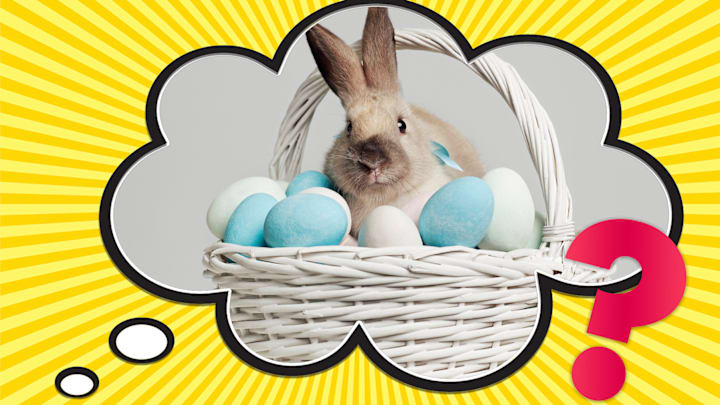
The Easter Bunny, in case you’ve been living in a cave, on Mars, with your fingers in your ears, is an anthropomorphic, egg-laying rabbit who sneaks into homes the night before Easter to deliver baskets full of colored eggs, toys and chocolate. A wise man once told me that “all religions are beautiful and all religions are wacko,” but even if you allow for miracles, angels, and pancake Jesus, the Easter Bunny really comes out of left field.
If you go way back, though, the Easter Bunny starts to make a little sense. Spring is the season of rebirth and renewal. Plants return to life after winter dormancy and many animals mate and procreate. Many pagan cultures held spring festivals to celebrate this renewal of life and promote fertility. One of these festivals was in honor of Eostre or Eastre, the goddess of dawn, spring and fertility near and dear to the hearts of the pagans in Northern Europe. Eostre was closely linked to the hare and the egg, both symbols of fertility.
As Christianity spread, it was common for missionaries to practice some good salesmanship by placing pagan ideas and rituals within the context of the Christian faith and turning pagan festivals into Christian holidays (e.g. Christmas). The Eostre festival occurred around the same time as the Christians’ celebration of Christ’s resurrection, so the two celebrations became one, and with the kind of blending that was going on among the cultures, it would seem only natural that the pagans would bring the hare and egg images with them into their new faith (the hare later became the more common rabbit).
The pagans hung on to the rabbit and eventually it became a part of Christian celebration. We don’t know exactly when, but it’s first mentioned in German writings from the 1600s. The Germans converted the pagan rabbit image into Oschter Haws, a rabbit that was believed to lay a nest of colored eggs as gifts for good children. (A poll of my Twitter followers reveals that 81% of the people who replied believe the Easter Bunny to be male, based mostly on depictions where it’s wearing a bowtie. The male pregnancy and egg-laying mammal aspects are either side effects of trying to lump the rabbit and egg symbols together, or rabbits were just more awesome back then.)
Oschter Haws came to America with Pennsylvania Dutch settlers in the 1700s, and evolved into the Easter Bunny as it became entrenched in American culture. Over time the bunny started bringing chocolate and toys in addition to eggs (the chocolate rabbit began with the Germans, too, when they started making Oschter Haws pastries in the 1800s).

The Easter Bunny also went with European settlers to Australia, as did actual bunnies, since there were no indigenous rabbits in Oz. These rabbits, fertile as they are, got a little out of control, so the Aussies regard them as serious pests. The destruction they’ve caused to habitats is responsible for the major decline of some native animals and causes millions of dollars worth of damage to crops. It is, perhaps, not a great idea to use an invasive species as a symbol for a religious holiday, so Australia retired the Easter Bunny and replaced it with the Easter Bilby (above, on the right), an endangered marsupial that kind of looks like a bunny if you squint.
“Lamb” by Christopher Moore also has an excellent explanation of the origins of the Easter Bunny (and is, overall, a very funny book).
posted by Kate on 4-9-2009 at 1:08 pm
I like the Easter Bilby so much more than an Easter Bunny. In my next lifetime it want to have Easter Pterodactyls
posted by cincypete on 4-9-2009 at 1:21 pm
I always knew the Easter Bunny was male, but I grew up thinking that rather than laying the eggs himself, he employed chickens who painted and decorated the eggs for him… he just gathered them up and delivered them. Must have watched too many cartoons as a tyke.
posted by Mama9cats on 4-9-2009 at 1:30 pm
It is interesting that a bunny that lays eggs happens to be male. It seems that this defiance of the hegemonic sexuality/reproductive norms has been largely overlooked by society.
posted by StrangelyTim on 4-9-2009 at 1:35 pm
Is it just me or does the bunny on the front page looked really honked off and like he’s ready to kill somebody!?
posted by crocostimpy on 4-9-2009 at 1:45 pm
I, too, never thought the Easter Bunny LAID the eggs, he just delivered them.
And given the choice, I’d like to be visited by the Easter Monkey.
posted by TBV on 4-9-2009 at 1:48 pm
Great article! Bill Hicks did a great bit on Easter. The bit starts at 0:22. If you have never heard his comedy I highly recomend it.
youtube.com/watch?v=AnjFhdO90Rg
posted by Stacy on 4-9-2009 at 1:51 pm
Actually, TBV, our family does get visited by the Easter Monkey. A tradition that my uncle began when I was small…he paints bananas and leaves them for the kids in the family. I’m looking forward to my daughter being visited by both Easter Bunny (at home) and Easter Monkey (at the grandparents’ house)!
posted by Laura G. on 4-9-2009 at 2:11 pm
I discovered the Easter Bilby many years ago, whilst working on a website for all things Chocolate. I LOVE the Easter Bilby. My dad, on a trip to Australia, even brought us back chocolate Easter Bilbies (which I hear are easier to find in Western parts of Australia, like Perth, than they are on the Eastern side)…
Awesome post, and you ROCK for mentioning the Easter Bilby!!!
Blessed Ostara (a little laste) and Happy Easter!
posted by Lidiu on 4-9-2009 at 2:25 pm
Crown Candy in Saint Louis is the Home of the Easter Monkey!
posted by Rachael on 4-9-2009 at 2:32 pm
I find the pagan connection to be weakly supported at best. I know that it’s the common one and I also get that it fits the mindset that everyone has about the spread of Christianity. However, there is such a gap between the spread of Christianity and the appearance of the Easter Bunny that I wouldn’t be surprised if the actual source was little more than a tale told to children, without all of the fertility overtones that everyone always brings up. I mean you have to consider that we’re talking at least a 1000 year gap with nothing recorded. Not definitive of course but certainly telling.
posted by David on 4-9-2009 at 2:44 pm
Another one here who never thought the E.B. laid the eggs. I, too, imagine a giant hen house, with the Big Bunny collecting and dyeing eggs.
posted by Vickey on 4-9-2009 at 3:15 pm
I never thought the bunny actually lays the eggs, especially since bunnies are born live. I had a rabbit when I was young so I witnessed this and trying to tell me that they lay eggs would not have fooled me. I was told that he comes around overnight and hides the eggs that we colored and decorated, and he also leaves awesome Easter baskets, hah.
This is what I do with my son now.
posted by Sarah in CA on 4-9-2009 at 3:19 pm
PS – And you’d really be messing with kid’s minds since the Easter Bunny miraculously lays CHICKEN eggs, hahaha.
posted by Sarah in CA on 4-9-2009 at 3:22 pm
I always figured the masculinity of the Easter Bunny was due to our societies inclination to make anyone/thing of importance male. Even something as feminine sounding as an egg-laying rabbit gets masculinized because we would never (god forbid) assume anything to be defaultly female!
posted by Bri on 4-9-2009 at 3:32 pm
i was raised in a catholic household and was never fed any of this bull about the easter bunny being real like santa. the same goes for all of my classmates in catholic school as a kid. kids are more likely to believe that barney is real than the easter bunny.
posted by bob on 4-9-2009 at 4:03 pm
I forget the exact details but my Medieval European History professor, Clifford Backman, told us that in feudal Europe, the peasants had to pay tithes to their lords on holidays and since they didn’t have actual currency, they gave them what they had available to them during Easter, which were eggs and rabbits. If anyone’s interested it’s mentioned somewhere in his book, The Worlds of Medieval Europe
posted by Jessica on 4-9-2009 at 4:25 pm
I read somewhere recently a tale about Eostre changing a wounded bird into a rabbit, but the transformation was incomplete and the bunny could still lay eggs. Anyone else heard of this?
posted by Kevin H on 4-10-2009 at 1:55 pm
Hey Matt, this is a great article. Easter is one of my favorite holidays. It’s another excuse to paint eggs, hide them, and dress up in a huge bunny suit which somehow earns you the adoration of young children. Thanks for demystifying the origin of the bunny. I made a list on my website of the top ten reasons I love about Easter: toptentopten.com/topten/reasons+i+love+easter. You can vote and also add your own reasons.
posted by Vince on 4-10-2009 at 2:31 pm
I grew up on a farm with chickens, so I knew where eggs came from: chicken butts. So when I was told the Easter Bunny laid eggs, I figured the eggs came from his butt. In anticipation of the holiday, I prepared for the holiday by making a nest for the Easter Bunny, sort of the way I would also hang a stocking for Santa. The nest would be a place where the Easter Bunny laid me some Easter eggs. But then, when the Easter Bunny left me such gifts as a BB gun and a box kite, I imagined him pooping me such toys from his butt. I felt sorry for him, imagine how much that must hurt.
posted by wpbrain on 5-7-2009 at 8:47 pm
We should have had the Easter Echidna :: an egg laying mammal!
posted by Ange on 5-10-2009 at 11:24 pm
I grew up in Bolivia. We were too poor to own a chicken, so we didn’t know what eggs where when I was I wee little vaquero. Me Madre did not want us to grow up with no good memories of the resurection of the Jesus man, so she did the best she could. She would spend 3 nights a year (one for each of us bebe’s) in the deepest part of the jungles. When she came home in the mornings, she looked like she had been ran over by a tremendous herd of burros. Years later when I was a grown man supporting myself and my wife at the age of 11, Me Madre finaly told me what she was doing in the deep dark jungles. She said “Pollo Loco”, thats what she call me. It means crazy chicken. Me Madre es Funny, huh? Anyway, she say “Pollo Loco, do you remember when you and your lil’ brother and lil’ sister would wake up on the morning of the Jesus man and you would have little woven baskets with the round tasty treats that tasted sweet and crunchy?” And I says “Yes, Madre. I remembers”. And she says “Well Pollo, I would go into the jungles to offer myself to the man of the mountain. And when he was done with using me up he would give me those pequito nuggets that tasted so sweet”. So that is how me and my brother and my seeester were taught the greatest tradition in our family. It’s all because f me Madre that we celebrate the arrival of the Easter El chupacabra! And if you are a good little vaquero, he will leave one of his sweet, tasty little Chupacabra poops in your basket! I love de Jesus man day! I love me Madre, too.
posted by Brady on 8-31-2009 at 9:37 pm
Where did the Easter bunny come from? The stork brought him!
posted by Miss Cellania on 9-8-2009 at 9:01 am
“As Christianity spread, it was common for missionaries to practice some good salesmanship by placing pagan ideas and rituals within the context of the Christian faith and turning pagan festivals into Christian holidays (e.g. Christmas).”
A little OT, but I thought that the reasons for placing Christmas on Dec 25 were unknown. I thought research showed that it was probable that the whole Christmas celebration being overlaid onto a pagan ritual was an urban myth, since Christmas seems to predate the feast of Sol Invictus by well over a century?
To quote Wikipedia (I know, I know, but it’s all I can get at work on short notice) :-)
“The question of the historical origin of Christmas, and its relationship to the festival of Dies Natalis Solis Invicti remains unresolved (it should be noted that the Romans also celebrated the end of the year with a festival called the Saturnalia, which ended on December 23).”
http://en.wikipedia.org/wiki/Sol_invictus
posted by Mark on 1-7-2010 at 11:42 pm
Every one should know that the easter bunny is a male. The older folks should remember the song; (Here comes Peter cottontail hoppin down the bunny trail).
The name Peter comes from the Bible as Christians wanted to edify Easter as the Holy day that it is. They named the bunny after Peter who hopped back and forth in His faithfullness in the firing line of possibly being crucified with Jesus. Peter denied Jesus in front of the people who were condemning Jesus to the Cross
posted by Bobby Beeman on 1-12-2010 at 9:26 pm
Mark,
Interesting comment. I did some research on the date of Christmas as well. While I can’t be sure why Dec 25 was first used (I believe some eastern Christians use Jan 6), the 2 most rational explanations seemed to be: 1) it was based on a pagan holiday (though there is no indication this was the reason this date was chosen in early church writings – this hypothesis was suggested hundreds of years after the Dec 25 date was established around 400 AD),or 2) there was some early Christian tradition that Jesus was conceived on the same date he was crucified. If he was crucified/conceived in spring, fast forward 9 months and you roughly land on Dec 25. The second hypothesis was new to me a quite interesting.
posted by Andy on 1-27-2010 at 3:39 pm
@ Mark
You’re going to take Ratzinger’s word on the subject?
The feast of Saturnalia predated the celebration of Christmas and Sol Invictus by centuries. Its far, far more likely that these later holidays were overlaid on Saturnalia (or other solstice celebrations) than some independent explanation.
posted by Reality on 2-24-2010 at 1:59 am
As far as I can recall from my readings, there have been celebrations around the solstices and equinoxes all through pre-history and history. Even Easter is set based on the full moon following the vernal equinox! Therefore, the setting of Christmas almost immediately following the winter solstice (also known as Yule) is quite understandable. The earliest celebrations were around the seasons, not the birth or death of anyone.
posted by Rose on 3-5-2010 at 7:05 am
In Mrs. Egolf’s Latin class, we were taught that Christmas coincides with the Saturnalia festival of the ancient Romans. Makes sense to me, as Saturnalia was a celebration of the winter solstice.
I’ll take Mrs. E’s word over Wikipedia.
posted by just me on 3-13-2010 at 5:49 pm
No one really knows for sure, but like many holiday traditions, it probably started out in Europe. As you may know, rabbits are well known for their enthusiastic breeding habits, making them a common symbol of fertility. Each year, we can view Mother Nature and remember that spring is part of the earths’ rebirth and renewal. Somewhere along the way, the prolific little bunny became associated with the prolific springtime display of brightly-colored flowers, blooming bulbs, and green leaves on our trees.
It is also interesting to note that the name Easter was derived Eostre, the Goddess of Fertility. This explains the how eggs, a long-standing symbol of fertility, became associated with Easter. Perhaps the reputation of the rabbits high-energy mating schedule may have started as an Easter joke; however, the association has become cemented in our holiday tradition.
These days, over 90 million chocolate Easter bunnies are made each Easter.
And the more important question is: do you eat the head or the tail first?
posted by Jeanette Hauser on 3-16-2010 at 6:06 pm
The rabbit was the consort of Eostre, the pagan fertility goddess. I always just assumed that the egg and the bunny were 2 seperate symbols of fertility. I never thought the bunny laid eggs. Somehow that just made it all a bit too odd for me.
posted by Jamie on 4-3-2010 at 12:00 am
I thought Jesus was born from a giant egg that came out of giant rabbit butt, he didn’t want anybody to F**k with the Jesus, so he hid him in the bushes.Jesus turned out to be a black man, so most likely his parent was a Chocolate Bunny.
posted by Dylan on 4-3-2010 at 1:17 am
I also heard that the eggs became part of the tradition because in springtime (around Easter) tax collectors would come around for taxes. They would tax farmers on the number of animals they had. Eggs were counted as a chicken so farmers would color them (to make finding them later easier) and hide them so the tax collector did not see them. Then when the tax collector left they would send the children to find them.
posted by Ruth on 10-12-2010 at 2:34 pm
SO, I never considered the EB laying eggs because a) the EB is either a male rabbit, or a very butch female and b) it is a mammal. even the female rabbit would not lay eggs…just assumed that he robbed a chicken coop. not really. I always pictured him with something like elfs…but sitting at cheerfull benches painting eggs.
posted by Megaroo on 1-10-2011 at 5:41 pm
OMG, some of these comments are killin’ me..
And that thing sitting by the foil wrapped Easter wabbit looks like a pissed off possum. Do not want.
posted by Paula on 1-21-2011 at 4:23 pm
Why did they use a rabbit for easter ? does it help childern undrestand easter better or is this something that makes easter more fun for kids in todays time.
posted by Detavious on 3-31-2011 at 9:23 am
The question is; Why did the Easter bunny come years after Jesus has been nailed to a cross.
posted by ReD on 4-18-2011 at 8:46 pm
Born in the UK in 1950, no Bunnies then only Eggs. Migrated to Australia 1962, Guess what was introduced to the Easter Bunny. Must have been introduced by the early settlers. Has got me beat.
posted by Ray Lilley on 4-22-2011 at 1:12 am
Although the Easter Bunny is celebrated in American culture, it’s not celebrated in the Christian tradition of Easter, so “eventually it became a part of Christian celebration” is somewhat incorrect. It’s true that many Christian families talk about the Easter Bunny, but it has nothing to do with the traditional story of Holy Weekend.
posted by Ethan DuBois on 4-22-2011 at 3:31 pm
I like when articles include perfectly ordinary-sounding sentences that the uber-nerds can recognize as Simpsons quotes.
And Chief Hydrological Engineer IS a calling.
posted by Dorkus on 8-17-2011 at 4:16 pm