%20%20--%3E%0A%3Csvg%20version%3D%221.1%22%20id%3D%22Layer_1%22%20xmlns%3D%22http%3A%2F%2Fwww.w3.org%2F2000%2Fsvg%22%20xmlns%3Axlink%3D%22http%3A%2F%2Fwww.w3.org%2F1999%2Fxlink%22%20x%3D%220px%22%20y%3D%220px%22%0A%09%20viewBox%3D%220%200%20684.6%2068.1%22%20style%3D%22enable-background%3Anew%200%200%20684.6%2068.1%3B%22%20xml%3Aspace%3D%22preserve%22%3E%0A%3Cg%3E%0A%09%3Cpath%20d%3D%22M444.1%2C29.3h-17.4v14.5h17.4V29.3z%20M36.4%2C68.1l29.3-50.8V0H50.4L32.9%2C36.8L15.5%2C0H0v68.1h16.7V45.8l12.4%2C22.3H36.4z%0A%09%09%20M49.1%2C68.1h16.6V23.4L49.1%2C52.1V68.1z%20M76.6%2C68.1h45V53.8H93.3V41.6h21V27.1h-21V14.8h28.3V0.1h-45V68.1z%20M175.6%2C68.1h17.3v-68%0A%09%09h-16.5v40.3L150%2C0.1h-17.6v68h16.7V27.7L175.6%2C68.1z%20M235.8%2C14.8h15.4V0.1h-47.4v14.7H219v53.2h16.8V14.8z%20M290.3%2C45.9h-17.1%0A%09%09l7.5-15.6h2L290.3%2C45.9z%20M298.7%2C68.1h18l-32.2-68h-5.7l-32%2C68h18l3.3-7.1h27.1L298.7%2C68.1z%20M325.2%2C68.1h46.2V53.8h-29.6V0.1h-16.7%0A%09%09V68.1z%20M423.7%2C14.8h27.2V0.1H407v68h16.7V14.8z%20M462%2C68.1h46.2V53.8h-29.6V0.1H462V68.1z%20M564.8%2C34.1c0%2C10.7-7.2%2C19.2-18.5%2C19.2%0A%09%09c-11.4%2C0-18.5-8.5-18.5-19.2s7.1-19.2%2C18.5-19.2C557.6%2C14.9%2C564.8%2C23.4%2C564.8%2C34.1%20M580.6%2C34.1c0-19-14.2-34-34.3-34%0A%09%09c-20.2%2C0-34.3%2C15-34.3%2C34c0%2C19%2C14.1%2C34%2C34.3%2C34C566.4%2C68.1%2C580.6%2C53.1%2C580.6%2C34.1%20M604.8%2C20.5c0-4.1%2C3.3-6.2%2C6.7-6.2%0A%09%09c4.4%2C0%2C6.6%2C3%2C6.6%2C6.6h14.7C631.8%2C9.1%2C625.1%2C0.1%2C611%2C0.1c-12%2C0-21.7%2C9.3-21.7%2C20.6c0%2C10.9%2C5.9%2C15.9%2C16.7%2C19.8%0A%09%09c5.2%2C1.8%2C11.5%2C3.2%2C11.5%2C8c0%2C3.3-2.4%2C5.5-6.4%2C5.5c-3.6%2C0-6.6-3-6.6-6.7h-15.2c0%2C11.5%2C7.9%2C20.8%2C21.8%2C20.8c12%2C0%2C21.6-9.3%2C21.6-20.6%0A%09%09c0-10-5.3-16.4-16.7-19.8C610.6%2C26.1%2C604.8%2C25.3%2C604.8%2C20.5%20M670%2C20.9h14.7C683.8%2C9.1%2C677.1%2C0.1%2C663%2C0.1c-12%2C0-21.7%2C9.3-21.7%2C20.6%0A%09%09c0%2C10.9%2C5.9%2C15.9%2C16.7%2C19.8c5.2%2C1.8%2C11.5%2C3.2%2C11.5%2C8c0%2C3.3-2.4%2C5.5-6.4%2C5.5c-3.6%2C0-6.6-3-6.6-6.7h-15.2c0%2C11.5%2C7.9%2C20.8%2C21.8%2C20.8%0A%09%09c12%2C0%2C21.6-9.3%2C21.6-20.6c0-10-5.3-16.4-16.7-19.8c-5.4-1.6-11.3-2.4-11.3-7.2c0-4.1%2C3.3-6.2%2C6.7-6.2C667.7%2C14.4%2C670%2C17.3%2C670%2C20.9%0A%09%09%22%2F%3E%0A%3C%2Fg%3E%0A%3C%2Fsvg%3E%0A)

Although its origins are unknown, there is at least a theory that, as a folkish name for the violin, the word fiddle can be traced back to Vitula, the name of a little-known Roman goddess of joy, victory, and exultation.
That etymology is by no means assured, but it could potentially make both fiddle and violin etymological cousins as well as synonyms, because viol, viola, and violin all also have been claimed to derive from the same root.
Admittedly, as popular an etymological tale as that may be, the written and historical evidence here doesn’t really give us enough to go on. But that’s not to say that Vitula is the only Roman deity hiding in our everyday vocabularies.
Let’s consider 10 additional Roman mythology words you use every day.
CEREAL

Ceres was a Roman goddess of agriculture, fertility, and the harvest, and the equivalent of the Greek goddess Demeter. As part of her responsibility was with food plants, her name came to be associated with the grains and other crops grown in Ancient Rome, and eventually gave us the word cereal. In the sense of growing or building over time, moreover, the Latin roots attached to Ceres’ name make it a distant etymological cousin of the Latin verb crescere, meaning to “grow”—which is likewise the origin of words such as creation, increase, procreate, and crescent.
FLORA AND FAUNA

Both of these frequently paired words were once the names of Roman goddesses. Flora was a Roman goddess of flowering plants, who was typically depicted in Roman art as wearing a garland of flowers around her head. Fauna, meanwhile, was a goddess of the woodlands, fields, pasture, flocks of animals, and, through association with them, of fertility and husbandry. Different accounts of her story present her as either the wife, daughter, or sister of the Roman god Faunus, who was in turn the Roman equivalent of the goat-legged Greek god Pan.
JANUARY

As the first month of the year, January derives its name from that of the dual-faced Roman god of entrances, archways and doorways, Janus. According to Roman tradition, Janus’ two faces would look outward in opposite directions—both in and out of whatever doorway or entrance way he was guarding, or, in the case of January, back over the year that has just gone, and forward into the year to come. In the sense of someone who acts as a custodian to an entranceway, meanwhile, it’s like Janus’ name too is related to the word janitor.
JOVIAL

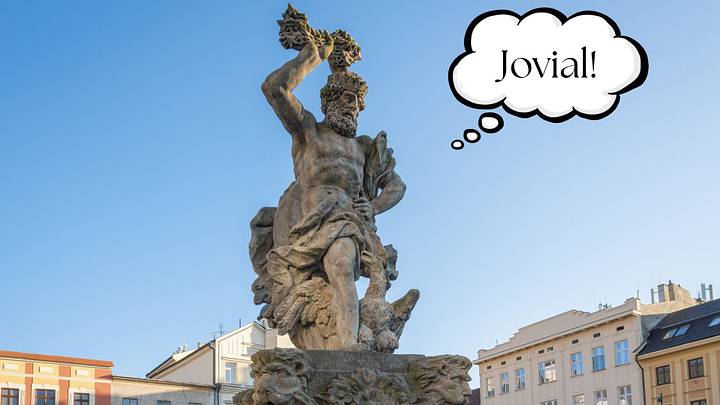
Jove was an epithet of the Roman king of the gods, Jupiter, who was in turn the Roman equivalent of Zeus. The related adjective jovial was originally used in astrological contexts to describe people born under or showing the influence of the planet Jupiter—but because that alignment of the stars and planets was said to produce an easy-going, joyful temperament, the word eventually came to be used to mean breezy or fun-loving. In astrological tradition, jovial was contrasted with saturnine, meaning gloomy or temperamental, which similarly derives from the name of Jupiter’s father in Roman mythology, Saturn.
MARTIAL AND MARTIN

Given their associations with fighting, conflict, and weaponry, the martial in words and phrases like court-martial, martial arts, and martial law derives from the name of the Roman god of war, Mars.
The boy’s name Martin likewise derives from the Latin Martinus, a diminutive form of the name of the Roman war god, Mars. No one is entirely sure how the name then became attached to the swallow-like birds we now know as Martins, but popular history claims the birds were traditionally claimed to have always departed Europe by the time of St. Martin’s Day, on November 11.
MERCURY

Perhaps originally in reference to the speed at which it appears to orbit the Sun, the planet Mercury takes its name from the swift-footed Roman messenger god Mercury—but so too does the liquid metal mercury, or quicksilver, found in some thermometers. The two have been connected since the 6th century at least, back when the planet’s symbol was used to represent mercury metal in ancient alchemy; the name as it is today emerged somewhat later, however, and is derived directly from medieval Latin.
MONEY

Moneta, literally meaning “the warner,” was an epithet of the Roman goddess Juno, the queen of the gods and female counterpart of Jupiter. A temple to Juno Moneta on Rome’s Capitoline Hill was erected in 344 BC; when it was later repurposed as a Roman mint, from where coinage could be produced and sent out across the empire, both the words mint (in this context, at least) and money came to derive from her name.
VULCANIZATION

Vulcan was the Roman god of fire, whose name (as well as giving us the word volcano) was invoked by the inventor Charles Goodyear in 1839 when he concocted a process of heat-treating rubber to produce a tougher, more durable product. The process Goodyear invented—which involves superheating the rubber with sulfur—has been known as vulcanization ever since.