%20%20--%3E%0A%3Csvg%20version%3D%221.1%22%20id%3D%22Layer_1%22%20xmlns%3D%22http%3A%2F%2Fwww.w3.org%2F2000%2Fsvg%22%20xmlns%3Axlink%3D%22http%3A%2F%2Fwww.w3.org%2F1999%2Fxlink%22%20x%3D%220px%22%20y%3D%220px%22%0A%09%20viewBox%3D%220%200%20684.6%2068.1%22%20style%3D%22enable-background%3Anew%200%200%20684.6%2068.1%3B%22%20xml%3Aspace%3D%22preserve%22%3E%0A%3Cg%3E%0A%09%3Cpath%20d%3D%22M444.1%2C29.3h-17.4v14.5h17.4V29.3z%20M36.4%2C68.1l29.3-50.8V0H50.4L32.9%2C36.8L15.5%2C0H0v68.1h16.7V45.8l12.4%2C22.3H36.4z%0A%09%09%20M49.1%2C68.1h16.6V23.4L49.1%2C52.1V68.1z%20M76.6%2C68.1h45V53.8H93.3V41.6h21V27.1h-21V14.8h28.3V0.1h-45V68.1z%20M175.6%2C68.1h17.3v-68%0A%09%09h-16.5v40.3L150%2C0.1h-17.6v68h16.7V27.7L175.6%2C68.1z%20M235.8%2C14.8h15.4V0.1h-47.4v14.7H219v53.2h16.8V14.8z%20M290.3%2C45.9h-17.1%0A%09%09l7.5-15.6h2L290.3%2C45.9z%20M298.7%2C68.1h18l-32.2-68h-5.7l-32%2C68h18l3.3-7.1h27.1L298.7%2C68.1z%20M325.2%2C68.1h46.2V53.8h-29.6V0.1h-16.7%0A%09%09V68.1z%20M423.7%2C14.8h27.2V0.1H407v68h16.7V14.8z%20M462%2C68.1h46.2V53.8h-29.6V0.1H462V68.1z%20M564.8%2C34.1c0%2C10.7-7.2%2C19.2-18.5%2C19.2%0A%09%09c-11.4%2C0-18.5-8.5-18.5-19.2s7.1-19.2%2C18.5-19.2C557.6%2C14.9%2C564.8%2C23.4%2C564.8%2C34.1%20M580.6%2C34.1c0-19-14.2-34-34.3-34%0A%09%09c-20.2%2C0-34.3%2C15-34.3%2C34c0%2C19%2C14.1%2C34%2C34.3%2C34C566.4%2C68.1%2C580.6%2C53.1%2C580.6%2C34.1%20M604.8%2C20.5c0-4.1%2C3.3-6.2%2C6.7-6.2%0A%09%09c4.4%2C0%2C6.6%2C3%2C6.6%2C6.6h14.7C631.8%2C9.1%2C625.1%2C0.1%2C611%2C0.1c-12%2C0-21.7%2C9.3-21.7%2C20.6c0%2C10.9%2C5.9%2C15.9%2C16.7%2C19.8%0A%09%09c5.2%2C1.8%2C11.5%2C3.2%2C11.5%2C8c0%2C3.3-2.4%2C5.5-6.4%2C5.5c-3.6%2C0-6.6-3-6.6-6.7h-15.2c0%2C11.5%2C7.9%2C20.8%2C21.8%2C20.8c12%2C0%2C21.6-9.3%2C21.6-20.6%0A%09%09c0-10-5.3-16.4-16.7-19.8C610.6%2C26.1%2C604.8%2C25.3%2C604.8%2C20.5%20M670%2C20.9h14.7C683.8%2C9.1%2C677.1%2C0.1%2C663%2C0.1c-12%2C0-21.7%2C9.3-21.7%2C20.6%0A%09%09c0%2C10.9%2C5.9%2C15.9%2C16.7%2C19.8c5.2%2C1.8%2C11.5%2C3.2%2C11.5%2C8c0%2C3.3-2.4%2C5.5-6.4%2C5.5c-3.6%2C0-6.6-3-6.6-6.7h-15.2c0%2C11.5%2C7.9%2C20.8%2C21.8%2C20.8%0A%09%09c12%2C0%2C21.6-9.3%2C21.6-20.6c0-10-5.3-16.4-16.7-19.8c-5.4-1.6-11.3-2.4-11.3-7.2c0-4.1%2C3.3-6.2%2C6.7-6.2C667.7%2C14.4%2C670%2C17.3%2C670%2C20.9%0A%09%09%22%2F%3E%0A%3C%2Fg%3E%0A%3C%2Fsvg%3E%0A)

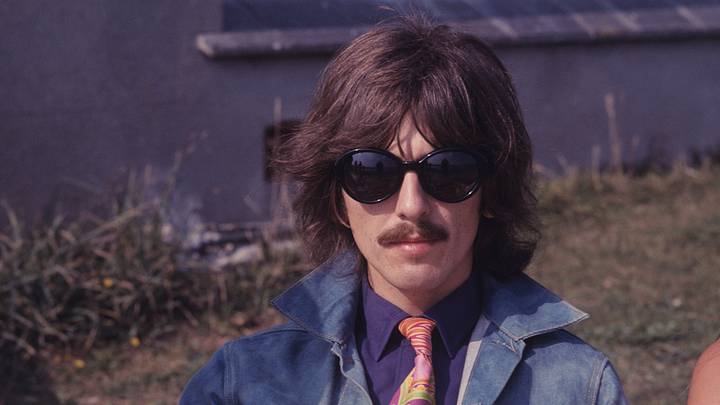
George Harrison first laid his hands on a sitar on the set of the film Help! That moment kicked off a lifelong love affair with Indian music for Harrison, who helped bring the instrument and its intricate, angular sound to the mainstream in the West after featuring it on the Beatles song “Norwegian Wood.”
Harrison went on to go to India to study with the sitarist Ravi Shankar in 1966. During his time with Shankar, Harrison developed a deeper interest in Indian philosophy. It was around then that Shankar handed him a book that would change his life. That same book also played a major role in popularizing Vedic philosophy for countless seekers around the world.
George Harrison and Autobiography of a Yogi

Shankar later recalled the moment he handed the tome to Harrison. “I gave him his first copy of Autobiography of a Yogi,” Shankar said, “and that was where his interest in Vedic culture and Indian-ness began. To me, he was something like a son.”
Harrison also remembered the same moment vividly, and told the story of it in a video about its author, Paramahansa Yogananda. “While I was in India with Ravi [Shankar], I kept saying, ‘I want to know about the yogis of the Himalayas’…he and his brother, Raju, gave me…Autobiography of a Yogi,” Harrison said. “It was an Indian copy—English text, but from India. I looked at the cover and Yogananda just zapped me with his eyes, and that was it—it was all over!”
The text was pivotal. “Then I read the book—and it gave me goose bumps,” he continued. “With some things you read you think, ‘Well, I’m not sure about that.’ But with Autobiography of a Yogi I was totally convinced about every word in the book; somehow his pureness and his heart just flowed out of it. I keep stacks of Autobiography of a Yogi around the house, and I give it out constantly to people. When people need regrooving, I say read this, because it cuts to the heart of every religion.”
Harrison’s love for Yogananda was such that he added a photo of him, his guru Sri Yukteswar Giri, Yogananda’s grand guru Lahiri Mahasaya, and Mahasaya’s guru Sri Mahavatara Babaji to the cover of Sgt. Pepper’s Lonely Hearts Club Band. Harrison meant for these inclusions to be small clues into his spiritual nature, which had become more important to him than making hit songs.
“I’d give up everything if I could be a monk walking from one side of India to the other,” he said to artist Peter Max at the time. He also infused his contribution to Sgt. Pepper’s Lonely Hearts Club Band, the song “Within You Without You,” with Indian spirituality, recording the song with Indian musicians and filling its lyrics with spiritual observations such as the lyric, “When you have seen beyond yourself you may find peace of mind is waiting there.”
Over the years, Harrison frequently reflected on just how much Yogananda influenced his belief system. “[Paramahansa Yogananda]'s probably been the greatest inspiration to me though I never met Yogananda personally, but he's had such a terrific influence on me for some very subtle reason,” Harrison said. “A lot of my feelings are the result of what he taught, and is still teaching in his subtle state.”
The Story of Autobiography of a Yogi

Autobiography of a Yogi was published by Yogananda in 1946. It details the author’s early life as a sensitive child, and explores how he connected to his guru, developed his own spiritual school, and eventually came to America.
Along the way, Yogananda tells extraordinary stories of encounters with various gurus and figures who perform seemingly impossible miracles, such as a saint who he says survived for decades without eating. These feats, he explains, are performed through deep meditation and spiritual practice that have enabled these people to transcend their bodies and even the limits of life through an understanding of one’s true, divine nature.
Yogananda is often called the Father of Yoga in the West, and played a major role himself in bringing Vedic philosophy around the world. At his guru’s behest, he established an ashram in Los Angeles and devoted himself to sharing Vedic insights, including the science of yoga and self-realization.
Yogananda’s insights were unique in that he often combined Hinduism and Christianity in his teachings, writing that Jesus was real and had achieved Christ Consciousness, or an awareness of his perfect oneness with God. The essential message of his book is that the purpose of life is to find God, and God can only be found within oneself. This, according to his philosophy, can be found through deep meditation and deep presence with the world around you, which can help you realize that there is actually no separation between oneself and the divine.
Harrison agreed with this view. “From the Hindu point of view each soul is potentially divine, the goal is to manifest the divinity…The Lord, or God, has got a million names, whatever you want to call him, it doesn’t matter as long as you call him, Jesus is on the mainline, tell him what you want,” he said at a 1974 press conference.
Harrison Dives Deeper Into Spirituality
Following the Beatles’ breakup, Harrison dove deeper into Indian music and spirituality, filling his song “My Sweet Lord” with mantras and repeating “Hare Krishna” over and over alongside “Hallelujah.”
“I wanted to show that ‘Hallelujah’ and ‘Hare Krishna’ are quite the same thing,” Harrison said of the decision to pair the two mantras in the song. His music helped popularize Indian spirituality in the West, adding fuel to a movement of people looking for deeper spiritual meaning, purpose, and peace.
Shankar, meanwhile, continued to accompany Harrison on his journeys and performed at Monterey and Woodstock, becoming beloved by hippies of the era along the way. However, Shankar took issue with the commercialization and simplification of Vedic philosophy that characterized the time period.
“I was extremely unhappy about the superficiality of it all, especially the wrong information that Dr. Timothy Leary and others were propagating—that everyone in India takes drugs,” he said. “It was a hodgepodge of Kama Sutra, Tantra, yoga, hash and LSD, while the true spiritual quality of our music was almost completely lost.”
Still, Harrison and Shankar remained friends until Harrison’s death in 2001. Harrison continued his spiritual work, and at one point he even handed a copy of Autobiography of a Yogi to President Gerald Ford when the two met.
The former Beatle often spoke out about his devotion to spirituality and his dedication to awakening others. “I always felt at home with Krishna. You see it was already a part of me. I think it’s something that’s been with me from my previous birth,” he once said. “I’d rather be one of the devotees of God than one of the straight, so-called sane or normal people who just don’t understand that man is a spiritual being, that he has a soul.”
After his own death in 2001, Harrison’s family brought some of his ashes to Self-Realization Fellowship Lake Shrine in Pacific Palisades, California, which Yogananda established.
Autobiography of a Yogi’s Influence on Other Fans
Autobiography of a Yogi has found fans in many spiritual seekers through the ages. The book was a favorite of Elvis Presley, who took it on tour with him along with a number of other spiritual texts. And at Steve Jobs’ funeral, guests were all given a copy of the book on their way out. The Apple founder first read the book in high school, and read it every year since, according to Walter Isaacson’s biography. Jobs credited the book with helping him access the intuition he needed to bring Apple to life.
Ultimately, Harrison remains one of the book’s biggest advocates. Yogananda’s open-hearted philosophy lives on in the lyrics of many of Harrison’s spiritual songs, which urge the listener to beware of the seductiveness of the world of form.
“Every one of us has within us a drop of that ocean and we have the same qualities as God, just like a drop of the ocean has the same qualities as the whole ocean,” Harrison said in 1974. “Everybody’s looking for something and we are it. We don’t have to look anywhere—it’s right there within ourselves.”