%20%20--%3E%0A%3Csvg%20version%3D%221.1%22%20id%3D%22Layer_1%22%20xmlns%3D%22http%3A%2F%2Fwww.w3.org%2F2000%2Fsvg%22%20xmlns%3Axlink%3D%22http%3A%2F%2Fwww.w3.org%2F1999%2Fxlink%22%20x%3D%220px%22%20y%3D%220px%22%0A%09%20viewBox%3D%220%200%20684.6%2068.1%22%20style%3D%22enable-background%3Anew%200%200%20684.6%2068.1%3B%22%20xml%3Aspace%3D%22preserve%22%3E%0A%3Cg%3E%0A%09%3Cpath%20d%3D%22M444.1%2C29.3h-17.4v14.5h17.4V29.3z%20M36.4%2C68.1l29.3-50.8V0H50.4L32.9%2C36.8L15.5%2C0H0v68.1h16.7V45.8l12.4%2C22.3H36.4z%0A%09%09%20M49.1%2C68.1h16.6V23.4L49.1%2C52.1V68.1z%20M76.6%2C68.1h45V53.8H93.3V41.6h21V27.1h-21V14.8h28.3V0.1h-45V68.1z%20M175.6%2C68.1h17.3v-68%0A%09%09h-16.5v40.3L150%2C0.1h-17.6v68h16.7V27.7L175.6%2C68.1z%20M235.8%2C14.8h15.4V0.1h-47.4v14.7H219v53.2h16.8V14.8z%20M290.3%2C45.9h-17.1%0A%09%09l7.5-15.6h2L290.3%2C45.9z%20M298.7%2C68.1h18l-32.2-68h-5.7l-32%2C68h18l3.3-7.1h27.1L298.7%2C68.1z%20M325.2%2C68.1h46.2V53.8h-29.6V0.1h-16.7%0A%09%09V68.1z%20M423.7%2C14.8h27.2V0.1H407v68h16.7V14.8z%20M462%2C68.1h46.2V53.8h-29.6V0.1H462V68.1z%20M564.8%2C34.1c0%2C10.7-7.2%2C19.2-18.5%2C19.2%0A%09%09c-11.4%2C0-18.5-8.5-18.5-19.2s7.1-19.2%2C18.5-19.2C557.6%2C14.9%2C564.8%2C23.4%2C564.8%2C34.1%20M580.6%2C34.1c0-19-14.2-34-34.3-34%0A%09%09c-20.2%2C0-34.3%2C15-34.3%2C34c0%2C19%2C14.1%2C34%2C34.3%2C34C566.4%2C68.1%2C580.6%2C53.1%2C580.6%2C34.1%20M604.8%2C20.5c0-4.1%2C3.3-6.2%2C6.7-6.2%0A%09%09c4.4%2C0%2C6.6%2C3%2C6.6%2C6.6h14.7C631.8%2C9.1%2C625.1%2C0.1%2C611%2C0.1c-12%2C0-21.7%2C9.3-21.7%2C20.6c0%2C10.9%2C5.9%2C15.9%2C16.7%2C19.8%0A%09%09c5.2%2C1.8%2C11.5%2C3.2%2C11.5%2C8c0%2C3.3-2.4%2C5.5-6.4%2C5.5c-3.6%2C0-6.6-3-6.6-6.7h-15.2c0%2C11.5%2C7.9%2C20.8%2C21.8%2C20.8c12%2C0%2C21.6-9.3%2C21.6-20.6%0A%09%09c0-10-5.3-16.4-16.7-19.8C610.6%2C26.1%2C604.8%2C25.3%2C604.8%2C20.5%20M670%2C20.9h14.7C683.8%2C9.1%2C677.1%2C0.1%2C663%2C0.1c-12%2C0-21.7%2C9.3-21.7%2C20.6%0A%09%09c0%2C10.9%2C5.9%2C15.9%2C16.7%2C19.8c5.2%2C1.8%2C11.5%2C3.2%2C11.5%2C8c0%2C3.3-2.4%2C5.5-6.4%2C5.5c-3.6%2C0-6.6-3-6.6-6.7h-15.2c0%2C11.5%2C7.9%2C20.8%2C21.8%2C20.8%0A%09%09c12%2C0%2C21.6-9.3%2C21.6-20.6c0-10-5.3-16.4-16.7-19.8c-5.4-1.6-11.3-2.4-11.3-7.2c0-4.1%2C3.3-6.2%2C6.7-6.2C667.7%2C14.4%2C670%2C17.3%2C670%2C20.9%0A%09%09%22%2F%3E%0A%3C%2Fg%3E%0A%3C%2Fsvg%3E%0A)

Cat-and-mouse team Tom and Jerry (although originally unnamed) made their debut on the big screen way back in 1940. They then went on to star in more than MGM 100 theatrical animated shorts in the 1940s and ‘50s, several of which won Academy Awards. When their creators, animators William Hanna and Joseph Barbera, left MGM in 1957, the duo briefly disappeared from cinemas until they were revived by MGM in 1961, with director Gene Deitch now in charge of the series. Deitch, however, wasn’t a fan—and when the original MGM shorts were repackaged and syndicated for Saturday morning television in the 1960s, the series quickly proved controversial.
Although Tom and Jerry had always had its fair share of slapstick humor, both Deitch (who initially dismissed the cartoons as “needlessly violent”) and American parents alike found it all a little too much to take, and so the 1960s cartoons were largely toned down.
But Tom and Jerry are by no means alone in stoking controversy despite their enduring popularity, and their otherwise rather tame and unprovocative content.
I LOVE LUCY (1951–1957)

It might have been one of the most popular shows of its time, but back in the 1950s I Love Lucy saw its fair share of controversies—some before the first episode was even broadcast.
Real-life husband and wife Lucille Ball and Desi Arnaz had been together for almost a decade when CBS executives approached Ball to transfer her successful radio show, My Favorite Husband, to television. She and Arnaz saw it as a chance to work together, but producers thought otherwise and pushed back on Arnaz’s casting before the show had even been picked up.
“The people [at Ball’s talent agency] said the public wouldn’t believe I was married to Desi,” Ball said in a retrospective interview after the show came to an end in 1958. “He talked with a Cuban accent, and after all, what typical American girl is married to a Latin?”
Even after Ball fought back against the institutional racism that Arnaz faced in even landing his role in the show, I Love Lucy continued to court controversy. When Ball became pregnant in 1952, the decision was made to write her pregnancy into the show—but executives banned the word “pregnant” from ever being spoken, advertisers warned never to show her pregnancy bump, and CBS even demanded each episode’s script be ran by a priest, a minister, and a rabbi to ensure it wasn’t too morally questionable.
In the end, the plotline proved one of the biggest successes in television history, with the finale—“Lucy Goes to the Hospital”—watched by a staggering 70% of television audience.
THE THREE STOOGES (1958)

In much the same way that Tom and Jerry had caused uproar when it was syndicated for the small screen in the 1960s, The Three Stooges likewise came under fire for glorifying violence when their shorts were adapted for syndication in the late 1950s.
In particular, PTA organizations and a group known as NABRTV, or The National Association for Better Radio and Television, singled the films out as “old relics” that were not suitable for children. The backlash even led to the Stooges taking to the airwaves themselves to prove that their slapstick comedy was actually carefully choreographed, ensuring that none of them ever got hurt.
THAT WAS THE WEEK THAT WAS (1962–1963)
In 1962, the BBC broke new ground with a short-lived satirical comedy show presented by David Frost (best known to Americans for his interviews with Richard Nixon) called That Was the Week That Was. The series—which poked fun at everyone from politicians and media figures to the prime minister and even royalty—quickly proved so successful with audiences that an American version followed in 1964, and ran weekly for 50 episodes.
As commonplace as satire is on television today, however, back in the early ‘60s—and especially on the hallowed British Broadcasting Company—things weren’t quite so open, and from its very first episode That Was the Week That Was caused outrage in the British political and media class.
Reportedly, having fielded several angry telephone calls from newspaper editors, Britain’s Postmaster General Reg Bevins, the minister then in charge of broadcasting, released a statement to the morning papers saying that he was going to “do something about this.” When he arrived at his office, however, he found a note from Prime Minister Harold Macmillan, reading, “Oh no you’re not.”
I DREAM OF JEANNIE (1965–1970)

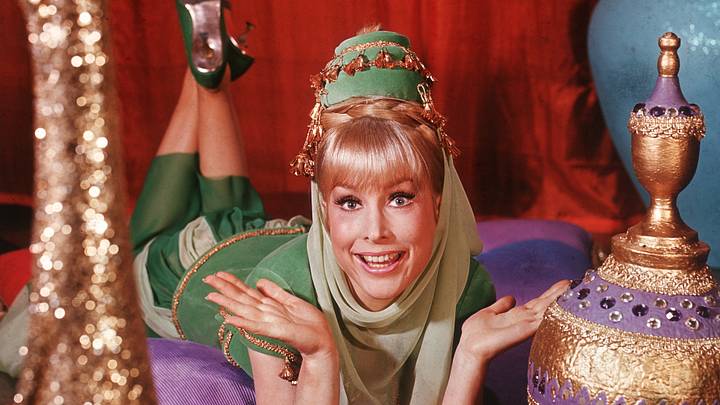
Of all the television shows to fall foul of early censorship rules, the quaint and sweet NBC sitcom I Dream of Jeannie might seem like an unlikely target. In fact, the show quickly caused a stir when executives first got wind of the bright pink costume that was to be worn by the eponymous star, Barbara Eden. The costume showed Eden’s midriff, leading censors to demand that, if she is to wear it on screen, her belly-button can never be seen.
STAR TREK (1966–1969)

As any Star Trek fan will doubtless tell you, the original 1960s series proved groundbreaking in several rather unexpected ways, with series creator Gene Roddenberry using the show’s futuristic sci-fi dressing to tackle a number of important issues, and push boundaries on several others—including in the Starship Enterprise’s noticeably international crew.
Perhaps most notably of all, though, the 1968 episode “Plato’s Stepchildren” saw Captain Kirk and Lieutenant Uhura share an interracial kiss, which saw the episode banned in several U.S. states. The episode came just one year after interracial marriage was made legal in the United States.
MONTY PYTHON’S FLYING CIRCUS (1969–1974)

Quintessentially British surreal sketch show Monty Python’s Flying Circus helped to launch the international careers of all its stars—including John Cleese, Eric Idle, and Terry Gilliam—but caused considerable controversy over its five-year run on the BBC.
The series (and even more notoriously, the troupe’s 1979 movie Life of Brian) faced considerable backlash at the time from religious groups, who saw much of their content as blasphemous. One notorious sketch in particular (about a cannibalistic mortician) was so shocking that its broadcast quickly led to a meeting of BBC executives who deemed the show “appalling,” “nihilistic,” and “cruel.”
ALL IN THE FAMILY (1971–1979)

Long-running sitcom All in the Family famously broke new ground in the 1970s by overtly tackling a raft of taboo issues including racism, homosexuality, and the Vietnam War. Perhaps understandably, that content—and the overt way in which it was tackled by the series’ bigoted central patriarch, Archie Bunker—caused considerable controversy among critics and viewers alike.
Before the first episode was even broadcast, CBS were so nervous of the series that they aired a disclaimer before the premiere, stating: “The program you are about to see is ‘All in the Family.’ It seeks to throw a humorous spotlight on our frailties, prejudices, and concerns. By making them a source of laughter we hope to show, in a mature fashion, just how absurd they are.”
MAUDE (1972–1978)

A spin-off of All in the Family, Maude, created by Norman Lear and starring future Golden Girl Bea Arthur in the title role, likewise brought several contentious subjects into American living rooms. Most notable of all was a two-part episode in the show’s debut season, in which 47-year-old Maude discovers she is pregnant, considers having an abortion, and discusses her husband getting a vasectomy.
A staggering 7,000 letters of complaint followed, but the show proved an immense success and continued to push boundaries over its six-year run.
M*A*S*H (1972–1983)

Considering that its finale is still the single most-watched episode of television in history, it’s easy to forget just how controversial Korean War sitcom M*A*S*H was when it was first broadcast in the early 1970s.
Its anti-war and anti-establishment tone understandably ruffled many feathers during its 11-year run, but notable clashes with CBS producers included the removal of the laugh-track (a compromise was eventually reached that there would be no laughter during scenes of surgical procedures), the removal of the word “virgin” from the script (despite it being said in the context of a soldier who had never fought in war before), and a particularly contentious episode in which it was implied that Alan Alda’s Hawkeye was seeing two women at the same time (a script idea that never even made it to air).
SATURDAY NIGHT LIVE (1975–)

Now a stalwart of American comedy television, Saturday Night Live has never shied away from difficult subjects or lampooning prominent political figures, but its early episodes proved especially controversial.
As if bringing countercultural viewpoints and outrageous political satire to network television in the mid ‘70s wasn’t provocative enough, when legendary notorious comedian Richard Pryor was hired as guest host the show only seven episodes into its debut season in 1975, NBC censors were nervous. Producer Lorne Michaels reportedly threatened to walk out if Pryor was not allowed to host, so in the end a compromise was reached and the episode was aired on a five-second delay, allowing the network to pull the plug if Pryor went too far off script.
I, CLAUDIUS (1976)
Costume dramas might not seem the most controversial of programs, but when the BBC decided to produce a lavish and star-studded adaptation of Robert Graves’ classic 1934 historical novel I, Claudius for television in 1976, the were soon in hot water.
The series—which related the early history of the Roman Empire, from the perspective of Emperor Claudius (played by legendary Shakespearean actor Derek Jacobi)—was an instant hit with audiences, but caused an understandable stir with its unflinching depictions of sex, adultery, prostitution, violence, homosexuality, abortion, and even incest.
THE GONG SHOW (1976–1980)

Although some early performers included the likes of Steve Martin, Broadway star Andrea McArdle, and even composer Danny Elfman (as part of his band Oingo Boingo), anarchic TV talent show The Gong Show, hosted by Chuck Barris, is perhaps best known for continually pushing the limits of what was allowed on television—but according to Barris, much of that was intentional.
Barris would supposedly intentionally hire provocative or close-to-the-bone acts for the show, on the theory that their outrageousness would attract the censors’ attention and allow all the other questionable acts through. His plan infamously backfired in 1977, when a performance by the “Popsicle Twins”—two barefoot 17-year-old girls in shorts, sat on the stage sucking popsicles while listening to “I’m in the Mood for Love”—was unexpectedly let through.
The broadcast was pulled before the performance reached the West Coast, but by then it was too late and a raft of complaints swiftly followed.
SOAP (1977–1981)
Long before she created The Golden Girls, writer Susan Harris caused a stir in the late 1970s when she came up with a prime-time sitcom that parodied daytime soap operas. Soap—which Harris wrote, directed, and produced—went on to run for four seasons and over 80 episodes. But it almost never made it to air at all.
In 1977, ABC sent out the first two episodes of Soap to its affiliate executives, and almost immediately received word that the show was not going to be well received. The feedback quickly found its way into the press, and before a single episode had been broadcast the show received immense numbers of complaints and protests—chiefly from religious groups and organizations (who were particularly incensed by word that the show would feature a Catholic priest being seduced inside a confessional)—and lost a number of advertisers.
ABC president Fred Silverman tried his best to downplay the controversy, but ironically the extra press proved sufficient advertising to make Soap one of the network’s biggest hits, despite the uproar.
EASTENDERS (1985–)

Now in its fifth decade, BBC prime-time soap opera EastEnders is one of the UK’s longest running television shows. Set around Albert Square, a neighborhood in the fictional borough of Walford in London’s East End (hence the name), EastEnders debuted on February 19, 1985, and immediately ran into controversy after only its first few opening minutes.
Viewers tuning in expecting a light-hearted and family-friendly early-evening show on the UK’s national broadcaster were instead met with a grim scene in which three local Walford residents force their way into a neighbor’s flat, only to find him dying in his armchair. The dark tone, macabre opening scene, and gritty language led to considerable pushback, with infamous 1980s moral campaigner Mary Whitehouse labeling the show, “a sordid story made in a controversial way,” and “one of the worst programs the BBC had ever made.”
GHOSTWATCH (1992)
Another now infamous British broadcast, Ghostwatch was a 90-minute Halloween special, broadcast “live” on the BBC on October 31, 1992. The show—which was actually a one-off drama, written and recorded months in advance—was marketed and presented as a genuine documentary-like investigation of paranormal activity at a family’s property in London that was supposedly haunted by a poltergeist known as Pipes.
Adding realism to the broadcast, legendary British talk show host and journalist Michael Parkinson was hired to present the show, with fellow BBC stalwarts Sarah Greene (best known at the time for hosting Saturday morning children’s television) and her broadcaster husband Mike Smith providing supplementary interviews, live investigations, and fielding (entirely fictional) telephone calls from viewers.
As the broadcast continued, the paranormal activity in the house was shown to gradually increase, with the family’s daughter apparently possessed by Pipes’ ghost, and Pipes himself making eerie appearances in the background of several shots. The haunting escalates to a memorable and surprisingly effective finale (that we won’t spoil here).
The hoax, perhaps understandably, traumatized the show’s viewers who were fully sold on its realism and the escalating horror of the haunting. Thousands of complaints were filed to the BBC (including one from a pregnant woman who apparently went into labor from the stress of watching it). Although now a legendary moment of British broadcast history, Ghostwatch has never been broadcast in the UK again.
BEAVIS AND BUTT-HEAD (1993–1997)

Animated series Beavis and Butt-Head caused immediate concern among parents, politicians, critics, and media watchdogs alike on its first broadcast in 1993, thanks to its crude humor and depictions of questionable behavior.
The show infamously came under increased scrutiny just a month into its first season, when it was blamed for the death of a two-year-old girl in a mobile home fire in Ohio that had been started by her five-year-old brother. The pair’s mother blamed an episode in which Beavis and Butt-Head claimed “fire is cool” for inspiring her son to start the fire (although quite how true that was later came under scrutiny itself).
NYPD BLUE (1993–2005)

Classic ‘90s cop serial NYPD Blue met with instant critical acclaim on its first broadcast in 1993, with its first season picking up a record-setting 26 Emmy Award nominations. But from even its first few minutes on screen, the show instantly courted controversy with its use of bad language and nudity, with the show quickly denounced by anti-obscenity activist groups, including the American Family Association. Amid the controversy—and despite the glowing critical acclaim—a quarter of ABC’s 200 networks refused to broadcast the pilot episode.
QUEER AS FOLK (1999)
Later adapted in both the U.S. and Canada, TV drama Queer As Folk—originally chronicling the lives of three gay men in Manchester, England—was created by future Doctor Who showrunner Russell T Davies, and broadcast on the UK’s Channel 4 network across a limited run of just eight episodes in 1999.
Its unflinching portrayal of life among young gay men in the ‘90s, including considerable on-screen nudity and sex, caused immediate controversy in the British press, with the famously conservative-leaning Daily Mail newspaper lamenting that the show “proves that we need censorship.”
BIG BROTHER (1999-)
Reality show mainstay Big Brother debuted on Dutch television in 1999; it is now franchised in more than 60 different countries, and remains in production around the world more than 25 years later.
That being said, practically all iterations of the show have faced several notable controversies over the idea’s long run—but when the very first edition was broadcast in the Netherlands in the 1990s, even the very idea of broadcasting every moment of contestants’ lives to the rest of the nation in the first place caused considerable moral outrage. Nonetheless, some 10,000 people applied to be on the first Dutch series, and Big Brother has remained a globally popular show ever since.
THE SOPRANOS (1999–2007)

Despite today being widely considered one of the greatest television shows of all time, The Sopranos sparked widespread controversy when it was first broadcast back in 1999 due to its graphic violence and strong language, and continued to face accusations of stereotyping of Italian Americans from several U.S. cultural organizations throughout its run.