%20%20--%3E%0A%3Csvg%20version%3D%221.1%22%20id%3D%22Layer_1%22%20xmlns%3D%22http%3A%2F%2Fwww.w3.org%2F2000%2Fsvg%22%20xmlns%3Axlink%3D%22http%3A%2F%2Fwww.w3.org%2F1999%2Fxlink%22%20x%3D%220px%22%20y%3D%220px%22%0A%09%20viewBox%3D%220%200%20684.6%2068.1%22%20style%3D%22enable-background%3Anew%200%200%20684.6%2068.1%3B%22%20xml%3Aspace%3D%22preserve%22%3E%0A%3Cg%3E%0A%09%3Cpath%20d%3D%22M444.1%2C29.3h-17.4v14.5h17.4V29.3z%20M36.4%2C68.1l29.3-50.8V0H50.4L32.9%2C36.8L15.5%2C0H0v68.1h16.7V45.8l12.4%2C22.3H36.4z%0A%09%09%20M49.1%2C68.1h16.6V23.4L49.1%2C52.1V68.1z%20M76.6%2C68.1h45V53.8H93.3V41.6h21V27.1h-21V14.8h28.3V0.1h-45V68.1z%20M175.6%2C68.1h17.3v-68%0A%09%09h-16.5v40.3L150%2C0.1h-17.6v68h16.7V27.7L175.6%2C68.1z%20M235.8%2C14.8h15.4V0.1h-47.4v14.7H219v53.2h16.8V14.8z%20M290.3%2C45.9h-17.1%0A%09%09l7.5-15.6h2L290.3%2C45.9z%20M298.7%2C68.1h18l-32.2-68h-5.7l-32%2C68h18l3.3-7.1h27.1L298.7%2C68.1z%20M325.2%2C68.1h46.2V53.8h-29.6V0.1h-16.7%0A%09%09V68.1z%20M423.7%2C14.8h27.2V0.1H407v68h16.7V14.8z%20M462%2C68.1h46.2V53.8h-29.6V0.1H462V68.1z%20M564.8%2C34.1c0%2C10.7-7.2%2C19.2-18.5%2C19.2%0A%09%09c-11.4%2C0-18.5-8.5-18.5-19.2s7.1-19.2%2C18.5-19.2C557.6%2C14.9%2C564.8%2C23.4%2C564.8%2C34.1%20M580.6%2C34.1c0-19-14.2-34-34.3-34%0A%09%09c-20.2%2C0-34.3%2C15-34.3%2C34c0%2C19%2C14.1%2C34%2C34.3%2C34C566.4%2C68.1%2C580.6%2C53.1%2C580.6%2C34.1%20M604.8%2C20.5c0-4.1%2C3.3-6.2%2C6.7-6.2%0A%09%09c4.4%2C0%2C6.6%2C3%2C6.6%2C6.6h14.7C631.8%2C9.1%2C625.1%2C0.1%2C611%2C0.1c-12%2C0-21.7%2C9.3-21.7%2C20.6c0%2C10.9%2C5.9%2C15.9%2C16.7%2C19.8%0A%09%09c5.2%2C1.8%2C11.5%2C3.2%2C11.5%2C8c0%2C3.3-2.4%2C5.5-6.4%2C5.5c-3.6%2C0-6.6-3-6.6-6.7h-15.2c0%2C11.5%2C7.9%2C20.8%2C21.8%2C20.8c12%2C0%2C21.6-9.3%2C21.6-20.6%0A%09%09c0-10-5.3-16.4-16.7-19.8C610.6%2C26.1%2C604.8%2C25.3%2C604.8%2C20.5%20M670%2C20.9h14.7C683.8%2C9.1%2C677.1%2C0.1%2C663%2C0.1c-12%2C0-21.7%2C9.3-21.7%2C20.6%0A%09%09c0%2C10.9%2C5.9%2C15.9%2C16.7%2C19.8c5.2%2C1.8%2C11.5%2C3.2%2C11.5%2C8c0%2C3.3-2.4%2C5.5-6.4%2C5.5c-3.6%2C0-6.6-3-6.6-6.7h-15.2c0%2C11.5%2C7.9%2C20.8%2C21.8%2C20.8%0A%09%09c12%2C0%2C21.6-9.3%2C21.6-20.6c0-10-5.3-16.4-16.7-19.8c-5.4-1.6-11.3-2.4-11.3-7.2c0-4.1%2C3.3-6.2%2C6.7-6.2C667.7%2C14.4%2C670%2C17.3%2C670%2C20.9%0A%09%09%22%2F%3E%0A%3C%2Fg%3E%0A%3C%2Fsvg%3E%0A)

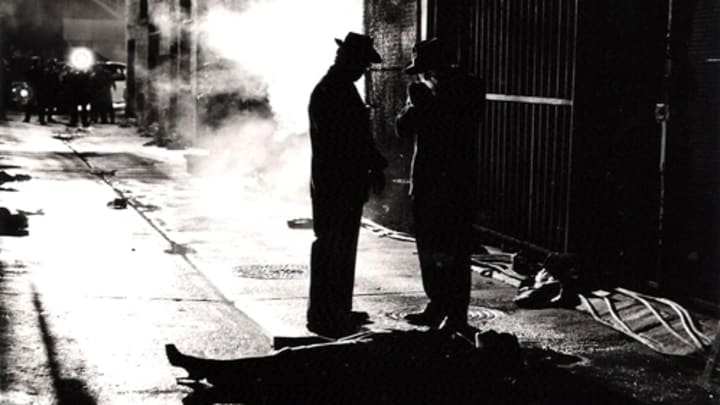
During production of the first season of Fallen Angels, a neo-noir anthology series airing on Showtime, creator and producer William Horberg came to a worrying conclusion. Like many of the hapless and desperate characters that populated crime fiction, they were running out of money.
“By the second or third show, we were way over budget,” Horberg tells Mental Floss.
Fallen Angels was set in postwar Los Angeles, which meant that everything onscreen had to be accurate to that period. No modern cars, clothes, or building facades could appear, making everything an expensive proposition. “[Producer] Steve Golin was bringing in his furniture from his house because he had some nice deco pieces,” Horberg says. “We were just begging, borrowing, and stealing.”
For Horberg, it was worth it. Filmmakers like Steven Soderbergh, Alfonso Cuarón, Phil Joanou, and Peter Bogdanovich had been enticed by the show’s hard-boiled crime story adaptations and creative freedom. So had novice directors Tom Hanks and Tom Cruise. And so had actors like Gary Oldman, Kiefer Sutherland, Brendan Fraser, Isabella Rossellini, John C. Reilly, and many others.
Despite that talent, the series has largely remained unseen since it aired its final episode in 1995, and it’s rarely discussed in retrospectives detailing how television elevated itself with “prestige” cable dramas in the late 1990s. In an era where viewers can stream every episode of Baywatch, how did a series with no fewer than eight Academy Award winners manage to virtually disappear?
Noir Town
The anthology television series format has been around as long as television itself. Early on, shows like Playhouse 90 presented self-contained stories that were essentially filmed plays; in the 1950s, director Alfred Hitchcock branded himself as a droll emcee for the crime-and-comeuppance series Alfred Hitchcock Presents (1955–1965). The most well-known anthology, The Twilight Zone (1959-1965), showcased moral allegories courtesy of creator and host Rod Serling.
It was Serling who got William Horberg thinking. A longtime film buff, Horberg leased a movie theater he ran with a friend at the age of 19. Later, he became a studio executive at Paramount and a film producer. The only thing competing for Horberg’s love of movies was his love of crime fiction, which populated postwar newsstand racks in magazines like Manhunt and Black Mask. He had even pursued an adaptation of writer Mickey Spillane’s novella Killer Mine in the 1980s to little avail.
When Horberg arrived at director Sydney Pollack’s Mirage Enterprises company in 1992, an idea began to form. “I’d had this thought of The Twilight Zone, but with hard-boiled crime stories instead of speculative fiction and fantasy stories,” Horberg says. “And why hadn’t anybody ever done that.”
Pollack told him to pursue the project. At the time, anthologies were somewhat back in style. HBO had Tales From the Crypt (1989–1996), a bloody take on the EC Comics horror comics of the 1950s. That network had also had success with The Hitchhiker (1983-1987), a lurid suspense drama.
You Might Also Like ...
- ‘Red Nails’: The Violent Animated Conan Movie That Was Never Finished
- ‘The Crack Monster’: The 30-Year Search for the Most Unsettling Cartoon on ‘Sesame Street’
- When Chuck Cunningham Vanished from ‘Happy Days’
Add Mental Floss as a preferred news source!
It was another pay cable network that landed Horberg’s show. “We all went and met with Showtime, and they bought in and said, ‘Yeah, we love this. Let’s try to do it.’ And they commissioned a couple of scripts and we started to figure out how to get the rights to these stories from 60, 70 years ago.”
With producers Steve Golin, Lindsay Doran, and others, Horberg began pouring over old pulp magazines for short stories that felt right for a 30-minute adaptation. Horberg estimates he and the production team might have read over 1000 stories. “It was truffle-hunting,” he says. “We knew we wanted a [Dashiell] Hammett, a [Raymond] Chandler, a Spillane, James M. Cain, Jim Thompson, David Goodis. So there were certain authors that we were looking for and kind of trolling through their work.”

The first episode, an adaptation of William Campbell Gault’s “Dead End for Delia,” became a proof of concept for the show, which was titled Fallen Angels. “[Screenwriter] Scott Frank was my friend from Paramount, and we had developed the movie Dead Again together, and worked on that through production. His brother-in-law was [director] Phil Joanou … Phil had made a movie with Sean Penn and Gary Oldman called State of Grace and Phil got Gary to say yes to being the hero and anti-hero in the first show. Once Gary was in, it was like we’ve been blessed by the Pope or something, because he was so highly regarded by other actors that it became a cool party.”
Frank wrote the adaptation; Janou directed; Oldman starred as a cop whose estranged wife turns up dead, leaving only a few final mysterious words behind. While the actor was a big name thanks to Sid & Nancy and Bram Stoker’s Dracula, he wasn’t the marquee attraction for the first season. That honor belonged to two stars who had stratospheric popularity: Tom Cruise and Tom Hanks.
Directed By
In 1993, Tom Hanks was one of the biggest film stars in the world. His run of hits—Philadelphia, Sleepless in Seattle, and the soon-to-be-released Forrest Gump—had solidified him as a modern Jimmy Stewart. But he also had an eye on trying his hand at directing. Shooting a half-hour show in roughly a week was an ideal training ground, and one that Hanks was familiar with thanks to his directorial stint on Tales From the Crypt in 1992. (Hanks would make his feature directorial debut with the comedy That Thing You Do! in 1996.)

“I’ll Be Waiting,” based on the Raymond Chandler story, details a house detective (Bruno Kirby) trying to protect a mobster’s wife (Marg Helgenberger) from killers. It was originally set to be directed by Michael Mann (Heat), and then David Fincher. But then Fincher went off to do Seven (often stylized as Se7en), the Brad Pitt and Morgan Freeman serial killer feature, leaving the slot open. “I think Fincher’s agent felt bad because he knew he was leaving us in the lurch 10 days before shooting or something, and he knew that Tom wanted to direct something, and he asked him whether he’d want to be a part of this,” Horberg recalls. “So it went from Mann to Fincher to Hanks, and I think because it was Raymond Chandler, it was considered like the champagne of the series, to do the Chandler story.”
In an unusual move for movie stars of the time, Hanks also has an small-screen role as one of the mobster’s hitmen. It was a rare villain turn for Hanks, who had made his name portraying nice guys. “It wasn’t like a quid pro quo. But it was kind of like, oh, man, it’d be awesome if he could, you know, just have a cameo, and we could use that to help promote the whole series. And he was willing to do it. So yeah, yeah, I guess he enjoyed putting on the trench coat.”
Hanks was also impressed by another booking: Tom Cruise. Like Hanks, Cruise was one of the hottest talents in Hollywood. Around the time Fallen Angels was gearing up, he was shooting the John Grisham legal thriller The Firm with Sydney Pollack. That relationship led to Cruise agreeing to direct an episode. “He very much had a father-son relationship with Sydney Pollack,” Horberg says. “They were super close. And I think he said, ‘If I’m gonna do this. I’d love to do it with [Pollack], you know, kinda looking over my shoulder.’ ”

Cruise directed “The Frightening Frammis,” based on a Jim Thompson story about a gambler who risks twice-stolen money in a high-stakes con game. Peter Gallagher played the lead. To Horberg’s recollection, it went off without a hitch.
“Cruise is a force of nature. He was a fantastic partner in the sense that he demanded no special treatment at all. ‘I want the same budget as everybody else. I want the same s****y trailer as everybody else. I’m not here to kind of bring my world into your production’ ... He was very meticulous about the whole thing, and he took it seriously.”
Though Cruise’s episode was well-reviewed by critics, it wound up being the only time the actor ever stepped behind the camera. “I don’t want to speak for him, but I ended up feeling like [Cruise] would have had a better time if he’d actually starred in it and directed himself,” Horberg said. “I think for him it was very hard to not be the star. He’s super specific in terms of that performance and just seeing it all through the lens of an actor, and how he would interpret it. You could see him trying to give Peter Gallagher his space, and just let him make his own choices and be his own version of that character, and I felt that was hard for him.”
The first season of Fallen Angels—which was rounded out by Alfonso Cuarón's “Murder, Obliquely,” Jonathan Kaplan’s “Since I Don’t Have You,” and Steven Soderbergh’s “The Quiet Room,” the latter of which Horberg cites as “as dark as it gets”—premiered to generally positive reviews in the fall of 1993. It earned 12 Cable ACE Award nominations: Oldman took home a Best Actor trophy for his role. Showtime was pleased enough to renew it for a second season. But it needed some significant changes.
Angels in LA
Fallen Angels was a prohibitively expensive show in its first season. Not, as one might assume, because of the talent involved—many often worked for scale, or the minimum wage permitted by unions—but because of the period setting. After overages, Horberg had to have a tough conversation with Showtime executives.
“We had to go back to Showtime and just say this has become something bigger than what you guys thought it was when you bought it, and certainly what we thought it was when we set up the template,” Horberg says. “And they increased the license fee per episode, which let us finish the first season. And then when we came back, we learned a lot from our mistakes.”
Showtime was actually enthusiastic enough to order nine episodes, up from the six of the first season, as well as permit the series to draw outside the lines. One entry “Red Wind,” was given an hour-long runtime and recast Chandler’s Philip Marlowe character as a Black man (Danny Glover).
Showtime had also insisted on the series being in color, but one episode appeared in black and white: “The Fly Paper,” based on a Dashiell Hammett story. “We had won a bunch of awards the first season. So [director] Tim Hunter said the Dashiell Hammett one has to be in black and white. You can’t do color with Hammett. And they let him do it. But we shot it and then desaturated it.”
The show kept locations limited and shot in downtown Los Angeles at night, which sometimes required police protection. “In those days, downtown LA at night, where we did quite a bit of filming for period locations, was a fairly dangerous place. The street population was not used to having a lot of film crews working down there, and they got pretty aggressive with our crew. The police tried to move them away from set, but they kept coming back.” One man was dragged off by cops and told he would no longer be a problem. Horberg, fearing life was imitating the crooked cops of the series, was afraid the man had been roughed up. He had simply been driven away too far to walk back to the set.
Not all the changes were due to budget. In the first season, the production had attempted to carry on the anthology series tradition of having a recurring host introduce the episodes. For Fallen Angels, Horberg wanted to hire Mickey Spillane, the famed crime writer who had something of a screen presence: He had even portrayed his own two-fisted detective, Mike Hammer, in a 1963 movie, The Girl Hunters.
But Spillane wasn’t interested. Instead, the host was Fay Friendly, a sultry femme fatale in the noir mold portrayed by actress Lynette Walden. Fay didn’t return for Season 2, which Horberg chalks up to her not being a “fully baked” character. (“Walden’s full figure is rarely seen within the frame,” wrote Washington Post television critic Tom Shales. “Instead she becomes a series of voluptuous body parts in black lace lingerie, intercut with shots of burning cigarettes, shimmering cocktails, shiny revolvers and the art deco nooks and crannies of Los Angeles’ magnificent Union Station.”)
“It was actually quite a lot of work to do that for each episode, and I think by the second season it wasn't such a home run idea that people wanted to invest in pursuing it,” Horberg says.
There were still familiar faces. Actor Dan Hedaya appeared in the first two episodes of the first season and returned for the second; Soderbergh came back for “Professional Man,” another personal favorite of Horberg’s that was based on the David Goodis story about an elevator operator (Brendan Fraser) who kills for money but grows torn when his next target is his male lover—an order made by his mobster employer who’s grown jealous. “Soderbergh was the genius who took that David Goodis story and flipped the gender to make it three guys. It’s just fantastic.”

Despite the acclaim, Fallen Angels aired for just two seasons. Like the unfortunate noir heroes it portrayed, its ambition may ultimately have been what did it in. “It was a super hard show to make,” Horberg says. “I think just we were exhausted after 15 episodes. The whole thing of television is, you build one world and you amortize it over a season or multiple seasons. So everything we were doing was against the model of efficiency and production wisdom.
“You know, the concept of A-list filmmakers who don’t really do television coming in to work with big actors and make these kind of one-off bespoke jewels ... it just wasn’t sustainable.”
Horberg was also focused on his feature film ventures. He went on to produce a string of hits, including The Talented Mr. Ripley, Sliding Doors, and, later, the watercooler Netflix hit The Queen’s Gambit. Fallen Angels might be one of the more obscure titles in his career: The show received only a modest VHS release in the states, and a DVD release in France. It’s not currently streaming anywhere, though episodes can be found on YouTube—some, inexplicably, dubbed over in Russian.
The show is likely tied up in a morass of dissolved companies. “Showtime doesn’t own it,” Horberg says. “Showtime only licensed the show. That’s kind of the problem. Mirage doesn’t exist. [Production company] Propaganda doesn’t exist … I was approached in maybe the late 1990s by a company that wanted to put it out on DVD. And we wanted it to happen. But nobody could figure out who owned or controlled the rights.” Nor is Horberg aware of who has the master tapes needed to make a high-quality transfer.
A formal release isn’t impossible—a friend of Horberg’s has an attorney looking into it—but for now, Fallen Angels occupies space as a curious bit of lost media. Today, it’s easy to find A-list talent on television. In the early 1990s, the series was an anomaly. Or, as Horberg puts it, “We were kind of ahead of our time.”