%20%20--%3E%0A%3Csvg%20version%3D%221.1%22%20id%3D%22Layer_1%22%20xmlns%3D%22http%3A%2F%2Fwww.w3.org%2F2000%2Fsvg%22%20xmlns%3Axlink%3D%22http%3A%2F%2Fwww.w3.org%2F1999%2Fxlink%22%20x%3D%220px%22%20y%3D%220px%22%0A%09%20viewBox%3D%220%200%20684.6%2068.1%22%20style%3D%22enable-background%3Anew%200%200%20684.6%2068.1%3B%22%20xml%3Aspace%3D%22preserve%22%3E%0A%3Cg%3E%0A%09%3Cpath%20d%3D%22M444.1%2C29.3h-17.4v14.5h17.4V29.3z%20M36.4%2C68.1l29.3-50.8V0H50.4L32.9%2C36.8L15.5%2C0H0v68.1h16.7V45.8l12.4%2C22.3H36.4z%0A%09%09%20M49.1%2C68.1h16.6V23.4L49.1%2C52.1V68.1z%20M76.6%2C68.1h45V53.8H93.3V41.6h21V27.1h-21V14.8h28.3V0.1h-45V68.1z%20M175.6%2C68.1h17.3v-68%0A%09%09h-16.5v40.3L150%2C0.1h-17.6v68h16.7V27.7L175.6%2C68.1z%20M235.8%2C14.8h15.4V0.1h-47.4v14.7H219v53.2h16.8V14.8z%20M290.3%2C45.9h-17.1%0A%09%09l7.5-15.6h2L290.3%2C45.9z%20M298.7%2C68.1h18l-32.2-68h-5.7l-32%2C68h18l3.3-7.1h27.1L298.7%2C68.1z%20M325.2%2C68.1h46.2V53.8h-29.6V0.1h-16.7%0A%09%09V68.1z%20M423.7%2C14.8h27.2V0.1H407v68h16.7V14.8z%20M462%2C68.1h46.2V53.8h-29.6V0.1H462V68.1z%20M564.8%2C34.1c0%2C10.7-7.2%2C19.2-18.5%2C19.2%0A%09%09c-11.4%2C0-18.5-8.5-18.5-19.2s7.1-19.2%2C18.5-19.2C557.6%2C14.9%2C564.8%2C23.4%2C564.8%2C34.1%20M580.6%2C34.1c0-19-14.2-34-34.3-34%0A%09%09c-20.2%2C0-34.3%2C15-34.3%2C34c0%2C19%2C14.1%2C34%2C34.3%2C34C566.4%2C68.1%2C580.6%2C53.1%2C580.6%2C34.1%20M604.8%2C20.5c0-4.1%2C3.3-6.2%2C6.7-6.2%0A%09%09c4.4%2C0%2C6.6%2C3%2C6.6%2C6.6h14.7C631.8%2C9.1%2C625.1%2C0.1%2C611%2C0.1c-12%2C0-21.7%2C9.3-21.7%2C20.6c0%2C10.9%2C5.9%2C15.9%2C16.7%2C19.8%0A%09%09c5.2%2C1.8%2C11.5%2C3.2%2C11.5%2C8c0%2C3.3-2.4%2C5.5-6.4%2C5.5c-3.6%2C0-6.6-3-6.6-6.7h-15.2c0%2C11.5%2C7.9%2C20.8%2C21.8%2C20.8c12%2C0%2C21.6-9.3%2C21.6-20.6%0A%09%09c0-10-5.3-16.4-16.7-19.8C610.6%2C26.1%2C604.8%2C25.3%2C604.8%2C20.5%20M670%2C20.9h14.7C683.8%2C9.1%2C677.1%2C0.1%2C663%2C0.1c-12%2C0-21.7%2C9.3-21.7%2C20.6%0A%09%09c0%2C10.9%2C5.9%2C15.9%2C16.7%2C19.8c5.2%2C1.8%2C11.5%2C3.2%2C11.5%2C8c0%2C3.3-2.4%2C5.5-6.4%2C5.5c-3.6%2C0-6.6-3-6.6-6.7h-15.2c0%2C11.5%2C7.9%2C20.8%2C21.8%2C20.8%0A%09%09c12%2C0%2C21.6-9.3%2C21.6-20.6c0-10-5.3-16.4-16.7-19.8c-5.4-1.6-11.3-2.4-11.3-7.2c0-4.1%2C3.3-6.2%2C6.7-6.2C667.7%2C14.4%2C670%2C17.3%2C670%2C20.9%0A%09%09%22%2F%3E%0A%3C%2Fg%3E%0A%3C%2Fsvg%3E%0A)

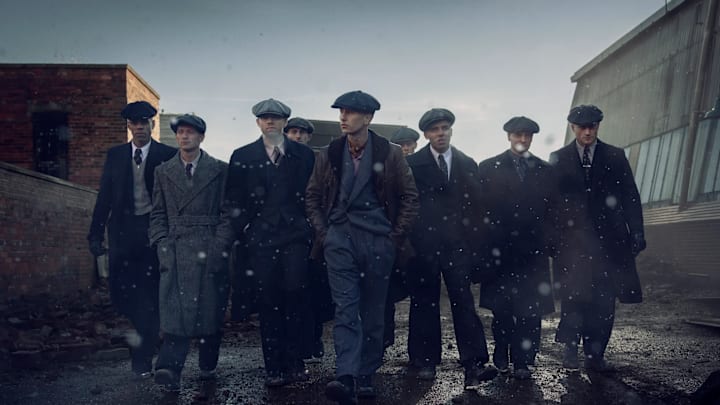
Gangs, politics, and razor blades aside, Peaky Blinders didn’t have to invent all of its drama. Set in post–World War I Birmingham, the series follows the rise of the Shelby crime family as they navigate a world shaped by shifting politics, class tensions, and a rapidly changing Britain. The show’s popularity—bolstered by its life on streaming and the feature film Peaky Blinders: The Immortal Man (2026)—has only expanded its cultural footprint.
While some characters—like Thomas Shelby and his siblings—are entirely fictional creations, others are drawn directly from history, reflecting real figures who once held power in the same world the show brings to life. From notorious gang leaders to influential political figures, many of the show’s biggest players have roots in reality. Here’s how their real-life counterparts compare to what you see on screen.
- Alfie Solomons
- Winston Churchill
- Oswald Mosley
- Jessie Eden
- Diana Mitford
- Billy Kimber
- Arthur Bigge
- Darby Sabini
- Charlie Chaplin
- Brilliant Chang
Alfie Solomons

Alfie Solomons is one of the most unpredictable figures in Peaky Blinders, a Camden-based crime boss who alternates between ally and adversary to Tommy Shelby. Played with chaotic energy by Tom Hardy, he runs his own criminal operation and brings a mix of sharp wit and dark humor to every appearance. His shifting loyalties make him both useful and dangerous, keeping Tommy constantly guessing. The character draws inspiration from Alfred Solomon, a real-life Jewish bookmaker connected to London’s underworld, who was arrested after shooting Billy Kimber in 1921 and later imprisoned in 1924 following another shooting incident involving two bookmakers.
Winston Churchill

Winston Churchill looms large throughout Peaky Blinders, where his presence adds political weight and real-world stakes to Tommy Shelby’s story. In the early seasons, he's depicted as a powerful government figure whose decisions help set key events in motion—including sending an agent to Birmingham to recover stolen machine guns tied to the Peaky Blinders. As the series unfolds, Churchill becomes an important, if uneasy, ally to Tommy, at one point intervening to save his life in exchange for continued cooperation. His portrayal, across multiple actors, reflects his evolving political career, while his real-life counterpart remains one of the most influential figures in modern history, grounding the series in the era’s political tensions.
Oswald Mosley

Oswald Mosley emerges in Peaky Blinders as a calculating and highly influential figure within Britain’s rising fascist movement—sharing more than just a mustache with his real-life counterpart. Mosley crosses paths with Tommy Shelby after his entry into politics, quickly establishing himself as a powerful presence and attempting to draw Tommy into his corner. Their relationship becomes a tense game of influence and strategy, including a failed assassination attempt, with Mosley often appearing one step ahead. History offers a version of this character in the real Oswald Mosley, a British politician who founded the British Union of Fascists in 1932 and became one of the most controversial figures of his time.
Jessie Eden

Jessie Eden enters Peaky Blinders as a no-nonsense union organizer who quickly proves she’s a match for Tommy Shelby’s usual tactics. She leads factory workers in strikes, pushing for better wages and working conditions, and refuses to be easily intimidated or outmaneuvered. While the show gives her a more personal connection to Tommy, including a complicated romantic relationship, her real-life counterpart was a pioneering labor activist and member of the Communist Party of Great Britain. The real Eden is remembered for organizing some of the largest strikes in British history and advocating fiercely for workers’ rights, particularly for women in industrial workplaces.
Diana Mitford

Diana Mitford marries her way into the world of Peaky Blinders, arriving as a coolly composed presence as she aligns herself with Oswald Mosley and his rising fascist movement. Beneath the aristocratic surface, she’s calculating and provocative, using status and influence to stir tension wherever she goes. Her real-life counterpart followed a similarly controversial path: a British socialite who married Mosley and became a devoted supporter of fascism, remaining a deeply divisive figure long after the era the show portrays.
Billy Kimber

Billy Kimber rules the early days of Peaky Blinders as the man to beat, a racecourse boss with a firm grip on England’s betting circuits. As head of the Birmingham Boys, he’s one of Tommy Shelby’s first major obstacles, and their clash quickly turns into a fight for control, culminating in Shelby shooting him in the head. The real Kimber was an even bigger figure, an early crime boss who built a far-reaching empire around the racetracks before eventually losing ground to rival gangs as the underworld shifted around him.
Arthur Bigge

When the Shelbys find themselves on the brink of disaster, Arthur Bigge is the unseen authority who helps tip the scales in Peaky Blinders. Though his appearance is brief, his intervention carries the full weight of the British establishment, underscoring just how high the stakes have become for Tommy and his family. His real-life counterpart was Sir Arthur Bigge, a British army officer and senior royal aide who served Queen Victoria and King George V for decades, holding a powerful behind-the-scenes role within the monarchy.
Darby Sabini

Darby Sabini storms into Peaky Blinders as one of Tommy Shelby’s most formidable rivals, a sharp-dressed London crime boss with a firm grip on the city’s betting underworld. He’s an old-school kingpin: running bookies, defending territory, and clashing with the Peaky Blinders at every turn. Though his power eventually fades, Sabini leaves his mark as a reminder that Birmingham isn’t the only game in town. The show’s take mirrors the real Charles “Darby” Sabini, a former boxer and gangster who, alongside his gang, battled rivals like Billy Kimber’s Birmingham Boys to dominate London’s gambling scene between the world wars.
Charlie Chaplin

Charlie Chaplin makes a brief but memorable appearance in Peaky Blinders, showing up as a silent-era icon whose fame adds a touch of glamour to Tommy Shelby’s world. Though his role is short, his presence reinforces the show’s connection to real cultural figures of the time. The character is based on the real Chaplin, the legendary silent film star whose influence helped shape early cinema and made him one of the most recognizable entertainers in history.
Brilliant Chang

Brilliant Chang pops up in Peaky Blinders as a powerful opium dealer who offers Tommy Shelby access to high-value shipments while proving he’s not a man to be crossed. Behind his smooth negotiations lies a ruthless edge, including taking Finn hostage to force Tommy’s hand. Behind the character is a real-life restaurateur nicknamed the “dope king,” who built a drug empire in early 20th-century Britain before being caught, convicted, and eventually deported.