%20%20--%3E%0A%3Csvg%20version%3D%221.1%22%20id%3D%22Layer_1%22%20xmlns%3D%22http%3A%2F%2Fwww.w3.org%2F2000%2Fsvg%22%20xmlns%3Axlink%3D%22http%3A%2F%2Fwww.w3.org%2F1999%2Fxlink%22%20x%3D%220px%22%20y%3D%220px%22%0A%09%20viewBox%3D%220%200%20684.6%2068.1%22%20style%3D%22enable-background%3Anew%200%200%20684.6%2068.1%3B%22%20xml%3Aspace%3D%22preserve%22%3E%0A%3Cg%3E%0A%09%3Cpath%20d%3D%22M444.1%2C29.3h-17.4v14.5h17.4V29.3z%20M36.4%2C68.1l29.3-50.8V0H50.4L32.9%2C36.8L15.5%2C0H0v68.1h16.7V45.8l12.4%2C22.3H36.4z%0A%09%09%20M49.1%2C68.1h16.6V23.4L49.1%2C52.1V68.1z%20M76.6%2C68.1h45V53.8H93.3V41.6h21V27.1h-21V14.8h28.3V0.1h-45V68.1z%20M175.6%2C68.1h17.3v-68%0A%09%09h-16.5v40.3L150%2C0.1h-17.6v68h16.7V27.7L175.6%2C68.1z%20M235.8%2C14.8h15.4V0.1h-47.4v14.7H219v53.2h16.8V14.8z%20M290.3%2C45.9h-17.1%0A%09%09l7.5-15.6h2L290.3%2C45.9z%20M298.7%2C68.1h18l-32.2-68h-5.7l-32%2C68h18l3.3-7.1h27.1L298.7%2C68.1z%20M325.2%2C68.1h46.2V53.8h-29.6V0.1h-16.7%0A%09%09V68.1z%20M423.7%2C14.8h27.2V0.1H407v68h16.7V14.8z%20M462%2C68.1h46.2V53.8h-29.6V0.1H462V68.1z%20M564.8%2C34.1c0%2C10.7-7.2%2C19.2-18.5%2C19.2%0A%09%09c-11.4%2C0-18.5-8.5-18.5-19.2s7.1-19.2%2C18.5-19.2C557.6%2C14.9%2C564.8%2C23.4%2C564.8%2C34.1%20M580.6%2C34.1c0-19-14.2-34-34.3-34%0A%09%09c-20.2%2C0-34.3%2C15-34.3%2C34c0%2C19%2C14.1%2C34%2C34.3%2C34C566.4%2C68.1%2C580.6%2C53.1%2C580.6%2C34.1%20M604.8%2C20.5c0-4.1%2C3.3-6.2%2C6.7-6.2%0A%09%09c4.4%2C0%2C6.6%2C3%2C6.6%2C6.6h14.7C631.8%2C9.1%2C625.1%2C0.1%2C611%2C0.1c-12%2C0-21.7%2C9.3-21.7%2C20.6c0%2C10.9%2C5.9%2C15.9%2C16.7%2C19.8%0A%09%09c5.2%2C1.8%2C11.5%2C3.2%2C11.5%2C8c0%2C3.3-2.4%2C5.5-6.4%2C5.5c-3.6%2C0-6.6-3-6.6-6.7h-15.2c0%2C11.5%2C7.9%2C20.8%2C21.8%2C20.8c12%2C0%2C21.6-9.3%2C21.6-20.6%0A%09%09c0-10-5.3-16.4-16.7-19.8C610.6%2C26.1%2C604.8%2C25.3%2C604.8%2C20.5%20M670%2C20.9h14.7C683.8%2C9.1%2C677.1%2C0.1%2C663%2C0.1c-12%2C0-21.7%2C9.3-21.7%2C20.6%0A%09%09c0%2C10.9%2C5.9%2C15.9%2C16.7%2C19.8c5.2%2C1.8%2C11.5%2C3.2%2C11.5%2C8c0%2C3.3-2.4%2C5.5-6.4%2C5.5c-3.6%2C0-6.6-3-6.6-6.7h-15.2c0%2C11.5%2C7.9%2C20.8%2C21.8%2C20.8%0A%09%09c12%2C0%2C21.6-9.3%2C21.6-20.6c0-10-5.3-16.4-16.7-19.8c-5.4-1.6-11.3-2.4-11.3-7.2c0-4.1%2C3.3-6.2%2C6.7-6.2C667.7%2C14.4%2C670%2C17.3%2C670%2C20.9%0A%09%09%22%2F%3E%0A%3C%2Fg%3E%0A%3C%2Fsvg%3E%0A)

For the vast majority of us, a string of rainy days is a perfectly valid reason to cancel plans, complain to coworkers, and curl up under the covers. After all, we are evolutionary softies who structure our entire existence around the sun, relying on it for everything from our circadian rhythms to our collective mood stability. But in certain corners of the globe, daylight isn’t a basic right: it’s an elusive luxury.
Whether due to extreme polar tilts that literally banish the sun for months at a time, or cruel geographic quirks that lock in a permanent layer of leaden clouds, there are communities that operate almost entirely in the shadows. From remote Arctic outposts to fog-shrouded capital cities, here are five of the darkest places where people actually live that prove humanity will stubbornly adapt to just about anything—even a total lack of vitamin D.
Tórshavn, Faroe Islands

Average annual sunshine: around 840 hours
The Faroe Islands have become a buzzworthy travel destination thanks to their moody, otherworldly landscapes and deep-rooted Viking history, but did you know the capital city, Tórshavn, is also the darkest in the region? Nestled between two mountains on the stormy North Atlantic, the city is shaped by a relentless oceanic climate that brings short, dim winters and cool, overcast summers. In total, Tórshavn averages just a few dozen fully sunny days a year, with December typically seeing only around six total hours of direct sunlight spread across the entire month.
Despite the harsh, sun-deprived climate, Tórshavn has burgeoned a warm and lively cultural scene, from its historic, turf-roofed Tinganes to its many museums and cafes. The roughly 20,000 residents cope by utilizing brightly colored seaside architecture and the cozy art of hygge. Backed by a steady fishing industry and active local soccer leagues, the city stands as proof that a population can thrive entirely on its own terms—with or without the sun.
Longyearbyen, Norway

Average annual sunshine: around 1,112 hours
Average duration of polar night: around 113 days
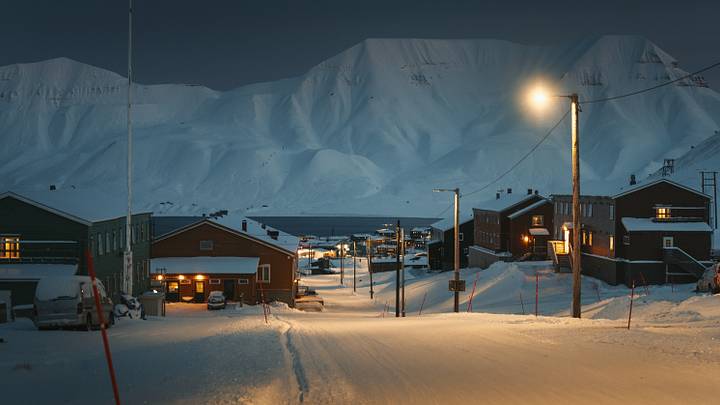
In the remote Arctic archipelago of Svalbard, you practically have to be a night owl to survive in its main settlement, Longyearbyen. Located midway between mainland Norway and the North Pole, this town faces a true polar night from late October to mid-February, during which the sun remains at least six degrees below the horizon. With a winter calendar that offers zero daily sunlight, its 2,400 residents navigate a world where noon and midnight are indistinguishable.
Life in Longyearbyen adapts accordingly. Residents rely on heavy winter gear and high-visibility clothing simply to handle everyday tasks in near-total darkness, while streetlights and brightly painted wooden houses help soften the Arctic gloom. Despite the extreme conditions, the town functions as a hub for research and tourism, with a surprisingly active international community.
Because the 24/7 dark makes it impossible to spot a hungry apex predator with the naked eye, local laws require residents to carry appropriate deterrents for protection the second they step outside the town limits.
Totoró, Colombia

Average annual sunshine: around 637 hours
Perched high in the Andes mountains is the town of Totoró, where you’ll find coffee farms, Indigenous Colombian culture, and more clouds than you could ever count. Sitting at over 2,500 meters above sea level, the town’s elevation plays a key role in its famously gloomy skies: moist air is constantly pushed upward, where it cools and condenses into persistent cloud cover and rain.
The result is a place that logs more than 210 precipitation days a year and, by some measures, ranks among the cloudiest on Earth. In fact, Totoró receives just 637 hours of sunshine annually—less than a single month’s worth of daylight stretched across an entire year.
Unlike polar regions, where darkness comes in a dramatic seasonal wave, Totoró’s grayness is a year-round condition. Even in daytime, the sky often stays dim, with sunlight appearing only in short shifts between clouds.
Utqiaġvik, Alaska

Average annual sunshine: around 1,860 hours
Average duration of polar night: around 65 days
If you want to visit the absolute northernmost community in the United States, you’ll have to travel 320 miles past the Arctic Circle to the coastal desert tundra of Utqiaġvik. Formerly known as Barrow, this remote outpost is home to a dedicated population of over 4,000 residents, a globally critical climate change research facility, and a landscape completely devoid of trees.
The town's extreme latitude on the edge of the Arctic Ocean dictates its severe seasonal mechanics: as the Earth tilts away from the sun in the winter, the sun drops completely beneath the horizon in mid-November, entering a hibernation of sorts until mid-January. This leaves the town to navigate a continuous 65-day polar night where daily operations take place in a perpetual cycle of deep civil twilight and absolute midnight.
In contrast to mountainous Arctic towns like Longyearbyen, where terrain creates pockets of light and shadow, Utqiaġvik’s darkness is amplified by flat, expansive tundra and intense coastal weather. Sub-zero winter winds whip across the frozen Beaufort Sea, creating blinding snow drifts and hazardous visibility conditions that make simple cross-town travel dangerous. Despite the prolonged solar deficit, the Indigenous Iñupiat community has lived here for centuries, adapting seasonal life around subsistence hunting and whaling cycles. The town’s extreme winter environment even helped inspire the setting of the horror graphic novel and film 30 Days of Night.
Lima, Peru

Average annual sunshine: around 1,238 hours
You don’t have to travel to an isolated polar ice cap to experience an environment without sunshine; you can find it in the massive South American capital of Lima. Aside from its ancient pre-Inca adobe pyramids and world-renowned culinary scene, Lima is known for experiencing a bizarre meteorological phenomenon that defies its tropical latitude.
The city sits directly adjacent to the freezing-cold Humboldt Current running through the Pacific Ocean: when warm, desert air blows toward the sea, the cold ocean water cools it rapidly from below, trapping a thick layer of low-altitude maritime mist known as the garúa. This thick, stagnant maritime mist completely cloaks the sprawling city for six months out of the year, blocking the sun entirely.
During the winter months, which give the city its famous nickname "Lima la Gris", the dense maritime fog hovers so low over the city's coastal cliffs that it drives humidity levels to a damp, near-100 percent, yet it almost never creates actual rainfall. Millions of commuters navigate a monochrome, concrete-colored landscape where the sun becomes a distant memory, forcing the massive city to rely on bright street lighting to keep its bustling economy running, while outlying hillside communities utilize fog-catching nets to harvest water from the thick air. It’s the second-largest desert city in the world, yet its population spends half the calendar year entirely enveloped in a haze.