%20%20--%3E%0A%3Csvg%20version%3D%221.1%22%20id%3D%22Layer_1%22%20xmlns%3D%22http%3A%2F%2Fwww.w3.org%2F2000%2Fsvg%22%20xmlns%3Axlink%3D%22http%3A%2F%2Fwww.w3.org%2F1999%2Fxlink%22%20x%3D%220px%22%20y%3D%220px%22%0A%09%20viewBox%3D%220%200%20684.6%2068.1%22%20style%3D%22enable-background%3Anew%200%200%20684.6%2068.1%3B%22%20xml%3Aspace%3D%22preserve%22%3E%0A%3Cg%3E%0A%09%3Cpath%20d%3D%22M444.1%2C29.3h-17.4v14.5h17.4V29.3z%20M36.4%2C68.1l29.3-50.8V0H50.4L32.9%2C36.8L15.5%2C0H0v68.1h16.7V45.8l12.4%2C22.3H36.4z%0A%09%09%20M49.1%2C68.1h16.6V23.4L49.1%2C52.1V68.1z%20M76.6%2C68.1h45V53.8H93.3V41.6h21V27.1h-21V14.8h28.3V0.1h-45V68.1z%20M175.6%2C68.1h17.3v-68%0A%09%09h-16.5v40.3L150%2C0.1h-17.6v68h16.7V27.7L175.6%2C68.1z%20M235.8%2C14.8h15.4V0.1h-47.4v14.7H219v53.2h16.8V14.8z%20M290.3%2C45.9h-17.1%0A%09%09l7.5-15.6h2L290.3%2C45.9z%20M298.7%2C68.1h18l-32.2-68h-5.7l-32%2C68h18l3.3-7.1h27.1L298.7%2C68.1z%20M325.2%2C68.1h46.2V53.8h-29.6V0.1h-16.7%0A%09%09V68.1z%20M423.7%2C14.8h27.2V0.1H407v68h16.7V14.8z%20M462%2C68.1h46.2V53.8h-29.6V0.1H462V68.1z%20M564.8%2C34.1c0%2C10.7-7.2%2C19.2-18.5%2C19.2%0A%09%09c-11.4%2C0-18.5-8.5-18.5-19.2s7.1-19.2%2C18.5-19.2C557.6%2C14.9%2C564.8%2C23.4%2C564.8%2C34.1%20M580.6%2C34.1c0-19-14.2-34-34.3-34%0A%09%09c-20.2%2C0-34.3%2C15-34.3%2C34c0%2C19%2C14.1%2C34%2C34.3%2C34C566.4%2C68.1%2C580.6%2C53.1%2C580.6%2C34.1%20M604.8%2C20.5c0-4.1%2C3.3-6.2%2C6.7-6.2%0A%09%09c4.4%2C0%2C6.6%2C3%2C6.6%2C6.6h14.7C631.8%2C9.1%2C625.1%2C0.1%2C611%2C0.1c-12%2C0-21.7%2C9.3-21.7%2C20.6c0%2C10.9%2C5.9%2C15.9%2C16.7%2C19.8%0A%09%09c5.2%2C1.8%2C11.5%2C3.2%2C11.5%2C8c0%2C3.3-2.4%2C5.5-6.4%2C5.5c-3.6%2C0-6.6-3-6.6-6.7h-15.2c0%2C11.5%2C7.9%2C20.8%2C21.8%2C20.8c12%2C0%2C21.6-9.3%2C21.6-20.6%0A%09%09c0-10-5.3-16.4-16.7-19.8C610.6%2C26.1%2C604.8%2C25.3%2C604.8%2C20.5%20M670%2C20.9h14.7C683.8%2C9.1%2C677.1%2C0.1%2C663%2C0.1c-12%2C0-21.7%2C9.3-21.7%2C20.6%0A%09%09c0%2C10.9%2C5.9%2C15.9%2C16.7%2C19.8c5.2%2C1.8%2C11.5%2C3.2%2C11.5%2C8c0%2C3.3-2.4%2C5.5-6.4%2C5.5c-3.6%2C0-6.6-3-6.6-6.7h-15.2c0%2C11.5%2C7.9%2C20.8%2C21.8%2C20.8%0A%09%09c12%2C0%2C21.6-9.3%2C21.6-20.6c0-10-5.3-16.4-16.7-19.8c-5.4-1.6-11.3-2.4-11.3-7.2c0-4.1%2C3.3-6.2%2C6.7-6.2C667.7%2C14.4%2C670%2C17.3%2C670%2C20.9%0A%09%09%22%2F%3E%0A%3C%2Fg%3E%0A%3C%2Fsvg%3E%0A)

The moment that the leaves begin to change, some houses whip out their skeletons, pumpkins, and zombie decor and gleefully display them all month long. Other homes wait until a few days before Halloween to set up their decor, but either way, by Halloween night, ordinary streets all across America reliably transform into illuminated displays of all things macabre and nightmarish.
Halloween decorations have their roots in the Celtic festival of Samhain, when people often carved faces into pumpkins, turnips, and other vegetables to ward off errant spirits. Today, this has morphed into an entire industry. Some homes take things much more seriously than others, of course, and many of the nation’s most famous Halloween decoration displays attract tens of thousands of visitors each year.
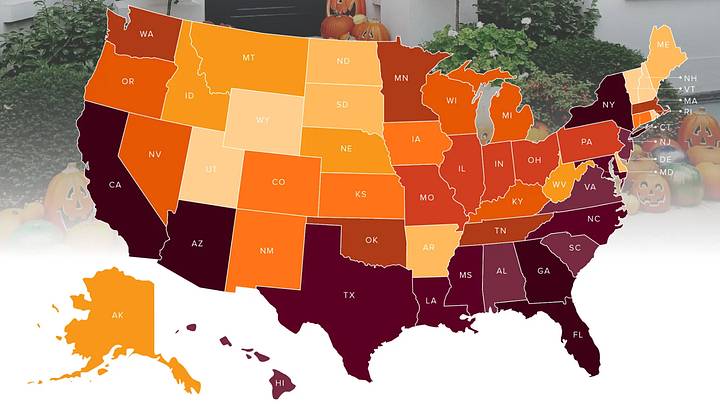
But most homes tend to display just a few key Halloween decorations. Is your home state more inclined to display skeletons, vampires, zombies, or something else entirely? A 2025 study from Lombardo Homes used Google Trends data and interviewed over 1,000 Americans to find out.
Skeletons, pumpkins, and ghosts galore

Unsurprisingly, the most common Halloween decoration in America is the reliable pumpkin. This decoration was the most common in Utah, Colorado, Missouri, Oklahoma, Pennsylvania, New Jersey, Texas, and California.
As previously mentioned, this winter squash’s connection to Halloween dates back to the festival of Samhain. This festival was traditionally seen as a time when the veil between the lands of the living and the dead grew thin. To dissuade wandering spirits from wreaking havoc, people would carve creepy faces into pumpkins and other vegetables. This tradition has become a Halloween staple; according to the survey, 55% of Americans said they planned on carving pumpkins in 2025.
Ghosts were the second-most-common Halloween decoration, finding favor in Rhode Island, Washington, Tennessee, Louisiana, Georgia, and Florida. Not to be confused with ghouls, ghosts are typically defined as spirits of the dead who continue to linger among the living. Given Halloween’s roots in a holiday deeply connected to the dead's return, it makes sense that ghosts still tend to appear in front of homes on Halloween night.
After ghosts came bats, which were favorites in New Hampshire, Nebraska, Idaho, New Mexico, Kansas, and Iowa. Once again, this creature’s connection to Halloween dates back to Samhain. Bats often gather around Halloween ahead of their migration and hibernation season, so it’s common to see these creatures in the autumn.
Additionally, Samhain was traditionally celebrated with gigantic bonfires that often attracted swarms of bats, cementing these creatures’ connection to the holiday. Bats were also used as an allegory for the devil in Dante’s Inferno, which added to their association with all things wicked and scary. Today, they frequently appear in spooky at-home Halloween displays.
After bats came witches, scarecrows, and tombstones, followed by skeletons and spiders. Finally, black cats came in at number 10. These felines have long been linked to witchcraft and bad luck, but in reality, black cats themselves experience high levels of abuse and cruelty due to this superstition, especially around Halloween.
The most annoying Halloween decorations in America

While most Halloween decorations these days are more charming and fun than genuinely scary or disruptive, some displays can get pretty intense—and not everyone is a fan of every type of type of Halloween home display out there.
Lombardo Homes also asked people about their least favorite decorations, and unsurprisingly, loud or noisy decorations—such as motion-activated noises and pre-recorded screams—were at the top of the list. Strobe or flashing lights came in second, followed by inflatables, gory decorations, and fake spider webs. People also cited disdain for creepy clowns and jump-scare animatronics.
When Americans typically decorate for Halloween (and more data)

The study also asked Americans when they typically put up and take down decorations. 18% said they put up decorations before October 1, but 37%—the largest group—said they decorated during the first week of October.
79% said they took down their decorations within the first week after Halloween. Those surveyed also said they spent an average of $99 on Halloween decorations that year, with 49% saying they’d be spending less than the year prior due to inflation.
47% of people surveyed said they saw fewer Halloween trick-or-treaters than the year prior, showing that collective Halloween-night habits might be changing overall. Still, spooky decorations don’t seem to be going anywhere; 87% of the people surveyed said they’d be decorating for Halloween, and 55% said they preferred creepy decorations over fun or gory ones.