%20%20--%3E%0A%3Csvg%20version%3D%221.1%22%20id%3D%22Layer_1%22%20xmlns%3D%22http%3A%2F%2Fwww.w3.org%2F2000%2Fsvg%22%20xmlns%3Axlink%3D%22http%3A%2F%2Fwww.w3.org%2F1999%2Fxlink%22%20x%3D%220px%22%20y%3D%220px%22%0A%09%20viewBox%3D%220%200%20684.6%2068.1%22%20style%3D%22enable-background%3Anew%200%200%20684.6%2068.1%3B%22%20xml%3Aspace%3D%22preserve%22%3E%0A%3Cg%3E%0A%09%3Cpath%20d%3D%22M444.1%2C29.3h-17.4v14.5h17.4V29.3z%20M36.4%2C68.1l29.3-50.8V0H50.4L32.9%2C36.8L15.5%2C0H0v68.1h16.7V45.8l12.4%2C22.3H36.4z%0A%09%09%20M49.1%2C68.1h16.6V23.4L49.1%2C52.1V68.1z%20M76.6%2C68.1h45V53.8H93.3V41.6h21V27.1h-21V14.8h28.3V0.1h-45V68.1z%20M175.6%2C68.1h17.3v-68%0A%09%09h-16.5v40.3L150%2C0.1h-17.6v68h16.7V27.7L175.6%2C68.1z%20M235.8%2C14.8h15.4V0.1h-47.4v14.7H219v53.2h16.8V14.8z%20M290.3%2C45.9h-17.1%0A%09%09l7.5-15.6h2L290.3%2C45.9z%20M298.7%2C68.1h18l-32.2-68h-5.7l-32%2C68h18l3.3-7.1h27.1L298.7%2C68.1z%20M325.2%2C68.1h46.2V53.8h-29.6V0.1h-16.7%0A%09%09V68.1z%20M423.7%2C14.8h27.2V0.1H407v68h16.7V14.8z%20M462%2C68.1h46.2V53.8h-29.6V0.1H462V68.1z%20M564.8%2C34.1c0%2C10.7-7.2%2C19.2-18.5%2C19.2%0A%09%09c-11.4%2C0-18.5-8.5-18.5-19.2s7.1-19.2%2C18.5-19.2C557.6%2C14.9%2C564.8%2C23.4%2C564.8%2C34.1%20M580.6%2C34.1c0-19-14.2-34-34.3-34%0A%09%09c-20.2%2C0-34.3%2C15-34.3%2C34c0%2C19%2C14.1%2C34%2C34.3%2C34C566.4%2C68.1%2C580.6%2C53.1%2C580.6%2C34.1%20M604.8%2C20.5c0-4.1%2C3.3-6.2%2C6.7-6.2%0A%09%09c4.4%2C0%2C6.6%2C3%2C6.6%2C6.6h14.7C631.8%2C9.1%2C625.1%2C0.1%2C611%2C0.1c-12%2C0-21.7%2C9.3-21.7%2C20.6c0%2C10.9%2C5.9%2C15.9%2C16.7%2C19.8%0A%09%09c5.2%2C1.8%2C11.5%2C3.2%2C11.5%2C8c0%2C3.3-2.4%2C5.5-6.4%2C5.5c-3.6%2C0-6.6-3-6.6-6.7h-15.2c0%2C11.5%2C7.9%2C20.8%2C21.8%2C20.8c12%2C0%2C21.6-9.3%2C21.6-20.6%0A%09%09c0-10-5.3-16.4-16.7-19.8C610.6%2C26.1%2C604.8%2C25.3%2C604.8%2C20.5%20M670%2C20.9h14.7C683.8%2C9.1%2C677.1%2C0.1%2C663%2C0.1c-12%2C0-21.7%2C9.3-21.7%2C20.6%0A%09%09c0%2C10.9%2C5.9%2C15.9%2C16.7%2C19.8c5.2%2C1.8%2C11.5%2C3.2%2C11.5%2C8c0%2C3.3-2.4%2C5.5-6.4%2C5.5c-3.6%2C0-6.6-3-6.6-6.7h-15.2c0%2C11.5%2C7.9%2C20.8%2C21.8%2C20.8%0A%09%09c12%2C0%2C21.6-9.3%2C21.6-20.6c0-10-5.3-16.4-16.7-19.8c-5.4-1.6-11.3-2.4-11.3-7.2c0-4.1%2C3.3-6.2%2C6.7-6.2C667.7%2C14.4%2C670%2C17.3%2C670%2C20.9%0A%09%09%22%2F%3E%0A%3C%2Fg%3E%0A%3C%2Fsvg%3E%0A)

The creators behind the stop-motion film Wildwood took 16 years to painstakingly craft every detail of the transportive fantasy epic. Based on a book by Colin Meloy and Carson Ellis, Wildwood tells the tale of a young girl named Prue whose brother is plucked from the ground by crows. Undeterred, she and her initially hapless sidekick Curtis venture into the wilderness to find him.
What follows is a surreal journey through a land where animals talk, trees are worshiped, coyotes wield cannons, and the dead return—albeit not always to their original forms. Interspersed throughout are recognizable landmarks from the city of Portland, Oregon, which add a sense of modernity and charm to the book and film.
I visited Portland to trace the real-world locations that found their way into Wildwood. Here are some of them.
- Forest Park
- The Bird Alliance
- Pittock Mansion
- St. Johns Bridge
- Stumptown Coffee
- Voodoo Doughnuts
- Tom McCall Waterfront Park
Forest Park

Meloy and Ellis conceptualized the story on their many walks through Portland’s Forest Park. From the first moment I spotted the wall of infinite shades of green rising up almost directly from the city streets, I could see why this place lent itself to imaginal flights of fancy.
It was a crisp autumn morning, a sheen of rain still on the ground. I had started my morning with a latte and breakfast burrito at the quaint Haven Coffee Co., so I was feeling pleasantly energized as I walked down a street lined with orange trees.
My guide from Around Portland Tours seemed to know everything about the area. We passed a hill overlooking a cluster of factories that provided the inspiration for the Industrial Wastes in Wildwood. They had been built on a former wetland, my guide informed me. In the book, these are a mysterious cluster of factories and warehouses that act as a barrier between Portland and the so-called Impassable Wilderness beyond.
Barely a minute later, we were inside another realm—a kingdom of trees. Towering Douglas firs and cedars soared towards the sky. Dewy ferns and huckleberry bushes shimmered, massive orange maple leaves coated the ground, and countless types of mushrooms covered fallen trees in the process of decomposing and becoming new life.

I have always felt uniquely at peace in forests, and this one was no exception; a sense of deep calm and presence washed over me immediately. Forest bathing—or the practice of wandering through a forest, exploring it with all your senses—is an increasingly popular way to reduce stress and improve health, my guide explained, and this one felt like the perfect place to do just that.
The fact that the forest stood so close to bustling city streets made it feel all the more otherworldly, as if we truly had stepped through a portal from the human world into something much wilder and older.
The woods of the Pacific Northwest have long inspired various tales of cryptids such as Sasquatch, and I didn’t have to look far to see withered, gnarled trunks or mossy stones that resembled various mythical creatures. This was the forest’s domain, and even human-made structures were all in the process of being reclaimed. We paused for a while at the dilapidated Witch’s Cabin, a former outpost rapidly being swallowed by moss and lichens. Altars made of stones, books, and Polaroids filled the crumbling windows.

Then we continued deeper and higher up into the woods. At one point, I caught a tiny glimpse of a house poking through the tall trees. That was the house originally used as the Cullens’ home in the first Twilight movie, my guide informed me, and indeed it wasn't too hard to imagine vampires leaping through these trees.
We continued our climb. The beauty was near-indescribable; the forest consisted of countless colors that shone far brighter in real life than in any of my photos. The air filling my lungs was clean, alive. I wanted to stay, to continue to wander through all 5,200 acres of the United States’ largest urban park.

The Bird Alliance

Our first stop within Forest Park was the Bird Alliance, which served as the inspiration for Wildwood's Avian Principality, or the kingdom of birds. Formerly the Audubon Society, this 150-acre expanse of land is dedicated to protecting birds and connecting people to nature.
We made our way down to a large enclosure, which I knew was home to the bird that inspired the noble Owl Rex in Wildwood. At first we couldn’t spot her. The enclosure was large, filled with various perches, fauna, and equipment, and had wire mesh walls that looked out onto the forest.
Suddenly I realized that she had been perched on a branch directly above us the whole time, almost as if she had specifically been waiting for our appointment. Julio was a Great Horned Owl who looked remarkably regal, with round golden eyes that burned with intelligence. The plaque beside her explained she had been rescued as a young owl and never learned how to successfully be wild, which was why she spent her days here.
Her head swiveled backward, and she stretched out her scalloped wings for a moment. It was not hard at all to see why Meloy and Ellis had thought to model the Crown Prince of the Avian Principality after her. As we left, I felt somehow obligated to thank her for her presence. I then bought a bird-themed puzzle at a quaint gift shop, and then we ventured back into the woods.
Pittock Mansion

We then made our way up Wildwood Trail, the path that inspired the name of Meloy and Ellis’s book. The forest seemed to grow deeper and ever-wilder, until a mansion emerged out of nowhere.
It was grand, built in the French Renaissance style with smooth sandstone walls, and I recognized it immediately. I had seen the film Wildwood just two days before, and now I had the strange feeling that I’d stepped directly into a scene from it. The experience was disorienting, as if the lines between reality and story had blurred ever-so slightly.
Pittock Mansion was built in 1914 for Oregonian publisher and businessman Henry Pittock and his wife Georgiana, a philanthropist who founded the Portland Rose Society. The mansion is rumored to be haunted by both Henry and Georgiana’s spirits, among others, and today it is preserved as a museum and event space.
We sat by the edge of the grounds, looking down over Portland and towards the towering Mount Hood, which was veiled in clouds. The mountain hasn’t been as snowy as usual in recent years, my guide said, and we both were quiet for a while. I thought of the droughts and wildfires that had filled the news recently. Wildwood, I reflected, is not only about fanciful forest adventures; it’s also about human greed and violence, and the dangers of taking what does not belong to you. “When you mess with nature,” my guide said, using more colorful language in reality to effectively sum up one of Wildwood’s core messages, “it messes back.”

I had thought we might walk back through the woods, but instead we made our way down a winding street that led us past a series of impressively elegant mansions, all staring out over the city. Then, all at once, we arrived at a bus station beside a bustling highway. Minutes later, we were back among the skyscrapers and gas stations of the metropolitan world.
I felt like I’d just been somewhere secret and magical yet profoundly real and alive, and this world of humans and cars felt more like the dream. I had been entertaining the idea of leaving the city to live closer to nature for some time, and this experience, among other things, made me sure that my next home would be somewhere closer to the woods.
St. Johns Bridge

That afternoon, I made my way over towards St. Johns, the neighborhood where Meloy and Ellis lived while writing Wildwood. Rain clouds were gathering, but I had my umbrella and decided to brave it. It was drizzling when I got out near the bridge.
First, I made my way to the neighboring town, grabbing some hot tea and then wandering through the array of bookshops and honey stores that made up the town center. I stopped off at Two Rivers Bookstore and browsed for a while, then headed back out. The rain made the trees look even more colorful in their autumn finery, and I admired them as I wandered past craft shops and quirky bars toward Cathedral Park.
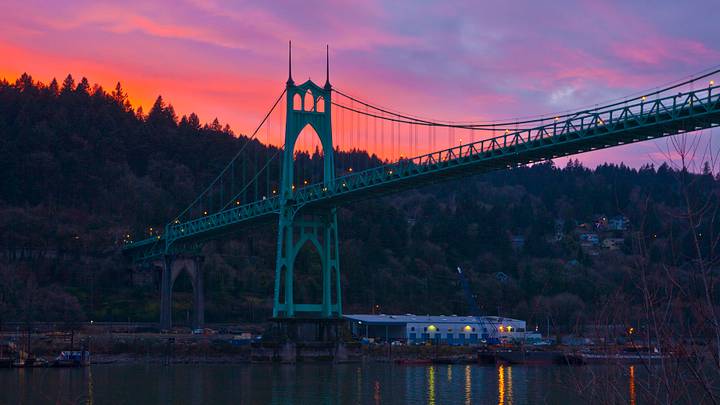
St. Johns Bridge towered above the charming expanse of the park beneath it, shivering slightly as cars and trucks crossed its vast expanse. I was safe from the rain underneath it, and fully able to take in its vast size.
The bridge appears in Wildwood, but in the story it is called the Ghost Bridge. It links Prue’s home of St. Johns to the Impassable Wilderness, and is a phantom bridge that can only be summoned with magic. During one particularly haunting scene, Alexandra, the primary antagonist of Wildwood, stands on it and makes a dangerous bargain with Prue’s parents. Just then, I could almost imagine her emerging from the foggy woods on the other side of the bridge.
Stumptown Coffee

Two mornings later, I made my way to Stumptown Coffee. Prue orders a shot of espresso in the movie, but I sat with my usual hot latte and read from the stack of books I’d acquired at Powell’s, the cavernous city block-sized bookstore I’d explored the night before. I’d been shocked when I checked my clock and realized two hours had passed there. Portland, I was discovering, was quite a charming place for a book and forest-lover.
I’d spent the previous day at the Portland Book Festival, where I heard Meloy and Ellis discuss the inspiration behind Wildwood. The idea first came to them as warehouse-dwelling young Portland artists, but they’d only revived it after finding creative success—Meloy is the lead singer of the band The Decemberists and Ellis has illustrated many children's books—and having kids. Wildwood emerged as a “mythogeography,” a story that projects magical worlds onto real-world locations and, as Meloy said, hopefully inspires kids to go out and connect with wild places like Forest Park.
Though I was not exactly the target audience, I reflected that the book and film had managed to do exactly that for me. The evening prior, I’d also found time to visit Portland’s majestic Japanese Garden, one of the most beautiful places I’d ever been. A blend of Japanese gardening techniques and the wild Pacific Northwest forests that I loved, it was exquisite. I’d also heard poets and writers read excerpts of their work in the Portland Art Museum as part of the Book Festival, and I’d had a lot of great food and excellent wine at Canard, a restaurant in East Portland. I was not, in short, quite ready to leave.
Voodoo Doughnuts

I had a plane to catch, but there were a few more places I wanted to see. The full brightness of the morning was just beginning to rouse the sleepy city when I reached Voodoo Doughnuts, which was easily visible thanks to its neon sign and bright pink paint. Prue visits this spot as well in the movie on her morning jaunt with her baby brother, pre-crow abduction. I’m not usually a doughnut person, but all I can say about the S’Mores Fritter I had is that it was, inarguably, the best doughnut I ever had.
Tom McCall Waterfront Park

Donut and coffee acquired, I then walked through Arkeny Plaza, past Skidmore Fountain and towards the river. On the way, I spotted a crow perched atop a building, cawing loudly. I stopped to snap a photo, and then realized that another crow had emerged. And another. And another.
Soon there were dozens of crows lining the tops of the buildings, the fountain, and the surrounding trees. This was exactly what happened in Wildwood before Prue’s brother was abducted. Had the lines between fiction and reality dissolved so completely that I’d stepped into the story? Were the crows about to somehow draw me back into the woods after them? Would I mind if they did?

I kept walking, and soon made it to the waterfront park, where a huge group of runners was gathering for their morning jog. The Willamette River sparkled. I had to go home; I’d had my time in the woods for now. But I would be back, I resolved, either in reality or in fiction—back somehow to those grand Pacific Northwest trees, so full of stories.
Then again, the forest in Wildwood is not a paradise; it is deeply fractured and plagued by violence and bureaucracy. Wildwood is less of an escapist tale than a deeper look at our own world and its problems mapped onto one of the oldest tales of all: a child’s adventure into the woods and home again.
Whenever I travel I leave with a better understanding of the places I come from, and the same goes for the stories I read. Wildwood is a story that reminds us of the magic all around us, within us, and in the plants on our desks just as much as the trees in distant woods. It is also about the way that pain and greed can warp that magic, leading to destruction and corruption—at least until enough people gather together to make a change. And amid all this, it’s also a love letter to the one-of-a-kind city of Portland.