%20%20--%3E%0A%3Csvg%20version%3D%221.1%22%20id%3D%22Layer_1%22%20xmlns%3D%22http%3A%2F%2Fwww.w3.org%2F2000%2Fsvg%22%20xmlns%3Axlink%3D%22http%3A%2F%2Fwww.w3.org%2F1999%2Fxlink%22%20x%3D%220px%22%20y%3D%220px%22%0A%09%20viewBox%3D%220%200%20684.6%2068.1%22%20style%3D%22enable-background%3Anew%200%200%20684.6%2068.1%3B%22%20xml%3Aspace%3D%22preserve%22%3E%0A%3Cg%3E%0A%09%3Cpath%20d%3D%22M444.1%2C29.3h-17.4v14.5h17.4V29.3z%20M36.4%2C68.1l29.3-50.8V0H50.4L32.9%2C36.8L15.5%2C0H0v68.1h16.7V45.8l12.4%2C22.3H36.4z%0A%09%09%20M49.1%2C68.1h16.6V23.4L49.1%2C52.1V68.1z%20M76.6%2C68.1h45V53.8H93.3V41.6h21V27.1h-21V14.8h28.3V0.1h-45V68.1z%20M175.6%2C68.1h17.3v-68%0A%09%09h-16.5v40.3L150%2C0.1h-17.6v68h16.7V27.7L175.6%2C68.1z%20M235.8%2C14.8h15.4V0.1h-47.4v14.7H219v53.2h16.8V14.8z%20M290.3%2C45.9h-17.1%0A%09%09l7.5-15.6h2L290.3%2C45.9z%20M298.7%2C68.1h18l-32.2-68h-5.7l-32%2C68h18l3.3-7.1h27.1L298.7%2C68.1z%20M325.2%2C68.1h46.2V53.8h-29.6V0.1h-16.7%0A%09%09V68.1z%20M423.7%2C14.8h27.2V0.1H407v68h16.7V14.8z%20M462%2C68.1h46.2V53.8h-29.6V0.1H462V68.1z%20M564.8%2C34.1c0%2C10.7-7.2%2C19.2-18.5%2C19.2%0A%09%09c-11.4%2C0-18.5-8.5-18.5-19.2s7.1-19.2%2C18.5-19.2C557.6%2C14.9%2C564.8%2C23.4%2C564.8%2C34.1%20M580.6%2C34.1c0-19-14.2-34-34.3-34%0A%09%09c-20.2%2C0-34.3%2C15-34.3%2C34c0%2C19%2C14.1%2C34%2C34.3%2C34C566.4%2C68.1%2C580.6%2C53.1%2C580.6%2C34.1%20M604.8%2C20.5c0-4.1%2C3.3-6.2%2C6.7-6.2%0A%09%09c4.4%2C0%2C6.6%2C3%2C6.6%2C6.6h14.7C631.8%2C9.1%2C625.1%2C0.1%2C611%2C0.1c-12%2C0-21.7%2C9.3-21.7%2C20.6c0%2C10.9%2C5.9%2C15.9%2C16.7%2C19.8%0A%09%09c5.2%2C1.8%2C11.5%2C3.2%2C11.5%2C8c0%2C3.3-2.4%2C5.5-6.4%2C5.5c-3.6%2C0-6.6-3-6.6-6.7h-15.2c0%2C11.5%2C7.9%2C20.8%2C21.8%2C20.8c12%2C0%2C21.6-9.3%2C21.6-20.6%0A%09%09c0-10-5.3-16.4-16.7-19.8C610.6%2C26.1%2C604.8%2C25.3%2C604.8%2C20.5%20M670%2C20.9h14.7C683.8%2C9.1%2C677.1%2C0.1%2C663%2C0.1c-12%2C0-21.7%2C9.3-21.7%2C20.6%0A%09%09c0%2C10.9%2C5.9%2C15.9%2C16.7%2C19.8c5.2%2C1.8%2C11.5%2C3.2%2C11.5%2C8c0%2C3.3-2.4%2C5.5-6.4%2C5.5c-3.6%2C0-6.6-3-6.6-6.7h-15.2c0%2C11.5%2C7.9%2C20.8%2C21.8%2C20.8%0A%09%09c12%2C0%2C21.6-9.3%2C21.6-20.6c0-10-5.3-16.4-16.7-19.8c-5.4-1.6-11.3-2.4-11.3-7.2c0-4.1%2C3.3-6.2%2C6.7-6.2C667.7%2C14.4%2C670%2C17.3%2C670%2C20.9%0A%09%09%22%2F%3E%0A%3C%2Fg%3E%0A%3C%2Fsvg%3E%0A)

When people refer to their city by a nickname or with a motto, they’re usually expressing hometown pride. Sometimes, however, that name started out expressing something very different. For example, people call Chicago “The Windy City” today, figuring the name has something to do with wind coming in over Lake Michigan, but the name really started out as an insult.
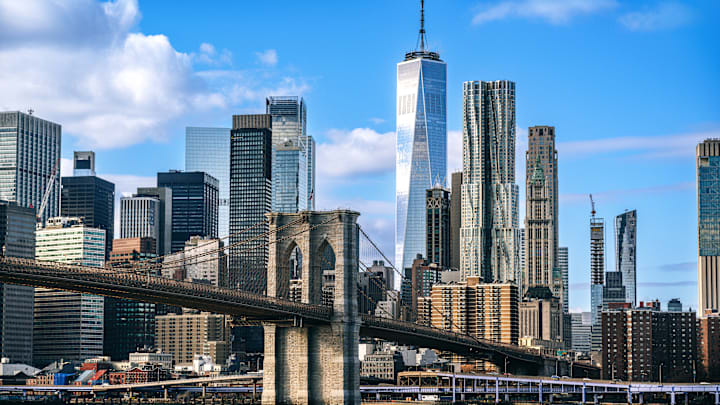
New York City appears to have more nicknames than any other city. Surprisingly, many of these names originated from something far from complimentary.
- THE BIG APPLE
- IF YOU CAN MAKE IT THERE, YOU’LL MAKE IT ANYWHERE
- THE CITY THAT NEVER SLEEPS
- THE TENDERLOIN
- I ♥ NY
- GOTHAM
THE BIG APPLE

“The Big Apple” refers to New York’s size and importance. In the 1920s, articles about horse racing popularized the nickname, so people back then may have seen a connection between the apple in the name and the apples you feed horses. The name did not originate from those apples, however.
A few years earlier, in 1909, a book titled The Wayfarer in New York wrote humorously about how other parts of the country resent New York. “Kansas is apt to see in New York a greedy city,” said the book, “wrapped up in itself, incredulous of Western wisdom, inhospitable to ‘broad American ideas,’ perched on the shore of the Atlantic Ocean and careless of the great land behind it except as a vast productive area from which it draws endless wealth.”
“New York is merely one of the fruits of that great tree whose roots go down in the Mississippi Valley, and whose branches spread from one ocean to the other, but the tree has no great degree of affection for its fruit. It inclines to think that the big apple gets a disproportionate share of the national sap,” the book continued.
Those words speak to the resentment some Americans have for big cities even today. But today, people don’t remember what the “apple” in “the big apple” means. They’re more likely to show up in Times Square, and guess the apple refers to Applebee’s.
IF YOU CAN MAKE IT THERE, YOU’LL MAKE IT ANYWHERE

Everyone recognizes this line as coming from the Frank Sinatra song “New York, New York.” The song’s full title is “Theme from New York, New York,” as it originates from the 1977 Martin Scorsese film New York, New York, in which it was sung by Liza Minnelli. It makes for a dubious anthem because it is not actually someone singing about their city.
It is sung from the perspective of someone in a little town who dreams of New York but has never been there. It’s a song about longing, in the vein of “Somewhere Over the Rainbow.” When the lyrics say, “If I can make it there,” they reveal that the singer, who has yet to set off, might not actually ever get to New York.
They believe that simply getting to New York will set them up for life, but the song frames that as desperate optimism, not a factual statement about New York opportunity. This is clearer in the original performance in the New York, New York movie, as it comes during the sad finale.
The lyrics, as originally scripted, were even more negative. They were originally not about someone liking New York at all, but instead began like this: “They always say it’s a nice place to visit, but I wouldn’t want to live here / They always say it’s a nice place to sightsee, but I wouldn’t want to stay here.”
Since the finished song is about never having visited New York, it doesn’t say much that relates to New York with any specificity, other than the line about “a city that doesn’t sleep.” And that line, it turns out, is another New York nickname with a surprising history.
THE CITY THAT NEVER SLEEPS

Newspapers in the early 20th century called New York “the city that never sleeps,” and they were complimenting the city, much like when people use the phrase today. They got the phrase, however, from the 1898 book Out of Mulberry Street, which was an exposé on New York poverty.
“The Bowery never sleeps,” wrote reformer Jacob Riis, referring to a neighborhood in Lower Manhattan. He was not talking about how fun it is to hang out with friends late at night. Instead, he was sharing an anecdote in which a drunk fortysomething woman died on the street by drinking carbolic acid.
The “never sleeps” observation referred to how a crowd quickly assembled, and a beat cop was soon there because police patrols continue at all hours.
Riis also published another book about New York tenements, whose title is the origin of another popular phrase: How the Other Half Lives.
THE TENDERLOIN

Several cities have a district they refer to as “the tenderloin,” with San Francisco’s being the most famous. They are all named after Manhattan’s tenderloin district, a chunk that today includes such sections as Chelsea and Hell’s Kitchen.
You might guess that tenderloin districts have histories related to meat production, much like meatpacking districts do. That is not the case. The Tenderloin was the red light district, and the name was coined by NYPD captain Alex “Clubber” Williams in 1876. Upon learning that he was being transferred to the area, Williams said, “I've been having chuck steak ever since I've been on the force and now I'm going to have a bit of tenderloin.”
He meant that he was going to be rich because the criminals who ran the establishments here would surely pay him a lot of bribes.
I ♥ NY

New York was seedy in 1876 and 1898, but it would have to wait a bit longer for crime to really shoot up. Between 1962 and 1972, the murder rate nearly tripled. It stayed that high for most of the 1970s, and late into this decade, the Department of Commerce commissioned a new slogan to attract tourists: I Love New York, with the “love” represented as a heart.
The slogan wasn’t being sarcastic. It really did aim to say that people loved New York. But it responded not to New York’s good reputation but to New York’s terrible reputation. In addition to the staggering crime rate, it was in the middle of a financial crisis, which included President Gerald Ford going on national television to declare that the federal government would not bail New York out.
In the years that followed, crime rose even more, peaking in 1990. Things have gotten a lot better since then, with the murder rate dropping 90 percent by 2025.
GOTHAM

New York used to be nicknamed Gotham, though you won’t hear people call it that very often anymore. You’re more likely to now associate that word with Batman’s Gotham City—which was named, by Batman writer Bill Finger, after the New York nickname, to set the fictional city up as a sort of alternate version of New York.
Washington Irving had dubbed New York “Gotham” in a 19th-century satirical periodical titled Salmagundi. He took this name from a village in England, the source of a legend called Wise Men of Gotham. So, that sounds like he was calling New Yorkers wise, right?
Not quite. Wise Men of Gotham is about the residents of Gotham doing foolish things, which is why the characters are sometimes called the Fools of Gotham. The legend has several different versions, with residents engaging in such absurd endeavors as trying to drown fish or sending cheese toward a market by kicking it down a hill.
In the story, they are feigning their stupidity to trick a king, but Irving called New York “Gotham” to mock it. And in the most concise version of the tale, they’re simply foolish with no excuse. Consider this nursery rhyme about them:
Three wise men of Gotham
They went to sea in a bowl
And if the bowl had been stronger
My song would have been longer