%20%20--%3E%0A%3Csvg%20version%3D%221.1%22%20id%3D%22Layer_1%22%20xmlns%3D%22http%3A%2F%2Fwww.w3.org%2F2000%2Fsvg%22%20xmlns%3Axlink%3D%22http%3A%2F%2Fwww.w3.org%2F1999%2Fxlink%22%20x%3D%220px%22%20y%3D%220px%22%0A%09%20viewBox%3D%220%200%20684.6%2068.1%22%20style%3D%22enable-background%3Anew%200%200%20684.6%2068.1%3B%22%20xml%3Aspace%3D%22preserve%22%3E%0A%3Cg%3E%0A%09%3Cpath%20d%3D%22M444.1%2C29.3h-17.4v14.5h17.4V29.3z%20M36.4%2C68.1l29.3-50.8V0H50.4L32.9%2C36.8L15.5%2C0H0v68.1h16.7V45.8l12.4%2C22.3H36.4z%0A%09%09%20M49.1%2C68.1h16.6V23.4L49.1%2C52.1V68.1z%20M76.6%2C68.1h45V53.8H93.3V41.6h21V27.1h-21V14.8h28.3V0.1h-45V68.1z%20M175.6%2C68.1h17.3v-68%0A%09%09h-16.5v40.3L150%2C0.1h-17.6v68h16.7V27.7L175.6%2C68.1z%20M235.8%2C14.8h15.4V0.1h-47.4v14.7H219v53.2h16.8V14.8z%20M290.3%2C45.9h-17.1%0A%09%09l7.5-15.6h2L290.3%2C45.9z%20M298.7%2C68.1h18l-32.2-68h-5.7l-32%2C68h18l3.3-7.1h27.1L298.7%2C68.1z%20M325.2%2C68.1h46.2V53.8h-29.6V0.1h-16.7%0A%09%09V68.1z%20M423.7%2C14.8h27.2V0.1H407v68h16.7V14.8z%20M462%2C68.1h46.2V53.8h-29.6V0.1H462V68.1z%20M564.8%2C34.1c0%2C10.7-7.2%2C19.2-18.5%2C19.2%0A%09%09c-11.4%2C0-18.5-8.5-18.5-19.2s7.1-19.2%2C18.5-19.2C557.6%2C14.9%2C564.8%2C23.4%2C564.8%2C34.1%20M580.6%2C34.1c0-19-14.2-34-34.3-34%0A%09%09c-20.2%2C0-34.3%2C15-34.3%2C34c0%2C19%2C14.1%2C34%2C34.3%2C34C566.4%2C68.1%2C580.6%2C53.1%2C580.6%2C34.1%20M604.8%2C20.5c0-4.1%2C3.3-6.2%2C6.7-6.2%0A%09%09c4.4%2C0%2C6.6%2C3%2C6.6%2C6.6h14.7C631.8%2C9.1%2C625.1%2C0.1%2C611%2C0.1c-12%2C0-21.7%2C9.3-21.7%2C20.6c0%2C10.9%2C5.9%2C15.9%2C16.7%2C19.8%0A%09%09c5.2%2C1.8%2C11.5%2C3.2%2C11.5%2C8c0%2C3.3-2.4%2C5.5-6.4%2C5.5c-3.6%2C0-6.6-3-6.6-6.7h-15.2c0%2C11.5%2C7.9%2C20.8%2C21.8%2C20.8c12%2C0%2C21.6-9.3%2C21.6-20.6%0A%09%09c0-10-5.3-16.4-16.7-19.8C610.6%2C26.1%2C604.8%2C25.3%2C604.8%2C20.5%20M670%2C20.9h14.7C683.8%2C9.1%2C677.1%2C0.1%2C663%2C0.1c-12%2C0-21.7%2C9.3-21.7%2C20.6%0A%09%09c0%2C10.9%2C5.9%2C15.9%2C16.7%2C19.8c5.2%2C1.8%2C11.5%2C3.2%2C11.5%2C8c0%2C3.3-2.4%2C5.5-6.4%2C5.5c-3.6%2C0-6.6-3-6.6-6.7h-15.2c0%2C11.5%2C7.9%2C20.8%2C21.8%2C20.8%0A%09%09c12%2C0%2C21.6-9.3%2C21.6-20.6c0-10-5.3-16.4-16.7-19.8c-5.4-1.6-11.3-2.4-11.3-7.2c0-4.1%2C3.3-6.2%2C6.7-6.2C667.7%2C14.4%2C670%2C17.3%2C670%2C20.9%0A%09%09%22%2F%3E%0A%3C%2Fg%3E%0A%3C%2Fsvg%3E%0A)

Most people have an idea in their mind about what it means to be a spy. Many, influenced by movie franchises like James Bond or Mission: Impossible, expect spies to be suave masters of disguise, hiding their names and changing their faces to sneak into enemy bases. But reality is much different. Most people working as spies in the real world are just ordinary citizens who happen to have access to vital information.
In a fascinating subversion of the stereotype, some spies are even chosen because of how much they stand out from the crowd. While it is valuable to know how to blend in, there are some forms of intelligence that are easiest to access by people who are way too prominent for anyone to imagine that they could be spies. Josephine Baker is one of the best examples of this situation.
In the 1930s and ‘40s, Baker was one of the most recognizable individuals in Europe. She was known to wear elaborate outfits and stroll down the streets of Paris with an exotic animal on a leash. Fans and media followed her as she held concerts around the world. And in the midst of her celebrity, she acquired information that fundamentally changed the course of World War II.
Josephine Baker’s Star on the Rise

Born in St. Louis, Missouri, in 1906, Baker saw the worst that Jim Crow America had to offer. The city was heavily segregated and was bubbling with hostility, as businesses pitted newly arrived Black laborers against the white employees who were attempting to unionize. In 1917, the city served as the setting for the worst race riot at that point in U.S. history, resulting in massive property damage, the displacement of approximately 6,000 Black Americans, and a death toll ranging from 39 to 200. Baker and her family saw their home burned to the ground, lucky only that they had not been trapped inside it like many of their neighbors.
Living in a cruel city with a mother who struggled to support her and her siblings, Baker set out at a young age. She began performing in the streets of St. Louis before getting the chance to tour the country with the Jones Family Band and the Dixie Steppers. While she was willing to work and take on small roles, Baker learned quickly that she needed to stand out to make it big.
This lesson changed her life when she joined the chorus of Shuffle Along on Broadway in 1923. Despite not having a principal role in the show, Baker added comedy to her performances that won her a more prominent role in the show Chocolate Dandies and a place at the Plantation Club, where she wowed audiences and understudied for Ethel Waters. In 1925, she was offered a role in La Revue nègre, a show that would be performed in Paris.
Baker took the job and flew away from everything she had ever known. But while that might have been frightening at first, she was stunned by the reception she was met with in France. There was no segregation, no racially motivated brutality. When she debuted her famous Danse Sauvage, the audiences fell in love with her.
From there, her career took off. She was given solo billing on performances and was able to travel across Europe as the highest-paid performer on the continent. Although many of her early performances relied on racial stereotypes, she was able to live a life that had been completely inaccessible in the United States. France had given her not only success, but acceptance, which she had never known at home.
Even Europe’s Greatest Star Faced Discrimination

Unfortunately, there were still many places that did not accept Baker’s celebrity status. When she returned to the United States in 1935 to star in the Ziegfeld Follies, audiences rejected her performance, filling reviews with racist commentary about how a Black woman shouldn’t have those kinds of roles. It was a harsh reminder that her home country was not as accepting as her adoptive one.
"You know, friends, that I do not lie to you when I tell you I have walked into the palaces of kings and queens and into the houses of presidents. And much more. But I could not walk into a hotel in America and get a cup of coffee, and that made me mad."Josephine Baker, March on Washington
Europe was also becoming an increasingly difficult place for a successful woman of color. Adolph Hitler published Mein Kampf in 1925 and 1926, and many found its arguments compelling when they needed someone to blame for their hardships. Baker was an easy target, labeled the “Black Devil” when she stopped in Vienna during her 1928 tour. She was forced to leave Berlin after only a few weeks of a six-month run.
Many people would have been cowed by these incidents, but Baker was furious. She had survived so much hardship and built a new life on her own talent and hard work, and racism was threatening to tear it all apart. This put her in the perfect mindset when World War II began, and the French Résistance came calling.
Josephine Baker’s Decision to Fight Back

According to the International Spy Museum, “persuading someone to put their life on the line is one of the hardest tasks for any intelligence officer.” Some informants need to be bribed or threatened to put themselves in such a dangerous position. Baker needed no such persuasion, quickly agreeing to collect intelligence that might help the Allies against their enemies.
When she was approached by intelligence agent Jacques Abtey about helping acquire information for the French Resistance, she agreed immediately, explaining, “France made me what I am. The Parisians gave me their hearts, and I am ready to give them my life.” She served as an “honorable correspondent,” which meant that she served the Résistance out of patriotism. She was never paid for any of the work she did during the war.
The position also meant she was in greater danger than official spies. As the International Spy Museum explains, intelligence officers usually have some form of official cover for their missions, which also means that their home government can intercede on their behalf. Honorable correspondents didn’t have that sort of protection and could be arrested or executed for their activities.
What could convince someone, especially someone with the wealth and prestige to flee war-torn Europe, to stay and risk their lives for no payment? Baker explained that it was out of love for the country that had accepted her, and which had granted her citizenship in 1937. But she had another reason that was just as personal.
Baker told Ebony magazine in 1973 that her strongest reason for joining the Résistance was moral. She explained:
"The thing that drove me as strongly as did the patriotism was my violent hatred of discrimination in any form. The Nazis were racists. They were bigots. I despised that sort of thing. I was determined that they must be defeated."Josephine Baker
Baker was a shining example of everything that the Nazi Party hated. She was an openly bisexual woman married to a Jewish man. Even worse, she was wildly successful, which went against every eugenicist argument about the superiority of the Aryan man. As they secured their power, the Nazi Party declared her a representative of untermenschlich (subhuman) art. That was the sort of ideology that she could never tolerate.
After spending her formative years experiencing the brutality of racism firsthand, Baker simply could not accept a country that was driven by that kind of hatred, especially when it was intent on spreading that mindset across the continent she had come to love. She fundamentally opposed everything they were fighting for and was ready to stake her life on those beliefs.
How a Celebrity Helped Win World War II

While many of Baker's actions during the war may still be classified, the intelligence community has been very clear on their significance. American counter-intelligence officer Lieutenant Paul Jensen claimed that “We would have been quite helpless without her.” British agents knew her as one of the most important figures in the Free French movement.
In the early days of the war, Baker used her popularity to gather information on how different countries intended to respond to the Nazi threat. She had pre-existing contacts at the Japanese and Italian agencies who were happy to talk to a celebrity about their plans. New diplomats would let information slip while trying to make themselves seem important, which allowed the Allies to learn who their real friends were.
Publicly, she was opposed to the Nazis, but in ways that were considered more appropriate for a woman of her standing. She raised money for the Résistance and to help refugees. She held private concerts for troops to improve morale. Perhaps most startling at the time, she even joined the Red Cross as part of the Infirmières Pilotes Secouristes de l’Air (Air Force Nurse Pilot Rescue Service), using her pilot’s license to rescue soldiers and transport medical professionals.

Despite her obvious political leanings, she was considered far too famous to ever be a spy. When she attended parties at the French Embassy, she would write notes about troop movements and military bases on her arms. She would pin notes and photographs inside her bra. Whenever she was warned that these were dangerous methods, she would laugh and say, “No one would ever think I am a spy.”
And no one did. She was allowed to travel more freely than most by claiming that she had concert tours, and her baggage was never searched. She was even able to smuggle people across borders by claiming they were managers or choreographers. Nobody paid attention to them, because she drew all eyes to herself. Her fame was a weapon, and she knew exactly how to wield it.
When Germany invaded France, she moved from Paris to a private estate, where she had relative freedom. She housed refugees and rebels, continuing to pass information however she could. But it was getting more dangerous. The Nazis actually went to her estate looking for resistance fighters, but she acted like an inconvenienced but harmless celebrity to get them to leave.
Her privileged situation couldn’t last for long, so she left France with Jacques Abtey, carrying as much information as they could in invisible ink on sheet music. The flow of information had been cut off by the Nazi occupation of France, so she and Abtey moved first to Portugal and then to Morocco to collect more information and see it safely transported to England.
According to the CIA, the information they gathered was invaluable for planning an Allied invasion called Operation Torch. After the successful operation, she served as a liaison between the French and American intelligence agencies as they worked to maintain control over North Africa, identifying spies and helping direct intelligence where it needed to go. Even when she was hospitalized for months, French and American agents gathered at her bedside to exchange information in the relative privacy that her celebrity had won her.
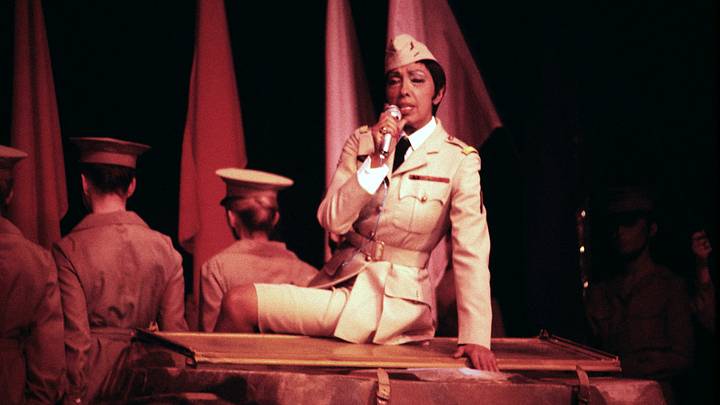
After France was liberated, Baker returned to Paris wearing her Air Auxiliary uniform. She sold her luxuries to pay for food and fuel for the people who were suffering in the city she had always loved. Her loyalty to France and its values was rewarded with some of the highest honors the government could offer, which included naming her a Chevalier de Légion d’honneur and awarding her the Croix de Guerre and the Rosette de la Résistance.
Over the course of the war, Baker proved that she was far more than the flighty performer she pretended to be. She continued to fight for equality for the rest of her life, speaking at the March on Washington and adopting multinational children to prove that hatred was taught, not born. In return, she was granted full military honors by the French government at her funeral and, more recently, a place in the Panthéon, a mausoleum for the greatest French citizens.
She showed just how impactful a celebrity can be when they use their wealth and influence for the betterment of humanity. Her mission was not easy, and her actions were not always appreciated. Her participation in the Civil Rights movement got her labeled a communist by her home country, which deemed her a potential threat and revoked her visa. But by fighting for what she believed in, she proved that we are all more powerful than we think and capable of more than our adversaries want us to know.