%20%20--%3E%0A%3Csvg%20version%3D%221.1%22%20id%3D%22Layer_1%22%20xmlns%3D%22http%3A%2F%2Fwww.w3.org%2F2000%2Fsvg%22%20xmlns%3Axlink%3D%22http%3A%2F%2Fwww.w3.org%2F1999%2Fxlink%22%20x%3D%220px%22%20y%3D%220px%22%0A%09%20viewBox%3D%220%200%20684.6%2068.1%22%20style%3D%22enable-background%3Anew%200%200%20684.6%2068.1%3B%22%20xml%3Aspace%3D%22preserve%22%3E%0A%3Cg%3E%0A%09%3Cpath%20d%3D%22M444.1%2C29.3h-17.4v14.5h17.4V29.3z%20M36.4%2C68.1l29.3-50.8V0H50.4L32.9%2C36.8L15.5%2C0H0v68.1h16.7V45.8l12.4%2C22.3H36.4z%0A%09%09%20M49.1%2C68.1h16.6V23.4L49.1%2C52.1V68.1z%20M76.6%2C68.1h45V53.8H93.3V41.6h21V27.1h-21V14.8h28.3V0.1h-45V68.1z%20M175.6%2C68.1h17.3v-68%0A%09%09h-16.5v40.3L150%2C0.1h-17.6v68h16.7V27.7L175.6%2C68.1z%20M235.8%2C14.8h15.4V0.1h-47.4v14.7H219v53.2h16.8V14.8z%20M290.3%2C45.9h-17.1%0A%09%09l7.5-15.6h2L290.3%2C45.9z%20M298.7%2C68.1h18l-32.2-68h-5.7l-32%2C68h18l3.3-7.1h27.1L298.7%2C68.1z%20M325.2%2C68.1h46.2V53.8h-29.6V0.1h-16.7%0A%09%09V68.1z%20M423.7%2C14.8h27.2V0.1H407v68h16.7V14.8z%20M462%2C68.1h46.2V53.8h-29.6V0.1H462V68.1z%20M564.8%2C34.1c0%2C10.7-7.2%2C19.2-18.5%2C19.2%0A%09%09c-11.4%2C0-18.5-8.5-18.5-19.2s7.1-19.2%2C18.5-19.2C557.6%2C14.9%2C564.8%2C23.4%2C564.8%2C34.1%20M580.6%2C34.1c0-19-14.2-34-34.3-34%0A%09%09c-20.2%2C0-34.3%2C15-34.3%2C34c0%2C19%2C14.1%2C34%2C34.3%2C34C566.4%2C68.1%2C580.6%2C53.1%2C580.6%2C34.1%20M604.8%2C20.5c0-4.1%2C3.3-6.2%2C6.7-6.2%0A%09%09c4.4%2C0%2C6.6%2C3%2C6.6%2C6.6h14.7C631.8%2C9.1%2C625.1%2C0.1%2C611%2C0.1c-12%2C0-21.7%2C9.3-21.7%2C20.6c0%2C10.9%2C5.9%2C15.9%2C16.7%2C19.8%0A%09%09c5.2%2C1.8%2C11.5%2C3.2%2C11.5%2C8c0%2C3.3-2.4%2C5.5-6.4%2C5.5c-3.6%2C0-6.6-3-6.6-6.7h-15.2c0%2C11.5%2C7.9%2C20.8%2C21.8%2C20.8c12%2C0%2C21.6-9.3%2C21.6-20.6%0A%09%09c0-10-5.3-16.4-16.7-19.8C610.6%2C26.1%2C604.8%2C25.3%2C604.8%2C20.5%20M670%2C20.9h14.7C683.8%2C9.1%2C677.1%2C0.1%2C663%2C0.1c-12%2C0-21.7%2C9.3-21.7%2C20.6%0A%09%09c0%2C10.9%2C5.9%2C15.9%2C16.7%2C19.8c5.2%2C1.8%2C11.5%2C3.2%2C11.5%2C8c0%2C3.3-2.4%2C5.5-6.4%2C5.5c-3.6%2C0-6.6-3-6.6-6.7h-15.2c0%2C11.5%2C7.9%2C20.8%2C21.8%2C20.8%0A%09%09c12%2C0%2C21.6-9.3%2C21.6-20.6c0-10-5.3-16.4-16.7-19.8c-5.4-1.6-11.3-2.4-11.3-7.2c0-4.1%2C3.3-6.2%2C6.7-6.2C667.7%2C14.4%2C670%2C17.3%2C670%2C20.9%0A%09%09%22%2F%3E%0A%3C%2Fg%3E%0A%3C%2Fsvg%3E%0A)

It's hard to believe that only 60 years ago, American women didn’t have the same rights we do today.
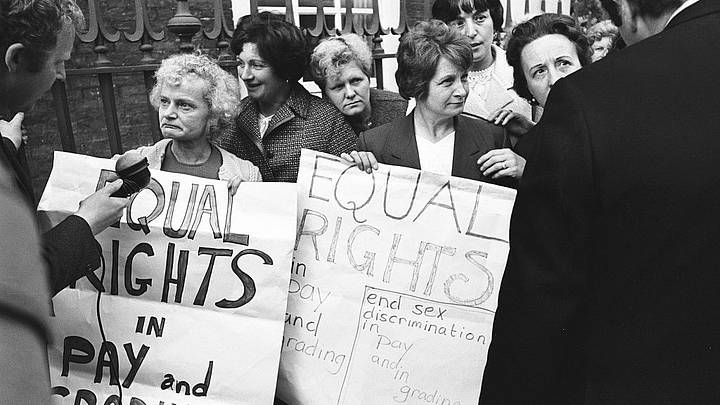
Many opportunities and freedoms we consider normal in 2026, like taking maternity leave or getting a credit card, weren’t available to women in the 1960s. Some rights existed, but, more often than not, required a man’s permission. Others, such as serving on a jury or being hired without gender bias, were entirely off the table in some states.
Several of these rights weren’t legally granted to women across the United States until well into the 1970s, with some states and workplaces moving toward equality faster than others.
While these rights seem standard now, single women, mothers, grandmothers, and great-grandmothers alive today once lived in a world without them.
Here are six things American women were not legally permitted to do in the 1960s.
- OPEN A BANK ACCOUNT
- MATERNITY LEAVE
- ATTEND AN IVY LEAGUE COLLEGE
- JURY DUTY
- GET HIRED WITHOUT GENDER BIAS
- USE ORAL CONTRACEPTIVES
OPEN A BANK ACCOUNT

Before the Equal Credit Opportunity Act of 1974, banks turned women away from receiving loans, mortgages, or credit cards. It was not unheard of for a financial institution to refuse a woman who requested these services unless a man was present to co-sign.
Unmarried women were denied most often, but a father, brother, or male relative could co-sign. Married women needed their husbands’ signatures.
MATERNITY LEAVE

Before the Pregnancy Discrimination Act of 1978, women could be fired or told to resign if they became pregnant and asked for time off to care for their child.
After Title VII of the Civil Rights Act of 1964 was passed, pregnant women were legally required to be treated like other employees. Pregnancy and childbirth were categorized as short-term disability, granting women similar benefits and leave.
ATTEND AN IVY LEAGUE COLLEGE

Many Ivy League colleges did not admit women until the late 1960s and early 1970s.
According to CNN, the University of Pennsylvania and Cornell accepted female students “on a case-by-case basis” and “under special circumstances” as early as the 1870s. Princeton accepted its first female student in 1969; Brown in 1971; Dartmouth in 1972; Harvard in 1977; and Columbia in 1981.
These institutions started admitting women after Title IX of the Education Amendments of 1972 was passed. For Harvard and Columbia, merging with their all-women colleges, Radcliffe and Barnard, took more time.
JURY DUTY

The 19th Amendment to the U.S. Constitution guaranteed white women the right to vote, but many states still did not permit women to serve on juries. The state governments were responsible for legalizing women’s jury service. Wyoming and Utah allowed women to serve on juries in the late 1800s, and other states slowly followed suit until 1973, when all 50 states allowed it.
But why were women kept off juries in the first place? According to CNN, women were considered primary caregivers at home and thought to be too “fragile” and “sympathetic” to remain objective regarding the offenses presented in court.
GET HIRED WITHOUT GENDER BIAS

Not only were women denied maternity leave until the late 1970s, but they could also be turned away from jobs simply because of their sex, at least until the Civil Rights Act of 1964 made it illegal to discriminate based on race, sex, or religion.
When it first passed, this law was loosely enforced, and many women were still excluded from male-dominated fields such as law, medicine, engineering, and architecture. Additional protections, like the Pregnancy Discrimination Act of 1978 and the Pregnant Workers Fairness Act of 2022 (yes, four years ago), furthered workplace rights over time.
USE ORAL CONTRACEPTIVES

The FDA approved the birth control pill in 1957, but initially, it could only be prescribed for “severe menstrual distress.” In 1960, it became available as a contraceptive but remained illegal in some states and was generally prescribed to married women for “family planning” purposes, following 1965’s Griswold v. Connecticut.
Many pharmacies didn’t even stock birth control, considering it “immoral,” according to CNN. It wasn’t until 1972, with Eisenstadt v. Baird, that unmarried couples could legally use contraceptives.