%20%20--%3E%0A%3Csvg%20version%3D%221.1%22%20id%3D%22Layer_1%22%20xmlns%3D%22http%3A%2F%2Fwww.w3.org%2F2000%2Fsvg%22%20xmlns%3Axlink%3D%22http%3A%2F%2Fwww.w3.org%2F1999%2Fxlink%22%20x%3D%220px%22%20y%3D%220px%22%0A%09%20viewBox%3D%220%200%20684.6%2068.1%22%20style%3D%22enable-background%3Anew%200%200%20684.6%2068.1%3B%22%20xml%3Aspace%3D%22preserve%22%3E%0A%3Cg%3E%0A%09%3Cpath%20d%3D%22M444.1%2C29.3h-17.4v14.5h17.4V29.3z%20M36.4%2C68.1l29.3-50.8V0H50.4L32.9%2C36.8L15.5%2C0H0v68.1h16.7V45.8l12.4%2C22.3H36.4z%0A%09%09%20M49.1%2C68.1h16.6V23.4L49.1%2C52.1V68.1z%20M76.6%2C68.1h45V53.8H93.3V41.6h21V27.1h-21V14.8h28.3V0.1h-45V68.1z%20M175.6%2C68.1h17.3v-68%0A%09%09h-16.5v40.3L150%2C0.1h-17.6v68h16.7V27.7L175.6%2C68.1z%20M235.8%2C14.8h15.4V0.1h-47.4v14.7H219v53.2h16.8V14.8z%20M290.3%2C45.9h-17.1%0A%09%09l7.5-15.6h2L290.3%2C45.9z%20M298.7%2C68.1h18l-32.2-68h-5.7l-32%2C68h18l3.3-7.1h27.1L298.7%2C68.1z%20M325.2%2C68.1h46.2V53.8h-29.6V0.1h-16.7%0A%09%09V68.1z%20M423.7%2C14.8h27.2V0.1H407v68h16.7V14.8z%20M462%2C68.1h46.2V53.8h-29.6V0.1H462V68.1z%20M564.8%2C34.1c0%2C10.7-7.2%2C19.2-18.5%2C19.2%0A%09%09c-11.4%2C0-18.5-8.5-18.5-19.2s7.1-19.2%2C18.5-19.2C557.6%2C14.9%2C564.8%2C23.4%2C564.8%2C34.1%20M580.6%2C34.1c0-19-14.2-34-34.3-34%0A%09%09c-20.2%2C0-34.3%2C15-34.3%2C34c0%2C19%2C14.1%2C34%2C34.3%2C34C566.4%2C68.1%2C580.6%2C53.1%2C580.6%2C34.1%20M604.8%2C20.5c0-4.1%2C3.3-6.2%2C6.7-6.2%0A%09%09c4.4%2C0%2C6.6%2C3%2C6.6%2C6.6h14.7C631.8%2C9.1%2C625.1%2C0.1%2C611%2C0.1c-12%2C0-21.7%2C9.3-21.7%2C20.6c0%2C10.9%2C5.9%2C15.9%2C16.7%2C19.8%0A%09%09c5.2%2C1.8%2C11.5%2C3.2%2C11.5%2C8c0%2C3.3-2.4%2C5.5-6.4%2C5.5c-3.6%2C0-6.6-3-6.6-6.7h-15.2c0%2C11.5%2C7.9%2C20.8%2C21.8%2C20.8c12%2C0%2C21.6-9.3%2C21.6-20.6%0A%09%09c0-10-5.3-16.4-16.7-19.8C610.6%2C26.1%2C604.8%2C25.3%2C604.8%2C20.5%20M670%2C20.9h14.7C683.8%2C9.1%2C677.1%2C0.1%2C663%2C0.1c-12%2C0-21.7%2C9.3-21.7%2C20.6%0A%09%09c0%2C10.9%2C5.9%2C15.9%2C16.7%2C19.8c5.2%2C1.8%2C11.5%2C3.2%2C11.5%2C8c0%2C3.3-2.4%2C5.5-6.4%2C5.5c-3.6%2C0-6.6-3-6.6-6.7h-15.2c0%2C11.5%2C7.9%2C20.8%2C21.8%2C20.8%0A%09%09c12%2C0%2C21.6-9.3%2C21.6-20.6c0-10-5.3-16.4-16.7-19.8c-5.4-1.6-11.3-2.4-11.3-7.2c0-4.1%2C3.3-6.2%2C6.7-6.2C667.7%2C14.4%2C670%2C17.3%2C670%2C20.9%0A%09%09%22%2F%3E%0A%3C%2Fg%3E%0A%3C%2Fsvg%3E%0A)

What if the most dangerous historical event in your city wasn't disease or war, but a rhythm no one could hear or resist?
Imagine stepping outside and seeing your neighbor dancing in the street. Not as a celebration or a scheduled performance. Just...dancing for hours and days. And before long, dozens (then hundreds) of people start doing the same thing, unable to stop even as their bodies begin to fail.
It’s a story so unbelievable, it borders on myth, yet the records are real. So what is the true story behind the mysterious plague, and what kept the people of Strasbourg, France, dancing through that fateful summer?
Let's find out.
A Medieval Mystery

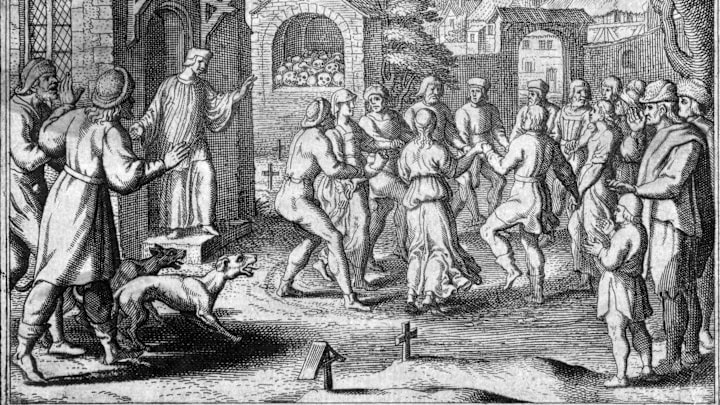
In July 1518, in Strasbourg, a woman known as Frau Troffea walked out to the street and started dancing. There was no special occasion. Just continuous swaying that didn't seem voluntary. What began as a spontaneous dance quickly turned into a full-fledged crisis.
Frau Troffea danced for days. Then others followed. Within a week, the number of dancers in the street had multiplied, and by early August, roughly 400 people were caught up in the same strange compulsion.
City leaders, desperate for answers, turned to doctors. Their conclusion sounds bizarre today: the dancers needed to keep moving in order to recover from their desire to dance. Acting on that advice, officials encouraged the phenomenon instead of stopping it. They set up a stage and even brought in musicians and professionals to accompany the dancers.
This decision intensified everything. People pushed their bodies beyond their limits, dancing for hours and even days without sleep. Exhaustion eventually took its toll. Some collapsed, others reportedly died from the physical strain, including heart attacks and strokes.
After weeks of chaos, authorities reconsidered their approach. The dancers were transported to a shrine dedicated to St. Vitus, a figure many believed had the power to start and stop dancing. There, through rituals and prayer, the unexplainable dancing finally came to a halt.
Why Couldn't They Stop Dancing?

What could cause a crowd of people to lose control in such a random (and dangerous) way? Historians still debate the answer.
One probable idea is psychological distress. At the time, Strasbourg was dealing with serious hardship, including famine and disease. In that environment, fear and anxiety may have manifested physically, spreading from person to person, setting off a chain reaction of sorts.
Belif likely played a role as well. Many in the region feared St. Vitus, who was thought to punish people with uncontrollable dancing. If enough people believed they were at risk, that expectation alone could have contributed to the outbreak.
There are also more physical explanations. Some scholars believe that eating spoiled food, specifically rye infected with poisonous mold, may have been responsible for the unusual behavior. Others have suggested religious practices, though there is little evidence to support that supposition.
No single theory fully explains the event. It likely arose from a combination of factors, environmental stresses, cultural influences, and the contagious power of suggestion, all driving people to dance through the streets.
The Last Dance

The dancing plague of 1518 is, without a doubt, one of history's strangest occurrences on record. Comparable incidents transpired across Europe, although none matched the scale of the 1518 outbreak. Under oddly specific circumstances, human behavior can take unexpected and even hazardous turns.
In Strasbourg, what started as one person's seemingly uncontrollable actions became a citywide phenomenon that danced its way into the history books.