%20%20--%3E%0A%3Csvg%20version%3D%221.1%22%20id%3D%22Layer_1%22%20xmlns%3D%22http%3A%2F%2Fwww.w3.org%2F2000%2Fsvg%22%20xmlns%3Axlink%3D%22http%3A%2F%2Fwww.w3.org%2F1999%2Fxlink%22%20x%3D%220px%22%20y%3D%220px%22%0A%09%20viewBox%3D%220%200%20684.6%2068.1%22%20style%3D%22enable-background%3Anew%200%200%20684.6%2068.1%3B%22%20xml%3Aspace%3D%22preserve%22%3E%0A%3Cg%3E%0A%09%3Cpath%20d%3D%22M444.1%2C29.3h-17.4v14.5h17.4V29.3z%20M36.4%2C68.1l29.3-50.8V0H50.4L32.9%2C36.8L15.5%2C0H0v68.1h16.7V45.8l12.4%2C22.3H36.4z%0A%09%09%20M49.1%2C68.1h16.6V23.4L49.1%2C52.1V68.1z%20M76.6%2C68.1h45V53.8H93.3V41.6h21V27.1h-21V14.8h28.3V0.1h-45V68.1z%20M175.6%2C68.1h17.3v-68%0A%09%09h-16.5v40.3L150%2C0.1h-17.6v68h16.7V27.7L175.6%2C68.1z%20M235.8%2C14.8h15.4V0.1h-47.4v14.7H219v53.2h16.8V14.8z%20M290.3%2C45.9h-17.1%0A%09%09l7.5-15.6h2L290.3%2C45.9z%20M298.7%2C68.1h18l-32.2-68h-5.7l-32%2C68h18l3.3-7.1h27.1L298.7%2C68.1z%20M325.2%2C68.1h46.2V53.8h-29.6V0.1h-16.7%0A%09%09V68.1z%20M423.7%2C14.8h27.2V0.1H407v68h16.7V14.8z%20M462%2C68.1h46.2V53.8h-29.6V0.1H462V68.1z%20M564.8%2C34.1c0%2C10.7-7.2%2C19.2-18.5%2C19.2%0A%09%09c-11.4%2C0-18.5-8.5-18.5-19.2s7.1-19.2%2C18.5-19.2C557.6%2C14.9%2C564.8%2C23.4%2C564.8%2C34.1%20M580.6%2C34.1c0-19-14.2-34-34.3-34%0A%09%09c-20.2%2C0-34.3%2C15-34.3%2C34c0%2C19%2C14.1%2C34%2C34.3%2C34C566.4%2C68.1%2C580.6%2C53.1%2C580.6%2C34.1%20M604.8%2C20.5c0-4.1%2C3.3-6.2%2C6.7-6.2%0A%09%09c4.4%2C0%2C6.6%2C3%2C6.6%2C6.6h14.7C631.8%2C9.1%2C625.1%2C0.1%2C611%2C0.1c-12%2C0-21.7%2C9.3-21.7%2C20.6c0%2C10.9%2C5.9%2C15.9%2C16.7%2C19.8%0A%09%09c5.2%2C1.8%2C11.5%2C3.2%2C11.5%2C8c0%2C3.3-2.4%2C5.5-6.4%2C5.5c-3.6%2C0-6.6-3-6.6-6.7h-15.2c0%2C11.5%2C7.9%2C20.8%2C21.8%2C20.8c12%2C0%2C21.6-9.3%2C21.6-20.6%0A%09%09c0-10-5.3-16.4-16.7-19.8C610.6%2C26.1%2C604.8%2C25.3%2C604.8%2C20.5%20M670%2C20.9h14.7C683.8%2C9.1%2C677.1%2C0.1%2C663%2C0.1c-12%2C0-21.7%2C9.3-21.7%2C20.6%0A%09%09c0%2C10.9%2C5.9%2C15.9%2C16.7%2C19.8c5.2%2C1.8%2C11.5%2C3.2%2C11.5%2C8c0%2C3.3-2.4%2C5.5-6.4%2C5.5c-3.6%2C0-6.6-3-6.6-6.7h-15.2c0%2C11.5%2C7.9%2C20.8%2C21.8%2C20.8%0A%09%09c12%2C0%2C21.6-9.3%2C21.6-20.6c0-10-5.3-16.4-16.7-19.8c-5.4-1.6-11.3-2.4-11.3-7.2c0-4.1%2C3.3-6.2%2C6.7-6.2C667.7%2C14.4%2C670%2C17.3%2C670%2C20.9%0A%09%09%22%2F%3E%0A%3C%2Fg%3E%0A%3C%2Fsvg%3E%0A)

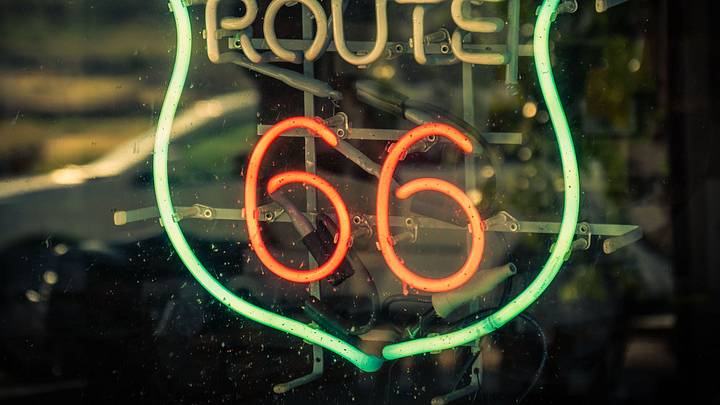
Driving down the stretch of Route 66 that passes through Albuquerque, New Mexico, I found myself swathed in the glow of countless roadside neon signs that shone even brighter than the full moon overhead.
They seemed to beckon me into another time, advertising motels and gas stations and all manner of roadside haunts. Riding in a classic lowrider car decked out with its own purple neon headlights, I felt like I was moving through an alternate universe made of neon.
A brief history of Route 66

Route 66 has long occupied a unique space in the American imagination. Commissioned in 1926, the road stretches from Lake Michigan to Los Angeles and winds through thousands of miles of desert plains and mesas on its way to the Pacific coast. It became a thriving artery that brought business to countless rural communities, many of which set up motels, shops, and all manner of roadside attractions to capitalize on the flow of life moving across the highway.
John Steinbeck coined its nickname “Mother Road” in his 1939 book The Grapes of Wrath to described how thousands of migrants flocked to the road during the Great Depression in search of jobs on the California coast. Nat King Cole’s classic 1946 song “Route 66,” meanwhile, helped cement its place in pop culture. Along the way, Route 66 became synonymous with the allure of the American West, and all the individualism, freedom, and ephemerality that come with it.
The roots of Route 66’s neon explosion

Neon remains a major part of Route 66’s visual iconography. Drive down any stretch of the road and you’re likely to spot a brilliant blue, green, or orange sign complete with a cactus, a cowboy hat, and a motel vacancy sign bleeding cherry red into the night. But how did neon so popular on this famous road in the first place?
The answer is simple: before Google Maps and digital itineraries, neon gave drivers an easy way to find food, lodging, and more in the dark. Additionally, neon’s heyday coincided with Route 66’s, making them a match made in highway heaven.
The first neon was created in the early 20th century by French engineer Georges Claude, and it made its way to the U.S. in the 1920s. Los Angeles car dealership owner Earler C. Anthony is thought to be the first U.S. business owner to use neon—he ordered two signs reading “Packard.” 1924 saw the first neon sign go up in Times Square.
From the 1930s to the 1950s, neon spread around the world and became an institution on Route 66. Many of the signs that went up along the road drew from local cultures, mythologies, and aspects of the regions they illuminated—thunderbirds, saguaro cacti, rearing cowboys, and four-pointed Zia sun symbols from local Native American tribes among them.
Neon began to decline in the 1960s as the novelty around it started to wear off, concerns about lead rose, and LED lighting offered a safer and cheaper alternative. Many signs were abandoned, but interest in them has re-emerged at different times over the years. Some signs have been lovingly preserved or restored, such as those lining Albuquerque’s downtown. Others have found indoor homes; neon museums can be found in Las Vegas, Saint Louis, and more.
Neon’s modern resurgence evokes the past

The best way to see neon might be in a lowrider, a customized American car with a lowered body that became popular after World War II, largely among Mexican-American youth. I drove in one with Jessica Roybal, who explained she’d started her career photographing women and children in lowrider communities before investing in her own vehicle.
Neon signs gleamed above us like planets as the car's custom-made hydraulics jerked us up and down. Many of the people who originally drove on Route 66 knew they might never be coming home again, Roybal explained. Route 66, with all its neon lights and tantalizing invitations to mysterious desert haunts, I thought, must have looked even more hallucinatory back then, when it was truly a point of no return.
Yet ultimately, those bright signs were more strategic than artful, designed to draw people (and their wallets) into the small towns and businesses lining the highway. In that, they embodied the same purpose as the road itself, and even of America on the whole: a promise, a dream, a siren song in th desert night.
Above us, the moon waited, its light mixing with the neon. People nodded and smiled at our car. The windows were down and a warm November breeze blew through. On modern-day Route 66, life hummed on.
Earlier that day, we’d stopped at the historic Hacienda Motel, which is in the process of being converted to a food hall. Local businesses, many of them Hispanic-owned, would be invited to fill the rooms. The renovations had been painstakingly carried out around a tree that the owner’s late father used to love, she told us. The tree soared above the little adobe buildings. Behind it, a carefully restored neon sign advertised a palm reader who no longer read the future there.
The future of America can seem unclear at times. No wonder we look, over and over again, to the past and its neon promises of linear growth and endless expansion. No wonder we find ourselves drawn to nostalgia for a world that perhaps never existed, but once seemed to at least promise that it could.
Somewhere in the distance, cranes flew among the clouds, and did not look forward or backward at all.