%20%20--%3E%0A%3Csvg%20version%3D%221.1%22%20id%3D%22Layer_1%22%20xmlns%3D%22http%3A%2F%2Fwww.w3.org%2F2000%2Fsvg%22%20xmlns%3Axlink%3D%22http%3A%2F%2Fwww.w3.org%2F1999%2Fxlink%22%20x%3D%220px%22%20y%3D%220px%22%0A%09%20viewBox%3D%220%200%20684.6%2068.1%22%20style%3D%22enable-background%3Anew%200%200%20684.6%2068.1%3B%22%20xml%3Aspace%3D%22preserve%22%3E%0A%3Cg%3E%0A%09%3Cpath%20d%3D%22M444.1%2C29.3h-17.4v14.5h17.4V29.3z%20M36.4%2C68.1l29.3-50.8V0H50.4L32.9%2C36.8L15.5%2C0H0v68.1h16.7V45.8l12.4%2C22.3H36.4z%0A%09%09%20M49.1%2C68.1h16.6V23.4L49.1%2C52.1V68.1z%20M76.6%2C68.1h45V53.8H93.3V41.6h21V27.1h-21V14.8h28.3V0.1h-45V68.1z%20M175.6%2C68.1h17.3v-68%0A%09%09h-16.5v40.3L150%2C0.1h-17.6v68h16.7V27.7L175.6%2C68.1z%20M235.8%2C14.8h15.4V0.1h-47.4v14.7H219v53.2h16.8V14.8z%20M290.3%2C45.9h-17.1%0A%09%09l7.5-15.6h2L290.3%2C45.9z%20M298.7%2C68.1h18l-32.2-68h-5.7l-32%2C68h18l3.3-7.1h27.1L298.7%2C68.1z%20M325.2%2C68.1h46.2V53.8h-29.6V0.1h-16.7%0A%09%09V68.1z%20M423.7%2C14.8h27.2V0.1H407v68h16.7V14.8z%20M462%2C68.1h46.2V53.8h-29.6V0.1H462V68.1z%20M564.8%2C34.1c0%2C10.7-7.2%2C19.2-18.5%2C19.2%0A%09%09c-11.4%2C0-18.5-8.5-18.5-19.2s7.1-19.2%2C18.5-19.2C557.6%2C14.9%2C564.8%2C23.4%2C564.8%2C34.1%20M580.6%2C34.1c0-19-14.2-34-34.3-34%0A%09%09c-20.2%2C0-34.3%2C15-34.3%2C34c0%2C19%2C14.1%2C34%2C34.3%2C34C566.4%2C68.1%2C580.6%2C53.1%2C580.6%2C34.1%20M604.8%2C20.5c0-4.1%2C3.3-6.2%2C6.7-6.2%0A%09%09c4.4%2C0%2C6.6%2C3%2C6.6%2C6.6h14.7C631.8%2C9.1%2C625.1%2C0.1%2C611%2C0.1c-12%2C0-21.7%2C9.3-21.7%2C20.6c0%2C10.9%2C5.9%2C15.9%2C16.7%2C19.8%0A%09%09c5.2%2C1.8%2C11.5%2C3.2%2C11.5%2C8c0%2C3.3-2.4%2C5.5-6.4%2C5.5c-3.6%2C0-6.6-3-6.6-6.7h-15.2c0%2C11.5%2C7.9%2C20.8%2C21.8%2C20.8c12%2C0%2C21.6-9.3%2C21.6-20.6%0A%09%09c0-10-5.3-16.4-16.7-19.8C610.6%2C26.1%2C604.8%2C25.3%2C604.8%2C20.5%20M670%2C20.9h14.7C683.8%2C9.1%2C677.1%2C0.1%2C663%2C0.1c-12%2C0-21.7%2C9.3-21.7%2C20.6%0A%09%09c0%2C10.9%2C5.9%2C15.9%2C16.7%2C19.8c5.2%2C1.8%2C11.5%2C3.2%2C11.5%2C8c0%2C3.3-2.4%2C5.5-6.4%2C5.5c-3.6%2C0-6.6-3-6.6-6.7h-15.2c0%2C11.5%2C7.9%2C20.8%2C21.8%2C20.8%0A%09%09c12%2C0%2C21.6-9.3%2C21.6-20.6c0-10-5.3-16.4-16.7-19.8c-5.4-1.6-11.3-2.4-11.3-7.2c0-4.1%2C3.3-6.2%2C6.7-6.2C667.7%2C14.4%2C670%2C17.3%2C670%2C20.9%0A%09%09%22%2F%3E%0A%3C%2Fg%3E%0A%3C%2Fsvg%3E%0A)

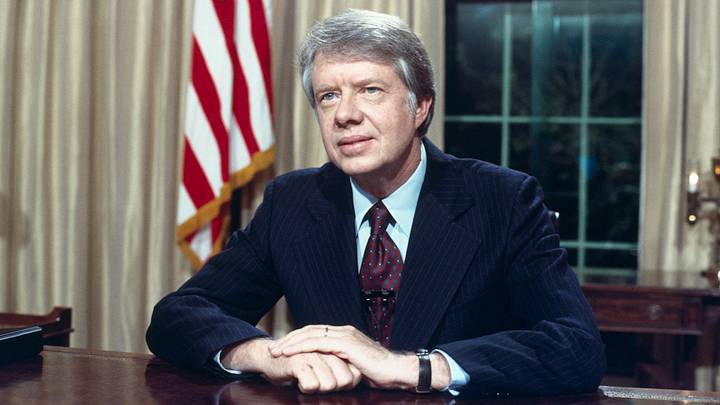
Jimmy Carter was a president, but he was also a father, a grandpa, a best-selling author, a Nobel Prize-winning humanitarian, and an environmentalist until his passing in 2024.
Born in 1924 into a family of peanut farmers, Carter won the 1977 presidential election and served until 1981. He created the Department of Energy and the Department of Education, and brokered the Camp David Accords. However, he faced criticism for the "stagflation" that strained the U.S. economy, the Iranian Hostage Crisis, and his "tone deaf" 1979 "malaise" speech, which many felt blamed the American people for the country's apparent “lack of confidence.”
His reputation improved after his presidency, during which he revealed his favorite president.
Let's look back at Jimmy Carter's presidency (and post-presidency) to discover the former head of state he admired most.
JIMMY CARTER'S PRESIDENCY
According to National Geographic, Jimmy Carter was "scandal-free" while campaigning for the presidency in 1976, a trait Americans valued after Nixon's resignation a few years prior. He defeated former President Gerald Ford, who was appointed, not elected, to become the 39th President of the United States.
Carter’s presidency centered around several significant events and initiatives. Commonly described as the "Greenest President," he was adamantly concerned about the environment and energy conservation. He established the Department of Energy to prompt research into solar energy and sustainable practices, and he played an important role in brokering the Camp David Accords, which brought peace between Israel and Egypt (for the first time).
The Democratic Party member was criticized for his 1979 "malaise” speech, delivered during a time of ongoing economic hardship and uncertainty. Many assumed his words faulted the American people for their growing lack of confidence in the government and the country as a whole.
“A majority of our people believe that the next 5 years will be worse than the past 5 years. Two-thirds of our people do not even vote. The productivity of American workers is actually dropping, and the willingness of Americans to save for the future has fallen below that of every Western nation.”
He also received disapproval for his failed attempt to rescue American hostages during the Iranian Hostage Crisis, first seeking a peaceful solution that proved unsuccessful. When the hostages were released, Carter, no longer president, traveled to Germany and met them as a private citizen.
Perhaps Carter is most revered not for his presidency, but for his humanitarian efforts after leaving office. The Carter Center, which he co-founded with his wife Rosalynn, has negotiated peace agreements between countries, helped establish fair elections worldwide, and sought to eliminate diseases globally, according to the Constitution Center. He also promoted Habitat for Humanity and authored 30 books (on topics ranging from his life and hobbies to his political views).
In 2002, Carter received the Nobel Peace Prize for his humanitarian efforts, and in 2006, he revealed which president inspired him most: a man who influenced his commitment to humanitarian causes.
FUN FACT: Carter was both the first president to use a nickname (Jimmy) and the first to be born in a hospital.
JIMMY CARTER'S FAVORITE PRESIDENT

The 39th president's early political career was challenged by his support of civil rights “inherited” from former President Harry S. Truman, Carter's favorite president.
In 2006, the Georgia native spoke about Truman's policies, highlighting his connection to the 33rd president and his advocacy for civil rights.
"Harry Truman has had more impact on my life than any other particular president. I served under him as a submarine officer. He was my Commander in Chief. And I inherited some of his beliefs. One particularly concerning issue was civil rights. Harry Truman was my preeminent hero on civil rights."
Carter mentioned how exceptional it was that Truman took action in accordance with his beliefs during a time when only a few leaders before him had taken a stand against racism in the United States. Truman also helped establish the United Nations for international cooperation.
"When I was still in the Navy in 1948," Carter shared, "I was just a young officer. Harry Truman ordered, under tremendous condemnation, that all racial discrimination would be ended in the military service. This was more than 10 years, 12 years maybe, before Rosa Parks sat down in the front of a bus in Montgomery; before anyone knew who Martin Luther King Jr. was. And Harry Truman was the one who did it."
He also singled out President Lyndon B. Johnson as another "hero" for signing into law "prohibition against racial segregation" (the Civil Rights Act of 1964).