%20%20--%3E%0A%3Csvg%20version%3D%221.1%22%20id%3D%22Layer_1%22%20xmlns%3D%22http%3A%2F%2Fwww.w3.org%2F2000%2Fsvg%22%20xmlns%3Axlink%3D%22http%3A%2F%2Fwww.w3.org%2F1999%2Fxlink%22%20x%3D%220px%22%20y%3D%220px%22%0A%09%20viewBox%3D%220%200%20684.6%2068.1%22%20style%3D%22enable-background%3Anew%200%200%20684.6%2068.1%3B%22%20xml%3Aspace%3D%22preserve%22%3E%0A%3Cg%3E%0A%09%3Cpath%20d%3D%22M444.1%2C29.3h-17.4v14.5h17.4V29.3z%20M36.4%2C68.1l29.3-50.8V0H50.4L32.9%2C36.8L15.5%2C0H0v68.1h16.7V45.8l12.4%2C22.3H36.4z%0A%09%09%20M49.1%2C68.1h16.6V23.4L49.1%2C52.1V68.1z%20M76.6%2C68.1h45V53.8H93.3V41.6h21V27.1h-21V14.8h28.3V0.1h-45V68.1z%20M175.6%2C68.1h17.3v-68%0A%09%09h-16.5v40.3L150%2C0.1h-17.6v68h16.7V27.7L175.6%2C68.1z%20M235.8%2C14.8h15.4V0.1h-47.4v14.7H219v53.2h16.8V14.8z%20M290.3%2C45.9h-17.1%0A%09%09l7.5-15.6h2L290.3%2C45.9z%20M298.7%2C68.1h18l-32.2-68h-5.7l-32%2C68h18l3.3-7.1h27.1L298.7%2C68.1z%20M325.2%2C68.1h46.2V53.8h-29.6V0.1h-16.7%0A%09%09V68.1z%20M423.7%2C14.8h27.2V0.1H407v68h16.7V14.8z%20M462%2C68.1h46.2V53.8h-29.6V0.1H462V68.1z%20M564.8%2C34.1c0%2C10.7-7.2%2C19.2-18.5%2C19.2%0A%09%09c-11.4%2C0-18.5-8.5-18.5-19.2s7.1-19.2%2C18.5-19.2C557.6%2C14.9%2C564.8%2C23.4%2C564.8%2C34.1%20M580.6%2C34.1c0-19-14.2-34-34.3-34%0A%09%09c-20.2%2C0-34.3%2C15-34.3%2C34c0%2C19%2C14.1%2C34%2C34.3%2C34C566.4%2C68.1%2C580.6%2C53.1%2C580.6%2C34.1%20M604.8%2C20.5c0-4.1%2C3.3-6.2%2C6.7-6.2%0A%09%09c4.4%2C0%2C6.6%2C3%2C6.6%2C6.6h14.7C631.8%2C9.1%2C625.1%2C0.1%2C611%2C0.1c-12%2C0-21.7%2C9.3-21.7%2C20.6c0%2C10.9%2C5.9%2C15.9%2C16.7%2C19.8%0A%09%09c5.2%2C1.8%2C11.5%2C3.2%2C11.5%2C8c0%2C3.3-2.4%2C5.5-6.4%2C5.5c-3.6%2C0-6.6-3-6.6-6.7h-15.2c0%2C11.5%2C7.9%2C20.8%2C21.8%2C20.8c12%2C0%2C21.6-9.3%2C21.6-20.6%0A%09%09c0-10-5.3-16.4-16.7-19.8C610.6%2C26.1%2C604.8%2C25.3%2C604.8%2C20.5%20M670%2C20.9h14.7C683.8%2C9.1%2C677.1%2C0.1%2C663%2C0.1c-12%2C0-21.7%2C9.3-21.7%2C20.6%0A%09%09c0%2C10.9%2C5.9%2C15.9%2C16.7%2C19.8c5.2%2C1.8%2C11.5%2C3.2%2C11.5%2C8c0%2C3.3-2.4%2C5.5-6.4%2C5.5c-3.6%2C0-6.6-3-6.6-6.7h-15.2c0%2C11.5%2C7.9%2C20.8%2C21.8%2C20.8%0A%09%09c12%2C0%2C21.6-9.3%2C21.6-20.6c0-10-5.3-16.4-16.7-19.8c-5.4-1.6-11.3-2.4-11.3-7.2c0-4.1%2C3.3-6.2%2C6.7-6.2C667.7%2C14.4%2C670%2C17.3%2C670%2C20.9%0A%09%09%22%2F%3E%0A%3C%2Fg%3E%0A%3C%2Fsvg%3E%0A)

During the early 20th century, aviators captured the imagination of people worldwide. These courageous pioneers of the sky etched their names into history by racking up astonishing aerial miles in what contemporaries would have regarded as primitive and fragile flying platforms.
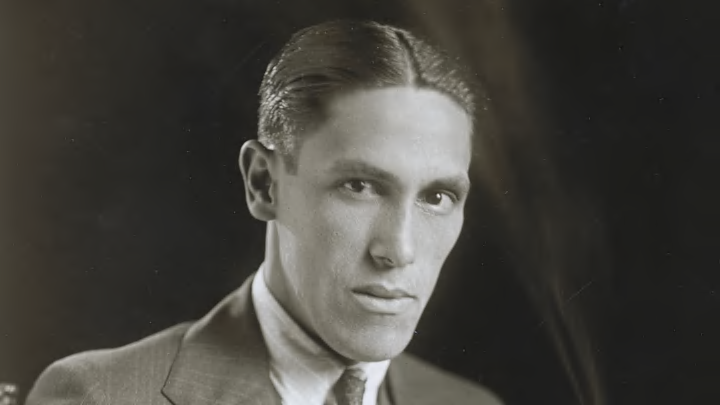
While figures such as the Wright Brothers, Amelia Earhart, and Charles Lindbergh remain household names, a far lesser-known flyer, Emilio Carranza, rose to international stardom during the 1920s, particularly in his native Mexico and the United States. Today, his legacy endures in an unlikely place: a quiet New Jersey town deep within the Pine Barrens, forever linked to the tragic plane crash that claimed his life in 1928.
Beginnings in Mexico
Emilio Carranza was born on December 9, 1905, in Ramos Arizpe, a small town in the northern Mexican state of Coahuila. His parents were Maria Dolores Rodriguez Gomez and Sebastian Carranza, a relative of Mexican President Venustiano Carranza and aviator Alberto Salinas Carranza. This provincial beginning marked the start of a short yet remarkable life, one that carried the “Lindbergh of Mexico” through cities including San Antonio, El Paso, Mexico City, San Diego, Washington, D.C., and New York City, before ultimately culminating in his death in New Jersey.
Aviator and National Hero
Carranza’s rise to national prominence began at a remarkably young age. At just 18, he entered the Mexican Military Academy at Chapultepec, where he quickly distinguished himself in aviation training. Within three years, he earned formal recognition as a military pilot after successfully test-flying a Mexican-built Avro biplane.
Carranza’s reputation grew further in 1924, when he flew operational missions for the Mexican government during campaigns against rebel forces in the north, emerging as a national hero and one of the country’s promising young pilots.
Flight to New York City
At just 22 years old, Carranza began the first leg of his goodwill flight to New York City. His journey to the United States was undertaken in response to Charles Lindbergh’s celebrated flight to Mexico in December 1927.
During this visit, Carranza and Lindbergh had become friends. The aircraft carrying the young aviator, Mexico Excelsior, was a Ryan Brougham single-engine airplane that closely resembled Lindbergh's famed Spirit of St. Louis.

Departing Valbuena Airfield in Mexico City on June 11, 1928, at 8:10 a.m., Carranza was forced down by weather in Mooresville, North Carolina. On June 12, a crowd of enthusiastic supporters, including President Calvin Coolidge, welcomed the airman to Bolling Field in Washington, D.C.
In the nation’s capital, Carranza laid a wreath on the Tomb of the Unknown Soldier at Arlington National Cemetery. He also attended a luncheon at the Pan-American Union building alongside President Coolidge, Secretary of State Frank B. Kellogg, Mexican Ambassador to the U.S. Manuel C. Tellez, and U.S. Ambassador to Mexico Dwight W. Morrow.
Morrow was also the father-in-law of Carranza’s American counterpart, Lindbergh. News reports later revealed that the famed American aviator had partially funded Carranza’s flight with a donation of approximately $1,200, while nearly $25,000 was contributed by the Mexican public.
Mexico Excelsior then proceeded to New York under the escort of five U.S. Army aircraft from Bolling Field. Carranza landed at Roosevelt Field on Long Island at 9:50 a.m. on June 18. As the ambassador of goodwill emerged from his plane, he was greeted by a large, cheering crowd that included Major General Hanson Edward Ely, Mexican Consul General in New York Arturo M. Elias, 200 soldiers, police officers, and a military band.
Carranza later proceeded to City Hall, where he was formally received by Mayor Jimmy Walker. During his stay in New York City, Carranza met with the leading citizens, civic organizations, social clubs, and representatives of the Mexican consulate.
For just under a month, New York served as Carranza’s base of operations for a series of short flights to Detroit and New England. Poor weather forced him to cancel a planned flight to the United States Military Academy at West Point, instead opting to drive to the school. There, he reviewed the troops and presented the institution with a photograph of the Mexican Military Academy at Chapultepec, Carranza’s alma mater.
In mid-July, Carranza was urged by fellow aviators (including Lindbergh), the Weather Bureau, members of the press, and airport officials to delay his flight back to Mexico and remain in New York until the storms passed. Eager to return home for reasons that remain unclear, Carranza disregarded this advice.
Though sometimes dismissed as apocryphal, some accounts claim his haste was influenced by a telegram sent by Mexican Secretary of War Joaquin Amaro, which allegedly demanded that he depart immediately “or the quality of your manhood will be in doubt.”
Crash in the Pine Barrens
Carranza departed Roosevelt Field quietly at 7:18 p.m. for his return flight to Mexico City, delaying his takeoff until the field had been cleared of spectators. The only people remaining to see him off were three mechanics, with whom he shook hands before leaving. He planned a route through Washington, D.C., where he would set a compass course south toward the Mexican capital.
Struggling with thunderstorms and darkness, Carranza flew just over 50 miles before crashing into the woods of the Pine Barrens. Some accounts claim that he was using a flashlight to aid navigation in poor conditions before striking trees while attempting a forced landing.
The following day, a local family picking berries discovered Carranza’s body amid the wreckage of the Mexico Excelsior. His remains were then secured and guarded in a local garage by members of the American Legion and a military detail composed of soldiers from the U.S. Army’s 16th Infantry stationed at Camp Dix.

A U.S. Army inquiry conducted by officers at Camp Dix in Burlington County, New Jersey, examined the circumstances surrounding the crash. This investigation dispelled rumors that the aircraft had been struck by lightning, concluding instead that Carranza, experiencing mechanical trouble, attempted a forced landing in the Pine Barrens. A medical officer, Lt. Col. Curtiss Caassen, determined that the aviator’s death was a direct result of the crash.
Soldiers from the 16th Infantry also accompanied the young pilot’s remains to New York City, where Lt. Vincent Mee and the New Jersey troops were joined by soldiers stationed on Governors Island, a detachment of mounted police, and a municipal band. This expanded escort was supported by Major General Ely, a highly decorated Army officer, who was serving the final assignment of his long and storied career on Governors Island when Carranza's remains arrived in the city.
Ely had become a great admirer of the young Mexican pilot during his visit to the city and deeply mourned his tragic death. The general “ordered that everything possible be done to pay him the last sad honors due to a soldier who died bravely.”
With flags at nearby City Hall lowered to half-staff, Carranza lay in state on July 14 at the Campbell Funeral Church at Broadway and 66th Street in Manhattan. With additional police details assigned to maintain order, large crowds gathered in the rain to pay their respects to the airman. For several hours beginning at 3:00 p.m., mourners filed past the casket, where Carranza’s head and shoulders were visible beneath a glass covering.
News of Carranza’s death was met with solemn tributes from government officials and fellow aviators alike. New York City officials sent telegrams of condolences to Carranza's father, Sebastian, and to the Mexican Consul General in New York, Arturo M. Elias.
Deep in mourning, Charles Lindbergh telegraphed Carranza’s pregnant widow with the following message: “The loss of Captain Carranza is shared equally on both sides of the Rio Grande. His life was devoted to his country and his death to the world.”
Return to Mexico
In a show of deep respect for Carranza, President Coolidge offered the use of the American battleship Florida to return the airman’s body to Mexico, along with a supplemental offer of a special train. The Mexican government ultimately chose rail transportation, and Carranza’s remains were formally transferred from U.S. Army personnel to the Mexican Army during a ceremony held at the center of the International Bridge linking the two nations.
Journalists covering the event noted a marked shift in sentiment between representatives of the two countries, long defined by a tumultuous relationship dating back to the nineteenth century, observing that “the death of Emilio Carranza linked the two countries in a common sympathy such as no other act probably has ever done.”
Finally returned to his native soil, the famed aviator was laid to rest at the Panteón Civil de Dolores, alongside numerous other distinguished Mexican civic, military, and cultural figures, in the Rotonda de las Personas Ilustres (Rotunda of Illustrious Persons).
Dedication of the Monument
Although Carranza was laid to rest in Mexico, the memory of his final flight and tragic end endured in New Jersey. In the years following the crash, veterans, civic leaders, and ordinary citizens on both sides of the border sought a permanent way to memorialize the young aviator and the goodwill mission that cost him his life.
Public efforts to raise funds for the monument took place in both the United States and Mexico, including the border town of Juarez, where a benefit bullfight was held on May 25, 1930. Mexican schoolchildren reportedly took the lead in collecting funds and making significant contributions toward the erection of a stone monument near the site of their hero's demise.
Five years after the tragic crash, a group of Mount Holly Legionnaires and representatives of the Mexican government gathered deep in the New Jersey Pine Barrens to dedicate a stone monument honoring the memory of Emilio Carranza. In recognition of the meaning behind Carranza’s mission, New Jersey Governor A. Harry Moore officially dedicated the day to “demonstrating the lasting appreciation of his efforts to further good will.”
The 12-foot monument features a central shaft constructed from stone blocks taken from the mountains near Carranza's home in Mexico. Inscribed in both English and Spanish, it marks the spot where Carranza died. Its granite elements include a skyward-pointing arrow, a falling Aztec eagle, and carved footprints symbolizing both the promise and tragedy of his final flight. The monument bears the inscription, “The people of Mexico hope that your high ideals will be realized.”
Legacy
The Carranza family’s aviation tradition lived on through Emilio’s sister and brother-in-law. Estela was admitted to Mexico City’s School of Civil Aviation, which was later named in her brother’s honor. Following her training, she emerged as an aviation pioneer, becoming one of Mexico’s first licensed female pilots.
Estela went on to distinguish herself as an accomplished pilot and was later recruited by U.S. intelligence to monitor suspicious activities within Mexican territory during World War II. She was married to Eduardo Maciel, an officer in the Mexican Army Air Service.
Each year, on the second Saturday in July, throngs of commemorators gather in the northeastern section of Wharton State Forest in Tabernacle to pay their respects to the early 20th-century ambassador of goodwill between the United States and Mexico.
These highly anticipated ceremonies draw members of American Legion Holly Post 11, representatives of the Mexican government, members of the Carranza family, and history enthusiasts from across the region. The annual commemoration serves as a powerful reminder of the enduring goodwill that can be forged between nations when humanity strives to soar above borders, politics, and time.