%20%20--%3E%0A%3Csvg%20version%3D%221.1%22%20id%3D%22Layer_1%22%20xmlns%3D%22http%3A%2F%2Fwww.w3.org%2F2000%2Fsvg%22%20xmlns%3Axlink%3D%22http%3A%2F%2Fwww.w3.org%2F1999%2Fxlink%22%20x%3D%220px%22%20y%3D%220px%22%0A%09%20viewBox%3D%220%200%20684.6%2068.1%22%20style%3D%22enable-background%3Anew%200%200%20684.6%2068.1%3B%22%20xml%3Aspace%3D%22preserve%22%3E%0A%3Cg%3E%0A%09%3Cpath%20d%3D%22M444.1%2C29.3h-17.4v14.5h17.4V29.3z%20M36.4%2C68.1l29.3-50.8V0H50.4L32.9%2C36.8L15.5%2C0H0v68.1h16.7V45.8l12.4%2C22.3H36.4z%0A%09%09%20M49.1%2C68.1h16.6V23.4L49.1%2C52.1V68.1z%20M76.6%2C68.1h45V53.8H93.3V41.6h21V27.1h-21V14.8h28.3V0.1h-45V68.1z%20M175.6%2C68.1h17.3v-68%0A%09%09h-16.5v40.3L150%2C0.1h-17.6v68h16.7V27.7L175.6%2C68.1z%20M235.8%2C14.8h15.4V0.1h-47.4v14.7H219v53.2h16.8V14.8z%20M290.3%2C45.9h-17.1%0A%09%09l7.5-15.6h2L290.3%2C45.9z%20M298.7%2C68.1h18l-32.2-68h-5.7l-32%2C68h18l3.3-7.1h27.1L298.7%2C68.1z%20M325.2%2C68.1h46.2V53.8h-29.6V0.1h-16.7%0A%09%09V68.1z%20M423.7%2C14.8h27.2V0.1H407v68h16.7V14.8z%20M462%2C68.1h46.2V53.8h-29.6V0.1H462V68.1z%20M564.8%2C34.1c0%2C10.7-7.2%2C19.2-18.5%2C19.2%0A%09%09c-11.4%2C0-18.5-8.5-18.5-19.2s7.1-19.2%2C18.5-19.2C557.6%2C14.9%2C564.8%2C23.4%2C564.8%2C34.1%20M580.6%2C34.1c0-19-14.2-34-34.3-34%0A%09%09c-20.2%2C0-34.3%2C15-34.3%2C34c0%2C19%2C14.1%2C34%2C34.3%2C34C566.4%2C68.1%2C580.6%2C53.1%2C580.6%2C34.1%20M604.8%2C20.5c0-4.1%2C3.3-6.2%2C6.7-6.2%0A%09%09c4.4%2C0%2C6.6%2C3%2C6.6%2C6.6h14.7C631.8%2C9.1%2C625.1%2C0.1%2C611%2C0.1c-12%2C0-21.7%2C9.3-21.7%2C20.6c0%2C10.9%2C5.9%2C15.9%2C16.7%2C19.8%0A%09%09c5.2%2C1.8%2C11.5%2C3.2%2C11.5%2C8c0%2C3.3-2.4%2C5.5-6.4%2C5.5c-3.6%2C0-6.6-3-6.6-6.7h-15.2c0%2C11.5%2C7.9%2C20.8%2C21.8%2C20.8c12%2C0%2C21.6-9.3%2C21.6-20.6%0A%09%09c0-10-5.3-16.4-16.7-19.8C610.6%2C26.1%2C604.8%2C25.3%2C604.8%2C20.5%20M670%2C20.9h14.7C683.8%2C9.1%2C677.1%2C0.1%2C663%2C0.1c-12%2C0-21.7%2C9.3-21.7%2C20.6%0A%09%09c0%2C10.9%2C5.9%2C15.9%2C16.7%2C19.8c5.2%2C1.8%2C11.5%2C3.2%2C11.5%2C8c0%2C3.3-2.4%2C5.5-6.4%2C5.5c-3.6%2C0-6.6-3-6.6-6.7h-15.2c0%2C11.5%2C7.9%2C20.8%2C21.8%2C20.8%0A%09%09c12%2C0%2C21.6-9.3%2C21.6-20.6c0-10-5.3-16.4-16.7-19.8c-5.4-1.6-11.3-2.4-11.3-7.2c0-4.1%2C3.3-6.2%2C6.7-6.2C667.7%2C14.4%2C670%2C17.3%2C670%2C20.9%0A%09%09%22%2F%3E%0A%3C%2Fg%3E%0A%3C%2Fsvg%3E%0A)

Most Americans know what to expect from the Fourth of July. Cities throw parades, families host barbecues, and seemingly everybody shoots off fireworks. Those with a more competitive side may sign up for annual corn hole, tug-of-war, or eating competitions, like Nathan’s Hot Dog Eating Contest.
But not every city sticks to just these traditions, and plenty of people throughout history found surprising ways to celebrate. The first official Fourth of July celebrations took place in 1777, and some elements of their festivities would seem very strange today.
Here are 13 of the most unusual traditions that people have created for Independence Day.
Some dropped off over time, while others have only grown more popular. As we look to the 250th anniversary of the United States' break from Great Britain, consider taking part in some of the unconventional celebrations that have developed throughout U.S. history.
- Cannon Fire (and Other Military Displays)
- Larger-than-Life Tug-of-War Battles
- Celebrating in Denmark
- Trespassing on Mount Vernon
- The Ocean Beach Marshmallow Wars
- Anvil Shooting
- Bonfires Bigger than Buildings
- Fence Painting Contests
- Traveling to Canada for the Friendship Festival
- Tapping the Liberty Bell
- The Redneck Games
- The Rebels and Redcoats Classic Car Show
- Protesting the US Government
Cannon Fire (and Other Military Displays)

One of the first documented Fourth of July celebrations took place in 1777, when Philadelphia held city-wide festivities. Those early celebrations are documented below:
"About noon all the armed ships and gallies in the river were drawn up before the city, dressed in the gayest manner, with the colors of the United States and streamers displayed. At one o’clock, the yards being properly manned, they began the celebration of the day by a discharge of thirteen cannon from each of the ships, and one from each of the thirteen gallies, in honor of the Thirteen United States."
This coincided with the Sons of Liberty shooting off the first Fourth of July fireworks in Boston. While fireworks have obviously become one of the most popular ways to celebrate Independence Day, military displays are still common in many regions. Since the early 19th century, every capable military base and docked Navy ship is required to perform a 21-gun salute on July 4, shooting once for each state in the Union.
Larger-than-Life Tug-of-War Battles
Tug-of-war is not an unusual Fourth of July tradition in itself, as it often appears as a party game during large community gatherings, but two towns in California take it to another level. Every year on the Fourth of July, the cities of Stinson and Bolinas go to war. Each city puts together a team of twenty or thirty participants, who try to pull their opponents into the Bolinas Channel. This tradition has been active for decades, playing into the rivalry between the two cities and building a sense of local pride as residents fight to bring glory to their home.
Celebrating in Denmark
If you’ve ever been mocked for wondering if other countries celebrate the Fourth of July, you need to know about the Rebild Festival. Thousands of Danes immigrated to the United States in the 19th and 20th centuries, and a group of them decided to honor their new home by purchasing 140 acres of land in Denmark and mandating that it be used to celebrate American holidays—including Independence Day.
The Rebild Festival has taken place annually since 1912, allowing Danes and their Danish-American loved ones to celebrate the friendship between the two countries. It’s common for the sitting U.S. President to send an official greeting to attendees, and American celebrities and diplomats frequently attend in person. While tensions have developed between Denmark and the United States, the Rebild Festival is still expected to take place in 2026, continuing its status as the largest Fourth of July celebration outside of the United States.
Trespassing on Mount Vernon

According to James R. Heintze’s book, The Fourth of July Encyclopedia, it was common in the early-to-mid 1800s for Americans to travel to George Washington’s home of Mount Vernon on the Fourth of July. Rather than participating in official events, like visitors do today, these celebrants would arrive via steamboat and explore the grounds on their own—despite the property still being privately owned.
George Washington did not sign the Declaration of Independence, but many early Americans saw him as the most significant figure in Revolutionary America, and thus, visiting his home was similar to a religious pilgrimage. While it’s less common for modern Americans to visit Mount Vernon specifically for Independence Day, the residence does offer special programming like its Independence Fireworks event and the 250th anniversary festivities, An American Celebration.
The Ocean Beach Marshmallow Wars
In 1985, a few San Diego families decided to throw marshmallows at one another on the Fourth of July. That spontaneous food fight turned into an annual tradition, where massive crowds would go to war on the sands of Ocean Beach after the fireworks were over. While some just threw the marshmallows, others created catapults or bought marshmallow guns. Unfortunately, as the tradition grew, it caused problems. People got hurt during the fights, and most participants had little interest in cleaning up, leaving a mess for others to clean the next day. Eventually, residents began to protest the annual tradition, prompting its official cancellation in 2014.
Anvil Shooting
According to The Foxfire 40th Anniversary Book: Faith, Family, and the Land, anvil shooting has a long history as an alternative to fireworks. Participants would place gunpowder inside or underneath an anvil, light the fuse, and send the heavy projectile into the sky. This was historically used as a celebration for those without access to cannons, including rural localities and former Confederate states after the Civil War. Today, the Museum of Appalachia continues the tradition by shooting 200-pound anvils into the air for the Fourth of July every year.
Bonfires Bigger than Buildings

Bonfires were used to celebrate holidays long before anyone travelled to the Americas, and that tradition continued in the original colonies. In Gallows Hill, Massachusetts, the residents were known for their rowdy celebrations of Pope Night (an anti-Catholic celebration of Guy Fawkes), where they would stack barrels, light them on fire, and burn effigies of religious figures and politicians. After receiving stern criticism of their actions from George Washington, many residents transferred the activity to the night before July 4th, where they claimed that the flames represented “that the night has turned into the morning of a new year of liberty.”
This tradition continued throughout the early years of the republic, but it nearly faded away in the 19th century until activists and politicians resurrected the record-breaking bonfires in the early 1900s as a safer alternative to gunfire and explosives. Massachusetts remained the heart of the trend, building pyramids 100 feet high before lighting them up. These official celebrations were incredibly popular and have continued, off and on, into the present day.
Fence Painting Contests
While many Independence Day traditions reference American military history, the city of Hannibal, Missouri, is more concerned with its cultural history. Author Mark Twain was raised in Hannibal and set many of his books there, including The Adventures of Tom Sawyer. In honor of this, the city has hosted National Tom Sawyer Days over Fourth of July weekend since 1959. The most famous event during this celebration tasks groups and individuals with painting a fence faster than their competitors, in honor of Tom Sawyer’s famous hijinks.
Traveling to Canada for the Friendship Festival
While most current Independence Day celebrations are strictly focused on the United States and its accomplishments, the Friendship Festival (first held in 1987) celebrated the historical camaraderie between the United States and Canada. Generally held between July 1 (Canada Day) and July 4, the event encouraged the neighboring countries to celebrate their freedom and history together.
The festival was held in both Fort Erie, Ontario, and Buffalo, New York, with attendees able to pass between the two cities using the Peace Bridge. Visitors could watch live music, try local food and drinks, and celebrate each country’s founding. Unfortunately, the relationship between Canada and the United States weakened over time, and there were no longer enough participants to justify the cost. The final Friendship Festival took place in 2019, marking the end of decades of international collaboration.
Tapping the Liberty Bell

On June 26, 1963, Congress passed a resolution mandating that July 4th should be honored by ringing bells thirteen times at 2 PM, as the Liberty Bell was rung in 1776. This order has been followed by many states over the years, but Philadelphia had to create its own version, known today as the Let Freedom Ring celebration. Due to the crack in the Liberty Bell and the city's desire to prevent any further damage, nobody is allowed to physically ring the bell. Instead, descendants of the Declaration’s signers come to Philadelphia, where they each tap the Liberty Bell thirteen times.
The Redneck Games
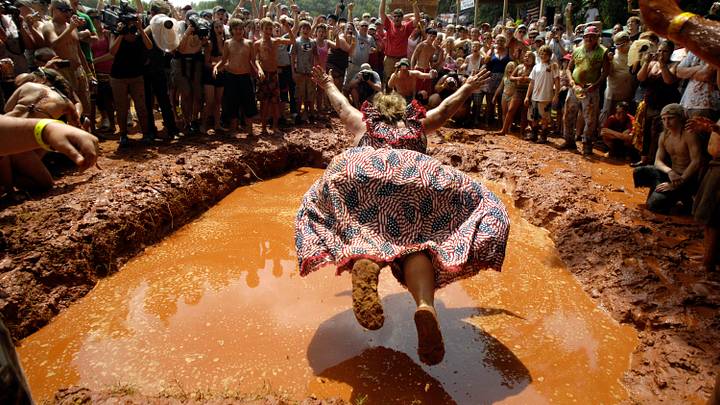
As the story goes, the 1996 Summer Olympics (hosted by Atlanta, Georgia) prompted a lot of jokes that rednecks were in charge of the historic competition. In response, radio station Y-96 created the Redneck Games, featuring events like bobbing for pig feet, armpit serenades, and mud pit bellyflops. What began out of spite turned into an annual event when thousands showed up in Dublin, Georgia, to enthusiastically participate.
The Summer Redneck Games continued every July until 2012, when the festivities were moved to May to avoid the summer heat. However, that would end up being the last iteration of the Games until 2023, when a former competitor brought them back. Although the 2026 competition is set for the week after July 4, competitors will likely be practicing their skills this Independence Day.
The Rebels and Redcoats Classic Car Show
One popular Pennsylvania tradition dedicates Fourth of July weekend to an unusual focus: classic cars. Every year around Independence Day weekend—this year, the event was delayed by a week due to 250th anniversary festivities—the Washington Crossing Historical Park fills up with classic cars from the year 2000 and earlier. But not just any classic cars are allowed.
To fit the patriotic season, the car show only allows vehicles created by “the four belligerents of the Revolutionary War”—the United States, Britain, France, and Germany. Although cars were not invented until more than a century after the Declaration of Independence was signed, the Rebels and Redcoats Classic Car Show brings awareness to lesser-known participants in the Revolutionary War and raises money for the park’s educational programs.
Protesting the US Government

While many Americans see it as practically sacrilegious, protest has been an important part of Fourth of July festivities for centuries. In 1788—just a few weeks after the Constitution received the required number of state ratifications needed to pass—a group of Anti-Federalists marched through Albany, New York, criticizing the document and burning a copy to show their displeasure.
Through the first half of the 19th century, abolitionists frequently used the holiday as a backdrop for their arguments against slavery. Frederick Douglass’s 1852 speech, “What to the Slave is the Fourth of July,” was a particularly impactful example, calling out the hypocrisy of celebrating “Independence Day” and the Founding Fathers' ideals of equality when millions of people were enslaved.
Although many today see the Fourth of July as inherently celebratory, it’s important to remember that the Declaration itself was an act of protest. Trying to make the country better is just as appropriate and historically accurate as shooting off fireworks and spending time with friends and family.