%20%20--%3E%0A%3Csvg%20version%3D%221.1%22%20id%3D%22Layer_1%22%20xmlns%3D%22http%3A%2F%2Fwww.w3.org%2F2000%2Fsvg%22%20xmlns%3Axlink%3D%22http%3A%2F%2Fwww.w3.org%2F1999%2Fxlink%22%20x%3D%220px%22%20y%3D%220px%22%0A%09%20viewBox%3D%220%200%20684.6%2068.1%22%20style%3D%22enable-background%3Anew%200%200%20684.6%2068.1%3B%22%20xml%3Aspace%3D%22preserve%22%3E%0A%3Cg%3E%0A%09%3Cpath%20d%3D%22M444.1%2C29.3h-17.4v14.5h17.4V29.3z%20M36.4%2C68.1l29.3-50.8V0H50.4L32.9%2C36.8L15.5%2C0H0v68.1h16.7V45.8l12.4%2C22.3H36.4z%0A%09%09%20M49.1%2C68.1h16.6V23.4L49.1%2C52.1V68.1z%20M76.6%2C68.1h45V53.8H93.3V41.6h21V27.1h-21V14.8h28.3V0.1h-45V68.1z%20M175.6%2C68.1h17.3v-68%0A%09%09h-16.5v40.3L150%2C0.1h-17.6v68h16.7V27.7L175.6%2C68.1z%20M235.8%2C14.8h15.4V0.1h-47.4v14.7H219v53.2h16.8V14.8z%20M290.3%2C45.9h-17.1%0A%09%09l7.5-15.6h2L290.3%2C45.9z%20M298.7%2C68.1h18l-32.2-68h-5.7l-32%2C68h18l3.3-7.1h27.1L298.7%2C68.1z%20M325.2%2C68.1h46.2V53.8h-29.6V0.1h-16.7%0A%09%09V68.1z%20M423.7%2C14.8h27.2V0.1H407v68h16.7V14.8z%20M462%2C68.1h46.2V53.8h-29.6V0.1H462V68.1z%20M564.8%2C34.1c0%2C10.7-7.2%2C19.2-18.5%2C19.2%0A%09%09c-11.4%2C0-18.5-8.5-18.5-19.2s7.1-19.2%2C18.5-19.2C557.6%2C14.9%2C564.8%2C23.4%2C564.8%2C34.1%20M580.6%2C34.1c0-19-14.2-34-34.3-34%0A%09%09c-20.2%2C0-34.3%2C15-34.3%2C34c0%2C19%2C14.1%2C34%2C34.3%2C34C566.4%2C68.1%2C580.6%2C53.1%2C580.6%2C34.1%20M604.8%2C20.5c0-4.1%2C3.3-6.2%2C6.7-6.2%0A%09%09c4.4%2C0%2C6.6%2C3%2C6.6%2C6.6h14.7C631.8%2C9.1%2C625.1%2C0.1%2C611%2C0.1c-12%2C0-21.7%2C9.3-21.7%2C20.6c0%2C10.9%2C5.9%2C15.9%2C16.7%2C19.8%0A%09%09c5.2%2C1.8%2C11.5%2C3.2%2C11.5%2C8c0%2C3.3-2.4%2C5.5-6.4%2C5.5c-3.6%2C0-6.6-3-6.6-6.7h-15.2c0%2C11.5%2C7.9%2C20.8%2C21.8%2C20.8c12%2C0%2C21.6-9.3%2C21.6-20.6%0A%09%09c0-10-5.3-16.4-16.7-19.8C610.6%2C26.1%2C604.8%2C25.3%2C604.8%2C20.5%20M670%2C20.9h14.7C683.8%2C9.1%2C677.1%2C0.1%2C663%2C0.1c-12%2C0-21.7%2C9.3-21.7%2C20.6%0A%09%09c0%2C10.9%2C5.9%2C15.9%2C16.7%2C19.8c5.2%2C1.8%2C11.5%2C3.2%2C11.5%2C8c0%2C3.3-2.4%2C5.5-6.4%2C5.5c-3.6%2C0-6.6-3-6.6-6.7h-15.2c0%2C11.5%2C7.9%2C20.8%2C21.8%2C20.8%0A%09%09c12%2C0%2C21.6-9.3%2C21.6-20.6c0-10-5.3-16.4-16.7-19.8c-5.4-1.6-11.3-2.4-11.3-7.2c0-4.1%2C3.3-6.2%2C6.7-6.2C667.7%2C14.4%2C670%2C17.3%2C670%2C20.9%0A%09%09%22%2F%3E%0A%3C%2Fg%3E%0A%3C%2Fsvg%3E%0A)

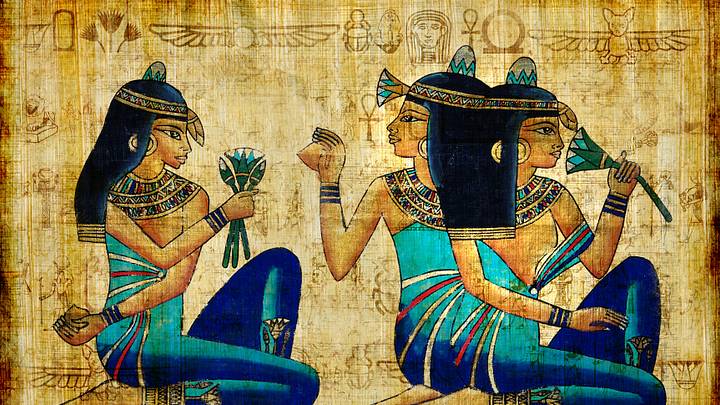
For thousands of years, ancient Egyptian was spoken along the Nile, and plenty of its words got out. Greek traders and Roman writers picked some of them up; Arabic and Spanish passed others along; and a handful made it all the way into English, where most people use them without a second thought. Here are nine words that are believed to have started out in Egypt. Some of these trails are well marked, and some run cold partway back, so etymologists hedge a few of them.
Paper

The word paper reached English in the mid-14th century, by way of Old French papier, from the Latin papyrus, the reed that gave the Ancient Egyptians a cheap, convenient writing surface. The Greeks called the plant papyros, and the Online Etymology Dictionary calls that a loanword of unknown origin that is “often said to be Egyptian.” So the trail runs from the Nile to your printer tray, with one smudged signpost in the middle.
Ebony
Egyptian had a word, hbnj, for a dark, hard wood prized for carving, and it’s probably where the Greeks got ebenos. From there the Romans made it ebenus, and English took ebony in the 1590s. Writers were using it to mean a vary dark black color by the 1620s, which is why a word for lumber now shows up in poetry, piano lessons, and paint-chip names.
Ivory

Before English borrowed ivory from French in the 13th century, Old English speakers called the stuff elpendban, or “elephant bone.” The newer word traces back to the Latin ebur, which the Online Etymology Dictionary says likely came from an African source by way of Phoenician, and it points to the Egyptian ab, “elephant,” and the Coptic ebu, “ivory.” By 1782, ivories was slang for teeth, and by 1818 it meant piano keys.
Adobe
The sun-dried brick of the American Southwest has an Egyptian name. English got adobe from Spanish in 1739, and the 19th-century Dutch Arabist Reinhart Dozy traced the Spanish word to the Arabic al-tob, “the brick.” Before that it was the Coptic tobe, from an ancient Egyptian word for brick, ḏbt, that turns up in hieroglyphics.
A competing theory ties adobe to the Spanish verb adobar, “to plaster,” but if Dozy was right, a mud brick in New Mexico still answers to roughly the name it had on the Nile.
Oasis

English got oasis through Latin from the Greek Oasis, and behind the Greek is the Egyptian wḥꜣt, which, according to Raymond Faulkner’s dictionary of Middle Egyptian, could mean both “oasis” and “cauldron.” The word passed through a later stage of Egyptian on its way to the Greeks, and its cousins survive in Coptic as ouahe and in Arabic as wāḥa.
Gum
The sticky stuff that seeps out of trees went from the Egyptian qmyt, a word for resin, to the Greek kommi, to the Latin gummi, and on into Middle English. Chewing gum came much later and simply inherited the name. The gums in your mouth are a different word entirely, from the Old English gōma, “palate,” so only half of the gum you have right now is Egyptian.
Barge

Greek had a word, baris, for a specifically Egyptian kind of boat, borrowed from Egyptian (Coptic bari, “small boat”). The Online Etymology Dictionary calls the next step uncertain, but a likely route runs through Latin and Old French to give English barge in the early 14th century. Its relatives bark and barque may share the same Nile ancestor. The sense of barging into a room, from the rough way barges got handled, dates only to 1898.
Ammonia
Here’s one for the cleaning cabinet. The ancient Greeks and Romans worshipped the Egyptian god Amun as Ammon, whose name is said to mean “hidden,” and he had an oracle at a desert shrine in what they called Libya. Mineral salts gathered near it came to be called sal ammoniac, Ammon’s salt, and in 1782 the Swedish chemist Torbern Bergman coined ammonia for the gas made from it.
The etymologist Joseph Shipley wrote that the salts traditionally came “from the sands where the camels waited while their masters prayed for good omens.”
Chemistry

This is the most debated word on the list. Chemistry was used to mean alchemy around 1600, and alchemy goes back through Arabic al-kimiya to a Greek word that turns up around 300 CE in a decree by the Roman emperor Diocletian against “the old writings of the Egyptians.” One theory traces it to Khemia, an old name for Egypt that means “land of black earth.” The other links it to a Greek word for pouring.
The Online Etymology Dictionary’s verdict is that the word “seems to have elements of both origins,” so Egypt gets at least partial credit.