%20%20--%3E%0A%3Csvg%20version%3D%221.1%22%20id%3D%22Layer_1%22%20xmlns%3D%22http%3A%2F%2Fwww.w3.org%2F2000%2Fsvg%22%20xmlns%3Axlink%3D%22http%3A%2F%2Fwww.w3.org%2F1999%2Fxlink%22%20x%3D%220px%22%20y%3D%220px%22%0A%09%20viewBox%3D%220%200%20684.6%2068.1%22%20style%3D%22enable-background%3Anew%200%200%20684.6%2068.1%3B%22%20xml%3Aspace%3D%22preserve%22%3E%0A%3Cg%3E%0A%09%3Cpath%20d%3D%22M444.1%2C29.3h-17.4v14.5h17.4V29.3z%20M36.4%2C68.1l29.3-50.8V0H50.4L32.9%2C36.8L15.5%2C0H0v68.1h16.7V45.8l12.4%2C22.3H36.4z%0A%09%09%20M49.1%2C68.1h16.6V23.4L49.1%2C52.1V68.1z%20M76.6%2C68.1h45V53.8H93.3V41.6h21V27.1h-21V14.8h28.3V0.1h-45V68.1z%20M175.6%2C68.1h17.3v-68%0A%09%09h-16.5v40.3L150%2C0.1h-17.6v68h16.7V27.7L175.6%2C68.1z%20M235.8%2C14.8h15.4V0.1h-47.4v14.7H219v53.2h16.8V14.8z%20M290.3%2C45.9h-17.1%0A%09%09l7.5-15.6h2L290.3%2C45.9z%20M298.7%2C68.1h18l-32.2-68h-5.7l-32%2C68h18l3.3-7.1h27.1L298.7%2C68.1z%20M325.2%2C68.1h46.2V53.8h-29.6V0.1h-16.7%0A%09%09V68.1z%20M423.7%2C14.8h27.2V0.1H407v68h16.7V14.8z%20M462%2C68.1h46.2V53.8h-29.6V0.1H462V68.1z%20M564.8%2C34.1c0%2C10.7-7.2%2C19.2-18.5%2C19.2%0A%09%09c-11.4%2C0-18.5-8.5-18.5-19.2s7.1-19.2%2C18.5-19.2C557.6%2C14.9%2C564.8%2C23.4%2C564.8%2C34.1%20M580.6%2C34.1c0-19-14.2-34-34.3-34%0A%09%09c-20.2%2C0-34.3%2C15-34.3%2C34c0%2C19%2C14.1%2C34%2C34.3%2C34C566.4%2C68.1%2C580.6%2C53.1%2C580.6%2C34.1%20M604.8%2C20.5c0-4.1%2C3.3-6.2%2C6.7-6.2%0A%09%09c4.4%2C0%2C6.6%2C3%2C6.6%2C6.6h14.7C631.8%2C9.1%2C625.1%2C0.1%2C611%2C0.1c-12%2C0-21.7%2C9.3-21.7%2C20.6c0%2C10.9%2C5.9%2C15.9%2C16.7%2C19.8%0A%09%09c5.2%2C1.8%2C11.5%2C3.2%2C11.5%2C8c0%2C3.3-2.4%2C5.5-6.4%2C5.5c-3.6%2C0-6.6-3-6.6-6.7h-15.2c0%2C11.5%2C7.9%2C20.8%2C21.8%2C20.8c12%2C0%2C21.6-9.3%2C21.6-20.6%0A%09%09c0-10-5.3-16.4-16.7-19.8C610.6%2C26.1%2C604.8%2C25.3%2C604.8%2C20.5%20M670%2C20.9h14.7C683.8%2C9.1%2C677.1%2C0.1%2C663%2C0.1c-12%2C0-21.7%2C9.3-21.7%2C20.6%0A%09%09c0%2C10.9%2C5.9%2C15.9%2C16.7%2C19.8c5.2%2C1.8%2C11.5%2C3.2%2C11.5%2C8c0%2C3.3-2.4%2C5.5-6.4%2C5.5c-3.6%2C0-6.6-3-6.6-6.7h-15.2c0%2C11.5%2C7.9%2C20.8%2C21.8%2C20.8%0A%09%09c12%2C0%2C21.6-9.3%2C21.6-20.6c0-10-5.3-16.4-16.7-19.8c-5.4-1.6-11.3-2.4-11.3-7.2c0-4.1%2C3.3-6.2%2C6.7-6.2C667.7%2C14.4%2C670%2C17.3%2C670%2C20.9%0A%09%09%22%2F%3E%0A%3C%2Fg%3E%0A%3C%2Fsvg%3E%0A)

The English language is fit to burst with terms named after people, a.k.a. eponyms. Some namesakes are pretty obvious—Elizabethan after Queen Elizabeth I, Orwellian after George Orwell, and so forth. Others are much sneakier, either because the words don’t sound like names at all or because you just never really thought about where they came from.
Let’s dive into some fun eponyms—from mesmerize to pants—as adapted from the above episode of The List Show on YouTube.
- Mesmerize
- Guy
- Galvanize
- Salmonella
- Guillotine
- Gardenia
- German chocolate cake
- Macadamia nut
- Praline
- Shrapnel
- Braille, Diesel, Leotard
- Jacuzzi
- Doily
- Syphilis
- Paparazzi
- Gargantuan
- Bloomers
- Pants
Mesmerize

Whenever you’re mesmerized by something, thank Franz Anton Mesmer for giving you a way to describe the experience. Mesmer was the 18th-century German physician behind mesmerism, the use of a magnet to move fluids inside the body to heal illness. Mesmer’s theories and practices were widely discredited during his lifetime since any positive effects were “illusions caused by patients’ imaginations,” but his influence lives on in the lexicon.
Guy

All guys are named after Guy Fawkes. Literally. The word guy in the “man” sense is believed to be a nod to the most infamous co-conspirator of the failed Gunpowder Plot of 1605. Every November 5, British people would commemorate the event by burning raggedy, scarecrow-ish effigies of Guy Fawkes in the streets. They called these effigies “guys”—which got co-opted for any badly dressed or foolish person, and then, by the late 19th century, for any man in general.
Galvanize

Luigi Galvani gave us a verb, too: galvanize, meaning “to stimulate or excite as if by an electric shock,” in Merriam-Webster’s words. Galvani was an 18th-century Italian physicist whose experiments with dead frogs deepened our understanding of how electricity is conducted and how it affects organic matter. Electricity produced by chemical action became known as galvanism. By the mid-1800s, people were using galvanize in its modern figurative sense—no dead frogs involved. Fun fact, Galvani’s experiments were also an inspiration for Mary Shelley’s Frankenstein.
You May Also Like ...
- The Interesting Etymologies of 71 Everyday Words
- The Forgotten Sources of 12 Common Phrases
- 15 Word Origins Hiding In Plain Sight
Add Mental Floss as a preferred news source!
Salmonella

Salmon can harbor bacteria in the Salmonella genus, but that’s not why it’s called that. Really, it should be Smithella—because Theobald Smith was the first person to isolate a bacterium in that genus in 1885. But it was Daniel Elmer Salmon who oversaw Smith’s research program and was listed first on the paper about the discovery.
Guillotine

French physician Joseph Guillotin suggested that France standardize its execution method during the French Revolution. Guillotin didn’t invent the guillotine—in fact, he was anti-death penalty. He just thought it would be more humane if beheadings were done with one mechanical chop, rather than by executioners of varying skill. When France took his advice and built such a machine, everyone started calling it “the guillotine.” Joseph Guillotin’s family was so appalled that they later lobbied the government to change the name of the device—and when their request was refused, they changed their name instead.
Gardenia

Maybe you assumed gardenias got their moniker from where you might find them. They’re actually named after Alexander Garden, an 18th-century Scottish naturalist who did most of his work in South Carolina. Garden didn’t name the genus of flowering plants after himself—his fellow naturalist, John Ellis, named it in his honor.
German chocolate cake

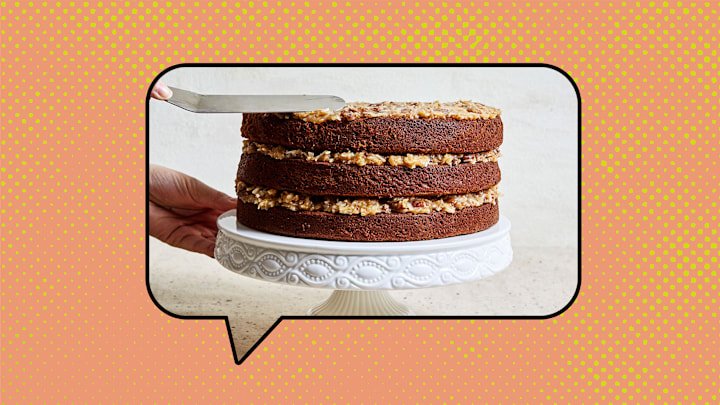
While we’re on misleading monikers, German chocolate cake wasn’t christened for its country of origin. The dessert, layers of chocolate cake filled and topped with coconut-pecan frosting, was created in Dallas, Texas in 1957. It’s named after Samuel German, who developed the sweet baking chocolate used in the recipe.
Macadamia nut

And macadamia nuts don’t hail from Macadamia, because Macadamia isn’t a place. The nuts (which are technically seeds) and the trees they grow on are endemic to Australia. Nineteenth-century German expat Ferdinand von Müller named them after his Scottish colleague John Macadam.
Praline

Another nutty eponym is praline. These days, the word refers to a candied nut or a paste made from them. Candied almonds are often considered the inaugural pralines—but the term wasn’t always specific to nuts. According to the Oxford English Dictionary, it could refer to any “confection made by browning in boiling sugar,” and early citations from 1662 feature lemons and violets. Praline’s namesake is the Maréchal du Plessis-Praslin, a 17th-century French nobleman whose personal chef purportedly invented the sweet treat.
Shrapnel

But plenty of things are named for their creators. Shrapnel originally referred to a specific kind of exploding shell invented by Henry Shrapnel, a British artillery officer, in the late 18th century. These days, we use the term more generally for fragments generated by an explosion.
Braille, Diesel, Leotard

Braille was invented by Louis Braille, a 19th-century French educator who went blind after a childhood accident. The diesel engine was invented by German mechanical engineer Rudolf Diesel in the late 19th century. And leotards were invented by Jules Léotard, the French acrobat who also invented the flying trapeze in 1859.
Jacuzzi

More than a century later, Roy Jacuzzi debuted the first integrated whirlpool bath. That particular bath was called “the Roman.” But the name of the family company, Jacuzzi, eventually caught on as shorthand for any whirlpool bath.
Doily

The kind of frilly napkin or paper mat we call a “doily” was also named for its purveyor: Doiley, among other spellings, anglicized from the French d’Ouilly. Mr. Doiley of late-17th-century London was also known for his affordable woVol that was popular for summer garments. Sources from around that time mention doily suits, doily coats, and doily petticoats.
Syphilis

In 1530, Italian physician Girolamo Fracastoro published a poem titled Syphilis, or the French Disease. It follows the fictional story of Syphilus, a shepherd who angers Apollo and gets cursed with a contagion that we now call “syphilis.” Fracastoro coined both the shepherd’s name—which ends in -us—and the name of the disease, which ends in -is. It’s unclear where he got the idea: One possible inspiration was Ovid’s Metamorphoses, in which Niobe, daughter of Tantalus, has a son named Sypilus. He’s killed as punishment for his mother’s hubris—by an arrow, though, not an STI.
Paparazzi

Paparazzi are also named after a character: Paparazzo, the opportunistic society photographer played by Walter Santesso in 1960’s La Dolce Vita. Director Federico Fellini didn’t invent the word; it was already an Italian surname. In his autobiography, Fellini said he found it in an opera libretto. But his screenplay co-writer, Ennio Flaiano, remembered the pair coming upon it in George Gissing’s travelogue By the Ionian Sea. Whatever its provenance, Fellini described the name as “like a buzzing insect, hovering, darting, stinging.” Fitting for a photog on the prowl for the perfect shot.
Gargantuan

Gargantuan seems like a fitting synonym for gigantic based on sound alone. It was inspired by character, too: Gargantua, one of the titular giants from The Five Books of the Lives and Deeds of Gargantua and Pantagruel, written by 16th-century French humanist François Rabelais. Pantagruel also inspired an adjective meaning “gigantic”—Pantagruelian.
Bloomers

The original bloomers were long, loose pants cinched at the ankle, worn beneath a knee-length skirt. Nineteenth-century American suffragist and editor Amelia Jenks Bloomer popularized the bottoms to the point that everyone started calling them by her surname. The getup was much more comfortable and less constricting than the longer, fuller skirts of the era—but it doesn’t come close to 21st-century leggings.
Pants

Bloomers aren’t the only pants named after a person. So are pants. The term pants is short for pantaloons, referring to the trousers worn by the Italian commedia dell’arte character Pantaloon. Pantaloon was a goofy old man clad in long red tights that covered his feet. The word pantaloons didn’t just describe that one type of bottoms—and, needless to say, neither does pants.