%20%20--%3E%0A%3Csvg%20version%3D%221.1%22%20id%3D%22Layer_1%22%20xmlns%3D%22http%3A%2F%2Fwww.w3.org%2F2000%2Fsvg%22%20xmlns%3Axlink%3D%22http%3A%2F%2Fwww.w3.org%2F1999%2Fxlink%22%20x%3D%220px%22%20y%3D%220px%22%0A%09%20viewBox%3D%220%200%20684.6%2068.1%22%20style%3D%22enable-background%3Anew%200%200%20684.6%2068.1%3B%22%20xml%3Aspace%3D%22preserve%22%3E%0A%3Cg%3E%0A%09%3Cpath%20d%3D%22M444.1%2C29.3h-17.4v14.5h17.4V29.3z%20M36.4%2C68.1l29.3-50.8V0H50.4L32.9%2C36.8L15.5%2C0H0v68.1h16.7V45.8l12.4%2C22.3H36.4z%0A%09%09%20M49.1%2C68.1h16.6V23.4L49.1%2C52.1V68.1z%20M76.6%2C68.1h45V53.8H93.3V41.6h21V27.1h-21V14.8h28.3V0.1h-45V68.1z%20M175.6%2C68.1h17.3v-68%0A%09%09h-16.5v40.3L150%2C0.1h-17.6v68h16.7V27.7L175.6%2C68.1z%20M235.8%2C14.8h15.4V0.1h-47.4v14.7H219v53.2h16.8V14.8z%20M290.3%2C45.9h-17.1%0A%09%09l7.5-15.6h2L290.3%2C45.9z%20M298.7%2C68.1h18l-32.2-68h-5.7l-32%2C68h18l3.3-7.1h27.1L298.7%2C68.1z%20M325.2%2C68.1h46.2V53.8h-29.6V0.1h-16.7%0A%09%09V68.1z%20M423.7%2C14.8h27.2V0.1H407v68h16.7V14.8z%20M462%2C68.1h46.2V53.8h-29.6V0.1H462V68.1z%20M564.8%2C34.1c0%2C10.7-7.2%2C19.2-18.5%2C19.2%0A%09%09c-11.4%2C0-18.5-8.5-18.5-19.2s7.1-19.2%2C18.5-19.2C557.6%2C14.9%2C564.8%2C23.4%2C564.8%2C34.1%20M580.6%2C34.1c0-19-14.2-34-34.3-34%0A%09%09c-20.2%2C0-34.3%2C15-34.3%2C34c0%2C19%2C14.1%2C34%2C34.3%2C34C566.4%2C68.1%2C580.6%2C53.1%2C580.6%2C34.1%20M604.8%2C20.5c0-4.1%2C3.3-6.2%2C6.7-6.2%0A%09%09c4.4%2C0%2C6.6%2C3%2C6.6%2C6.6h14.7C631.8%2C9.1%2C625.1%2C0.1%2C611%2C0.1c-12%2C0-21.7%2C9.3-21.7%2C20.6c0%2C10.9%2C5.9%2C15.9%2C16.7%2C19.8%0A%09%09c5.2%2C1.8%2C11.5%2C3.2%2C11.5%2C8c0%2C3.3-2.4%2C5.5-6.4%2C5.5c-3.6%2C0-6.6-3-6.6-6.7h-15.2c0%2C11.5%2C7.9%2C20.8%2C21.8%2C20.8c12%2C0%2C21.6-9.3%2C21.6-20.6%0A%09%09c0-10-5.3-16.4-16.7-19.8C610.6%2C26.1%2C604.8%2C25.3%2C604.8%2C20.5%20M670%2C20.9h14.7C683.8%2C9.1%2C677.1%2C0.1%2C663%2C0.1c-12%2C0-21.7%2C9.3-21.7%2C20.6%0A%09%09c0%2C10.9%2C5.9%2C15.9%2C16.7%2C19.8c5.2%2C1.8%2C11.5%2C3.2%2C11.5%2C8c0%2C3.3-2.4%2C5.5-6.4%2C5.5c-3.6%2C0-6.6-3-6.6-6.7h-15.2c0%2C11.5%2C7.9%2C20.8%2C21.8%2C20.8%0A%09%09c12%2C0%2C21.6-9.3%2C21.6-20.6c0-10-5.3-16.4-16.7-19.8c-5.4-1.6-11.3-2.4-11.3-7.2c0-4.1%2C3.3-6.2%2C6.7-6.2C667.7%2C14.4%2C670%2C17.3%2C670%2C20.9%0A%09%09%22%2F%3E%0A%3C%2Fg%3E%0A%3C%2Fsvg%3E%0A)

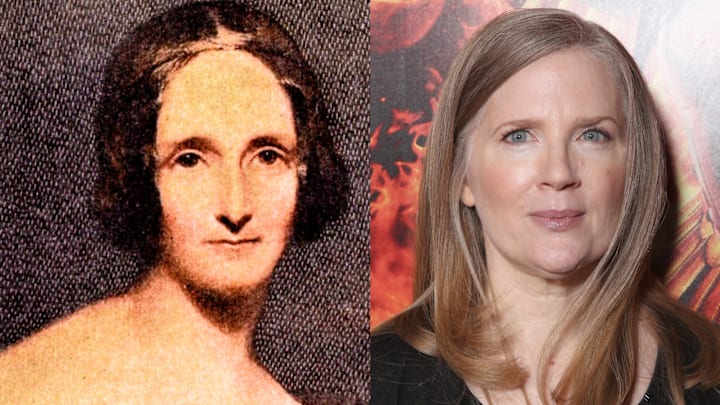
Jules Verne and H.G. Wells are often credited with creating the science fiction genre, but while both authors had a massive influence on sci-fi, they were actually beaten to the punch by Mary Shelley, who penned and published Frankenstein (1818) years before Verne and Wells were even born.
Although science fiction has historically been dominated by male authors, there are plenty of female writers who have also left an important mark on the genre. Here are six women whose stories about time travel, alien planets, and dystopian futures have shaped sci-fi.
Mary Shelley

Mary Shelley was just 18 years old when she wrote what is widely considered to be the first science fiction novel: Frankenstein; or, The Modern Prometheus. The gothic story got its start in 1816 when Shelley (then going by her maiden name, Godwin) and her soon-to-be husband, Percy Bysshe Shelley, traveled to Switzerland to stay with Lord Byron at his villa near Lake Geneva.
They ended up spending most of the summer inside due to the unseasonably cold and wet weather—1816 was known as “the year without a summer”—caused by the eruption of Indonesia’s Mount Tambora the previous year. After reading ghost stories one night, the trio—along with Byron’s physician, John Polidori—challenged each other to write their own scary stories, out of which Frankenstein was born.
The book was published anonymously two years later and many people incorrectly believed that Percy was actually the author. Shelley was first credited in the 1821 French translation.
In addition to being regarded as the first proper sci-fi novel, Frankenstein also originated the mad scientist trope. Iconic characters such as Dr. Jekyll from Robert Louis Stevenson’s Dr. Jekyll and Mr. Hyde (1886) and Dr. Moreau from H.G. Wells’s The Island of Doctor Moreau (1896) owe a debt to Shelley’s Dr. Frankenstein.
Most of Shelley’s subsequent novels were historical rather than speculative, but she did make another foray into the world of sci-fi with The Last Man (1826), an apocalyptic novel about a bubonic plague causing the extinction of humanity.
Ursula K. Le Guin

For the first half of the 20th century, science fiction was in its pulp era—that is fast-paced, fun, and adventurous stories printed on cheap paper created from wood pulp.
Although there are, of course, many examples of sci-fi writers who wrote more intellectually stimulating stories—such as the works of Golden Age writers like Isaac Asimov and Ray Bradbury—it wasn’t until the New Wave in the ’60s that a more sophisticated and philosophical style started to gain popularity. Ursula K. Le Guin was one of the key New Wave writers.
Le Guin explored themes of feminism, sexuality, and politics in her works. For instance, one of her best-known books, The Left of Darkness (1969), is about an alien race who have no fixed sex.
Although one publisher rejected the novel because they thought it was “so endlessly complicated by details of reference and information” that it rendered the story “unreadable,” the book went on to win both the Hugo and Nebula Awards—the two most prestigious sci-fi prizes. Le Guin then achieved this feat again just a few years later with her anarchist utopian novel The Dispossessed (1974).
After Le Guin’s death, sci-fi author Mary Robinette Kowal praised her for helping to garner science fiction more serious consideration from the mainstream. “I think that she did a lot for science fiction and fantasy, not just for women and women’s roles because of her feminism but also legitimizing us as an art form,” she told NPR in 2018.
Octavia E. Butler

When Octavia E. Butler was just 12 years old she watched a B-movie, Devil Girl from Mars (1954), which was so bad that it inspired her to become a writer. In a 1998 talk, she explained the three successive thoughts that came to her while she watched: “Geez, I can write a better story than that,” “Gee, anybody can write a better story than that,” and “Somebody got paid for writing that awful story.”
After seeing the film, Butler was soon submitting her own stories to sci-fi magazines and a little over a decade later she became the first Black female sci-fi writer to be published, with her short story “Crossover” appearing in a 1971 anthology. She’s also credited as the “mother of Afrofuturism,” with her novels—including the time-traveling Kindred (1979) and the post-apocalyptic Parable of the Sower (1993)—being pillars of the genre.
Margaret Atwood

Margaret Atwood doesn’t actually consider herself to be a sci-fi writer. According to her own definition, science fiction is about “things that could not possibly happen,” while speculative fiction—the genre into which she thinks many of her works fall—is about “things that really could happen but just hadn’t completely happened when the authors wrote the books.”
With The Handmaid’s Tale (1985)—a dystopian novel about the few fertile women left on Earth being forced to produce babies for the ruling elite—Atwood went as far as to only include things that had actually happened somewhere, at some point in history. The result is a searing commentary on sexism and power that feels as relevant today as it did back in 1985.
By writing more plausible and grounded speculative stories, Atwood helped to further bridge the gap between literary fiction and science fiction.
Suzanne Collins

Although there are a few dystopian books featuring teenage protagonists that predate The Hunger Games—Koushun Takami’s Battle Royale (1999) being the prime example—it’s undeniable that Suzanne Collins’s 2008 book kick started the young adult dystopian trend.
The story follows teenager Katniss Everdeen as she competes in the titular Hunger Games—a televised tournament that sees contestants kill each other until there is only one victor.
By the time the film adaptation, starring Jennifer Lawrence, hit cinemas in 2012, the book had sold a staggering 26 million copies. The next two books in the series, Catching Fire (2009) and Mockingjay (2010), were also bestsellers and the successful trilogy led to a publishing boom of similar stories.
Veronica Roth’s Divergent series, Ally Condie’s Matched trilogy, and Kiera Cass’s The Selection series are just a few of the YA dystopias that followed in the wake of The Hunger Games.
Becky Chambers
The Long Way to a Small, Angry Planet (2014)—a cozy space opera which follows the adventures of the crew aboard the Wayfarer spaceship—was originally self-published. Becky Chambers raised the money she needed to complete the book on Kickstarter and the novel then became the first self-published title to be shortlisted for a Kitschie award—an achievement that led to the book being traditionally published.
The Long Way to a Small, Angry Planet soon spawned the Wayfarers series, which went on to win the Hugo Award for Best Series in 2019.
Chambers’s other stories—including the novella To Be Taught, if Fortunate (2019) and the Monk & Robot series—are similarly hopeful and heartwarming, leading to her being named as one of the pioneers of a sci-fi subgenre: hopepunk. The term is a riff on other sci-fi subgenre labels, like cyberpunk and steampunk, and is essentially the opposite in feel to grimdark books, such as George R.R. Martin’s A Song of Ice and Fire series.
“Hope is something that is desperately needed,” Chambers said in a 2022 BBC interview. “And it’s needed right now.”