%20%20--%3E%0A%3Csvg%20version%3D%221.1%22%20id%3D%22Layer_1%22%20xmlns%3D%22http%3A%2F%2Fwww.w3.org%2F2000%2Fsvg%22%20xmlns%3Axlink%3D%22http%3A%2F%2Fwww.w3.org%2F1999%2Fxlink%22%20x%3D%220px%22%20y%3D%220px%22%0A%09%20viewBox%3D%220%200%20684.6%2068.1%22%20style%3D%22enable-background%3Anew%200%200%20684.6%2068.1%3B%22%20xml%3Aspace%3D%22preserve%22%3E%0A%3Cg%3E%0A%09%3Cpath%20d%3D%22M444.1%2C29.3h-17.4v14.5h17.4V29.3z%20M36.4%2C68.1l29.3-50.8V0H50.4L32.9%2C36.8L15.5%2C0H0v68.1h16.7V45.8l12.4%2C22.3H36.4z%0A%09%09%20M49.1%2C68.1h16.6V23.4L49.1%2C52.1V68.1z%20M76.6%2C68.1h45V53.8H93.3V41.6h21V27.1h-21V14.8h28.3V0.1h-45V68.1z%20M175.6%2C68.1h17.3v-68%0A%09%09h-16.5v40.3L150%2C0.1h-17.6v68h16.7V27.7L175.6%2C68.1z%20M235.8%2C14.8h15.4V0.1h-47.4v14.7H219v53.2h16.8V14.8z%20M290.3%2C45.9h-17.1%0A%09%09l7.5-15.6h2L290.3%2C45.9z%20M298.7%2C68.1h18l-32.2-68h-5.7l-32%2C68h18l3.3-7.1h27.1L298.7%2C68.1z%20M325.2%2C68.1h46.2V53.8h-29.6V0.1h-16.7%0A%09%09V68.1z%20M423.7%2C14.8h27.2V0.1H407v68h16.7V14.8z%20M462%2C68.1h46.2V53.8h-29.6V0.1H462V68.1z%20M564.8%2C34.1c0%2C10.7-7.2%2C19.2-18.5%2C19.2%0A%09%09c-11.4%2C0-18.5-8.5-18.5-19.2s7.1-19.2%2C18.5-19.2C557.6%2C14.9%2C564.8%2C23.4%2C564.8%2C34.1%20M580.6%2C34.1c0-19-14.2-34-34.3-34%0A%09%09c-20.2%2C0-34.3%2C15-34.3%2C34c0%2C19%2C14.1%2C34%2C34.3%2C34C566.4%2C68.1%2C580.6%2C53.1%2C580.6%2C34.1%20M604.8%2C20.5c0-4.1%2C3.3-6.2%2C6.7-6.2%0A%09%09c4.4%2C0%2C6.6%2C3%2C6.6%2C6.6h14.7C631.8%2C9.1%2C625.1%2C0.1%2C611%2C0.1c-12%2C0-21.7%2C9.3-21.7%2C20.6c0%2C10.9%2C5.9%2C15.9%2C16.7%2C19.8%0A%09%09c5.2%2C1.8%2C11.5%2C3.2%2C11.5%2C8c0%2C3.3-2.4%2C5.5-6.4%2C5.5c-3.6%2C0-6.6-3-6.6-6.7h-15.2c0%2C11.5%2C7.9%2C20.8%2C21.8%2C20.8c12%2C0%2C21.6-9.3%2C21.6-20.6%0A%09%09c0-10-5.3-16.4-16.7-19.8C610.6%2C26.1%2C604.8%2C25.3%2C604.8%2C20.5%20M670%2C20.9h14.7C683.8%2C9.1%2C677.1%2C0.1%2C663%2C0.1c-12%2C0-21.7%2C9.3-21.7%2C20.6%0A%09%09c0%2C10.9%2C5.9%2C15.9%2C16.7%2C19.8c5.2%2C1.8%2C11.5%2C3.2%2C11.5%2C8c0%2C3.3-2.4%2C5.5-6.4%2C5.5c-3.6%2C0-6.6-3-6.6-6.7h-15.2c0%2C11.5%2C7.9%2C20.8%2C21.8%2C20.8%0A%09%09c12%2C0%2C21.6-9.3%2C21.6-20.6c0-10-5.3-16.4-16.7-19.8c-5.4-1.6-11.3-2.4-11.3-7.2c0-4.1%2C3.3-6.2%2C6.7-6.2C667.7%2C14.4%2C670%2C17.3%2C670%2C20.9%0A%09%09%22%2F%3E%0A%3C%2Fg%3E%0A%3C%2Fsvg%3E%0A)

Head back in time 50 years, and the best-sellers charts of 1976 would have featured not only some of the most popular books of the year, but books that would go on to become some of the best-selling and most loved books of the second half of the century.
The final posthumous releases of two of the most popular authors of all time would also find their way onto bookshelves the world over this year—alongside titles by the likes of Robert Ludlum, Gore Vidal, and even Dr. Seuss.
- Interview With the Vampire by Anne Rice
- The Deep by Peter Benchley
- The Selfish Gene by Richard Dawkins
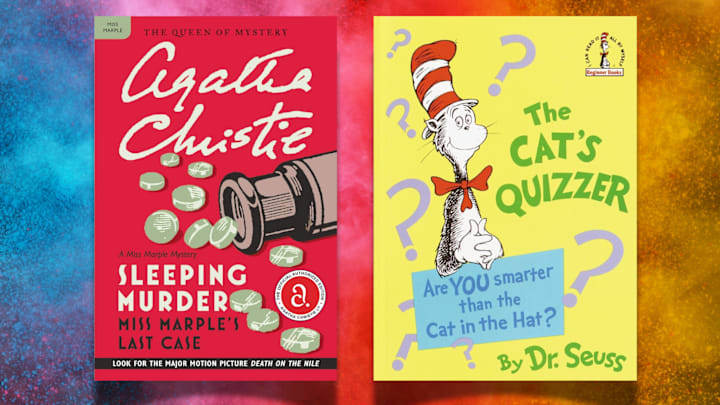
- Sleeping Murder by Agatha Christie
- The Cat’s Quizzer by Dr. Seuss
- Kiss of the Spider Woman by Manuel Puig
- 1876 by Gore Vidal
- Trinity by Leon Uris
- The Gemini Contenders by Robert Ludlum
- Dolores by Jacqueline Susann
Interview With the Vampire by Anne Rice

While struggling with drinking and still coming to terms with the loss of her young daughter to leukemia, in 1973, the author Anne Rice began reworking an old short story she had written several years earlier, in the late 1960s.
The result was her first full-length novel and one of the best-selling novels of the decade, Interview With the Vampire. Perhaps reflecting the awful circumstances and tragic darkness of Rice’s own personal life at the time, the novel—in which a generations-old vampire, Louis de Pointe du Lac, relates his life story to a reporter—is a dark, brooding, gothic masterpiece that deals with complex themes of loss, grief, and immortality, as well as power, politics, and sexuality.
The Deep by Peter Benchley
Already an established voice in narrative nonfiction, US author Peter Benchley burst onto the fiction literary scene in 1974 with his best-selling thriller Jaws (which was adapted in a similarly block-bustering fashion for cinema the following year).
The year after that, though, in 1976, Benchley returned to the sea (and to the Publishers Weekly best-sellers lists) with his second work of fiction, The Deep. The book tells the story of a young couple who journey to Bermuda for their honeymoon. While scuba diving off the island’s reefs, the pair stumble across two shipwrecks—one loaded with ancient Spanish gold, the other with a World War II supply of morphine.
As it soon transpires, however, they’re not the only people to know of the wrecks’ whereabouts…
The Selfish Gene by Richard Dawkins

Now just as well-known as an advocate of atheism as he is as an evolutionary biologist, Oxford University’s Professor Richard Dawkins published his first book, The Selfish Gene, in 1976.
Its approachable and non-technical style established Dawkins as an expert science communicator, and made the remarkably complex topic about which he was writing—how Darwin’s natural selection takes place at the genetic rather than species-wide level—understandable to a wide audience for the very first time.
More popular science titles followed, including his later groundbreaking best-seller The Blind Watchmaker, which further opened up this esoteric field, and Dawkins went on to be made the first Professor for the Public Understanding of Science at Oxford University in 1995.
Sleeping Murder by Agatha Christie

1976 got off to an inauspicious start when one of the most popular and successful authors of all time, Dame Agatha Christie, died just a few days into the new year, on January 12, at the age of 85.
On her death, she left one final unpublished novel—Miss Marple’s very last case, titled Sleeping Murder. Chiefly set in the fictional Devonshire village of Dillmouth, the story follows a young newlywed named Gwenda Reed, who moves into an isolated house that it soon transpires is connected to a murder that took place two decades earlier.
As increasingly strange things happen at the house, Gwenda turns to her friend Miss Marple to investigate and hunt down the culprit of the still unsolved murder.
The Cat’s Quizzer by Dr. Seuss

The third of Dr. Seuss’s Cat in the Hat books was 1976’s The Cat’s Quizzer, a mixture of memory tests, general knowledge questions, and riddling trivia puzzles presented in the form of a colorful and highly illustrated series of verses.
The book begins with the eponymous cat introducing the readers’ competition in the quiz, Ziggy and Zizzy Zozzfozzel, who apparently scored 100%, but “got every question wrong.” Then, over the page, the quiz begins with a set of questions (in suitably irreverent style) such as whether or not elephants have uncles, whether there are ducks on the moon, and how old you have to be to fry an egg.
Kiss of the Spider Woman by Manuel Puig

Long before there was the play, the stage musical, the movie, and the 2025 movie of the musical, there was the novel.
Kiss of the Spider Woman began life as an unconventional novel by the Argentinian author Manuel Puig, featuring a challenging mixture of stream-of-consciousness writing, protracted footnotes, and open transcript-like dialogue, chiefly between two cellmates, Valentin and Molina, in an Argentine prison.
1876 by Gore Vidal

Written in the form of a journal by the central character, Charlie Schuyler, Gore Vidal’s 1876 was—following 1967’s Washington D.C. and 1973’s Burr—the third published of the seven historical novels in Gore Vidal’s acclaimed Narratives of Empire series.
The book tells the story of a man, Schuyler, who returns to America following several decades in Europe to find the land he once knew transformed by corruption and inequity. Central to the novel is the disputed 1876 presidential election, and as such, the book contains several real-life historical characters, including James A Garfield, Rutherford B Hayes, and Hayes’s Democratic opponent in the election, Samuel J Tilden. The main character, however, is pure fiction.
Trinity by Leon Uris

Publishers Weekly’s biggest-selling novel of the year, Leon Uris’s Irish historical epic Trinity tells the interweaving story of three Irish families across several decades either side of the turn of the last century, stretching from the potato famine of the 1840s to the Easter Rising of 1916.
The book was an astonishing success, spending five months at the top of the New York Times’ best-sellers list in the year of its publication, and a further three-and-a-half months at the top of the chart the following year. It was followed nearly 20 years later by an equally well-received sequel, Redemption, that shifted the action forward to the First World War and beyond.
The Gemini Contenders by Robert Ludlum

The eighth of thriller and suspense maestro Robert Ludlum’s more than twenty full-length novels (every one of which was a New York Times best-seller), 1976’s The Gemini Contenders is a twisting, decades-spanning war thriller that opens with a mysterious order of monks transporting an equally mysterious vault high up to a secret location in the Italian Alps.
As the decades drift by, the Second World War breaks out, and the location of the vault—whose contents threaten the entire Christian world—becomes a target of the encroaching Nazis.
Dolores by Jacqueline Susann
A fictionalized retelling of the life of Jackie O, Dolores was Valley of the Dolls author Jacqueline Susann’s final completed work, written shortly before her death from cancer in 1974 at the age of just 54.
Originally planned as a short story to be published in the February 1974 edition of Ladies’ Home Journal, Dolores initially proved too long to be published unedited in the magazine, and so the entire text was restored two years later and published posthumously, in full, as a novella in 1976.
Although perhaps not as acclaimed or critically well-received as Susann’s other work, the book nevertheless ended her career on a high note as one of the best-selling books of the year.
You Might Also Like:
Add Mental Floss as a preferred news source!