%20%20--%3E%0A%3Csvg%20version%3D%221.1%22%20id%3D%22Layer_1%22%20xmlns%3D%22http%3A%2F%2Fwww.w3.org%2F2000%2Fsvg%22%20xmlns%3Axlink%3D%22http%3A%2F%2Fwww.w3.org%2F1999%2Fxlink%22%20x%3D%220px%22%20y%3D%220px%22%0A%09%20viewBox%3D%220%200%20684.6%2068.1%22%20style%3D%22enable-background%3Anew%200%200%20684.6%2068.1%3B%22%20xml%3Aspace%3D%22preserve%22%3E%0A%3Cg%3E%0A%09%3Cpath%20d%3D%22M444.1%2C29.3h-17.4v14.5h17.4V29.3z%20M36.4%2C68.1l29.3-50.8V0H50.4L32.9%2C36.8L15.5%2C0H0v68.1h16.7V45.8l12.4%2C22.3H36.4z%0A%09%09%20M49.1%2C68.1h16.6V23.4L49.1%2C52.1V68.1z%20M76.6%2C68.1h45V53.8H93.3V41.6h21V27.1h-21V14.8h28.3V0.1h-45V68.1z%20M175.6%2C68.1h17.3v-68%0A%09%09h-16.5v40.3L150%2C0.1h-17.6v68h16.7V27.7L175.6%2C68.1z%20M235.8%2C14.8h15.4V0.1h-47.4v14.7H219v53.2h16.8V14.8z%20M290.3%2C45.9h-17.1%0A%09%09l7.5-15.6h2L290.3%2C45.9z%20M298.7%2C68.1h18l-32.2-68h-5.7l-32%2C68h18l3.3-7.1h27.1L298.7%2C68.1z%20M325.2%2C68.1h46.2V53.8h-29.6V0.1h-16.7%0A%09%09V68.1z%20M423.7%2C14.8h27.2V0.1H407v68h16.7V14.8z%20M462%2C68.1h46.2V53.8h-29.6V0.1H462V68.1z%20M564.8%2C34.1c0%2C10.7-7.2%2C19.2-18.5%2C19.2%0A%09%09c-11.4%2C0-18.5-8.5-18.5-19.2s7.1-19.2%2C18.5-19.2C557.6%2C14.9%2C564.8%2C23.4%2C564.8%2C34.1%20M580.6%2C34.1c0-19-14.2-34-34.3-34%0A%09%09c-20.2%2C0-34.3%2C15-34.3%2C34c0%2C19%2C14.1%2C34%2C34.3%2C34C566.4%2C68.1%2C580.6%2C53.1%2C580.6%2C34.1%20M604.8%2C20.5c0-4.1%2C3.3-6.2%2C6.7-6.2%0A%09%09c4.4%2C0%2C6.6%2C3%2C6.6%2C6.6h14.7C631.8%2C9.1%2C625.1%2C0.1%2C611%2C0.1c-12%2C0-21.7%2C9.3-21.7%2C20.6c0%2C10.9%2C5.9%2C15.9%2C16.7%2C19.8%0A%09%09c5.2%2C1.8%2C11.5%2C3.2%2C11.5%2C8c0%2C3.3-2.4%2C5.5-6.4%2C5.5c-3.6%2C0-6.6-3-6.6-6.7h-15.2c0%2C11.5%2C7.9%2C20.8%2C21.8%2C20.8c12%2C0%2C21.6-9.3%2C21.6-20.6%0A%09%09c0-10-5.3-16.4-16.7-19.8C610.6%2C26.1%2C604.8%2C25.3%2C604.8%2C20.5%20M670%2C20.9h14.7C683.8%2C9.1%2C677.1%2C0.1%2C663%2C0.1c-12%2C0-21.7%2C9.3-21.7%2C20.6%0A%09%09c0%2C10.9%2C5.9%2C15.9%2C16.7%2C19.8c5.2%2C1.8%2C11.5%2C3.2%2C11.5%2C8c0%2C3.3-2.4%2C5.5-6.4%2C5.5c-3.6%2C0-6.6-3-6.6-6.7h-15.2c0%2C11.5%2C7.9%2C20.8%2C21.8%2C20.8%0A%09%09c12%2C0%2C21.6-9.3%2C21.6-20.6c0-10-5.3-16.4-16.7-19.8c-5.4-1.6-11.3-2.4-11.3-7.2c0-4.1%2C3.3-6.2%2C6.7-6.2C667.7%2C14.4%2C670%2C17.3%2C670%2C20.9%0A%09%09%22%2F%3E%0A%3C%2Fg%3E%0A%3C%2Fsvg%3E%0A)

Although we often believe that children should be protected from the harsh realities of life, children’s games and entertainment have a long history of showcasing dark topics. For example, about half of the known Grimm fairy tales include murder, with multiple also depicting cannibalism. This might seem like an outlier on first glance, but it's surprisingly common for these topics to appear.
As another example, children’s games and rhymes tend to have dark undertones beneath seemingly innocent lyrics. For example, “Ring Around the Rosie” is about the Plague, while “Mary, Mary, Quite Contrary” is generally considered to be about Queen Mary I’s slaughter of English Protestants. The rhymes created opportunities for parents to explain the complicated horrors of their time to their children, as well as allowing potentially treasonous ideas to spread without censorship or punishment.
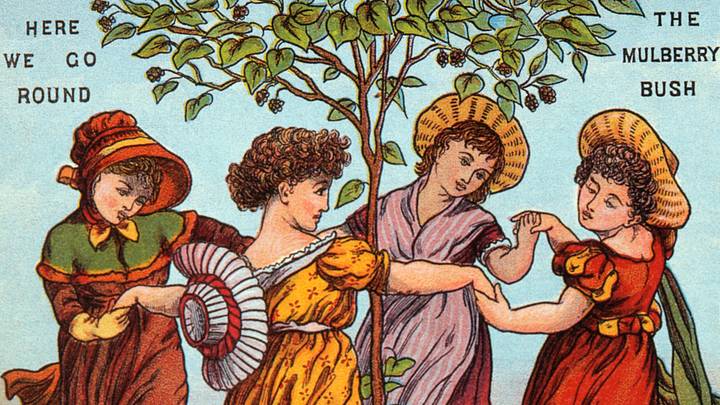
However, not all of these rhymes are innately grim. Some simply emerged as ways for parents to make the best out of a bad situation. That is true of “Here We Go Round the Mulberry Bush,” a nursery rhyme and game which most likely emerged from the most infamous prison in the United Kingdom.
The Lyrics

While there have been some variations to the lyrics of “Here We Go Round the Mulberry Bush” over the years, most people agree on at least the beginning of each verse. Listed below are the most common lyrics, per BBC Music’s Classical Music website:
Here we go round the mulberry bush,
The mulberry bush,
The mulberry bush.
Here we go round the mulberry bush
On a cold and frosty morning.
This is the way we wash our face,
Wash our face,
Wash our face.
This is the way we wash our face
On a cold and frosty morning.
This is the way we comb our hair,
Comb our hair,
Comb our hair.
This is the way we comb our hair
On a cold and frosty morning.
This is the way we brush our teeth,
Brush our teeth,
Brush our teeth.
This is the way we brush our teeth
On a cold and frosty morning.
This is the way we put on our clothes,
Put on our clothes,
Put on our clothes.
This is the way we put on our clothes
On a cold and frosty morning.
Here we go round the mulberry bush,
The mulberry bush,
The mulberry bush.
Here we go round the mulberry bush
On a cold and frosty morning.
The most common variations on these lyrics comes in the last line of each verse. Rather than referring to the "cold and frosty" morning, some children single simplifications like "so early in the morning" or just "early in the morning." These changes likely emerged as the song moved beyond its original location and climate. There are also variants of the song that sprung up in Scandinavian regions, where the titular Mulberry Bush was replaced with the more common local plant, the Juniper Bush.
The First Records of “Here We Go Round the Mulberry Bush”

The first written records of “Here We Go Round the Mulberry Bush” come from the 1840s, when it was included in two collections of nursery rhymes. The earliest, Popular Rhymes, Fireside Stories, and Amusements of Scotland by Robert Chambers (1842), includes the titular lyrics as a variant on “The Merry-Ma-Tanzie,” a game for young girls in which they acted out various chores or activities.
The second record comes from James Orchard Halliwell’s 1849 work, Popular Rhymes and Nursery Tales: A Sequel to The Nursery Rhymes of England, where the game is compared to the popular game-rhyme “The Bramble-Bush.” The same basic lyrics and activities are included, although Halliwell notes that this rhyme “requires too much exercise” compared to similar games.
These early records give us a rough timeline on when the nursery rhyme became popular, but they don’t provide much information about where it comes from. There are two common theories, although one makes more sense in context.
Theories on the Song’s Origins

Bill Bryson’s 2010 history of domestic culture, At Home: A Short History of Private Life, theorized that the song might have emerged as a reference to Britain’s unsuccessful attempts to produce silk in the eighteenth and nineteenth centuries. Mulberry trees were common habitats for silkworms, but they struggled to thrive in the British climate. Bryson suggests that the song was a joke about how difficult it was to grow mulberry trees and produce silk on the game’s “cold and frosty morning.” Furthermore, mulberries grow on trees, not bushes, so the wording might be mocking the lackluster growth of the trees that did survive.
While this explanation has some merit, as mulberry trees only came to the United Kingdom because of the silk industry, there is no real evidence connecting the production of silk with this song. The far more likely origin comes from R. S. Duncan, a local historian and former director of HMP Wakefield. He claimed that the song was created by female prisoners, who would sing during their exercise period and teach their children about personal cleanliness.
Life at Wakefield Prison in the Industrial Age

Known today as the “Monster Mansion” thanks to its reputation for housing the worst of the worst British criminals, Wakefield Prison transformed many times throughout its history. The prison was originally constructed in 1594 to provide jobs for the poor and create labor projects for those needing behavioral ‘correction.’ There were few long-term inmates until the 18th and 19th centuries, when perceptions of crime evolved and public police forces began to emerge.
During the Victorian period, Wakefield housed both male and female inmates, though they lived under vastly different conditions. Men were forced into extreme forms of isolation and manual labor. Women were considered unable to handle such treatment, but they were looked upon with greater shame.
As Catherine Cox and Hilary Marland explained in their book Disorder Contained: Mental Breakdown and the Modern Prison in England and Ireland, 1840 – 1900, “women required saving twice, from their criminality and their upturning of expected female behaviour.” Under this level of personal indictment, it would make sense for female inmates to seek communal activities.
If R. S. Duncan can be believed, the women incarcerated at Wakefield would sing “Here We Go Round the Mulberry Bush” during their allotted exercise period, as they walked in circles around a mulberry tree on the prison grounds. The song was a way for the women to socialize and entertain themselves during prison sentences that generally mandated boredom. The limited time allotted for exercise might also explain why early records noted that the game associated with this song required more effort than others from the same time period.
As the number of inmates increased, prison systems also found themselves having to address a new problem. Some female inmates were pregnant when they were convicted. Others were the only available caregivers for young children. In these cases, the children typically grew up in the prison, though they might be relocated if a viable guardian could be found.

Reports from the late 1700s show that, while Wakefield had better conditions than many prisons at the time, it was endangering its staff and residents. Hygiene standards were low, both from personal disregard and systemic negligence, and the prison's overpopulation problem created the perfect environment for infectious diseases like cholera to spread.
With this in mind, the lyrics of “Here We Go Round the Mulberry Bush” can be seen as a way for mothers to make a game out of keeping clean. The activities described align with the prison’s mandates for daily washing of the hands, face, and head, helping children stay safe and stay out of trouble.
While it is hard to imagine a children’s song and game originating in one of the most secure prisons in the United Kingdom, it makes sense for the time period in question. Mid-to-late 20th-century prisons were constantly experimenting to find the best way to eliminate criminality, often at the prisoners’ expense. By creating “Here We Go Round the Mulberry Bush,” female inmates built a community for themselves and taught their children how to stay safe in a hazardous environment.
The Wakefield Mulberry Tree

One of the most compelling pieces of evidence for this origin story is that there was a mulberry tree on the Wakefield property that would have been well-known to the inmates. Duncan explained that the mulberry tree had been grown from a cutting from the nearby Hatfeild Hall, and as it grew, it became a gathering point for prisoners. They would walk in circles around the tree during regimented activity periods, mirroring the circle-dance that accompanied the song.
According to a recent Wakefield prison officer, the mulberry tree was a fixture at the institution: “it’s instrumental in the place, everything revolves around it.” However, the tree died in 2017, with the dead wood being removed two years later.
Because of its significance to both the prison and British folklore, however, quests are underway to revive the tree through its descendants. Trees grown from the original’s cuttings are being sought out, with one new tree planted in the Yorkshire Sculpture Park in 2023 and others being scouted to bring the mulberry tree back home to Wakefield.