%20%20--%3E%0A%3Csvg%20version%3D%221.1%22%20id%3D%22Layer_1%22%20xmlns%3D%22http%3A%2F%2Fwww.w3.org%2F2000%2Fsvg%22%20xmlns%3Axlink%3D%22http%3A%2F%2Fwww.w3.org%2F1999%2Fxlink%22%20x%3D%220px%22%20y%3D%220px%22%0A%09%20viewBox%3D%220%200%20684.6%2068.1%22%20style%3D%22enable-background%3Anew%200%200%20684.6%2068.1%3B%22%20xml%3Aspace%3D%22preserve%22%3E%0A%3Cg%3E%0A%09%3Cpath%20d%3D%22M444.1%2C29.3h-17.4v14.5h17.4V29.3z%20M36.4%2C68.1l29.3-50.8V0H50.4L32.9%2C36.8L15.5%2C0H0v68.1h16.7V45.8l12.4%2C22.3H36.4z%0A%09%09%20M49.1%2C68.1h16.6V23.4L49.1%2C52.1V68.1z%20M76.6%2C68.1h45V53.8H93.3V41.6h21V27.1h-21V14.8h28.3V0.1h-45V68.1z%20M175.6%2C68.1h17.3v-68%0A%09%09h-16.5v40.3L150%2C0.1h-17.6v68h16.7V27.7L175.6%2C68.1z%20M235.8%2C14.8h15.4V0.1h-47.4v14.7H219v53.2h16.8V14.8z%20M290.3%2C45.9h-17.1%0A%09%09l7.5-15.6h2L290.3%2C45.9z%20M298.7%2C68.1h18l-32.2-68h-5.7l-32%2C68h18l3.3-7.1h27.1L298.7%2C68.1z%20M325.2%2C68.1h46.2V53.8h-29.6V0.1h-16.7%0A%09%09V68.1z%20M423.7%2C14.8h27.2V0.1H407v68h16.7V14.8z%20M462%2C68.1h46.2V53.8h-29.6V0.1H462V68.1z%20M564.8%2C34.1c0%2C10.7-7.2%2C19.2-18.5%2C19.2%0A%09%09c-11.4%2C0-18.5-8.5-18.5-19.2s7.1-19.2%2C18.5-19.2C557.6%2C14.9%2C564.8%2C23.4%2C564.8%2C34.1%20M580.6%2C34.1c0-19-14.2-34-34.3-34%0A%09%09c-20.2%2C0-34.3%2C15-34.3%2C34c0%2C19%2C14.1%2C34%2C34.3%2C34C566.4%2C68.1%2C580.6%2C53.1%2C580.6%2C34.1%20M604.8%2C20.5c0-4.1%2C3.3-6.2%2C6.7-6.2%0A%09%09c4.4%2C0%2C6.6%2C3%2C6.6%2C6.6h14.7C631.8%2C9.1%2C625.1%2C0.1%2C611%2C0.1c-12%2C0-21.7%2C9.3-21.7%2C20.6c0%2C10.9%2C5.9%2C15.9%2C16.7%2C19.8%0A%09%09c5.2%2C1.8%2C11.5%2C3.2%2C11.5%2C8c0%2C3.3-2.4%2C5.5-6.4%2C5.5c-3.6%2C0-6.6-3-6.6-6.7h-15.2c0%2C11.5%2C7.9%2C20.8%2C21.8%2C20.8c12%2C0%2C21.6-9.3%2C21.6-20.6%0A%09%09c0-10-5.3-16.4-16.7-19.8C610.6%2C26.1%2C604.8%2C25.3%2C604.8%2C20.5%20M670%2C20.9h14.7C683.8%2C9.1%2C677.1%2C0.1%2C663%2C0.1c-12%2C0-21.7%2C9.3-21.7%2C20.6%0A%09%09c0%2C10.9%2C5.9%2C15.9%2C16.7%2C19.8c5.2%2C1.8%2C11.5%2C3.2%2C11.5%2C8c0%2C3.3-2.4%2C5.5-6.4%2C5.5c-3.6%2C0-6.6-3-6.6-6.7h-15.2c0%2C11.5%2C7.9%2C20.8%2C21.8%2C20.8%0A%09%09c12%2C0%2C21.6-9.3%2C21.6-20.6c0-10-5.3-16.4-16.7-19.8c-5.4-1.6-11.3-2.4-11.3-7.2c0-4.1%2C3.3-6.2%2C6.7-6.2C667.7%2C14.4%2C670%2C17.3%2C670%2C20.9%0A%09%09%22%2F%3E%0A%3C%2Fg%3E%0A%3C%2Fsvg%3E%0A)

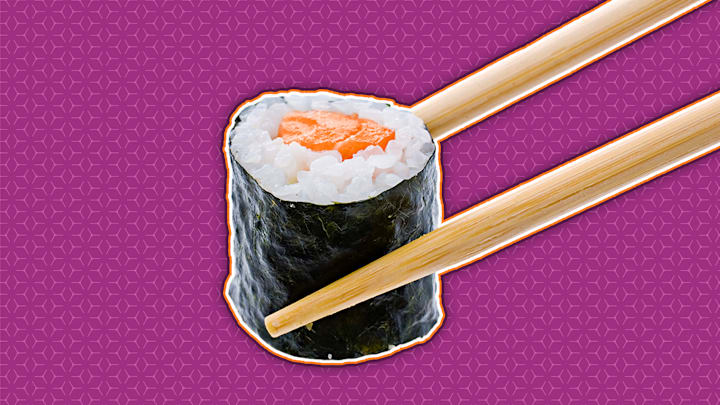
Think Machu Picchu is super ancient, or that people have been noshing on raw salmon sushi for hundreds of years? Think again.
Let’s explore some creations that aren’t nearly as long in the tooth as you may believe, as adapted from the above episode of The List Show on YouTube.
- Paramedics and 911
- CPR
- “Red States” and “Blue States”
- Masking Tape and Transparent Tape
- Post-it Notes
- Paper Clips
- Sunglasses
- Karate
- Raw Salmon Sushi
- Cheeseburgers
- Ciabatta Bread
- Chicken Tikka Masala
- 401(k)s
- At-Home Pregnancy Tests
- Machu Picchu
- Kilts
- Matches Lit with Friction
- High Fives
- The Sports Bra
- The Word Hoodie
- Barcodes
- Supermarkets and Shopping Carts
- Crossword Puzzles and Word Searches
- Commercial Tea Bags
Paramedics and 911

In 1966, the National Academy of Sciences released a paper that led to two amazing inventions: paramedics and 911. The paper reported that an American soldier in the Vietnam War would be more likely to survive a serious wound than someone on a city street because there was such a poor emergency response system at home.
At the time, if someone had an at-home emergency, they could dial the police or local funeral home for a ride to the hospital. But, those drivers weren’t trained for any on-scene treatment. The NAS paper inspired an anesthesiologist in Pittsburgh to create a paramedic course. The first trained paramedics were a group of local Black men, who worked for an organization that delivered food. They learned how to handle some common medical events and started driving for emergencies instead.
Before 911, which was also created as a result of the NAS paper, people had to take the time to dial a full seven-digit phone number for help. In 1968, the first 911 call was placed. The number was chosen in part because it hadn’t been used for an area code yet, and it didn’t take long to dial it on a rotary phone.
CPR

Staying on the topic of emergency services, we didn’t have CPR as we know it until 1960. People were already aware that mouth-to-mouth resuscitation could save lives, but researchers paired that with chest compression in the first-ever modern paper on CPR. They had discovered its effectiveness while studying heart defibrillation on dogs.
“Red States” and “Blue States”

Nowadays, it wouldn’t be an election without TV channels showing big maps that change colors when a candidate wins a state: Red for Republican and blue for Democrat. But those colors weren't always synonymous with those particular parties. NBC debuted the first electoral map in 1976. At the time, they used blue for states that voted for Republican Gerald Ford and red for Democrat Jimmy Carter. Other networks started using maps for their coverage in subsequent elections, but there was little consistency in color until 2000, and as a result, we now have the terms “red state” and “blue state” to symbolize states that go vote largely republican or democrat, respectively.
Masking Tape and Transparent Tape

You wouldn’t have wanted to paint a room before the 1920s. Until that point, there was no masking tape. It was patented by 3M employee Richard Drew, who was inspired when he went to an auto body shop and heard the workers cursing about their solution to painting two-tone cars: sticking paper (either with glue or very strong tapes) to the areas they didn’t want to paint. It was messy and stuck to the cars, and Drew thought there had to be a better solution—and thus the idea masking tape was born. Drew also invented transparent tape in 1930.
You May Also Like ...
- 11 Truly Random Facts That May Save Your Life
- How to Tell the Difference Between 14 Commonly Confused Things
- 200 Random Facts Presented Without Context
Add Mental Floss as a preferred news source!
Post-it Notes

Another 3M product, the Post-it note, was released in 1980. Sadly, it wasn’t invented by Romy or Michele. It was another 3M employee, Spencer Silver, who’d actually become somewhat of a companywide nuisance for constantly talking about his microspheres that were sticky but also removable. He came up with them in 1968, but in 1974 a colleague who sang in a choir approached him. He’d been using bookmarks in his songbooks, but they tended to fall out, so he saw the brilliance in a substance that could stick, but also be removed without wear and tear. Before long, Post-It came along.
Paper Clips

Before paper clips, people had to secure multi-page documents with a straight pin. It was not flexible, left holes in papers, and, honestly, sounds kind of dangerous. But in the late 19th-century, the first paper clip came on the scene because a type of bendy wire had been invented that made them possible. The most popular early model (and the one that we use today) was known as a “Gem clip.”
Sunglasses

Sunglasses had predecessors throughout history. All over the globe, there are examples of ancient individuals looking through tinted glass, or other materials, to reduce glare from the sun. But sunglasses didn’t become a commonly worn accessory until the 1930s.
Karate

Karate also had plenty of ancient predecessors, but it mainly evolved from a martial arts style out of the then-independent Ryukyu Kingdom. Surprisingly though, it didn’t become the karate we know today—with the white uniforms, colored belts, and rankings—until the 1920s in Japan. And it really started spreading even later: after World War II.
Raw Salmon Sushi

But something we associate with Japan that’s even later is salmon sushi, at least with raw fish. According to NPR, in the 1980s the Norwegian salmon industry had a glut of the fish, so they tried to offload it on Japan by trying to convince them to eat it raw. Which, for reasons like parasites, wasn’t an idea Japanese fish executives were overly fond of. Obviously that distaste was overcome, and now salmon sushi is a classic that appeared in the United States in the 1970s.
Cheeseburgers

In America, references to hamburger or hamburg steaks start popping up only in the 1870s or so— but it took a couple decades for anyone to decide to put the meal between bread, with the hamburger steak sandwich being definitely established only in the 1890s.The origins of the cheeseburger are debated, but one man who often gets credited with first putting a slice of American cheese on a hamburger is Lionel Sternberger. A few stories about the cheeseburger’s invention float around, but it’s safe to say that by the mid-1930s, they were on the menus of numerous restaurants around the United States.
Ciabatta Bread

Another food that may be younger than you think is ciabatta bread. It seems like the kind of bread that some ancient Italian peasants ate, but it turns out it was invented in 1982 when Arnaldo Cavallari took advantage of his family’s flour mill to experiment with baking. Why did he take on this mission? He reportedly wanted to compete with the French baguette, which he was totally appalled had started becoming popular in Italy.
Chicken Tikka Masala

There’s a little debate about the origins of chicken tikka masala, but the most widespread explanation you’ll see is that it was invented by a chef who ran a restaurant in Scotland in the 1970s. The story goes that a customer complained the chicken tikka was too dry, so the restaurant owner whipped up a sauce from spices, cream, and tomato soup. Whether that’s true or the dish had already been around for decades, as some claim, this version certainly helped increase its popularity, and some call it the first instance of fusion cuisine.
401(k)s

401(k)s weren't even possible until Congress passed the Revenue Act of 1978. The retirement plans are actually named after Section 401(k) of the Internal Revenue Code, which allowed company employees to tax-defer bonuses or stock options. A benefits consultant named Ted Benna realized that corporations could use this for a new type of retirement plan. By 1983, over 7 million people had a 401(k).
At-Home Pregnancy Tests

Another product of the 1970s is the at-home pregnancy test. Before these went to market, women had to go to a doctor’s office or clinic to get tested. The first at-home test wasn’t totally easy; it involved a test tube, purified water, a sheep’s red blood cells, and a mirror for you to read the results on the bottom of the tube. But still, it allowed women to figure out whether they were pregnant on their own terms. It was even marketed as “a private little revolution.”
Machu Picchu

We tend to think of Machu Picchu as this very ancient archeological site, but it’s actually from 1420, which means it’s younger than the Tower of London, the Leaning Tower of Pisa, and Notre Dame. Gutenberg’s printing press is just a couple decades younger.
Kilts

If you watched Braveheart, which takes place in the 13th century and features characters wearing kilts, you might think that kilts are older than they are. The traditional Scottish belted plaid (sometimes anachronistically called “the great kilt”) was worn starting in the 16th century. It’s a large piece of fabric that gets wrapped like a kilt, but a piece also goes over the upper body. The kilt, as a separate piece of fabric, started to be worn in the 17th century.
Matches Lit with Friction

And while we’re on comparison points, a match that you light with friction is technically younger than the lighter. In 1826, chemist John Walker had a stick that was covered in chemicals and realized he could create fire when he moved it across his hearth. Lighters, on the other hand, date back to 1823.
High Fives

The origins of the high five are debated. Some say it started with volleyball players in the 1960s. Others attribute it to the LA Dodgers baseball team in the late 1970s, or a University of Louisville basketball team around the same time. Magic Johnson even claimed to invent it at one point. But what we do know is that high fiving surprisingly didn’t take off until the early 1980s, despite the low five being around since at least World War II.
The Sports Bra

Another sporty invention is the sports bra, which only came to be in 1977, right around when jogging took off. Three female friends realized they needed a more supportive bra and set out to solve the problem. Their first prototype was two jockstraps sewn together, which inspired its original name: “jock bra.” Eventually, it became “Jogbra.” In 1990, the company was acquired by Playtex Apparel; more corporate acquisitions landed it at the sportswear brand Champion.
The Word Hoodie

And Champion used to be called Knickerbocker Knitting Company, which started making hooded sweatshirts back in the 1930s. You may be thinking, “Well, that’s not younger than I would expect.” But the word “hoodie” is—it had its first known use in the year 1990.
Barcodes

In the 1940s, inventor N. Joseph Woodland came up with the idea for a barcode. He was inspired by Morse code’s dots and dashes to create the lines of an early barcode prototype. But he was a bit ahead of the technology, so the idea didn’t go anywhere fast. All the way in 1974, the first item with a Universal Product Code, or UPC, was scanned at a supermarket checkout. The head of research and development for Marsh Supermarkets handed a Juicy Fruit chewing gum to a cashier who scanned it for “purchase” in a ceremonial event.
Supermarkets and Shopping Carts

Marsh can not claim the title of first supermarket, by the way. Piggly Wiggly can. The first Piggly Wiggly opened in 1916 in Memphis, Tennessee. While not the first store that allowed customers to select products for themselves instead of relying on a store clerk to retrieve them, Piggly Wiggly scientifically systemized and standardized their stores, while also requiring people to walk past every item in the store to get out.The company also pioneered shopping baskets. It wasn’t until 1937 that we got shopping carts, which first appeared at Humpty Dumpty grocery stores. Nowadays, it’s hard to imagine grocery stores being a novelty, but in 1957, Queen Elizabeth and Prince Philip visited America and just had to take a 15-minute trip to check one out.
Crossword Puzzles and Word Searches

We have a word puzzle dating back to at least 62 CE, so it’s surprising that the simple crossword wasn’t invented until 1913. Newspaper editor Arthur Wynne was scrambling for something to fill the Sunday paper in the New York World. He threw together a diamond puzzle for readers to fill in answers. The New York World could have patented it but decided not to because they didn’t want to pay, which would have cost around $100. The puzzles took off, and Wynne eventually became overwhelmed; the job was pawned off onto Margaret Petherbridge. She’s the one who really turned crosswords into what they are today, with the lists of Across and Down clues. The word search is also pretty new, just dating back to the 1960s.
Commercial Tea Bags

And finally, it seems like someone should have figured out the convenience of putting loose tea in a bag and dunking that in hot water a lot earlier than 1901. And they did. Despite what you see in most blogs and YouTube videos that talk about some serendipitous early 20th-century discovery, people in the 19th century definitely were using tea bags, with one 1883 Coffee House journal explaining that the best way to make tea was to “place the tea in a muslin or other bag . . . when the water is boiling vigorously, place the bag in the kettle” and wait. For fifteen to twenty minutes. Which sounds utterly undrinkable. People in Japan were also using tea bags in the 19th century at the latest. But what are younger are commercial tea bags, which started to take off in America in the late 1910s and early 1920s. Their rise was a fair bit slower across the pond: as late as 1970, they accounted for only 10 percent of the British tea market.