%20%20--%3E%0A%3Csvg%20version%3D%221.1%22%20id%3D%22Layer_1%22%20xmlns%3D%22http%3A%2F%2Fwww.w3.org%2F2000%2Fsvg%22%20xmlns%3Axlink%3D%22http%3A%2F%2Fwww.w3.org%2F1999%2Fxlink%22%20x%3D%220px%22%20y%3D%220px%22%0A%09%20viewBox%3D%220%200%20684.6%2068.1%22%20style%3D%22enable-background%3Anew%200%200%20684.6%2068.1%3B%22%20xml%3Aspace%3D%22preserve%22%3E%0A%3Cg%3E%0A%09%3Cpath%20d%3D%22M444.1%2C29.3h-17.4v14.5h17.4V29.3z%20M36.4%2C68.1l29.3-50.8V0H50.4L32.9%2C36.8L15.5%2C0H0v68.1h16.7V45.8l12.4%2C22.3H36.4z%0A%09%09%20M49.1%2C68.1h16.6V23.4L49.1%2C52.1V68.1z%20M76.6%2C68.1h45V53.8H93.3V41.6h21V27.1h-21V14.8h28.3V0.1h-45V68.1z%20M175.6%2C68.1h17.3v-68%0A%09%09h-16.5v40.3L150%2C0.1h-17.6v68h16.7V27.7L175.6%2C68.1z%20M235.8%2C14.8h15.4V0.1h-47.4v14.7H219v53.2h16.8V14.8z%20M290.3%2C45.9h-17.1%0A%09%09l7.5-15.6h2L290.3%2C45.9z%20M298.7%2C68.1h18l-32.2-68h-5.7l-32%2C68h18l3.3-7.1h27.1L298.7%2C68.1z%20M325.2%2C68.1h46.2V53.8h-29.6V0.1h-16.7%0A%09%09V68.1z%20M423.7%2C14.8h27.2V0.1H407v68h16.7V14.8z%20M462%2C68.1h46.2V53.8h-29.6V0.1H462V68.1z%20M564.8%2C34.1c0%2C10.7-7.2%2C19.2-18.5%2C19.2%0A%09%09c-11.4%2C0-18.5-8.5-18.5-19.2s7.1-19.2%2C18.5-19.2C557.6%2C14.9%2C564.8%2C23.4%2C564.8%2C34.1%20M580.6%2C34.1c0-19-14.2-34-34.3-34%0A%09%09c-20.2%2C0-34.3%2C15-34.3%2C34c0%2C19%2C14.1%2C34%2C34.3%2C34C566.4%2C68.1%2C580.6%2C53.1%2C580.6%2C34.1%20M604.8%2C20.5c0-4.1%2C3.3-6.2%2C6.7-6.2%0A%09%09c4.4%2C0%2C6.6%2C3%2C6.6%2C6.6h14.7C631.8%2C9.1%2C625.1%2C0.1%2C611%2C0.1c-12%2C0-21.7%2C9.3-21.7%2C20.6c0%2C10.9%2C5.9%2C15.9%2C16.7%2C19.8%0A%09%09c5.2%2C1.8%2C11.5%2C3.2%2C11.5%2C8c0%2C3.3-2.4%2C5.5-6.4%2C5.5c-3.6%2C0-6.6-3-6.6-6.7h-15.2c0%2C11.5%2C7.9%2C20.8%2C21.8%2C20.8c12%2C0%2C21.6-9.3%2C21.6-20.6%0A%09%09c0-10-5.3-16.4-16.7-19.8C610.6%2C26.1%2C604.8%2C25.3%2C604.8%2C20.5%20M670%2C20.9h14.7C683.8%2C9.1%2C677.1%2C0.1%2C663%2C0.1c-12%2C0-21.7%2C9.3-21.7%2C20.6%0A%09%09c0%2C10.9%2C5.9%2C15.9%2C16.7%2C19.8c5.2%2C1.8%2C11.5%2C3.2%2C11.5%2C8c0%2C3.3-2.4%2C5.5-6.4%2C5.5c-3.6%2C0-6.6-3-6.6-6.7h-15.2c0%2C11.5%2C7.9%2C20.8%2C21.8%2C20.8%0A%09%09c12%2C0%2C21.6-9.3%2C21.6-20.6c0-10-5.3-16.4-16.7-19.8c-5.4-1.6-11.3-2.4-11.3-7.2c0-4.1%2C3.3-6.2%2C6.7-6.2C667.7%2C14.4%2C670%2C17.3%2C670%2C20.9%0A%09%09%22%2F%3E%0A%3C%2Fg%3E%0A%3C%2Fsvg%3E%0A)

From beliefs that the Earth might be flat to the idea that the sun revolved around the Earth and not vice versa, science has reached some strange and very incorrect conclusions over the years. Science is an ever-changing discipline built on constant inquiry and revisions of outdated hypotheses, so it’s not surprising that it’s simply gotten things plain wrong numerous times.
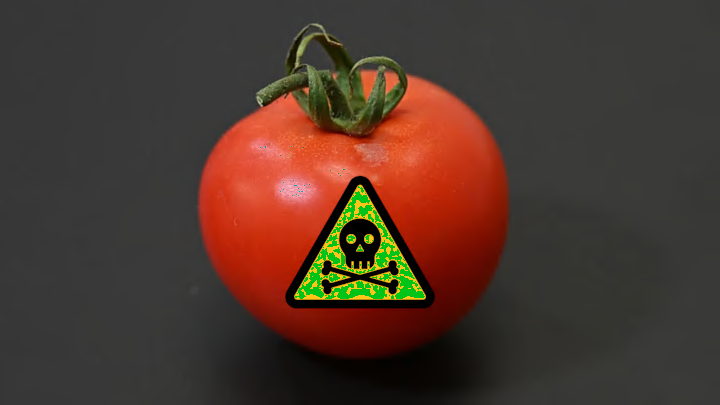
What’s surprising, though, is how obvious it might seem that some of the facts on this list are plain incorrect—at least to our modern eyes. At one point, though, each of these concepts was widely accepted as scientific dogma, and sometimes they had extremely horrific consequences—like the belief that handwashing was unnecessary. Other times, the fallout from these misconceptions was merely mildly unfortunate, like the long-held belief that tomatoes were poisonous, which of course prevented an untold number of people from enjoying this delectable fruit (or vegetable, depending on who you ask).
- Women Have Fewer Ribs Than Men
- Tomatoes Are Poisonous
- Something Comes From Nothing
- Washing Hands Is Unnecessary
- Bloodletting Works
- Anything Can Be Turned Into Gold
- Women’s Wombs Move—And Cause Hysteria
Women Have Fewer Ribs Than Men

Women and men have the same number of ribs: 12 on each side, making a total of 24. But for a long time, many people believed that men had fewer ribs than women. This belief likely originated from the Bible story that describes how Eve was made from one of Adam’s ribs. It is true that some people do have extra ribs—usually one extra rib near the neck, caused by a condition called cervical rib—though this can occur in people of any gender.
Tomatoes Are Poisonous

Tomatoes might be innocuous kitchen staples today, but for a long time, they struck fear into the hearts of many. That’s because, for over two centuries, many Europeans believed these fruits were deadly.
The exact origins of this belief remain obscure, but seeds may have been planted when the fruit—or vegetable—was mentioned in John Gerard’s 1597 book Herbal, which apparently plagiarized largely false research from earlier botanists Rembert Dodoens and Charles de L’Ecluse. In the book, Gerard wrote that the “leaves and stalk of the tomato plant are toxic,” starting a rumor that would last for centuries. By the 1700s, tomatoes were abhorred among Europe's upper classes due to a belief that they were killing some of the aristocrats who ate them, and were sometimes even called “poison apples.”
Some blame this misconception on the tomato’s similarities to berries that grow on the poisonous belladonna plant. Regardless, fears involving tomatoes lingered until the early 1830s. By the end of the century, however, they were popular delights, and by 1897, Joseph Campbell’s signature canned tomato soup had reached shelves.
Something Comes From Nothing
For a long time, people resolutely believed in the concept of spontaneous generation, a theory that suggests that living things can come from nonliving materials. The idea helped explain mystifying occurrences like maggots arising from rotting meat, but soon studies in the 18th century began to indicate that living things could only come from other living things.
Subsequent research revealed that the maggots that appear on meat left out for too long actually come from tiny flies that lay microscopic eggs on the surface of the putrid material in question. In the mid-1800s, Louis Pasteur’s research definitively proved that even microorganisms don’t spontaneously emerge, but rather arise from existing germs rather than non-living matter.
Washing Hands Is Unnecessary

Hopefully, washing your hands is a ritual that you partake in regularly. Ideally, you wash your hands before and after each meal and after using the bathroom, and preferably for at least 20 seconds each time, according to the Cleveland Clinic.
Some religions have always extolled the virtues of washing hands, more as a cleansing practice than a health-related one. Yet at one point, hand-washing for health reasons was rejected even among doctors so aggressively that supporting this practice compromised one physician’s career.
In 1850, when handwashing was not common in the least, a Hungarian doctor named Ignaz Semmelweis attempted to understand why many new mothers were getting sick and dying in his hospital. He found that women whose babies were delivered by female midwives tended to fare far better than those delivered by male physicians. Ultimately, he realized this might be because the physicians often spent mornings working with cadavers while training medical students and, disturbingly, may have carried material from those cadavers on their hands into the delivery room.
He then implemented a mandatory handwashing policy and saw a massive improvement in patient mortality rates. But when he shared his findings onstage at the Vienna Medical Society, he was ostracized by the medical community and later suffered a mental breakdown.
Yet after his death, his research began to become more popular among other doctors and eventually helped inform Louis Pasteur’s discovery of germs. Handwashing became common practice among doctors by the 1870s, but it actually wasn’t formally incorporated into American healthcare guidelines until the 1980s.
Bloodletting Works

There were a lot of sketchy things going on in the medical systems of yore, but one of the most well-known and disconcerting practices—which fortunately is largely obsolete today, except in some specific cases and cultures—is bloodletting.
Believed to have originated in ancient Egypt, this practice was built on the theory that the human body could accumulate negative substances called "humours" that could cause illness, and so releasing the blood could also release these humors. This treatment was used for everything from gout to epilepsy, and led to a lot of weak, faint, and still very sick patients. Bloodletting was in use for at least 3000 years, but finally began to decline in popularity in the 19th century.
Anything Can Be Turned Into Gold

For a long time, many ancient alchemists shared the same single-minded goal: to discover the art of turning non-gold metals into gold. Many believed that this could be achieved using a substance called “the philosopher’s stone,” said to be a tincture or material that could turn base metals into pure gold.
People from ancient cultures across China, India, and Egypt all attempted to find the philosopher’s stone. This legend was also an object of fascination for European alchemists of the Middle Ages like Sir Isaac Newton and Nicholas Flamel—the latter of whom claimed, without proof, to have discovered it. Unfortunately, scientists eventually concluded that it is highly unlikely any base metal could be transformed into gold—unless, perhaps, you have access to nuclear fusion.
Still, the intricate experiments and research conducted by early alchemists helped lay the groundwork for what would become modern chemistry. Of course, there are definitely some alchemists still out there seeking out the stone…or jealously guarding Flamel’s revelations, depending on what you believe.
Women’s Wombs Move—And Cause Hysteria

Women’s health has historically been a highly understudied topic, and that issue continues today. Naturally, a brief glance at the history of medicine reveals that doctors and scientists once believed some seriously strange things about women.
One particularly strange and since-disproven belief is the wandering womb theory, a hypothesis that dates back to ancient Greece and claimed that many sicknesses in women were the result of their wombs moving around their bodies, seeking moisture. This was thought to harm women’s organs, and was believed to cause “hysteria”—a catch-all term for any kind of emotional strain a woman was undergoing, which was a medical diagnosis for thousands of years until it fell out of favor in the late 20th century.