%20%20--%3E%0A%3Csvg%20version%3D%221.1%22%20id%3D%22Layer_1%22%20xmlns%3D%22http%3A%2F%2Fwww.w3.org%2F2000%2Fsvg%22%20xmlns%3Axlink%3D%22http%3A%2F%2Fwww.w3.org%2F1999%2Fxlink%22%20x%3D%220px%22%20y%3D%220px%22%0A%09%20viewBox%3D%220%200%20684.6%2068.1%22%20style%3D%22enable-background%3Anew%200%200%20684.6%2068.1%3B%22%20xml%3Aspace%3D%22preserve%22%3E%0A%3Cg%3E%0A%09%3Cpath%20d%3D%22M444.1%2C29.3h-17.4v14.5h17.4V29.3z%20M36.4%2C68.1l29.3-50.8V0H50.4L32.9%2C36.8L15.5%2C0H0v68.1h16.7V45.8l12.4%2C22.3H36.4z%0A%09%09%20M49.1%2C68.1h16.6V23.4L49.1%2C52.1V68.1z%20M76.6%2C68.1h45V53.8H93.3V41.6h21V27.1h-21V14.8h28.3V0.1h-45V68.1z%20M175.6%2C68.1h17.3v-68%0A%09%09h-16.5v40.3L150%2C0.1h-17.6v68h16.7V27.7L175.6%2C68.1z%20M235.8%2C14.8h15.4V0.1h-47.4v14.7H219v53.2h16.8V14.8z%20M290.3%2C45.9h-17.1%0A%09%09l7.5-15.6h2L290.3%2C45.9z%20M298.7%2C68.1h18l-32.2-68h-5.7l-32%2C68h18l3.3-7.1h27.1L298.7%2C68.1z%20M325.2%2C68.1h46.2V53.8h-29.6V0.1h-16.7%0A%09%09V68.1z%20M423.7%2C14.8h27.2V0.1H407v68h16.7V14.8z%20M462%2C68.1h46.2V53.8h-29.6V0.1H462V68.1z%20M564.8%2C34.1c0%2C10.7-7.2%2C19.2-18.5%2C19.2%0A%09%09c-11.4%2C0-18.5-8.5-18.5-19.2s7.1-19.2%2C18.5-19.2C557.6%2C14.9%2C564.8%2C23.4%2C564.8%2C34.1%20M580.6%2C34.1c0-19-14.2-34-34.3-34%0A%09%09c-20.2%2C0-34.3%2C15-34.3%2C34c0%2C19%2C14.1%2C34%2C34.3%2C34C566.4%2C68.1%2C580.6%2C53.1%2C580.6%2C34.1%20M604.8%2C20.5c0-4.1%2C3.3-6.2%2C6.7-6.2%0A%09%09c4.4%2C0%2C6.6%2C3%2C6.6%2C6.6h14.7C631.8%2C9.1%2C625.1%2C0.1%2C611%2C0.1c-12%2C0-21.7%2C9.3-21.7%2C20.6c0%2C10.9%2C5.9%2C15.9%2C16.7%2C19.8%0A%09%09c5.2%2C1.8%2C11.5%2C3.2%2C11.5%2C8c0%2C3.3-2.4%2C5.5-6.4%2C5.5c-3.6%2C0-6.6-3-6.6-6.7h-15.2c0%2C11.5%2C7.9%2C20.8%2C21.8%2C20.8c12%2C0%2C21.6-9.3%2C21.6-20.6%0A%09%09c0-10-5.3-16.4-16.7-19.8C610.6%2C26.1%2C604.8%2C25.3%2C604.8%2C20.5%20M670%2C20.9h14.7C683.8%2C9.1%2C677.1%2C0.1%2C663%2C0.1c-12%2C0-21.7%2C9.3-21.7%2C20.6%0A%09%09c0%2C10.9%2C5.9%2C15.9%2C16.7%2C19.8c5.2%2C1.8%2C11.5%2C3.2%2C11.5%2C8c0%2C3.3-2.4%2C5.5-6.4%2C5.5c-3.6%2C0-6.6-3-6.6-6.7h-15.2c0%2C11.5%2C7.9%2C20.8%2C21.8%2C20.8%0A%09%09c12%2C0%2C21.6-9.3%2C21.6-20.6c0-10-5.3-16.4-16.7-19.8c-5.4-1.6-11.3-2.4-11.3-7.2c0-4.1%2C3.3-6.2%2C6.7-6.2C667.7%2C14.4%2C670%2C17.3%2C670%2C20.9%0A%09%09%22%2F%3E%0A%3C%2Fg%3E%0A%3C%2Fsvg%3E%0A)

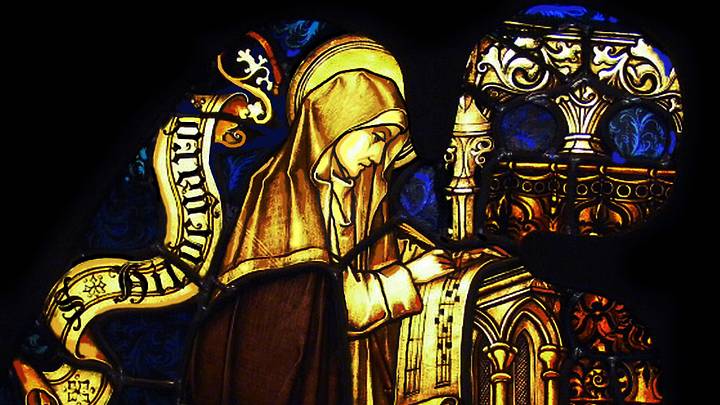
Hildegard von Bingen was a German Benedictine abbess, writer, mystic, healer, scientist, and saint. Born in 1098 in the Germanic territories, her birthday is sometimes identified as September 16, and her feast day is traditionally celebrated on September 17.
Hildegard composed over 77 songs and penned what is widely considered to be the first surviving morality play. She wrote books on botany, medicine, natural history, and science, and recorded detailed prophecies and vibrant imagery from her visions. She also wrote wisdom-filled letters in response to the many clergy and laypeople who wrote to her for assistance, making her into a kind of medieval advice columnist.
Additionally, she founded two monasteries, traveled and preached extensively, and was an outspoken critic of corruption in the church. In her work, she often lavished praise on the beauty and sacredness of nature. Much of her work was inspired by the extensive mystical visions she had been experiencing since she was young. Long venerated as a saint, she was finally formally proclaimed a Doctor of the Church by Pope Benedict XVI in 2012.
Hildegard possessed limitless curiosity and creativity that knew no bounds in terms of genre or subject. One of the abbess’s many innovative creations includes an entirely original language, which she dubbed the Lingua Ignota.
Hildegard von Bingen’s secret language

The Lingua Ignota consists of 1,011 unique words invented by von Bingen. They can be found in several anthologies of her work, including the Risen Codex, a collection of Hildegard’s theological writings that were compiled near the end of her life. The list begins with words for God and angels, and then moves on to describe many different types of living things.
In her secret language, her word for God was Aigonz, and the devil was called Diuueliz. Many of the words appear to borrow elements from Latin and German. She only used her so-called “Unknown Language” in one known work: the song “O Orzchis Ecclesia.” The song blends Latin words with those of Hildegard’s own creation; Orzchis was Hildegard’s word for “immense.”
“O, o, tu es etiam crizanta in alto sono et es chorzta gemma,” the song's final line reads. This translates to “O, o, you are anointed too in soaring song, you are a sparkling gem.” Crizanta was Hildegard’s word for anointed, and Chortza was meant sparkling.
Hildegard’s linguistic innovations did not stop there. She also created her own alphabet, consisting of 23 symbols and called the Litterae Ignotae. These so-called “Unknown Letters” resemble Hebrew, Greek, and Aramaic characters in part, but are entirely original. She is known to have used these letters only a few times in various correspondences.
Why did Hildegard create her own language and letters?

No one knows entirely why Hildegard created her secret language and letters. What we do know is that they came to her in mystical visions, like many of her works.
Some have proposed that Hildegard may have wished to create a new language in order to communicate privately with her nuns. Others have said that her intention was to keep her criticisms of the medieval church secret.
However, she certainly did not hold back from criticizing Pope Anastasius IV in a language he could understand. In 1153 or 1154, she penned him a letter that condemned his passive acceptance of the corruption around him.
In that very same letter, Hildegard briefly mentioned witnessing a miracle that led her to create her “Unknown Letters” and “Unknown Language.” In the preface to her work Liber vitae meritorum, she also mentioned that the language and letters appeared to her in a vision.
Still, she never explained her intentions for the language and letters. Some have suggested that she perhaps intended to craft a universal language, or a tongue that could escape the limitations of ordinary speech and more aptly describe the innate holiness that Hildegard saw within everything.
Others have claimed that Hildegard created her language to be able to converse directly with the angels, or that it was even the tongue spoken by Adam himself in the Garden of Eden. Regardless, the Lingua Ignota remains the earliest documented invented language in history.