%20%20--%3E%0A%3Csvg%20version%3D%221.1%22%20id%3D%22Layer_1%22%20xmlns%3D%22http%3A%2F%2Fwww.w3.org%2F2000%2Fsvg%22%20xmlns%3Axlink%3D%22http%3A%2F%2Fwww.w3.org%2F1999%2Fxlink%22%20x%3D%220px%22%20y%3D%220px%22%0A%09%20viewBox%3D%220%200%20684.6%2068.1%22%20style%3D%22enable-background%3Anew%200%200%20684.6%2068.1%3B%22%20xml%3Aspace%3D%22preserve%22%3E%0A%3Cg%3E%0A%09%3Cpath%20d%3D%22M444.1%2C29.3h-17.4v14.5h17.4V29.3z%20M36.4%2C68.1l29.3-50.8V0H50.4L32.9%2C36.8L15.5%2C0H0v68.1h16.7V45.8l12.4%2C22.3H36.4z%0A%09%09%20M49.1%2C68.1h16.6V23.4L49.1%2C52.1V68.1z%20M76.6%2C68.1h45V53.8H93.3V41.6h21V27.1h-21V14.8h28.3V0.1h-45V68.1z%20M175.6%2C68.1h17.3v-68%0A%09%09h-16.5v40.3L150%2C0.1h-17.6v68h16.7V27.7L175.6%2C68.1z%20M235.8%2C14.8h15.4V0.1h-47.4v14.7H219v53.2h16.8V14.8z%20M290.3%2C45.9h-17.1%0A%09%09l7.5-15.6h2L290.3%2C45.9z%20M298.7%2C68.1h18l-32.2-68h-5.7l-32%2C68h18l3.3-7.1h27.1L298.7%2C68.1z%20M325.2%2C68.1h46.2V53.8h-29.6V0.1h-16.7%0A%09%09V68.1z%20M423.7%2C14.8h27.2V0.1H407v68h16.7V14.8z%20M462%2C68.1h46.2V53.8h-29.6V0.1H462V68.1z%20M564.8%2C34.1c0%2C10.7-7.2%2C19.2-18.5%2C19.2%0A%09%09c-11.4%2C0-18.5-8.5-18.5-19.2s7.1-19.2%2C18.5-19.2C557.6%2C14.9%2C564.8%2C23.4%2C564.8%2C34.1%20M580.6%2C34.1c0-19-14.2-34-34.3-34%0A%09%09c-20.2%2C0-34.3%2C15-34.3%2C34c0%2C19%2C14.1%2C34%2C34.3%2C34C566.4%2C68.1%2C580.6%2C53.1%2C580.6%2C34.1%20M604.8%2C20.5c0-4.1%2C3.3-6.2%2C6.7-6.2%0A%09%09c4.4%2C0%2C6.6%2C3%2C6.6%2C6.6h14.7C631.8%2C9.1%2C625.1%2C0.1%2C611%2C0.1c-12%2C0-21.7%2C9.3-21.7%2C20.6c0%2C10.9%2C5.9%2C15.9%2C16.7%2C19.8%0A%09%09c5.2%2C1.8%2C11.5%2C3.2%2C11.5%2C8c0%2C3.3-2.4%2C5.5-6.4%2C5.5c-3.6%2C0-6.6-3-6.6-6.7h-15.2c0%2C11.5%2C7.9%2C20.8%2C21.8%2C20.8c12%2C0%2C21.6-9.3%2C21.6-20.6%0A%09%09c0-10-5.3-16.4-16.7-19.8C610.6%2C26.1%2C604.8%2C25.3%2C604.8%2C20.5%20M670%2C20.9h14.7C683.8%2C9.1%2C677.1%2C0.1%2C663%2C0.1c-12%2C0-21.7%2C9.3-21.7%2C20.6%0A%09%09c0%2C10.9%2C5.9%2C15.9%2C16.7%2C19.8c5.2%2C1.8%2C11.5%2C3.2%2C11.5%2C8c0%2C3.3-2.4%2C5.5-6.4%2C5.5c-3.6%2C0-6.6-3-6.6-6.7h-15.2c0%2C11.5%2C7.9%2C20.8%2C21.8%2C20.8%0A%09%09c12%2C0%2C21.6-9.3%2C21.6-20.6c0-10-5.3-16.4-16.7-19.8c-5.4-1.6-11.3-2.4-11.3-7.2c0-4.1%2C3.3-6.2%2C6.7-6.2C667.7%2C14.4%2C670%2C17.3%2C670%2C20.9%0A%09%09%22%2F%3E%0A%3C%2Fg%3E%0A%3C%2Fsvg%3E%0A)

From a string of high-profile real-life art heists to the fiercely guarded identity of anonymous street artists like Banksy, it’s easy to think modern art holds a monopoly on mystery. But you don’t need to look at contemporary capers to find a good riddle. In fact, some of the most jaw-dropping secrets in art history have been sitting in plain sight for centuries, painted right into the foreground of the world’s most celebrated masterpieces.
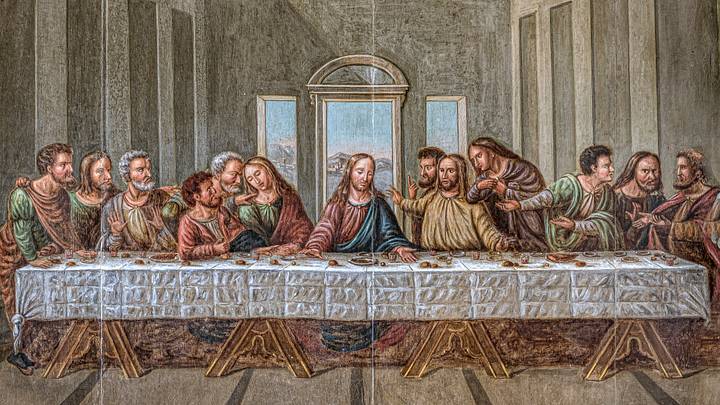
Take Leonardo da Vinci’s The Last Supper. Painted between 1495 and 1498 on the wall of a convent’s dining hall in Milan, the mural is universally recognized, heavily parodied, and permanently etched into global pop culture. Yet, despite being stared at by millions of eyes for over half a millennium, the painting still doubles as a sprawling, 15th-century puzzle. No halos, a hidden blade, and a secret soundtrack hiding in the bread basket—Leonardo didn't just paint a historic dinner party; he packed it with mathematical multiples, religious Easter eggs, and secret acts of artistic exploration.
Grab a seat at the table as we unpack six fascinating symbols hidden in Leonardo's masterpiece that you’ve probably walked right past.
- The Mary Magdalene Illusion
- The Missing Halos
- The Spilled Salt
- The Sacred Geometry
- Peter’s Hidden Knife
- The Secret Melody
The Mary Magdalene Illusion

Thanks to Dan Brown’s 2003 megahit The Da Vinci Code, you can’t talk about The Last Supper without addressing the massive elephant—or rather, the alleged woman—at the table.
Conspiracy theorists love to point out the figure seated immediately to Jesus's right (our left). Traditionally identified as Saint John, the "beloved disciple," the figure sports remarkably soft features, long flowing hair, and a distinct lack of the rugged, bearded look favored by the rest of the crew. According to the pop-culture rumor mill, this isn't John at all: it's Mary Magdalene, and Leonardo secretly hid her right next to Christ to hint at their secret marriage.
To back this up, theorists point to a glaring geometric optical illusion. If you look at the negative space separating Christ and this figure, their leaning postures form a perfect, distinct letter "V". In ancient semiotics, the "V" is the chalice symbol—a representation of a woman's womb. Zoom out a bit further to look at their complete body alignments as compositional elements, and their clothes seamlessly track together to form a giant letter "M", standing for "Mary Magdalene" or "Matrimony".
While actual art historians will tell you that young male figures in Renaissance art were routinely painted with soft, effeminate features to symbolize purity, the visual geometry is undeniable. Whether it was a deliberate riddle left behind by Leonardo or a classic case of humans finding patterns where none exist, the "V" and the "M" remain the ultimate plain-sight illusion fueling art history’s favorite forbidden romance theory.
The Missing Halos
If you were a Renaissance artist tasked with painting the most important dinner party in Christian theology, your first instinct would probably be to grab a bucket of gold paint and start giving everyone glowing rings above their heads. For centuries, halos were the go-to visual cue for divinity and holiness in religious art.
But when Leonardo sat down to paint The Last Supper, he left the gold leaf in the cupboard.
Look closely at the space above the heads of Jesus and the twelve apostles. There isn't a single shiny disc or divine aura in sight. While earlier Renaissance masters wouldn't dream of leaving Christ halo-less, Leonardo deliberately chose to skip the tradition.
Many art historians believe this wasn't an oversight, but a calculated message. Leonardo was deeply invested in nature and anatomy, and to him, the raw human drama of the moment was far more compelling than a supernatural light show. By ditching the traditional halos, he stripped away the safety net of divine detachment, forcing the viewer to look at the characters not as untouchable icons but as ordinary, mortal men experiencing a wave of profound shock, panic, and human vulnerability.
Of course, Leonardo couldn't leave his central figure entirely out in the dark. Instead of a magical golden ring, he used a brilliant architectural trick: he placed a single, large window directly behind Christ. The sunlight pouring through the frame illuminates Christ from behind, creating a natural "halo" of the sort. In the end, he didn’t erase divinity—he just illuminated it differently.
The Spilled Salt

If you’ve ever thrown a pinch of salt over your left shoulder after accidentally knocking over the shaker, you can thank centuries of European superstition. But if you want to see the most famous dining mishap in art history, you need to zoom in directly on Judas Iscariot’s right elbow in The Last Supper.
At the exact moment Jesus drops the bombshell that a betrayer is sitting at the table, the disciples react with a wave of defensive shock. Judas, frantically trying to play it cool while tightly clutching a leather pouch containing his thirty pieces of silver, has a bit of a physical slip-up. In his sudden panic, his elbow jolts backward, cleanly knocking over a small salt cellar on the table.
To a modern viewer, it looks like a simple accident. But to a 15th-century audience, this was a subtle narrative red flag.
In the Renaissance, spilling salt wasn’t just a messy nuisance; it was the ultimate bad omen, universally recognized as a symbol of bad luck, broken trust, and impending doom. By placing this tiny, spilled container right in front of Judas, Leonardo painted a psychological spoiler alert directly onto the table, highlighting the fact that the ultimate betrayal was already underway. It proved that Judas's fate was sealed before the main course was even cleared.
The Sacred Geometry
Leonardo wasn't just a painter; he was a mathematician, an engineer, and a master of perspective. So, when it came time to stage The Last Supper, he didn’t just guess where everyone should sit. He turned the entire room into a meticulously calculated math problem built entirely around two loaded digits: three and four.
Symbolically, the number three represents divinity and the heavenly realm. It’s the minimum number of lines needed to create a closed geometric shape, making it the mathematical definition of wholeness. To further stress this, Leonardo painted Jesus’s physical posture to form a perfect, solitary triangle right in the dead center of the frame—a structural choice that would later anchor centuries of Christian art compositions. Look past Christ, and you'll see the theme continues: the central back wall features exactly three open windows, and the ceiling features six rows of coffers (three and three) hovering overhead.
On the flip side, the number four represents the earthly realm and finite existence. Just think of the four cardinal directions or the four sides of a square. To root this divine dinner to Earth, Leonardo strictly organized the twelve apostles (three times four) into four distinct groups of three. He then lined the side walls with four sets of tapestries on each side, framed by four structural supports around the windows.
By weaving these numbers directly into the architecture, Leonardo was showing that heaven and earth weren’t just intersecting—they were sharing a dinner table. It’s the ultimate visual proof that to Leonardo, math and art were completely inseparable.
Peter’s Hidden Knife

A knife may not necessarily seem out of place in a dinner party scene. But take a closer look at this particular piece of cutlery—especially in the cluster of disciples to the left of Jesus—and the psychological tension suddenly takes a sharp turn into something closer to a gritty action sequence. Amidst all the defensive hand-waving and frantic whispering, there’s a hand fiercely clutching a long, unsheathed blade pointed directly away from the table.
For centuries, due to the painting's deterioration, viewers thought this was a disembodied "phantom hand." But after careful modern restoration work, art historians traced the arm back to its hot-headed owner: Simon Peter.
Peter has his arm pulled all the way back, twisting his wrist at a wildly unnatural angle to conceal the weapon behind his back. While he leans forward to whisper to Saint John, his hand tells a completely different story.
According to New Testament accounts, just a few hours after this dinner concludes, a contingent of soldiers arrives in the Garden of Gethsemane to arrest Christ. Peter—never known for his restraint—instantly loses his temper, draws his blade, and slices off the right ear of a high priest's servant named Malchus. By depicting Peter already armed and dangerously tense at the dinner table, Leonardo suggests he isn’t merely reacting to the idea of betrayal—he’s already primed for violence.
The Secret Melody
To wrap up the ultimate Renaissance scavenger hunt, we have to look at a mind-blowing discovery that went completely unnoticed for over 500 years. It turns out Leonardo didn't just paint a history-defining mural—he hid an actual, playable soundtrack right on the dinner table. In 2007, Italian musician Giovanni Maria Pala was studying The Last Supper when he noticed something odd about the arrangement of the food items and the disciples' hands. He realized that if you draw a standard musical staff straight across the painting, the loaves of bread and the hands of Jesus and the apostles align perfectly with where musical notes would sit.
At first, Pala tried playing the notes from left to right, but it sounded like complete chaos. That’s when he remembered who he was dealing with. Leonardo was famously left-handed and wrote all of his personal notebooks in a backward mirror-script. When Pala reversed the notes and read the table from right to left, the painting finally spoke. The hidden code revealed a somber, 40-second musical composition played on a pipe organ. This hidden funeral requiem perfectly captures the raw grief of the scene, offering ultimate proof that Leonardo's genius extended far beyond the paintbrush.