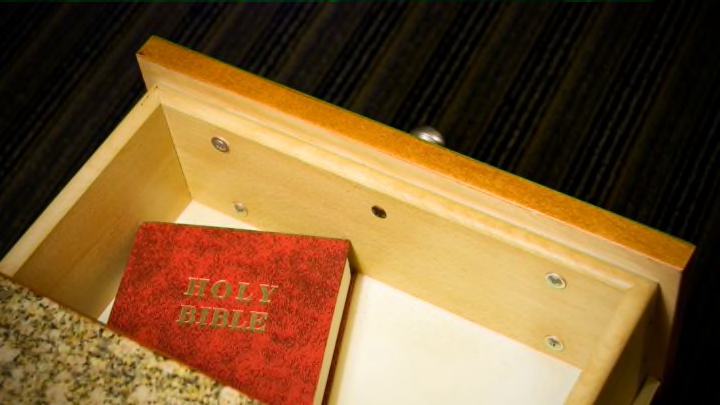
Why Are There Gideon Bibles in Hotel Rooms?

istock.com/mrod
istock.com/mrod

Because the Gideons put them there!

The Gideon Bible is not some special version or translation of the Bible that hotels really like (the books are usually plain old King James Versions); they're named for the group that distributes them.

Gideons International got its start in 1898, when two traveling businessmen, John H. Nicholson and Samuel E. Hill, arrived at the crowded Central Hotel in Boscobel, Wisconsin, for the night.

The two had never met, but there was only one double room left, so they decided to share it. The men got to talking and found they shared a common faith and had both toyed with the idea of creating an evangelical association for Christian businessmen.

They decided to give it a shot together. They called a meeting the following year for men who were interested in joining together for “mutual recognition, personal evangelism, and united service for the Lord.” Only one other person showed up to that meeting—William J. Knights, who suggested they name their organization after Gideon, an Old Testament judge who led a small band of men to defeat a much larger army.

As the group expanded in its first few years, most of the new members were men who frequently traveled for work and spent many of their nights in hotel rooms. They wondered how they might be more effective witnesses for Christ on the road, and hit upon the idea of providing Bibles to hotels. They could be used not only by the Gideons’ members as they traveled around the country, but also borrowed by other guests in need of them. They started with the Superior Hotel in Superior, Montana, then set out to put a Bible in every hotel room in America. Since 1908, they’ve distributed more than 1.7 billion Bibles, expanding beyond the U.S. to more than 190 other countries.

Passing Them Out

The Gideons don’t go room to room themselves, slipping the books in nightstands like Bible elves. When a hotel opens, local Gideons members will present a Bible to the hotel's general manager in a small ceremony and then give enough books for each room and some extras to the housekeeping staff for distribution. In addition to hotel rooms, the Gideons also give Bibles to military bases, hospitals, nursing homes, prisons and to students on college campuses.

Each Bible handed out is free of charge, and the project is funded entirely by donations to the group. The Gideons will also replace any books that go missing or get worn out, and the group says that the books have a six-year life expectancy, on average. They don’t get bent out of shape when people ignore the “thou shalt not steal” rule when it comes to the Bibles, either. They’d rather you just take the book if you need it that badly.

Based on the success of the Gideons’ Bible project -- the group’s own statistics claim 25% of the people who check into a hotel room will read the Bible placed there -- other religious groups have begun distributing their own free literature to hotels. The Marriott hotel chain, founded by a Mormon, places the The Book of Mormon in many of its rooms, and many hotels also offer Buddhist, Hindu, Christian Scientist or Scientologist books along with the standard Gideon Bible.

10 Rad Gifts for Hikers

Greg Rosenke/Unsplash

The popularity of bird-watching, camping, and hiking has skyrocketed this year. Whether your gift recipients are weekend warriors or seasoned dirtbags, they'll appreciate these tools and gear for getting most out of their hiking experience.

1. Stanley Nesting Two-Cup Cookset; $14

Amazon

Stanley’s compact and lightweight cookset includes a 20-ounce stainless steel pot with a locking handle, a vented lid, and two insulated 10-ounce tumblers. It’s the perfect size for brewing hot coffee, rehydrating soup, or boiling water while out on the trail with a buddy. And as some hardcore backpackers note in their Amazon reviews, your favorite hiker can take the tumblers out and stuff the pot with a camp stove, matches, and other necessities to make good use of space in their pack.

Buy it: Amazon

2. Osprey Sirrus and Stratos 24-Liter Hiking Packs; $140

Amazon

Osprey’s packs are designed with trail-tested details to maximize comfort and ease of use. The Sirrus pack (pictured) is sized for women, while the Stratos fits men’s proportions. Both include an internal sleeve for a hydration reservoir, exterior mesh and hipbelt pockets, an attachment for carrying trekking poles, and a built-in rain cover.

Buy them: Amazon, Amazon

3. Yeti Rambler 18-Ounce Bottle; $48

Amazon

Nothing beats ice-cold water after a summer hike or a sip of hot tea during a winter walk. The Yeti Rambler can serve up both: Beverages can stay hot or cold for hours thanks to its insulated construction, and its steel body (in a variety of colors) is basically indestructible. It will add weight to your hiker's pack, though—for a lighter-weight, non-insulated option, the tried-and-true Camelbak Chute water bottle is incredibly sturdy and leakproof.

Buy it: Amazon

4. Mappinners Greatest 100 Hikes of the National Parks Scratch-Off Poster; $30

Amazon

The perfect gift for park baggers in your life (or yourself), this 16-inch-by-20-inch poster features epic hikes like Angel’s Landing in Zion National Park and Half Dome in Yosemite National Park. Once the hike is complete, you can scratch off the gold foil to reveal an illustration of the park.

Buy it: Amazon

5. National Geographic Adventure Edition Road Atlas; $19

Amazon

Hikers can use this brand-new, updated road atlas to plan their next adventure. In addition to comprehensive maps of all 50 states, Puerto Rico, Canada, and Mexico, they'll get National Geographic’s top 100 outdoor destinations, useful details about the most popular national parks, and points on the maps noting off-the-beaten-path places to explore.  

Buy it: Amazon

6. Adventure Medical Kits Hiker First-Aid Kit; $25

Amazon

This handy 67-piece kit is stuffed with all the things you hope your hiker will never need in the wilderness. Not only does it contain supplies for pain, cuts and scrapes, burns, and blisters (every hiker’s nemesis!), the items are organized clearly in the bag to make it easy to find tweezers or an alcohol wipe in an emergency.

Buy it: Amazon

7. Hiker Hunger Ultralight Trekking Poles; $70

Amazon

Trekking poles will help increase your hiker's balance and stability and reduce strain on their lower body by distributing it to their arms and shoulders. This pair is made of carbon fiber, a super-strong and lightweight material. From the sweat-absorbing cork handles to the selection of pole tips for different terrain, these poles answer every need on the trail. 

Buy it: Amazon

8. Leatherman Signal Camping Multitool; $120

Amazon

What can’t this multitool do? This gadget contains 19 hiking-friendly tools in a 4.5-inch package, including pliers, screwdrivers, bottle opener, saw, knife, hammer, wire cutter, and even an emergency whistle.

Buy it: Amazon

9. RAVPower Power Bank; $24

Amazon

Don’t let your hiker get caught off the grid with a dead phone. They can charge RAVPower’s compact power bank before they head out on the trail, and then use it to quickly juice up a phone or tablet when the batteries get low. Its 3-inch-by-5-inch profile won’t take up much room in a pack or purse.

Buy it: Amazon

10. Pack of Four Indestructible Field Books; $14

Amazon

Neither rain, nor snow, nor hail will be a match for these waterproof, tearproof 3.5-inch-by-5.5-inch notebooks. Your hiker can stick one in their pocket along with a regular pen or pencil to record details of their hike or brainstorm their next viral Tweet.

Buy it: Amazon

Sign Up Today: Get exclusive deals, product news, reviews, and more with the Mental Floss Smart Shopping newsletter!

This article contains affiliate links to products selected by our editors. Mental Floss may receive a commission for purchases made through these links.

Can the Electoral College Reverse the Results of an Election?

Tumisu, Pixabay // Public Domain

Every four years, people talk about the oddness of the Electoral College. And just like 2000's popular vote/Electoral College mismatch, after the 2016 election, some citizens attempted to flip electors from Donald Trump to either Hillary Clinton or a third candidate (if enough electors go to the third candidate, the House would then have to choose from among the top three).

Which leads to the question: Can the Electoral College actually change the results of the election? It’s an awkwardly worded question for a very specific reason, and the answer is no. But for the question people think that they’re asking—could the Electoral College reverse the results of the election?—the answer is yes, although it’s profoundly unlikely.

The reason it’s an oddly worded question is that the November election is not a vote for president. The vote is for a set of electors who will then go and vote for the president in December. Therefore, the electors cannot change the results of the election since they’re the ones being elected. In one of the Federalist Papers, Alexander Hamilton explained the reasoning for forgoing direct democracy, as well as why they avoided letting politicians make the decision. Largely, the problem was that neither the public nor the politicians could be trusted. Hamilton wrote:

“The Executive should be independent for his continuance in office on all but the people themselves. He might otherwise be tempted to sacrifice his duty to his complaisance for those whose favor was necessary to the duration of his official consequence. This advantage will also be secured, by making his re-election to depend on a special body of representatives, deputed by the society for the single purpose of making the important choice.”

There were other issues the Founding Fathers were trying to avoid as well, such as the risk of a smorgasbord of regional candidates. As historian Jack Rakove told Stanford News in 2012, “it would become truly difficult to produce a popular majority with a field of favorite sons.”

More controversially, the Founding Fathers faced the issue of slavery. Because enslaved people couldn’t vote, a direct popular vote would weaken the power of the South. Thanks to the three-fifths compromise, however, the slave states had greater power under an electoral system than under a direct voting system, because enslaved people couldn’t vote but did count for the number of representatives. And more representatives meant more electors (the number of electors equals the state’s number of representatives plus the number of senators). As James Madison said in 1787:

“There was one difficulty however of a serious nature attending an immediate choice by the people. The right of suffrage was much more diffusive in the Northern than the Southern States; and the latter could have no influence in the election on the score of the Negroes. The substitution of electors obviated this difficulty and seemed on the whole to be liable to fewest objections.”

But objections to the elector’s powers appeared as soon as races got competitive. In 1796, Pennsylvanian Samuel Miles became the first known faithless elector when, despite being chosen as a Federalist, he voted for opposition candidate Thomas Jefferson. In a letter to the Gazette of the United States, a disgruntled Pennsylvania voter asked, “What, do I choose Samuel Miles to determine for me whether John Adams or Thomas Jefferson shall be President? No! I choose him to act, not to think.”

SO WOULD IT WORK?

As we have written about before, in about half the states plus Washington, D.C., electors are required to vote for their state’s popular vote winner—some states to the point that any attempt to defy this would forfeit the elector’s position. They’re extreme, but in the controversial 1952 Ray v. Blair case, the Supreme Court ruled that requiring pledges from electors to vote for a particular candidate was constitutional. But the question that remains unanswered is whether any punishment for breaking those pledges is constitutional. It’s never mattered, but would quickly become a critical issue if electors defected en masse.

Regarding the 2016 election, others say that because Hillary Clinton had already conceded, this strategy wouldn’t have worked. But there’s no requirement that an elector vote for a viable candidate. In 1976, one of the electors voted for Ronald Reagan, who hadn’t even won his party’s primary. In 1956, another elector voted for a local circuit court judge rather than Adlai Stevenson.

A stronger issue standing in the way is how electors are chosen. Generally, in spring and summer, each state’s political parties nominate a slate of electors from a list of party faithful. Any attempt to get defections would require electors to go against a party that chose them specifically for their loyalty.

The Ray v. Blair decision gave one of the most famous dissents in Supreme Court history, where Justice Jackson wrote, “No one faithful to our history can deny that the plan originally contemplated, what is implicit in its text, that electors would be free agents, to exercise an independent and nonpartisan judgment as to the men best qualified for the Nation's highest offices.” While it would be considered highly irregular and is highly unlikely, the possibility is there. And will remain there until January 6, 2021, when the votes are officially counted before a joint session of Congress.

Have you got a Big Question you'd like us to answer? If so, let us know by emailing us at bigquestions@mentalfloss.com.