%20%20--%3E%0A%3Csvg%20version%3D%221.1%22%20id%3D%22Layer_1%22%20xmlns%3D%22http%3A%2F%2Fwww.w3.org%2F2000%2Fsvg%22%20xmlns%3Axlink%3D%22http%3A%2F%2Fwww.w3.org%2F1999%2Fxlink%22%20x%3D%220px%22%20y%3D%220px%22%0A%09%20viewBox%3D%220%200%20684.6%2068.1%22%20style%3D%22enable-background%3Anew%200%200%20684.6%2068.1%3B%22%20xml%3Aspace%3D%22preserve%22%3E%0A%3Cg%3E%0A%09%3Cpath%20d%3D%22M444.1%2C29.3h-17.4v14.5h17.4V29.3z%20M36.4%2C68.1l29.3-50.8V0H50.4L32.9%2C36.8L15.5%2C0H0v68.1h16.7V45.8l12.4%2C22.3H36.4z%0A%09%09%20M49.1%2C68.1h16.6V23.4L49.1%2C52.1V68.1z%20M76.6%2C68.1h45V53.8H93.3V41.6h21V27.1h-21V14.8h28.3V0.1h-45V68.1z%20M175.6%2C68.1h17.3v-68%0A%09%09h-16.5v40.3L150%2C0.1h-17.6v68h16.7V27.7L175.6%2C68.1z%20M235.8%2C14.8h15.4V0.1h-47.4v14.7H219v53.2h16.8V14.8z%20M290.3%2C45.9h-17.1%0A%09%09l7.5-15.6h2L290.3%2C45.9z%20M298.7%2C68.1h18l-32.2-68h-5.7l-32%2C68h18l3.3-7.1h27.1L298.7%2C68.1z%20M325.2%2C68.1h46.2V53.8h-29.6V0.1h-16.7%0A%09%09V68.1z%20M423.7%2C14.8h27.2V0.1H407v68h16.7V14.8z%20M462%2C68.1h46.2V53.8h-29.6V0.1H462V68.1z%20M564.8%2C34.1c0%2C10.7-7.2%2C19.2-18.5%2C19.2%0A%09%09c-11.4%2C0-18.5-8.5-18.5-19.2s7.1-19.2%2C18.5-19.2C557.6%2C14.9%2C564.8%2C23.4%2C564.8%2C34.1%20M580.6%2C34.1c0-19-14.2-34-34.3-34%0A%09%09c-20.2%2C0-34.3%2C15-34.3%2C34c0%2C19%2C14.1%2C34%2C34.3%2C34C566.4%2C68.1%2C580.6%2C53.1%2C580.6%2C34.1%20M604.8%2C20.5c0-4.1%2C3.3-6.2%2C6.7-6.2%0A%09%09c4.4%2C0%2C6.6%2C3%2C6.6%2C6.6h14.7C631.8%2C9.1%2C625.1%2C0.1%2C611%2C0.1c-12%2C0-21.7%2C9.3-21.7%2C20.6c0%2C10.9%2C5.9%2C15.9%2C16.7%2C19.8%0A%09%09c5.2%2C1.8%2C11.5%2C3.2%2C11.5%2C8c0%2C3.3-2.4%2C5.5-6.4%2C5.5c-3.6%2C0-6.6-3-6.6-6.7h-15.2c0%2C11.5%2C7.9%2C20.8%2C21.8%2C20.8c12%2C0%2C21.6-9.3%2C21.6-20.6%0A%09%09c0-10-5.3-16.4-16.7-19.8C610.6%2C26.1%2C604.8%2C25.3%2C604.8%2C20.5%20M670%2C20.9h14.7C683.8%2C9.1%2C677.1%2C0.1%2C663%2C0.1c-12%2C0-21.7%2C9.3-21.7%2C20.6%0A%09%09c0%2C10.9%2C5.9%2C15.9%2C16.7%2C19.8c5.2%2C1.8%2C11.5%2C3.2%2C11.5%2C8c0%2C3.3-2.4%2C5.5-6.4%2C5.5c-3.6%2C0-6.6-3-6.6-6.7h-15.2c0%2C11.5%2C7.9%2C20.8%2C21.8%2C20.8%0A%09%09c12%2C0%2C21.6-9.3%2C21.6-20.6c0-10-5.3-16.4-16.7-19.8c-5.4-1.6-11.3-2.4-11.3-7.2c0-4.1%2C3.3-6.2%2C6.7-6.2C667.7%2C14.4%2C670%2C17.3%2C670%2C20.9%0A%09%09%22%2F%3E%0A%3C%2Fg%3E%0A%3C%2Fsvg%3E%0A)

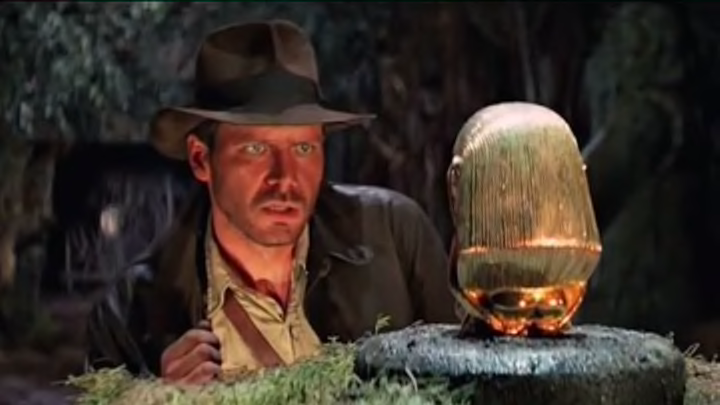
Thirty-five years after Indiana Jones made his big-screen debut—and nearly a decade after the adventurous archaeologist's last feature film outing—Disney recently announced that both Steven Spielberg and Harrison Ford have officially signed up for a fifth Indiana Jones film.
“Indiana Jones is one of the greatest heroes in cinematic history,” Disney chairman Alan Horn said. “It’s rare to have such a perfect combination of director, producers, actor and role, and we couldn’t be more excited to embark on this adventure with Harrison and Steven.”
Though fans will have to wait until 2019 to see what happens next, on the 35th anniversary of the original film's release, we're going back to the beginning with these 20 adventurous facts about Raiders of the Lost Ark.
1. Indiana Jones was conceived in Hawaii.
Producer George Lucas first told director Steven Spielberg about his idea for Raiders of the Lost Ark when they were both on vacation in Hawaii in May 1977. Spielberg got away for the weekend from finishing up post-production on his now-classic film Close Encounters of the Third Kind while Lucas wanted to get to anywhere far, far away—Star Wars was coming out that weekend, and he was afraid that the movie would bomb at the box office.
But the film broke the bank that weekend (and would go on to become a massive worldwide phenomenon), which prompted the two to ponder what they wanted to do next. While lounging on Mauna Kea beach, Spielberg told Lucas that he always wanted to do a James Bond film. Lucas promised him he had that beat, and proceeded to lay out his idea for a swashbuckling throwback adventure movie based on Saturday matinee serials that would eventually become Raiders of the Lost Ark.
2. One dog inspired both Indiana Jones and Chewbacca.
While developing the film with Spielberg and screenwriter Lawrence Kasdan, Lucas named the main character “Indiana Smith.” But Spielberg protested that it was too similar to the 1966 Steve McQueen western Nevada Smith and requested a change. The three agreed that the last name should be as universal and nondescript as “Smith,” so Lucas threw out “Jones” as a possibility. Indiana came from Lucas’ dog, an Alaskan malamute named Indiana. The big, hairy pup was also the inspiration for Chewbacca from Star Wars.
3. A dentist came up with the film's macguffin.
Way back in 1973—when Lucas was still cooking up his galaxy far, far away—he was also coming up with nascent ideas for Indiana Jones. He and fellow filmmaker Philip Kaufman got together for a few weeks to throw around concepts about archeology and the Nazis’ obsession with the occult for a potential movie, but Kaufman departed the project soon after when he was hired by Clint Eastwood to develop The Outlaw Josey Wales. The final film bears little resemblance to what the two began with, but Kaufman still has a “Story By” credit on Raiders because he was responsible for the film’s main plot point: the Ark of the Covenant. The two were looking for a mystical plot device to move the story along, and Kaufman suggested the Ark because his childhood dentist had told him the story behind the Biblical artifact and its powers, and it had fascinated him ever since.
4. For the iconic design of Indy, the proof is in the paintings.
As he did with illustrator Ralph McQuarrie’s famous concept art for Star Wars, George Lucas commissioned artwork to set the tone and visualize the concepts of Raiders of the Lost Ark in 1979 before any frame of the movie was actually shot. Famed graphic artist and illustrator Jim Steranko was chosen to bring the world of Indiana Jones to life, and he created four paintings of the rogue archeologist in thrilling situations that were inspired by—among other influences—Humphrey Bogart in Treasure of the Sierra Madre, Doc Savage pulp magazine covers, and a production still from the 1937 film Zorro Rides Again that showed Zorro jumping from a horse onto a moving truck. Steranko’s interpretation of the character effectively defined the Indiana Jones look and persona we would see onscreen—including the iconic hat, beat up leather jacket, and bullwhip.

5. Tom Selleck was supposed to be Indy.

Prior to the production's start date in May 1980, Lucas and Spielberg set up shop in the old Lucasfilm corporate headquarters—located at 3855 Lankershim Boulevard in North Hollywood—to begin the casting process. Actors and actresses in consideration for the lead roles of Indiana Jones and his tough but beautiful companion Marion Ravenwood included Jane Seymour, Debra Winger, Mark Harmon, Mary Steenburgen, Michael Biehn, Sam Shepard, Valerie Bertinelli, Bruce Boxleitner, Sean Young, Don Johnson, Dee Wallace (who would later go on to star as the mother in Spielberg’s E.T.), Barbara Hershey, and even David Hasselhoff.
For Indy, Lucas and Spielberg eventually settled on actor Tom Selleck. But when CBS got wind of what the two were up to, the network legally barred Selleck—the lead of the hit show Magnum, P.I.—from appearing in the film. Spielberg then suggested Harrison Ford as a quick replacement, but Lucas was reluctant to cast Ford because he was already Han Solo in his Star Wars films. But Spielberg’s quick thinking prevailed, and Ford was added to the cast just two weeks before principal photography began. (A similar snafu happened with Danny DeVito, the first choice to play Indy’s jovial companion Sallah, who couldn’t take the part due to his contractual obligation to appear on the popular ABC show Taxi.)
6. Marion Ravenwood's name was inspired by loved ones and locales.
For Marion, Spielberg and Lucas settled on the young actress Karen Allen, who had previously appeared in National Lampoon’s Animal House. The name of the character she was to play came from an assortment of inspirations from screenwriter Lawrence Kasdan’s life. “Marion” was Kasdan’s wife’s grandmother’s name, while “Ravenwood” came from Ravenwood Court, a small street off of North Beverly Glen Boulevard in Los Angeles that Kasdan drove on to get to the studio every day.
7. Many of the film's set pieces were made as miniatures during pre-production.
In order to shoot fast (principal photography lasted just three months) and stay on budget, many of the film’s more elaborate set pieces were created in a studio during the film’s six-month pre-production as room-size scale miniatures by production designer Norman Reynolds. Spielberg blocked out all of the shots for the Well of Souls, the Egyptian marketplace, the Tanis dig, and the final canyon scene with the Ark prior to getting on set so they could expedite the process and film seemingly off the cuff—similar to the shooting method of the old serials that inspired Raiders.
8. The first shot of the film was inspired by Spielberg's earliest days as a moviemaker.
When making films as a kid, Spielberg thought up a phony movie studio he dubbed “Play-Mount Pictures” (a play on Paramount and his name—“Spielberg” roughly translates to “Playmount” in German), and he would try to mimic the famous Paramount logo with natural scenery the best he could. So when he came to direct an actual Paramount motion picture, he thought a similar approach would work with the start of the film; he wanted to have the actual logo dissolve into a real mountain peak. To find a summit that matched the Paramount logo, Spielberg dispatched producer Frank Marshall all over Hawaii where they were shooting the opening scene in order to get the right one. Needless to say they found a picture perfect peak, and the shot lives on as the opening of the film.
9. It took some female spiders to make an early scene work.
While shooting the scene where Indy and his companion Satipo (played by Alfred Molina) carefully pass booby traps to get to a hidden golden idol, some other co-stars nearly ruined everything. In the scene, Satipo stops in his tracks to shoo away a few tarantulas that crawl up Indy’s back, causing Indy to make Satipo turn around and reveal his entire back covered in dozens of huge tarantulas. While shooting the scene, Spielberg wanted the tarantulas to be crawling all over Molina, but the tarantulas stood absolutely still. When he asked why they weren’t moving, the animal wranglers informed Spielberg that all of the tarantulas on Molina’s back were males so they weren’t acting aggressive. When Spielberg directed them to put a female on Molina’s back, the male tarantulas were thrown into a rage, and they got the shot.
10. The boulder scene almost wasn't a scene at all.
A boulder nearly crushing Indy as he escaped from the temple with the idol in the opening was always part of the script, but it was originally only supposed to be a minor detail. When production designer Norman Reynolds brought the 22-feet-in-diameter fiberglass boulder onto set, Spielberg fell in love with it so much that he decided to extend the rolling boulder another 50 feet to make it a major part at the end of the thrilling scene.
11. Spielberg didn't have enough snakes in the Well Of Souls.
Indy is famously afraid of snakes, but Steven Spielberg is most definitely not. When shooting the scene where Indy and Sallah descend into the Well of Souls to uncover the Ark—only to find it completely covered in slithering asps—the production originally had about 2000 snakes on set at their disposal. But that didn’t satisfy the director, because the 2000 snakes didn’t cover the entire set. Spielberg then estimated they would need at least 7000 more snakes to make it believably scary, so he had the producers raid all the pet shops in London (where they were shooting the film at Elstree Studios) and elsewhere around Europe to get enough of the slithering reptiles. They picked up with the same scene again a few days later, this time with 10,000 snakes, to Spielberg’s devious delight.
12. Indy didn't shoot first, according to the script.
The famously improvised scene where Indy simply shoots the sinister looking swordsman (played by stuntman Terry Richards) in the middle of the Egyptian bazaar was born out of hellish shooting conditions: The daily temperature in Tunisia where they shot the scenes averaged 100+ degree heat. As originally planned, the scene included an elaborate gag involving Indy, the swordsman, and a nearby butcher. The swordsman was to chase Indy through the bazaar, and just as he was about to cut down the archeologist with a deathblow, Indy ducks causing the swordsman to mistakenly—and conveniently—chop the meat at the butcher's shop, giving our hero enough time to get away.
The gag was scrapped, leading to one of the film’s best moments, but Lucas reportedly wasn’t a fan. He apparently tested two versions of the film at the Northpoint Theater in San Francisco—the same place he first previewed Star Wars—and the audiences liked the version of the scene the way it was, so they kept it in.
13. Everybody got sick, except for Spielberg.
The hellish shooting conditions in Tunisia weren’t just because of heat exhaustion. Apparently, over 150 members of the crew got sick from food-based illnesses—but not Spielberg. The director wisely drank only bottled water and ate canned food from the UK that he brought over in an old steamer trunk that he kept in his hotel room. Despite his relative health, he still called the time in Tunisia “one of my worst location experiences.”
14. The scene between Belloq and Marion in his tent was improvised.
The script called for Marion to shed her conservative Egyptian garb and don a revealing dress to heighten the tension when she and Indy are fending off snakes as they’re sealed in the Well of Souls—but the script didn't include why she ended up in the dress. In order to get her into the dress, Allen and actor Paul Freeman (who plays Belloq) improvised the scene where she hides a knife with the older clothes she takes off to try to seduce Belloq and escape, and thus giving her character a plausible reason to be in the dress. Allen thought it would also be a good idea to callback to the drinking game scene that introduces her character in the beginning of the movie as well.
15. Spielberg recycled a gag from his previous film, 1941, and included it in Raiders.
The scene where the devious Gestapo officer Toht interrupts Marion and Belloq and displays what the two characters think is a torture device—only to have it be revealed as a simple coat hanger—was actually a gag Spielberg intended to use in his film 1941. In that film, a Nazi officer played by actor Christopher Lee plans to interrogate an American country bumpkin played by Slim Pickens who inadvertently ends up on a Japanese sub, and produces the would-be torture device only to reveal the hanger. Test audiences didn’t find it funny, so it was cut (though the scene can actually be seen on the DVD of 1941). Even though test audiences didn't like it, Spielberg still thought it was a worthy gag, so he tried it again in Raiders with a more sinister tone—and this time, it worked.
Gags weren’t the only thing recycled for the movie. The Nazi sub used in the film was actually rented from the production of director Wolfgang Peterson’s film Das Boot because it allowed them to cut costs.
16. It took days to get the monkey to deliver a Nazi salute.
The insert scene where the small capuchin monkey gives the Nazi salute to the German spies was part of the film’s post-production pickup schedule—an allotted time to reshoot or tweak scenes from the principal production shoot—supervised by George Lucas at Elstree Studios in London. Despite the animal trainers training the monkey to perform the move prior to the shoot, they couldn’t get the monkey to do it during a take. At first, the animal trainers were tapping the monkey on the head to get a reaction, but days dragged on and the monkey didn’t do the proper salute. Finally, they resorted to dangling grapes with fishing line just off camera to provoke the monkey, and that was what got the little actor to do a good take. The final shot in the film is the monkey reaching for the grapes just above the frame.
17. Indy can hold his breath for a long time (because of an edit).
Fans of the film have been wondering for a long time just how Indy managed to swim from the steamer ship to the Nazi submarine and then survive the trip all the way to the secret island where the ceremony with the Ark takes place. The short answer is that he can hold his breath for a very, very long time, but a deleted scene from the film gives a better—if not implausible—answer. The scene shows Indy clutching the periscope of the Nazi sub that is conveniently above the water for the entire trip to the secret island, which explains how he managed to not drown. Spielberg thought the scene looked cheesy and scrapped it, hoping that audiences wouldn’t question the unresolved logistics considering the fantastical elements that would happen in the film’s climax.
18. A receptionist at Lucasfilm helped out with the film's special effects.
Advanced CGI was still far off when Spielberg tasked the effects wizards at Industrial Light and Magic to create the otherworldly elements for his film after the fact—no easy task when you consider it features flying ghosts interacting with characters onscreen. In fact, Karen Allen recalled it was the first time she’d ever had to act opposite something that wasn’t there. To create the deadly specters that emerge from the Ark, ILM model maker Steve Gawley suspended small puppets with silk robes into a clouded water tank in front of a bluescreen. Puppeteers would shake the model back and forth in the water to achieve the surreal flowing movements Spielberg wanted, which would then be composited onto the actual footage by optical supervisor Bruce Nicholson. To pull off the effect where an idyllic ghost floats towards camera only to reveal a hideous visage, the ILM guys found a receptionist from Lucasfilm and outfitted her in long white robes and painted her face a ghostly shade of blue and white. They then had her sit on a flat trapeze mechanism in front of a bluescreen and swing away from camera—which was run backwards in the final film to achieve a dreamlike quality. The receptionist’s performance was then composited with a grotesque, skeletal model to create the final transformation.
19. a little dentistry went into Toht's melting face.
The facial cast of actor Ronald Lacey for Toht’s famous face-melt scene was made of alginate—the same thing dentists use to make impressions of your teeth. Special makeup effects supervisor Chris Walas was responsible for making the melting look effectively hideous. First he used a negative facial mold on top of a stone skull to survive the heat that would make the mold melt. Walas covered the skull with thin layers of gelatin that melted at low temperatures and added colored yarn to mimic muscles and sinews. Two propane space heaters were placed on either side of the head, which, over the course of 10 minutes, melted the face. Walas sat just below camera with a hair dryer to do some on-the-spot melting wherever needed. The final shot was sped up. Belloq’s exploding head was made of mostly the same materials—but some meat and liver were placed inside to make it especially disgusting. It was so gross, in fact, that the effects team had to add in a pillar of fire in the foreground of the shot to tone down the gore.
20. Just as he did on Star Wars, sound designer Ben Burtt created an original library for the soundscape of the film.
Famed sound designer Ben Burtt recorded nearly all original sounds for the film. Indy’s distinct gunshot is an unprocessed live recording of a .30-30 Winchester rifle firing (he uses a .455 Smith & Wesson revolver in the film), and the embellished punching sounds come from Burtt hitting a pile of leather jackets and baseball gloves repeatedly with a baseball bat. The sounds for the snakes in the Well of Souls come from the layered noise of Burtt running his fingers through a cheese casserole made by his wife and of wet sponges being dragged across the grip tape on a skateboard. The strange emanations of the Ark ghosts are sea lion and dolphin cries filtered through a vocoder to give them a musical quality, and the sound of the lid being lifted off the Ark is actually Burtt lifting off the heavy top cover of his own toilet. Surprisingly, the sounds of Indy’s whip-cracks are simply outdoor recordings of Harrison Ford and sound effects recordist Gary Summers practicing snapping a bullwhip.
Additional Sources: Raiders of the Lost Ark Blu-ray special features
The Complete Making of Indiana Jones, by J.W. Rinzler,