Mental Floss just launched a new podcast with iHeartRadio calledHistory Vs., and our first season is all about Theodore Roosevelt. Subscribe here!
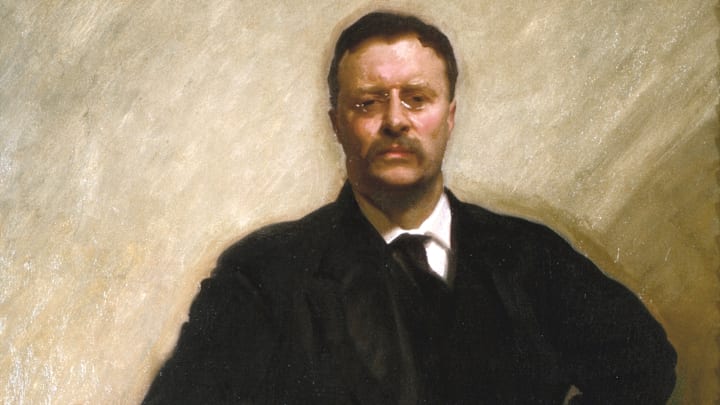
On April 23, 1910, Theodore Roosevelt gave what would become one of the most widely quoted speeches of his career. The former president—who left office in 1909—had spent a year hunting in Central Africa before embarking on a tour of Northern Africa and Europe in 1910, attending events and giving speeches in Cairo, Berlin, Naples, and Oxford, among others. He stopped in Paris on April 23, and, at 3 p.m. at the Sorbonne, before a crowd that included, according to the Edmund Morris biography,Colonel Roosevelt, “ministers in court dress, army and navy officers in full uniform, nine hundred students, and an audience of two thousand ticket holders,” Roosevelt delivered a speech called “Citizenship in a Republic,” which, among some, would come to be known as “The Man in the Arena.”
In addition to touching on his own family history, war, human and property rights, the responsibilities of citizenship, and France’s falling birthrate, Roosevelt railed against cynics who looked down at men who were trying to make the world a better place. “The poorest way to face life is to face it with a sneer,” he said. “A cynical habit of thought and speech, a readiness to criticize work which the critic himself never tries to perform, an intellectual aloofness which will not accept contact with life's realities—all these are marks, not ... of superiority but of weakness.” Then he delivered an inspirational and impassioned message that drew huge applause:
"It is not the critic who counts; not the man who points out how the strong man stumbles, or where the doer of deeds could have done them better. The credit belongs to the man who is actually in the arena, whose face is marred by dust and sweat and blood; who strives valiantly; who errs, who comes short again and again, because there is no effort without error and shortcoming; but who does actually strive to do the deeds; who knows great enthusiasms, the great devotions; who spends himself in a worthy cause; who at the best knows in the end the triumph of high achievement, and who at the worst, if he fails, at least fails while daring greatly, so that his place shall never be with those cold and timid souls who neither know victory nor defeat."
The speech was a wild success. According to Morris—who calls it “one of [Roosevelt’s] greatest rhetorical triumphs”—“Citizenship in a Republic” ran in the Journal des Debats as a Sunday supplement, got sent to the teachers of France by Le Temps, was printed by Librairie Hachette on Japanese vellum, was turned into into a pocket book that sold 5000 copies in five days, and was translated across Europe. Roosevelt, Morris writes, “was surprised at its success, admitting to Henry Cabot Lodge that the reaction of the French was ‘a little difficult for me to understand.’”
He might be even more surprised to learn that the most famous section of his speech still resonates and inspires, even today. It was quoted by Nixon in his resignation speech and has been paraphrased in TED Talks. It has a place in sports history, too: Before the 1995 World Cup, Nelson Mandela gave a copy of the passage to Francois Pienaar, captain of the South African rugby team—and they won, defeating the favored All Blacks of New Zealand. Washington Nationals player Mark DeRosa would read it to himself before big games; before the Nationals faced the St. Louis Cardinals in Game 4 of the National League Division Series in 2012, DeRosa read it aloud to his teammates. “That’s a quote I’ve always gone back to,” he told the Washington Post. “I go to that a lot, I really do. I’ve done it since college. I like it because people think they know, but they have no idea what we’re thinking from pitch to pitch. With our backs against the wall I wanted to say something that brought us together, a little band of brothers. Go out and fight. See what happens. I felt it was fitting. It fires me up when I read it.” The team was victorious.
After nearly two years of waiting, fans of The Crown have finally gotten their latest fill of royal family drama—and a full season of Olivia Colman, Tobias Menzies, and Helena Bonham Carter in their new roles as Queen Elizabeth II, Prince Philip, and Princess Margaret, respectively. Now, as you anxiously await the fourth season—or just because you’re desperate to learn more—here are 25 things you might not know about The Crown.
1. The Crown creator Peter Morgan didn’t have much of an interest in the royal family.
Robert Viglasky, Netflix
Considering that The Crown creator Peter Morgan also wrote 2006’s The Queen (which earned Morgan an Oscar nomination for Best Original Screenplay and Helen Mirren an Oscar for her portrayal of Queen Elizabeth II), it would be easy to think that he has had a deep and lifelong interest in the royal family—but you’d be wrong. “It was a horrible mistake,” Morgan toldEntertainment Weekly. “I don’t know how we’ve ended up here.”
The road to The Crown started with The Deal, a 2003 TV movie starring Michael Sheen about former prime minister Tony Blair’s rise to power. The Queen was a continuation of that story, with its focus on a newly elected Blair working to push the Queen to take action in the wake of Princess Diana’s death. “I so enjoyed writing those scenes between the Queen and Blair that I thought, ‘Well, I’ll do a play about those audiences, because she’s had 13 prime ministers,” Morgan said. That turned into The Audience, a play that opened in London in 2013 and eventually made its way to Broadway. And it was The Audience that got Morgan interested in a project that would let the Queen’s relationship with Winston Churchill play out a bit further.
2. Peter Morgan was “sick” of the Queen when the idea for The Crown came about.
Had you told Morgan in 2013 that he’d be dedicating the next several years of his life to creating a series about Queen Elizabeth, he probably would have laughed—or screamed. In 2016, when asked by Variety why he was interested in telling the story of the Queen’s rise to power, his response was honest: “I didn’t really. I’m sick of writing the world of Elizabeth. But when we did the play The Audience, the scene between Churchill and the young queen struck me as having lots of potential—this young 25-year-old girl and this 73-year-old, this daughter and this grandfather. And yet he was so in awe of her. I thought, I’d like to try writing this as a movie, Churchill and Elizabeth. Like Educating Rita. And then as I got writing, I thought actually her marriage is quite interesting, too. So let me just go back a bit. And then before I knew it, I thought this needs more time. That’s when I first rang the producer and thought, this could be a TV show. And Netflix just jumped at it.”
3. The Crown was originally pitched as a three-season project.
While the current plan is to create a total of at least six seasons, Morgan initially envisioned half that. “Originally, when I went to Netflix, I was pitching it as three seasons. It just kept growing,” Morgan, who was glad the idea kept expanding, toldEW. “By the time we got to the end with Claire and Matt, I think they were ready to go somewhere else.”
4. Claire Foy flew under the radar during auditions.
Robert Viglasky, Netflix
Though it’s hard to imagine the first two seasons of The Crown with anyone but Claire Foy in the role of Elizabeth, Morgan admits that she did not stand out to him at first. “I tried to cast almost everyone in Britain before Claire Foy,” Morgan toldVariety. “It was weird. Every time I went to a read-through where we were doing auditions for The Queen, I was interested in actress A or B. I would skip the bit where Claire was in there. And then after about the fourth time, I went, ‘This one is sensational, who’s this?’ And they said, ‘Pete, she’s been in four times. And you’ve gone for a better-known actress.’”
Fading into the background a bit is one of the very things that made Foy such a brilliant fit for the part. “She very queen-like … and has proven to be very queen-like,” Morgan said. “Brilliantly effective. Completely undivaish. I don’t know whether the part made her that or whether she really is that … It’s such a hard role—she has to be both stunningly beautiful but only fleetingly and then be quite plain and forgettable. And yet at the same time genuinely startling. She has to be in the background sort of anonymous and then, every now and then, have devastating impact. It’s really not easy.”
5. Peter Morgan didn’t think there would be a show without Matt Smith as Prince Philip.
As much a challenge as it was casting the role of Elizabeth, the role of Prince Philip was equally difficult—albeit for different seasons. “[Matt Smith] really had a challenge,” Morgan toldVariety. “When those two read together, there was complete electricity. They worked so perfectly. A number of other actors had read for the part and absolutely nobody interested me. Matt was the hardest one for us to pin down, to do a deal with. I just said to the casting director, ‘He’s the only one.’ I don’t care if this plays to his agent’s advantage. It’s him or nobody. Don’t posture. We won’t have a show. I’m afraid I gave them no negotiating position. I’m sure Matt’s being hideously overpaid as a result. He was the only one.”
6. There was a pay discrepancy.
Though Claire Foy was the undoubted star of The Crown’s first two seasons, Morgan wasn’t kidding when he said that Matt Smith may have been overpaid for the role. In March 2018, during a Q&A, one of the producers revealed that Smith was paid more than Foy for The Crown. This ignited a global debate regarding the gender pay gap, with lots of people involved in the production making their voices heard. Jared Harris, who played King George VI (Elizabeth’s father), called the situation an “embarrassment” for the production team and made it clear that Foy should be compensated. “I understand they made an apology but, you know, an apology and a check would be more welcome,” Harris told Digital Spy. “She worked longer hours. Her performance is a huge reason why this thing is going to have a season three, four, five, and six ... send her a paycheck and, in retrospect, bring her pay up to parity.”
For their parts, Foy and Smith remained rather tight-lipped about the controversy. When asked by EW whether she was surprised to learn that Smith was paid more than her for a smaller role, Foy replied:
“I’m surprised because I’m at the center of it, and anything that I’m at the center of like that is very, very odd, and feels very, very out of the ordinary. But I’m not [surprised about the interest in the story] in the sense that it was a female-led drama. I’m not surprised that people saw [the story] and went, ‘Oh, that’s a bit odd.’ But I know that Matt feels the same that I do, that it’s odd to find yourself at the center [of a story] that you didn’t particularly ask for.”
7. Felicity Jones was reportedly in contention for the role of the Queen.
Dia Dipasupil/Getty Images
Before The Crown officially began filming, several well-known actors gathered in London to read the scripts for an assembly of producers and Netflix executives. Among the actors on hand was Felicity Jones, who was considered a front runner after she read the role of Elizabeth. Her performance was apparently described as “breathtaking” by several people in attendance.
8. A corset helped Claire Foy get into character.
While actors have a variety of ways of finding their characters, Foy said that tapping into Queen Elizabeth came with wearing a corset. “I’d just had a baby when I started filming, so I had to wear a proper corset because I was about five dress sizes bigger than I normally am,” she toldVanity Fair. “The corset helps you not slouch. Now we’re doing the second series. I’m not wearing it anymore, but it stays with you, that posture, and being a lady."
9. John Lithgow was not an obvious choice to play Winston Churchill.
Though Winston Churchill has been portrayed by dozens of actors over the years, John Lithgow’s interpretation of the former prime minister was one of the series’s acting highlights. But there was some skepticism when casting director Nina Gold suggested him for the role, partly because he’s American (even though Churchill’s mother was American). But it all worked out: “It’s an astonishingly versatile piece of acting by one of the world’s great character actors,” Morgan toldVariety. “We’re privileged to have him. Even though he’s tall enough to be Churchill the basketball player. That’s why Nina Gold is who Nina Gold is. Every now and then, every head of department needs to prove why they are at the top of their field. Nina’s choice of John Lithgow is exactly that kind of moment. No one else would have thought of that and the moment she did everyone went ‘Oh my god, what a great idea.’”
10. John Lithgow channeled his inner Winston Churchill by stuffing cotton up his nose.
Alex Bailey/Netflix
In 2017, John Lithgow won an Emmy for Outstanding Supporting Actor in a Drama Series for his portrayal of Winston Churchill on The Crown. In an interview with USA Today he explained that getting Churchill's somewhat nasally sound just right wasn’t easy, or pretty—and included shoving bits of cotton up his nose. “It was rather repulsive watching me pluck cotton out of my nose after every scene, but they just had to put up with it," Lithgow said.
11. Claire Foy watched a lot of the royals’ home videos for research.
Elizabeth’s father once gifted her with a video camera, and she regularly used it to shoot home videos, some of which Buckingham Palace has released to the public. For Foy, watching these videos provided an invaluable insight into who Elizabeth was as a person.
“The palace did this thing [for the Queen’s 90th birthday] where the royal family sat down and watched the home videos together [for a BBC documentary],” Foy toldVanity Fair. “William and Harry sat down and watched some. The Queen and Prince Charles watched some. It was the most amazing thing, watching them watch these home videos. A lot of these home videos are of her and Margaret and Philip and, at that point, Charles and Anne—them messing about and rolling down hills. That was very, very early on in her reign … Those were really amazing, because even then she had such a reserved quality. She wasn’t, obviously, as frivolous as Margaret.”
12. At one point, Claire Foy worried that agreeing to make The Crown was the worst mistake she had ever made.
While playing Queen Elizabeth II might seem like a dream role, it felt more like a nightmare to Foy very early on. "On the first day of filming, I found myself halfway up a Scottish mountain with engorged boobs and no way of getting down to feed my baby," Foy, a new mom at the time, toldBritish Vogue. "I had to ring my husband and tell him to give her formula … as I sat in a Land Rover trying to get my broken breast pump to work, I felt I’d made the worst mistake of my life.”
13. Prince William offered Matt Smith one word of advice about Prince Philip.
While appearing on The Graham Norton Show, Matt Smith shared that he met Prince William prior to The Crown's debut and someone told him that Smith would be playing his grandfather. Smith asked if he had any advice for how to nail the character. William’s response? “Legend. He's an absolute legend."
14. Olivia Colman was the only choice to play the Queen in seasons 3 and 4.
In 2019, Oscar winner Olivia Colman took over the role of Queen Elizabeth II from Claire Foy, and according to Morgan, it was Colman or no one. “Olivia Colman was a list of one,” Morgan toldEntertainment Weekly. “I think I wanted to know [she would play the part] even before negotiations were done for seasons 3 and 4.” That the world saw Colman play Queen Anne in The Favourite before The Crown’s third season debuted wasn’t ideal, but it all worked out in the end. “Obviously I’d have preferred her not to be playing another queen before,” Morgan said. “But it’s so different—such a different tone.”
15. Olivia Colman said yes to The Crown because of a large tax bill.
When asked about her decision to take on the imposing role of Queen Elizabeth II in The Crown, Olivia Colman gave a very honest answer to her reason for saying yes: “I had a tax bill and they called me and I went: ‘Ok’—it’s true,” the Oscar winner said.
“I just went: ‘Yes please.’ That was before I’d really thought it through as to whether it was the right decision. But I was a big fan anyway.”
16. Tobias Menzies wasn’t very interested in royal life, or Prince Philip.
Sophie Mutevelian, Netflix
Like so many of the show’s other players, Tobias Menzies—who took over the role of Prince Philip from Matt Smith in season 3—didn’t have much interest in royal life or Prince Philip. But working on The Crown and getting to understand the man behind the public persona has changed his opinion. “I wasn’t someone who read about [the royal family] or involved myself with them, but I’ve been very intrigued by his life,” Menzies said. “He’s a pretty interesting bloke. He’s a complex person, with complex stories. I have a lot of regard for him.”
17. Helena Bonham Carter met Princess Margaret once—who commented on her acting abilities.
In season 3, Helena Bonham Carter took over the role of the wild—and wildly intimidating—Princess Margaret, and had a little personal history from which she could pull. “My uncle was actually very close to her,” Bonham Carter toldEW. “She was pretty scary. At one point, she met me at Windsor Castle and she said, ‘You are getting better, aren’t you?’” Bonham Carter presumed the princess was referring to her acting.
18. The show is a global hit, particularly in the UK.
According to the Royal Television Society, nine percent of Netflix subscribers in the UK watched The Crown—which is more people than have watched major hits like Breaking Bad, Orange Is the New Black, or Narcos.
19. The Crown’s audience skews older—and wealthier.
Nielsen broke down the demographics of The Crown’s audience in 2017, shortly after the premiere of its second season, and found that nearly two-thirds of the show’s viewers were 35 or older, with half of those viewers being over 49. Women made up 65 percent of the audience, and 40 percent of those watching the show were in households with incomes of at least $100,000 per year.
20. It’s one of the most expensive TV shows ever made.
Robert Viglasky / Netflix
Everything about The Crown is lavish, and it shows in the series’s production budget, which is one of the highest of any television series ever produced. According to the BBC, each episode of the first two seasons cost between $6.5 and $13 million to make—leading to a grand production total of $130 million for just seasons 1 and 2. (For the record: Morgan says those numbers are “absolute nonsense.”)
21. Recreating the Queen's wedding dress was a difficult task.
While the costume department takes a lot of creative liberties with their clothing choices, they do create replica outfits for major events that are easy for people to still watch today, like Elizabeth’s wedding to Philip and her coronation. In fact, season 1 costume designer Michele Clapton (who also worked on Game of Thrones) toldHarper’s Bazaar that the Queen’s wedding dress was the “most elaborate [and] time-consuming" costume she and her team worked on. "I thought it was so important that it was as close as we could possibly make it,” Clapton said. “That whole procession with the bridesmaids and the train and everything was something which I thought, ‘If we don't get that right, then we don't actually have the right to make anything else up.’”
22. The Crown’s corgis eat a lot of cheese.
Olivia Colman stars as Queen Elizabeth II in Netflix's The Crown.
Sophie Mutevelian, Netflix
In The Crown, the Queen is never too far away from her beloved corgis. And Foy revealed that one of the ways the trainers on the set get them to behave is with cheese. “They love cheese, like cheddar cheese,” Foy toldVanity Fair. “Most dogs, when you’ve got them on set, they love a treat like biscuits or a little bit of meat or something like that. The smell doesn’t necessarily linger. Also, you sort of worry that they’re going to have a heart attack when you’re giving it to them. These corgis are cheesed up to the max—they’re eating like a whole block of cheddar every day. It’s scary.”
23. The show has some royal fans.
Before Meghan Markle became the Duchess of Sussex, the New York Postreported that she had already moved into Kensington Palace with her now-husband Prince Harry, and that their nights often consisted of home-cooked meals and watching Netflix shows…including The Crown.
24. The Queen herself is rumored to have watched The Crown—and liked it.
Jane Barlow, Pool/Getty Images
In 2017, the Daily Express reported that the Queen had watched season 1 of The Crown—and quite liked it. "It has been a longstanding arrangement that [Prince Edward and his wife] drive to Windsor at the weekend to join the Queen for an informal supper while watching TV or a film,” an unnamed source told the paper. “They have a Netflix account and urged her to watch it with them. Happily, she really liked it, although obviously there were some depictions of events that she found too heavily dramatized."
The Queen was apparently less impressed with season 2. In 2018, the Daily Express reported that Elizabeth was upset by the way the show portrayed Philip and Charles’s relationship. A yet-again-unnamed source said she "was particularly annoyed at a scene in which Philip has no sympathy for a plainly upset Charles while he is flying him home from Scotland. That simply did not happen."
Philip, on the other hand, must have been in another room. When a friend of Matt Smith’s met the Prince at an event, he asked him if he had watched any of the series. Prince Philip’s response, according to Smith? "Don’t. Be. Ridiculous.”
25. Peter Morgan doesn't think people binge-watch The Crown.
While plenty of viewers have watched each season of The Crown in a single sitting, Peter Morgan isn’t so sure that’s the best way to watch the series. “I don’t think this is a show where people will be watching more than two [episodes] at a time,” he toldVariety. “You just want to process it. I just watched a show recently, The Fall, where I watched seven episodes in one night. Insane. I don’t think [The Crown is] that kind of a show. There’s too much going on in one episode to process it like that. Which is a shame, because I’d love people to watch it all, going up in one night. I once had the flu, had a raging temperature, and watched an entire season of 24—24 episodes in 28 hours. It stayed with me forever as a result. It was a deep experience. I hope people stay with this. You never know."
LZ-129 Hindenburg, a rigid airship manufactured in Germany by the Zeppelin Company, catches fire as it comes in for a landing in Lakehurst, New Jersey, on May 6, 1937.
Fine Art Images/Heritage Images/Getty Images
Rigid zeppelins used to carry the rich and well-to-do across the Atlantic Ocean in style. But after the Hindenburg disaster—in which a German airship caught fire and crashed in New Jersey on May 6, 1937—the industry went belly up. Here are a few things you might not know about the ill-fated flying machine.
1. The Hindenburg was built using metal from an airship that had exploded.
Construction on the 804-foot-long LZ-129 Hindenburg began in 1931. The Friedrichshafen, Germany-based Luftschiffbau Zeppelin Company purchased Duralumin from the remains of Britain's R-101 hydrogen airship, which had crashed in October 1930, and used the material (a light but hard alloy of aluminum, copper, and other metals) to make parts for the Hindenburg.
2. The Hindenburg was partially funded by the Nazis.
Hugo Eckener—the long-serving president of the company that manufactured the Hindenburg—had well-known disagreements with the Nazi Party. Still, when construction of the Hindenburg lagged due to the effects of the depression, he accepted money from the Nazis to fund its construction in 1934. It wouldn't be the Nazi regime's last contribution, either: An even bigger injection of funds would soon follow, which resulted in the company being split into two companies: the Luftschiffbau Zeppelin Company, responsible for building airships, and the Deutsche Zeppelin-Reederei, responsible for operating them. The ship was completed in 1936.
3. The Hindenburg was named after a former German president.
The name was a tribute to Paul von Hindenburg, a distinguished general who became Germany’s second president during the Weimar Republic era and appointed Adolf Hitler chancellor in 1933. He died in 1934.
4. The Hindenburg was supposed to be filled with helium—but hydrogen was used instead.
Hydrogen-powered airships didn’t have the best safety record, so the Hindenburg’s designers planned to fill it with non-flammable helium gas. However, America had a corner on the helium market, as well as a law on the books declaring that “no helium gas shall be exported from the United States” without approval from the president and various cabinet officials. So German engineers had no choice but to pump the Hindenburg full of flammable hydrogen—a switch that had horrific consequences.
5. The Hindenburg made an appearance at the 1936 Olympics.
Propaganda Minister Joseph Goebbels was behind the initial Nazi contribution to the Hindenburg's construction. According to Airships.net, Goebbels was "aware of the potential symbolic value of LZ-129 as a showcase for German strength and technology." After its completion, the ship was used to help promote Adolf Hitler’s interests. On August 1, 1936, the Hindenburg flew over the Reichssportfeld complex in Berlin to kick off that year’s Summer Olympic games. By then, swastika flags had been painted on the tail fins.
6. The Hindenburg made many trips across the Atlantic.
During the 1936 flight season, it finished 17 round-trip crossings of the ocean, and even set a new record that July by flying across the Atlantic—and back—in just five days, 19 hours, and 51 minutes. At the time, this was the fastest double-crossing of the Atlantic ever carried out.
7. The Hindenburg's fares weren't cheap.
Among the people who died in the Hindenburg disaster was American Burtis J. Dolan, who bought a one-way ticket on the ill-fated flight for 1000 Reichsmarks. During the Great Depression, that was the equivalent of roughly $450. Thanks to inflation, Dolan’s ticket would cost around $8000 today.
8. The Hindenburg flew over New York City in its final hours.
Thirty-six passengers boarded the Hindenburg in Frankfurt on May 3, 1937. The ship's ultimate destination was Lakehurst, New Jersey, which took them right over New York. One passenger would later remark that “in the mist the skyscrapers below us appeared like a board full of nails.” They also interrupted a baseball game.
8. The Hindenburg disaster unfolded in less than a minute.
At 7:25 p.m., around 180 feet above the ground, the Hindenburg suddenly caught fire. Within 40 seconds, the inferno stripped away the airship's fabric covering and the metal framework crashed down to Earth.
9. The death toll of the Hindenburg disaster was surprisingly low.
When the Hindenburg was incinerated, there were 97 passengers and crew on board. Sixty-two survived—including its captain Max Pruss and professional acrobat Joseph Spah (who escaped through a window). Most bystanders were likewise unscathed, although one ground worker was killed by the falling ship. In total, 36 people died.
10. What caused the Hindenburg to catch fire is a mystery.
Even now, scientists are unsure about what set the Hindenburg ablaze. According to a 1937 investigation, the trouble started when some of the ship’s hydrogen leaked into the electrically charged atmosphere. At some point, an “electrostatic discharge” ignited the gas, dooming the zeppelin. Conflicting eyewitness accounts and incomplete camera footage have only deepened the mystery.
11. A retired NASA scientist blamed the Hindenburg disaster on paint.
In the 1990s, Addison Bain put forth a theory that the Hindenburg was covered in paints which chemically resembled rocket fuel. He believed that this—and not the hydrogen containers—was the main culprit behind the raging fire. However, those skeptical of the theory think that if the paint had behaved like rocket fuel, the ship’s outer canvas would have burned much faster than it actually did [PDF]. (Bain also sought to restore hydrogen's good name and advocated the use of hydrogen as an aerospace fuel.)
12. Herb Morrison's voice is distorted on his famous recording recounting the Hindenburg disaster.
Herb Morrison was working as a reporter for a Chicago-based radio station when he witnessed the Hindenburg disaster firsthand. His narration of the tragedy was replayed across the country, becoming almost as famous as the event itself. But the recording of Morrison’s report—complete with the now-iconic line “Oh, the humanity!”—artificially distorted his voice, making it sound a lot higher than it really was.
13. The Hindenburg and the Titanic had many similarities.
Though they went down 25 years apart, both ships will be forever linked in the public mind thanks to their tragic and well-documented ends. Both were mail ships, both were luxurious, and both boasted the top technology of their day. And it turns out they had similar dimensions. The Titanic was lengthier, measuring about 882 feet long from bow to stern. But while that passenger ship was only 92.5 feet across at its widest point, the Hindenburg had the impressive width of 135 feet. When it came to maximum occupancy, there was no contest. The Hindenburg could only accommodate 72 passengers (at most), the Titanic had room for around 2500.
14. Werner G. Doehner, the Hindenburg disaster's last survivor, passed away on November 8, 2019.
The German-born Doehner was just 8 years old when he, his two siblings, and his mother and father boarded the Hindenburg. His father and sister were killed in the crash. Doehner would go on to become an engineer for General Electric; he died at age 90.
15. The Hindenburg was the largest craft to ever fly.
More than three times longer than a Boeing 747, the Hindenburg (and its sister ship, which never flew a regular passenger route) was the largest craft to fly. It had a top speed of 84 mph and a cruising speed of 78 mph.