%20%20--%3E%0A%3Csvg%20version%3D%221.1%22%20id%3D%22Layer_1%22%20xmlns%3D%22http%3A%2F%2Fwww.w3.org%2F2000%2Fsvg%22%20xmlns%3Axlink%3D%22http%3A%2F%2Fwww.w3.org%2F1999%2Fxlink%22%20x%3D%220px%22%20y%3D%220px%22%0A%09%20viewBox%3D%220%200%20684.6%2068.1%22%20style%3D%22enable-background%3Anew%200%200%20684.6%2068.1%3B%22%20xml%3Aspace%3D%22preserve%22%3E%0A%3Cg%3E%0A%09%3Cpath%20d%3D%22M444.1%2C29.3h-17.4v14.5h17.4V29.3z%20M36.4%2C68.1l29.3-50.8V0H50.4L32.9%2C36.8L15.5%2C0H0v68.1h16.7V45.8l12.4%2C22.3H36.4z%0A%09%09%20M49.1%2C68.1h16.6V23.4L49.1%2C52.1V68.1z%20M76.6%2C68.1h45V53.8H93.3V41.6h21V27.1h-21V14.8h28.3V0.1h-45V68.1z%20M175.6%2C68.1h17.3v-68%0A%09%09h-16.5v40.3L150%2C0.1h-17.6v68h16.7V27.7L175.6%2C68.1z%20M235.8%2C14.8h15.4V0.1h-47.4v14.7H219v53.2h16.8V14.8z%20M290.3%2C45.9h-17.1%0A%09%09l7.5-15.6h2L290.3%2C45.9z%20M298.7%2C68.1h18l-32.2-68h-5.7l-32%2C68h18l3.3-7.1h27.1L298.7%2C68.1z%20M325.2%2C68.1h46.2V53.8h-29.6V0.1h-16.7%0A%09%09V68.1z%20M423.7%2C14.8h27.2V0.1H407v68h16.7V14.8z%20M462%2C68.1h46.2V53.8h-29.6V0.1H462V68.1z%20M564.8%2C34.1c0%2C10.7-7.2%2C19.2-18.5%2C19.2%0A%09%09c-11.4%2C0-18.5-8.5-18.5-19.2s7.1-19.2%2C18.5-19.2C557.6%2C14.9%2C564.8%2C23.4%2C564.8%2C34.1%20M580.6%2C34.1c0-19-14.2-34-34.3-34%0A%09%09c-20.2%2C0-34.3%2C15-34.3%2C34c0%2C19%2C14.1%2C34%2C34.3%2C34C566.4%2C68.1%2C580.6%2C53.1%2C580.6%2C34.1%20M604.8%2C20.5c0-4.1%2C3.3-6.2%2C6.7-6.2%0A%09%09c4.4%2C0%2C6.6%2C3%2C6.6%2C6.6h14.7C631.8%2C9.1%2C625.1%2C0.1%2C611%2C0.1c-12%2C0-21.7%2C9.3-21.7%2C20.6c0%2C10.9%2C5.9%2C15.9%2C16.7%2C19.8%0A%09%09c5.2%2C1.8%2C11.5%2C3.2%2C11.5%2C8c0%2C3.3-2.4%2C5.5-6.4%2C5.5c-3.6%2C0-6.6-3-6.6-6.7h-15.2c0%2C11.5%2C7.9%2C20.8%2C21.8%2C20.8c12%2C0%2C21.6-9.3%2C21.6-20.6%0A%09%09c0-10-5.3-16.4-16.7-19.8C610.6%2C26.1%2C604.8%2C25.3%2C604.8%2C20.5%20M670%2C20.9h14.7C683.8%2C9.1%2C677.1%2C0.1%2C663%2C0.1c-12%2C0-21.7%2C9.3-21.7%2C20.6%0A%09%09c0%2C10.9%2C5.9%2C15.9%2C16.7%2C19.8c5.2%2C1.8%2C11.5%2C3.2%2C11.5%2C8c0%2C3.3-2.4%2C5.5-6.4%2C5.5c-3.6%2C0-6.6-3-6.6-6.7h-15.2c0%2C11.5%2C7.9%2C20.8%2C21.8%2C20.8%0A%09%09c12%2C0%2C21.6-9.3%2C21.6-20.6c0-10-5.3-16.4-16.7-19.8c-5.4-1.6-11.3-2.4-11.3-7.2c0-4.1%2C3.3-6.2%2C6.7-6.2C667.7%2C14.4%2C670%2C17.3%2C670%2C20.9%0A%09%09%22%2F%3E%0A%3C%2Fg%3E%0A%3C%2Fsvg%3E%0A)

Whenever awards season comes around, there’s inevitably much discourse and column inches dedicated to the contending films and performances. And once the nominations (and then winners) are announced, there’s often just as much discourse surrounding the movies and performers who have been snubbed.
A lot of this kind of talk is subjective, of course, but as time goes by, certain films emerge as classics, earning their place in cinema history. In contrast, others fall by the wayside, the list of those that failed to be recognized with a single Academy Award grows ever longer—and in the case of some movies, ever more egregious.
The films listed here, ultimately, despite their status as groundbreaking classics, are now ranked among some of the greatest Oscar snubs in Hollywood history.
- FRANKENSTEIN (1931)
- THE GREAT DICTATOR (1940)
- DOUBLE INDEMNITY (1944)
- SINGIN’ IN THE RAIN (1952)
- THE SEARCHERS (1956)
- PSYCHO (1960)
- DR. STRANGELOVE (1964)
- EASY RIDER (1969)
- TAXI DRIVER (1976)
- BLADE RUNNER (1982)
- THE COLOR PURPLE (1985)
- RESERVOIR DOGS (1992)
- THE SHAWSHANK REDEMPTION (1994)
- THE BLAIR WITCH PROJECT (1999)
- AMÉLIE (2001)
FRANKENSTEIN (1931)
The Academy Awards have long had a rocky relationship with horror, and there’s been considerable debate in recent years surrounding the lack of awards interest in heavy-hitting performances, like Toni Collette in Hereditary, Mia Goth in Pearl, and Essie Davis in The Babadook.
But the Academy’s distaste for horror is by no means new: almost a century ago, James Whale’s Frankenstein, memorably starring Boris Karloff, failed to receive even a single nomination in 1931. Its 1935 sequel, Bride of Frankenstein, did at least earn a technical nod for Best Sound Recording, but lost out to MGM’s musical Naughty Marietta.
THE GREAT DICTATOR (1940)
Charlie Chaplin’s The Great Dictator was his most commercially successful movie. A groundbreaking satirical condemnation of the fascism and antisemitism sweeping across Europe at the time of its release (when the United States was still not involved in World War II and on a diplomatically neutral standing with Nazi Germany), the movie picked up five Oscar nominations: Picture, Actor, and Screenplay for Chaplin, while Jack Oakie picked up a Supporting Actor nod, and the movie’s composer Meredith Wilson was nominated for Best Score.
The film missed out on all of them, though, in what would turn out to be a staggeringly competitive year: Best Picture went to Alfred Hitchcock’s Rebecca; Best Director went to John Ford for The Grapes of Wrath; Chaplin lost Best Actor to James Stewart in The Philadelphia Story; Oakie lost out to Walter Brennan in The Westerner; and Disney’s Pinocchio picked up that year’s award for Original Score.
DOUBLE INDEMNITY (1944)
Billy Wilder’s movies picked up a total of 73 Oscar nominations across his entire career, winning a total of 17 (including Best Picture Oscars for both The Lost Weekend and The Apartment). A number of his biggest successes and most significant films, however, failed to pick up a single award, including Marlene Dietrich’s knotty courtroom drama Witness for the Prosecution (six nominations, no wins) and classic Marilyn Monroe comedy The Seven Year Itch (which received no nominations at all).
Of all Wilder’s snubs, though, perhaps the most egregious is the 1944 classic Double Indemnity, which has since gone on to be recognized for setting the standard for classic film noir.
Despite seven nominations, the film took home no awards on Oscar night; its star, Barbara Stanwyck, lost Best Actress to Ingrid Bergman in Gaslight, while Wilder missed out on Best Screenplay, Best Director, and Best Picture to the Bing Crosby musical Going My Way. The film’s leading man, Fred MacMurray, meanwhile, wasn’t even nominated.
SINGIN’ IN THE RAIN (1952)
Musicals have always fared well at the Oscars, with ten—from The Broadway Melody (1929) to Chicago (2002)—picking up Best Picture over the years. It was the ‘50s and ‘60s that were the musical heyday, though, with six Best Picture-winning musicals in this era alone. 1952’s Singin’ in the Rain, however, wasn’t one of them.
Despite now being a landmark of musical cinema (if not the greatest musical of all time), Singin’ in the Rain earned just two Oscar nominations: Best Supporting Actress for Jean Hagen (who lost out to Gloria Grahame in The Bad and the Beautiful), and Best Original Score for a Musical (which went to With a Song in My Heart instead).
Lead stars Gene Kelly, Donald O’Connor, and Debbie Reynolds were all snubbed, while Best Picture that year went to Barnum & Bailey circus drama The Greatest Show on Earth (now touted as one of the least deserving Best Picture winners in Oscar history).
THE SEARCHERS (1956)
Legendary filmmaker John Ford won a record four Best Director Oscars—for The Informer (1935), The Grapes of Wrath (1940), How Green Was My Valley (1941), and The Quiet Man (1952)—more than any other filmmaker in Hollywood history. Despite it being perhaps his greatest masterpiece, however, Ford’s 1956 epic The Searchers wasn’t nominated for a single award.
Best Picture that year went to the now somewhat unloved comic epic Around the World in Eighty Days, while Best Director went to George Stevens for James Dean’s last film, Giant.
PSYCHO (1960)
Alfred Hitchcock famously didn’t win a single competitive Oscar in his entire 50-year career, and although his movies picked up over 40 nominations in all—including five for Best Director—they won just six in total.
Among the many Hitchcock classes to have failed to win a single Oscar are Strangers on a Train (nominated for one in 1951), Rear Window (nominated for four in 1954), Vertigo (two nominations in 1958), and Psycho (four nominations, including Hitchcock’s last for Best Director, in 1960). Alas, this was the year that Billy Wilder’s The Apartment swept the boards instead, while Janet Leigh lost out on her Supporting Actress nomination to Shirley Jones in Elmer Gantry.
DR. STRANGELOVE (1964)
Stanley Kubrick was another legendary filmmaker who never quite found his feet with the Academy, winning just a single Oscar in his entire movie career from 13 nominations; surprisingly, the only award he won was for his contribution to the Special Visual Effects in 2001: A Space Odyssey.
Even more extraordinarily, however, 2001 was one of just three Kubrick films to pick up any awards at all on Oscar night: Spartacus won four awards (from six nominations) in 1960, while Barry Lyndon picked up four awards (from seven nominations) in 1975. Not one film in the rest of Kubrick’s stellar filmography won a single award, however, including Dr. Strangelove (four nominations), A Clockwork Orange (four nominations), and Full Metal Jacket (one nomination).
EASY RIDER (1969)
It might have helped to kickstart the New Hollywood era of low-budget, avant-garde filmmaking in the late ‘60s and early ‘70s, but Easy Rider didn’t have quite the same impact at the Academy Awards in 1969.
The film picked up just two nominations, losing both: Jack Nicholson lost Supporting Actor to Gig Young in They Shoot Horses, Don’t They?, while the film’s screenplay (for which stars Peter Fonda and director Dennis Hopper both picked up writing credits) lost to William Goldman’s script for Butch Cassidy and the Sundance Kid.
TAXI DRIVER (1976)
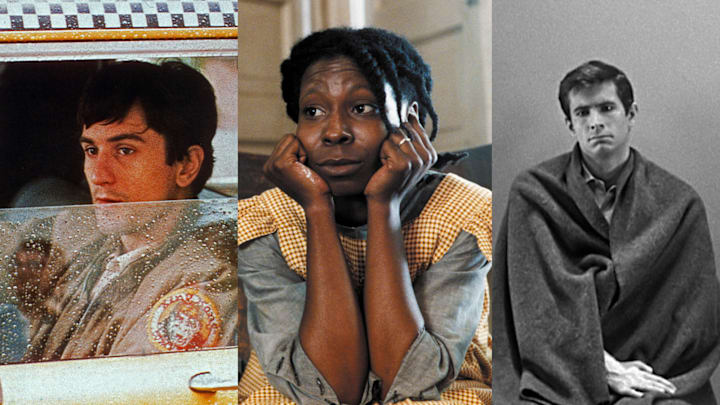
Widely considered one of the greatest films ever made, Martin Scorsese’s fifth feature film Taxi Driver was nominated for four Oscars in 1977, including Best Picture, Best Actor (for Robert De Niro), Best Supporting Actress (for 14-year-old Jodie Foster), and Best Score (for Bernard Hermann, who died just a matter of hours after completing the film’s music; the movie is dedicated to him as a result). In a highly unusual and competitive year, though, it lost out on all of them.
Both of Taxi Driver’s acting nods went instead to the stars of Network—Peter Finch (who had died just a few weeks earlier, earning the first and to date only posthumous Best Actor award in Oscar history), and Beatrice Straight (whose Best Supporting Actress win was earned for a screen time of just five minutes). Composer Bernard Hermann lost out on his posthumous win to Jerry Goldsmith’s monumental score for The Omen, while Best Picture that year went to Rocky.
BLADE RUNNER (1982)
2017’s sci-fi sequel Blade Runner 2049 was nominated for five Oscars, winning two. Ridley Scott’s 1982 epic that kickstarted the franchise, however, picked up just two nominations, losing Best Art Director to Gandhi and Visual Effects to E.T.
THE COLOR PURPLE (1985)
Alongside 1977’s Turning Point, the 1985 adaptation of Alice Walker’s The Color Purple holds the record for the most Oscar nominations without a single win. A critical and commercial success, the film earned eleven Oscar nods that year, including Best Picture and Best Actress for Whoopi Goldberg.
It also achieved the rare feat of multiple nominations in the same acting category (both Margaret Avery and Oprah Winfrey were up for Supporting Actress), while Quincy Jones picked up three of the film’s nominations all to himself: Jones was nominated for both Original Score and, Original Song, while his production credit earned him a claim to the Best Picture nomination, alongside director Steven Spielberg.
However, 1985 was the year that Sydney Pollack’s Out of Africa also picked up eleven nominations, beating The Color Purple to Best Picture, Best Adapted Screenplay, Best Score, Sound, Art Direction, and Cinematography. Elsewhere, Geraldine Page took home Best Actress for The Trip to Bountiful, while the Supporting Actress award went to Anjelica Houston in Prizzi’s Honor.
RESERVOIR DOGS (1992)
Quentin Tarantino’s 1992 directorial debut, Reservoir Dogs, might have earned both itself and its director their places in cinema history, but it failed to pick up sufficient mainstream buzz to earn a single Oscar nomination (despite a slew of film festival prizes).
THE SHAWSHANK REDEMPTION (1994)
Acclaimed prison drama The Shawshank Redemption famously failed to win any of the seven Oscars that it was nominated for in 1994, with Morgan Freeman missing out on Best Actor to Tom Hanks in Forrest Gump (which also beat Shawshank to Best Picture and Adapted Screenplay), while Thomas Newman’s music lost the Best Score award to Hans Zimmer’s music for The Lion King.
THE BLAIR WITCH PROJECT (1999)
Made on a budget of just $35,000, The Blair Witch Project went on to earn a staggering quarter of a billion dollars at the global box office in 1999, making it dollar for dollar the most profitable film in cinema history. Its immense popularity sparked the 21st-century’s love of the “found footage” horror genre, while the filmmaker’s neat attempt to market the movie as a genuine missing persons mystery revolutionized how films in this genre can be publicized. Despite its place in modern cinema history, however, The Blair Witch Project failed to scare up a single Oscar nomination.
AMÉLIE (2001)
The Oscars have taken on an increasingly global flavor in recent years, with several international films and performances picking up major nominations and awards. French films in particular have led this wave, with silent epic The Artist notably sweeping the boards in 2011, and Marion Cotillard earning Best Actress for her staggering performance in the Edith Piaf biopic La Vie en Rose in 2007 (the first Best Actress-winning performance spoken in a language other than English for a staggering 46 years).
Jean-Pierre Jeunet’s 2001 romantic comedy Amélie, however, arrived just a little too early to ride this wave: despite picking up five Oscar nominations, it didn’t win a single one (even losing that year’s Best International Feature Film award to Bosnian war drama No Man’s Land). More controversially, however, lead star Audrey Tautou wasn’t even recognized. Best Actress that year went to Halle Berry in Monster’s Ball.